English
  Español



Nobody asks the question politely. It arrives typed into a search bar late at night, usually framed as an apology: why does a body smell at all? The honest answer is less dramatic than the worry behind it.
Every human body has a scent because every human body is a chemistry set, warm and damp and populated by billions of microbes that spend their lives eating what the skin produces and exhaling what they don't need. Smell is the byproduct of that arrangement. It is no more a failing than the aroma of bread is a failing of yeast.
What follows is the chemistry of body odor taken seriously, the way a good writer treats wine or aged cheese: as a subject with molecules, a vocabulary, and a long and occasionally absurd cultural history. It begins with the two families of apocrine and eccrine glands, which do very different work and are routinely confused.
- Newly secreted sweat from both gland types carries almost no smell. Scent appears when skin bacteria break odorless precursors into small, airborne molecules.
- A single gene, ABCC11, largely decides how much of that raw material a body produces, and its variants are spread unevenly across the globe.
- For most of recorded history, women's scent was treated as a matter of culture and status. The idea that it needed correcting is barely a century old, and it was sold.
Two Glands, Two Very Different Jobs
The eccrine glands are the workhorses. An adult carries somewhere between two and four million of them, spread across nearly the whole surface of the skin and densest on the palms and soles. Their product is mostly water with a pinch of salt, and their job is cooling. Eccrine sweat evaporates, takes heat with it, and leaves very little behind for anything to smell.
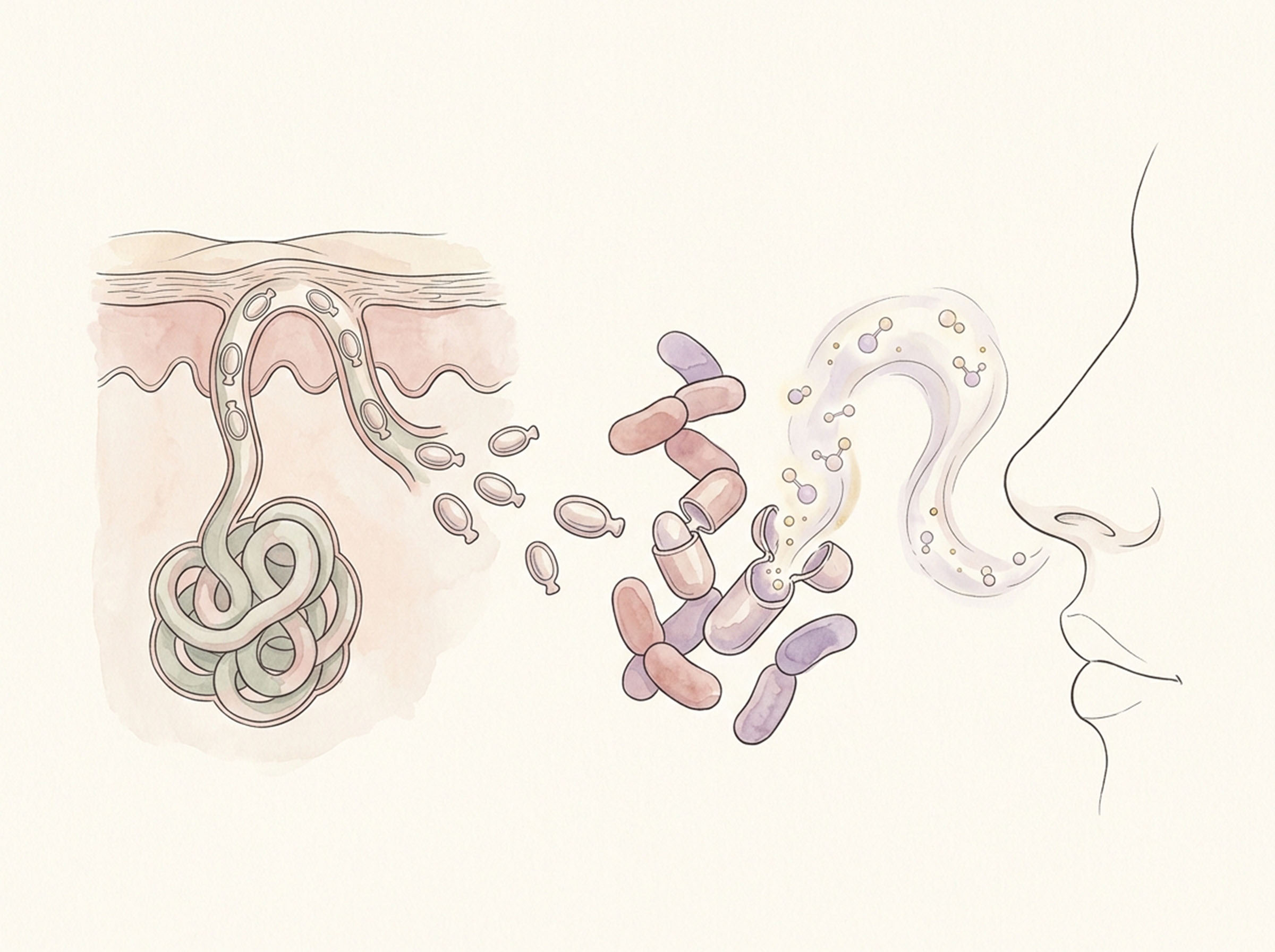
The apocrine glands are another matter. They sit in a handful of places: the underarms, the groin, the outer genital skin and the ring of skin around the nipple. They stay dormant through childhood and switch on at puberty, which is why a small child's sweaty head smells faintly of warm biscuit and a teenager's gym bag does not. What they release is thicker and richer, a milky mixture of fats and proteins laced with steroids. And here is the detail that surprises almost everyone: when it first reaches the skin, apocrine secretion is close to odorless too.
The smell is added afterward, by the residents.
The Bacteria Do the Talking
Human skin hosts a dense and stable community of bacteria, and in the warm, closed folds where apocrine glands open, two groups dominate: Corynebacterium species and Staphylococcus hominis. Neither is a villain. Both are permanent tenants that have co-evolved with people for a very long time, and both have learned to treat apocrine secretion as food.
The chemistry is elegant. The glands do not release odor molecules directly. They release them chemically attached to carrier molecules, rather like a perfume locked inside a capsule. Researchers have identified the bacterial enzymes that break those bonds. One enzyme in Corynebacterium snips a compound called 3-hydroxy-3-methylhexanoic acid away from its carrier, an amino acid called glutamine. Freed, it is volatile, and it carries the warm, spicy, faintly cumin-like note that most of the world recognizes as underarm scent. A close relative, 3-methyl-2-hexenoic acid, was first isolated in the early 1990s by chemists at the Monell Chemical Senses Center in Philadelphia, and it adds a goaty edge.
The second route belongs to Staphylococcus hominis, which unlocks a sulfur compound called 3-methyl-3-sulfanylhexan-1-ol. Sulfur compounds are the heavy artillery of scent; the human nose can detect some of them at concentrations measured in parts per trillion. This particular molecule reads as oniony and sulfurous up close, and it has a famous chemical cousin. Change one small piece of its structure and it becomes 3-sulfanylhexan-1-ol, the compound responsible for the grapefruit and passion fruit notes prized in Sauvignon Blanc. The line between a body and a celebrated wine is, chemically, one methyl group wide.
There is a sex difference here, though a modest one. A Swiss study of underarm secretions found that women's samples tended to carry relatively more of the sulfur precursor and men's relatively more of the acid precursor. Both sexes produce both. The proportions shift the bouquet without changing its basic grammar.
The groin adds layers of its own. Apocrine glands there follow the same pattern as the underarm, while the vaginal environment runs on entirely different chemistry. There, the lactobacilli ferment glycogen into lactic acid, the same acid that gives yogurt and sourdough their tang. It is a reminder that a single body hosts several distinct chemical neighborhoods, each with its own microbial population and its own characteristic molecules.
Within about a week of birth, breastfed newborns turn their heads toward a pad worn by their own mother rather than one worn by another nursing woman. Scent is among the first ways an infant tells one person from everyone else, long before faces come into focus.
A Working Vocabulary
Sommeliers have tasting notes; chemists have compound names. Placed side by side, the two vocabularies turn out to overlap more than either profession usually admits.
| Compound | Produced by | How it reads | Found elsewhere |
|---|---|---|---|
| 3-Hydroxy-3-methylhexanoic acid | Corynebacterium enzymes | Warm, spicy, cumin-like | Echoes the spice cabinet |
| 3-Methyl-3-sulfanylhexan-1-ol | Staphylococcus hominis | Sulfurous, oniony | Near-twin of Sauvignon Blanc's grapefruit note |
| Isovaleric acid | Skin bacteria breaking down leucine | Cheesy, pungent | Washed-rind cheeses |
| Androstenone | Steroid in apocrine secretion | Varies by nose: vanilla-sweet, musky, or nothing at all | Truffles |
| Lactic acid | Lactobacillus species | Tangy, lightly sour | Yogurt, sourdough, sauerkraut |
| 2-Nonenal | Oxidation of skin fatty acids | Greasy, grassy, papery | Stale beer, old books |
Odor descriptions follow the flavor-chemistry literature; perception varies considerably from one nose to the next.
What Changes the Bouquet
If the glands supply the raw material and bacteria do the processing, anything that alters either one alters the result. Researchers have studied a surprising number of these variables.
Genetics sits at the top of the list. In 2006 a Japanese-led team reported in Nature Genetics that a single-letter variation in the ABCC11 gene determines whether a person has wet or dry earwax. The same gene governs a transporter that loads odor precursors into apocrine secretion. Inherit two copies of the dry-type variant and the glands ship far less of that material, leaving skin bacteria with little to work on. The researchers found the variant most common among Chinese and Korean populations, with frequency falling steadily westward and southward across the globe. Body odor, in other words, has a map.
Temperature and activity change the volume rather than the recipe. More warmth means more secretion, more moisture and more bacterial growth, and so more of the same molecules in the air.
Diet leaves traces, though fewer than folklore claims. The best documented case is garlic. Its sulfur compound allyl methyl sulfide resists breakdown in the body and leaves slowly, through the lungs and the skin, for many hours after a meal. Most other dietary claims rest on thin or anecdotal evidence.
Textiles turned out to be a genuine variable, which surprised the researchers who measured it. A group at Ghent University found that polyester shirts worn during exercise smelled noticeably stronger than cotton ones afterward, and that the synthetic fibers had favored the growth of Micrococcus bacteria. Cotton seems to hold on to odor molecules differently, and less stubbornly.
Age matters too. Apocrine glands wake at puberty and slow in later life, and in 2001 the cosmetics firm Shiseido reported that 2-nonenal appeared in the skin of adults over forty. Japanese has a word for the scent of aging, kareishū, and the study became famous there. Later work has been less consistent, and the question remains open. Hormones govern apocrine activity across a lifetime, and researchers have also looked for chemical shifts across the monthly cycle, with findings that are modest and inconsistent.
How the Nose Reads a Person
Smelling begins when a volatile molecule drifts into the upper nose and lands on a patch of tissue about the size of a postage stamp. Humans carry roughly four hundred working types of olfactory receptor, and almost no molecule activates just one. Each scent lights up a particular combination, and the brain reads the pattern rather than any single signal, much as a chord is heard as one sound rather than separate notes.
Those signals travel to the olfactory bulb and then, unusually among the senses, almost directly to brain regions involved in memory and emotion. This is the standard explanation for why a scent can return a person to a grandmother's kitchen in an instant while a photograph of the same kitchen merely informs.
Individual noses differ far more than most people realize. A variant in a single receptor gene, OR7D4, changes how androstenone is perceived: some people find it sweet, some find it sharp and musky, and a substantial minority cannot detect it at all. Similar "specific blind spots" exist for other body compounds. Two people standing in the same room are not, chemically speaking, smelling the same room.
There is also the matter of adaptation. The nose stops registering a steady, familiar odor within minutes, which is why every household seems scentless to the people who live in it and distinctive to anyone walking in the door. It also means the body a person knows least well, by smell, is usually her own.
How many scents can a human tell apart? A widely reported 2014 paper put the figure at a trillion. Other scientists soon challenged the mathematics behind it, and the honest answer is that nobody knows, only that the number is very large.
The Pheromone Question
Few words in this subject travel further on less evidence. A pheromone, properly defined, is a chemical signal shared by all members of a species that triggers a specific, reliable response, the way a female silk moth's signal brings males from miles away. Since the 1970s various steroid molecules found in human sweat have been promoted as human pheromones, and a commercial market grew up around them.
The 1971 finding that women living together synchronize their menstrual cycles through scent became one of the most repeated "facts" about female biology. Later and larger studies failed to reproduce it, and most researchers now consider it unproven.
The same caution applies to every steroid marketed as a human pheromone. No study has yet met the standard of evidence used to confirm pheromones in other mammals.
In 2015 the Oxford zoologist Tristram Wyatt reviewed four decades of that research in a widely cited review of the evidence for human pheromones and concluded that it did not hold up: small samples, unreplicated results, and molecules chosen for testing without good reason. He called the period the "lost decades." Wyatt did not rule pheromones out; humans are mammals, and most mammals use them. But the most promising lead he identified has nothing to do with romance. It is a secretion from the small glands around the areola of nursing mothers, which appears to prompt suckling in newborns, any newborn, not only the mother's own.
Four Thousand Years of Deciding What a Woman Should Smell Like
Every culture has had opinions on this subject, and those opinions have rarely stayed still.
Ancient Egyptian tomb paintings show banqueting women with cones on their heads, long assumed to be scented fat that melted in the heat and perfumed hair and linen. Scholars argued for decades over whether the cones were real objects or an artistic convention, until archaeologists excavating burials at Amarna reported actual cone remains in 2019. The Greek philosopher Theophrastus wrote an entire treatise on scents around 300 BC, cataloguing which oils held their perfume longest. Roman women of means applied scented oils after the baths as routinely as they dressed their hair.
The line between a body and a celebrated wine is, chemically, one methyl group wide.
Medieval and early modern Europe took a darker view of smell generally. Under the miasma theory, disease was believed to travel through foul air, so scent became a matter of survival as much as beauty. Pomanders of ambergris and spice hung from belts, and the beaked hoods of plague-era physicians were packed with aromatic herbs. Perfume served as a kind of armor.

The nineteenth century brought a quieter shift, traced by the French historian Alain Corbin in The Foul and the Fragrant. As cities installed sewers and the germ theory displaced miasma, middle-class taste moved away from the heavy animal musks of earlier courts toward delicate florals such as violet and rose. A respectable woman, by the new standard, was expected to suggest a garden rather than an animal. Scent had become a marker of class and propriety, and the absence of a personal smell began to look like a virtue.
That set the stage for something new. The first trademarked deodorant, Mum, appeared in Philadelphia in 1888. An antiperspirant called Odorono followed in 1912, developed by a Cincinnati teenager named Edna Murphey, and for years it sold poorly, because few women thought they had any need of it.
How a Worry Was Sold
In 1919 a copywriter named James Webb Young, working for the J. Walter Thompson agency, wrote an Odorono advertisement for Ladies' Home Journal under the decorous headline "Within the Curve of a Woman's Arm." It suggested, delicately, that a woman might carry a scent she could not detect herself and that others would be too polite to mention. Some two hundred readers reportedly canceled their subscriptions in protest. Odorono's sales rose by more than a hundred percent within a year.
The advertisement had found a seam that chemistry explains perfectly: olfactory adaptation means nobody can fully smell herself. Turn that biological fact into a private doubt and it becomes a lifelong purchase. The formula spread across the decade. Listerine popularized "halitosis," a near-forgotten medical term, as a social catastrophe. Lysol, a household disinfectant, was advertised to wives for decades as an intimate product, on the premise that a woman's body required one. In 1966 the first feminine deodorant spray reached American shelves.
None of these campaigns argued with the chemistry. They simply reframed it. A body producing exactly the molecules it had always produced was recast as a body with something to hide, and the fix was always for sale. It is a useful lens for reading the products of the present, many of which still sell the same premise in softer language.
Put the advertising aside, though, and the chemistry tells a plainer story. Glands built for cooling and for signaling, bacteria that have lived on human skin since before there were humans, molecules shared with truffles, wine, aged cheese and the bread on the kitchen table. And a newborn, a few days old, turning unerringly toward the one scent in the world that means home.
For the cultural side of the story, including how the long silence around women's scent took hold, the history runs deeper still.
Questions Readers Ask About the Chemistry of Scent
Disclaimer: All content on this website—including articles, educational materials, and interactive calculators—is for informational, educational, and entertainment purposes only. The calculations, percentiles, and outputs generated by tools on this site are based on general statistical data and mathematical models; they do not constitute medical data, a clinical assessment, or a diagnosis.
Nothing contained on this website is a substitute for professional medical advice, diagnosis, or treatment. Always seek the guidance of a qualified healthcare professional or urologist with any questions you have regarding physical development, anatomy, or health conditions. Reliance on any information or tools provided by this website is solely at your own risk.