English
  Español



The three things working against comfort on a long-haul flight are dry air, reduced cabin pressure, and hours of stillness in one position. Two of them are decided before you leave the house — by what you wear and what sits in the seat pocket rather than in the overhead bin. The third is decided by a timer.
Long-haul regulars tend to dress for friction rather than for the arrivals hall, carry water in a refillable bottle instead of waiting on the cart, and stand up on a schedule they set at the gate. If you want the deeper background on which fabrics stay comfortable against skin for hours, start there — everything below assumes it.
Quick Start — Before You Board
Wear: flat-seamed cotton or modal knits, a mid-rise waistband with give, one warm layer that packs down, socks you can walk the aisle in.
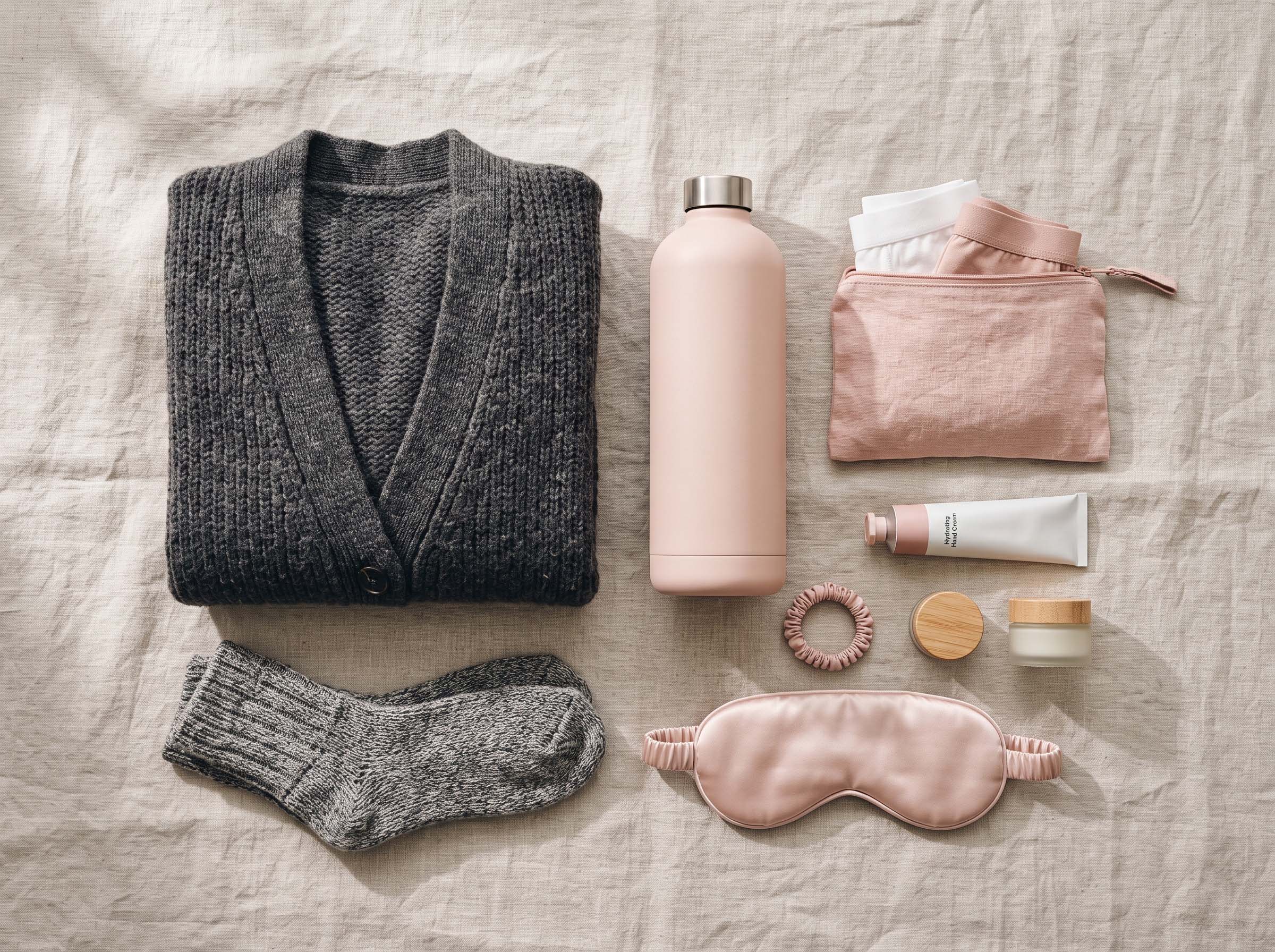
Carry in the seat pocket: refillable bottle (filled airside), lip balm, hand cream, a spare pair of cotton underwear in a zip pouch, hair tie.
Do: set an hourly reminder before takeoff. Choose an aisle seat if the flight is over seven hours. Refill at the galley, not from the cart.
Don't: board in denim with a centre seam, new shoes, shapewear, or anything that needs the overhead bin to be reachable.
What the cabin is actually doing
An aircraft cruising at 35,000 feet is not pressurised to sea level. Under normal flight conditions, United States regulations require commercial aircraft to hold cabin pressure equivalent to a maximum altitude of 8,000 feet, and most flights sit somewhere between 6,000 and 8,000 feet — roughly the pressure of a mountain town, held steady for the length of the journey. Newer aircraft such as the Boeing 787 and Airbus A350 hold a lower equivalent altitude, which is why passengers often report those aircraft as easier flights.
The air itself is the bigger variable. Outside air at cruising altitude carries almost no water vapour, and by the time it has been drawn in, compressed and cooled, cabin relative humidity typically settles somewhere around 10 to 20 percent, according to the CDC's travel health reference. For comparison, most homes run between 30 and 50 percent. Humidifying a cabin would mean carrying water, and water is weight, and weight is fuel — which is why the industry has largely decided that dry air is the cheaper trade. The National Research Council's study of the airliner cabin environment covers the engineering behind that decision in detail.
Reduced pressure has one further effect worth planning around: gases expand. Between sea level and 8,000 feet, trapped air increases in volume by roughly a third. That's the popping sound on ascent, and it's also why a lotion tube packed full at home arrives with its contents pressed up against the cap.
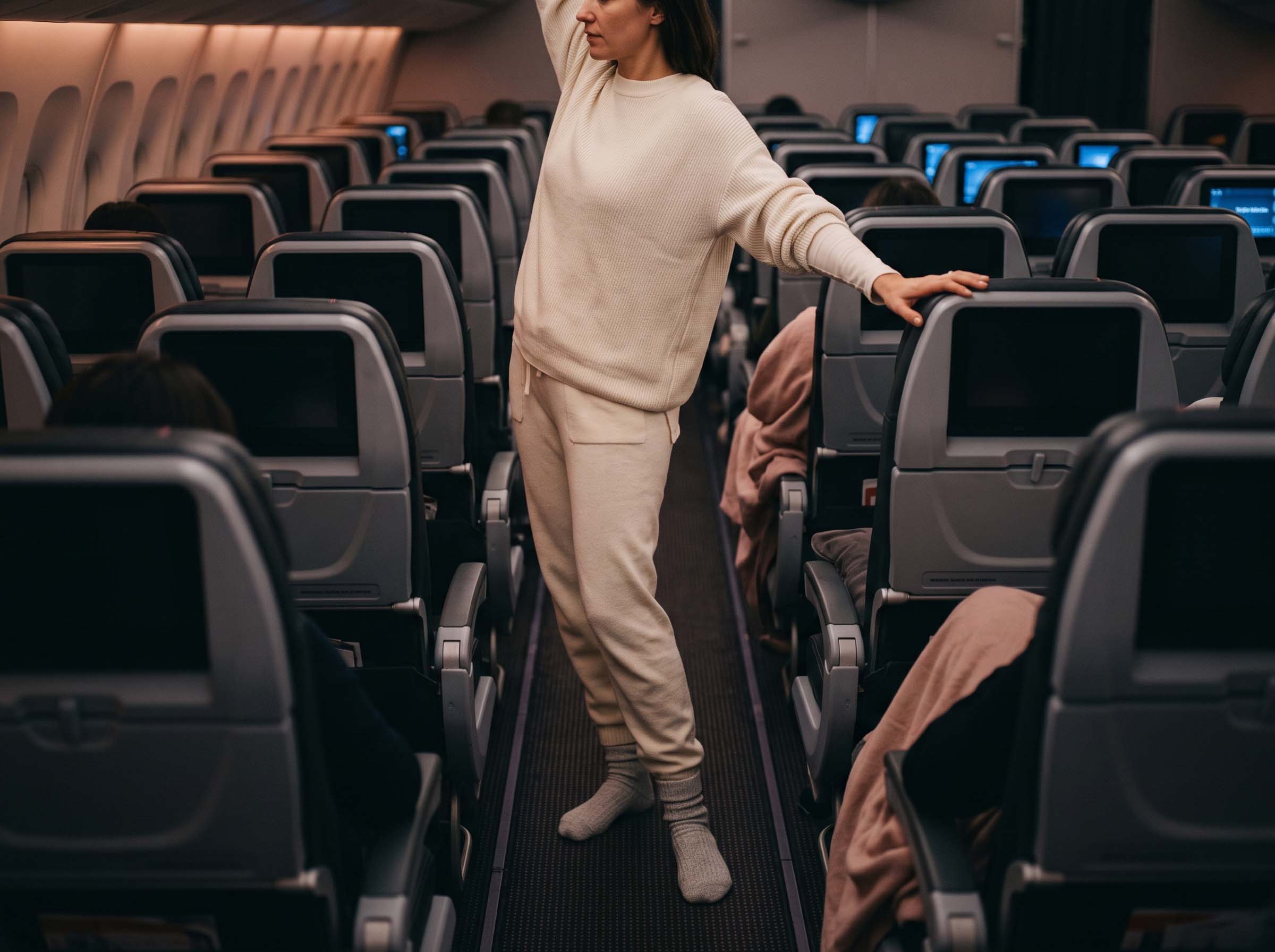
The dressing decision is made at home
Nothing you can buy on board fixes a bad clothing choice at hour six. The single most useful habit among women who fly long-haul often is to treat the outfit as equipment rather than as an outfit.
Seams do most of the damage. A flat-front knit or a French-seamed cotton behaves very differently over nine seated hours than a jean with a thick centre seam and a rivet at the crotch. The same logic applies to waistbands: a hard button at the natural waist presses in when seated and stays pressed for the length of the flight, while a knit band or a soft elastic redistributes. Shapewear is a poor traveller for the same reason — it's engineered for a few hours upright, not for a long stretch folded at the hip.
Fabric choice matters most in the layer closest to skin. Cotton, modal and bamboo viscose move moisture and let air through; polyester and nylon hold heat against the body and dry slowly once damp. Layering is what makes this workable, because cabin temperature is never one thing: cold at the gate, warm during boarding, cold again once the lights go down. A merino or cotton cardigan and a large scarf will cover the range without needing the overhead bin. Our piece on airflow and everyday clothing goes further on why the base layer earns the attention.
| Garment | How it behaves in a dry, pressurised cabin | Verdict |
|---|---|---|
| Cotton or modal knit trousers | Soft waistband, no rigid seam at the centre, air moves through the weave | Wear it |
| Rigid denim | Thick centre seam under constant seated pressure; slow to release heat | Pack it |
| Cotton underwear (plus a spare) | Breathable; the spare is the single highest-value item in the personal bag | Wear it |
| Shapewear or high-compression leggings | Built for hours upright, not for a long stretch folded at the hip | Leave it |
| Merino cardigan & large scarf | Covers the swing between a warm boarding and a cold night cabin | Wear it |
| New or laced shoes | Feet swell over hours of sitting; laces get tight and stay tight | Leave it |
Water, on a schedule you set
The cart comes when the cart comes, and on a night flight that can be a gap of several hours. Women who fly these routes regularly carry a one-litre refillable bottle, fill it at a fountain past security, and top it up at the galley rather than waiting for service. Small, frequent sips through the flight fit the rhythm better than a single large glass with a meal.
There's a practical trade-off nobody mentions on the packing lists: more water means more trips down the aisle. That's not a cost, it's the plan. The walk is the point — the standing, the few steps, the return. Two goals get met by one movement, which is exactly why aisle seats hold their value on flights over seven hours.
Airline meals run salty by design, since flavour perception drops in a low-pressure, dry, noisy cabin and salt is the cheapest correction. If you'd rather not board hungry and eat what's handed to you, a bought sandwich and a piece of fruit past security solve it.
"More water means more trips down the aisle. That's not a cost — that's the plan."
Moving on the hour
Stillness is the part of a long-haul flight that people plan for least and feel most. The fix is unglamorous and it works: get up roughly once an hour while the seatbelt sign is off, and change position in the seat between those walks.
Set the reminder before takeoff, on airplane mode, with the phone on vibrate. Waiting until it seems worth getting up means waiting several hours past the point it was. Time the walks around the cabin's own rhythm — after the meal carts clear, before the lights come down, and again when the cabin starts to wake — and the aisle will be empty when you want it.
Between walks, small changes do the work. Uncross the ankles. Roll them a few times. Shift the weight from one hip to the other. Tilt the pelvis forward and back a couple of times against the seat back to change the contact points. Slide slightly forward so the seat edge isn't pressing in the same place for the ninth consecutive hour. None of it looks like anything to the person beside you, which is the whole design brief.
The Hourly Plan
A nine-hour flight, mapped. Adjust the middle block for a longer route.
Fill the bottle. Set the hourly reminder. Last stop before boarding.
Shoes off, socks on. Cardigan and bottle out of the bag and into the seat pocket — the bag goes up and stays up.
Meal service clears. First aisle walk while the galley is still open — refill on the way back.
The long middle. Stand once an hour; shift position in between. Lip balm and hand cream on each return. This is the block where the spare underwear earns its place.
Cabin wakes. Go before the queue forms — change, freshen, shoes back on while there's still room to bend down.
Everything back in the bag before the seatbelt sign. Open lotion tubes over a sink, not over a lap — pressure has been working on them for nine hours.
The bag, and which pocket things go in
Overhead bins are effectively locked for the first and last hour of any flight, and inaccessible whenever the cart is in the aisle. Anything you'll want in flight belongs in the personal item under the seat in front — and the small handful of things you'll want repeatedly belongs in the seat pocket from the moment the seatbelt sign goes off.
The Long-Haul Kit
- Seat pocket: refillable bottle, lip balm, hand cream, hair tie, phone.
- Zip pouch, front of the personal item: one spare pair of cotton underwear, a few unscented wipes, a small comb.
- Main compartment: cardigan or wrap, socks, eye mask, a folded cotton tote for the airport change.
- Quart bag: tubes squeezed to remove trapped air before packing — pressure expands what's left inside.
- Not in the bag at all: anything glass, anything scented, anything you'd have to stand up to reach.
The airport change on arrival is worth the eight minutes it costs. A clean base layer and a face wash in a terminal bathroom before immigration will do more for the first day than anything available in the air. If you're heading somewhere warm, our guide to packing for a warm-weather arrival covers what the top of the suitcase should hold.
What the flight owes you, and what it doesn't
Crew will refill a water bottle at the galley on most carriers, and asking is normal. Blankets and extra pillows exist in limited numbers and go early. Some long-haul aircraft have a small area near the rear galley where standing for a few minutes is tolerated, and the crew will tell you plainly whether yours does.
What the flight won't do is manage any of it for you, which is the honest version of long-haul flight comfort tips for women that most lists leave out. The cabin is a fixed environment with known properties — dry, mildly depressurised, and immobile. Everything that makes it comfortable is something you brought aboard or something you decided to do on the hour.
Long-Haul Questions, Answered
Disclaimer: All content on this website—including articles, educational materials, and interactive calculators—is for informational, educational, and entertainment purposes only. The calculations, percentiles, and outputs generated by tools on this site are based on general statistical data and mathematical models; they do not constitute medical data, a clinical assessment, or a diagnosis.
Nothing contained on this website is a substitute for professional medical advice, diagnosis, or treatment. Always seek the guidance of a qualified healthcare professional or urologist with any questions you have regarding physical development, anatomy, or health conditions. Reliance on any information or tools provided by this website is solely at your own risk.