English
  Español


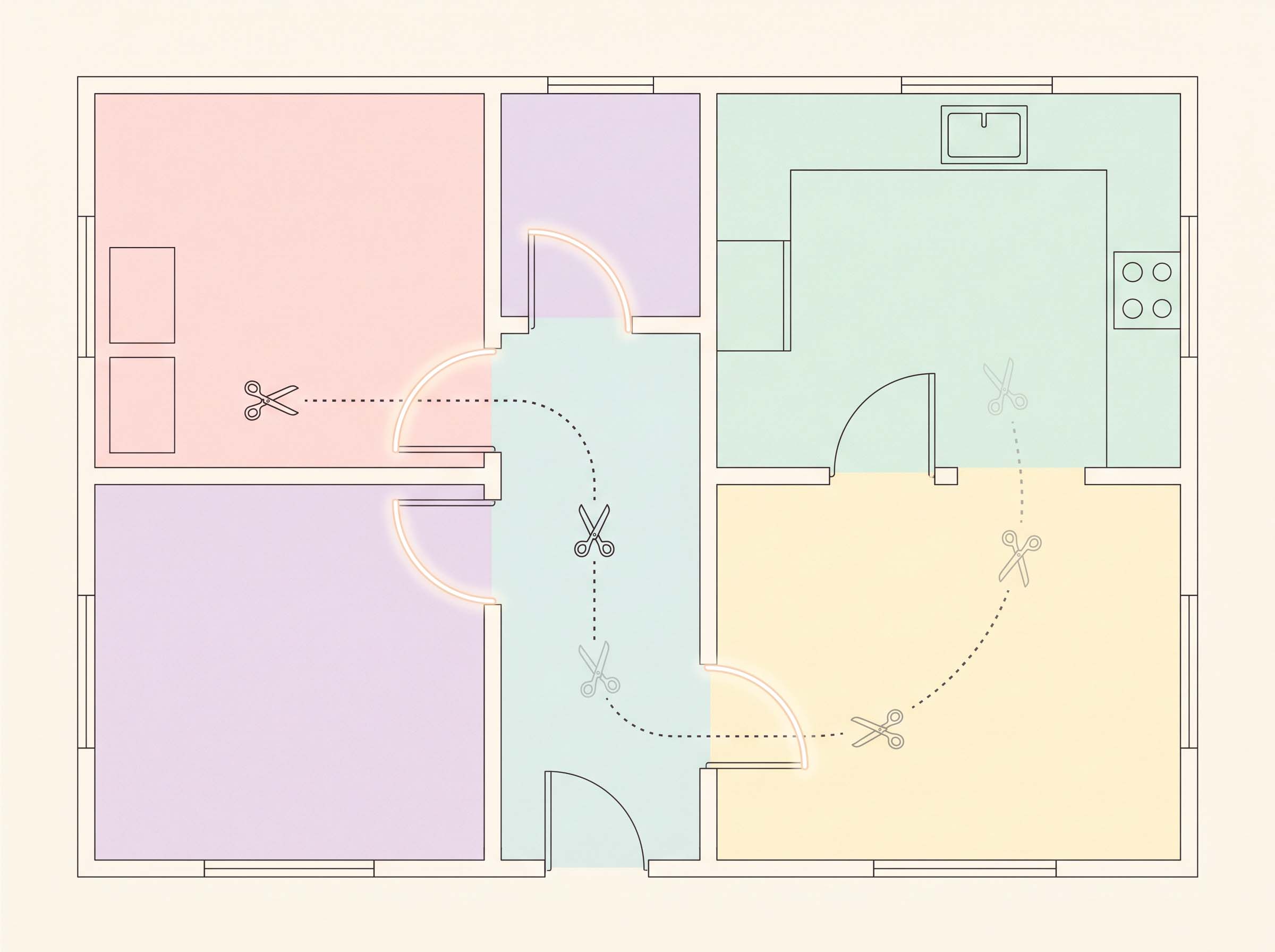
You are halfway through a basket of warm towels when you remember the tag on your daughter's new sweater, the scratchy one she has complained about twice. The scissors are in the kitchen drawer. You set the towel down, walk the length of the hall, step into the kitchen, and stop dead. The drawer is right there. The reason you came for it is not.
For a moment you stand there the way everyone does, one hand on the counter, scanning the room as if the answer might be pinned to the fridge. Then you give up, wander back to the laundry, see the sweater lying on the bed, and the whole errand drops back into place with a small, irritated laugh.
So What Just Happened in the Hallway?
The trip took perhaps eight seconds. Nothing interrupted it. No one called your name. By any sensible account the thought should have survived the journey, and yet it regularly doesn't, for grandmothers and graduate students alike. The plain version of the question, why do I forget what I was doing when I walk into a room, turns out to be one of the more satisfying puzzles in memory research. It is also where our new Thinking Brain series begins: with the everyday machinery of thought, and the design logic hiding inside its small misfires.
Psychologists have a name for the moment. They call it the doorway effect, or, in the drier language of the journals, the location updating effect. The explanation they have built around it says less about forgetfulness than about how the mind organizes a day.
- The blank you hit in a doorway has a research name: the doorway effect, or location updating effect.
- In 2011, Gabriel Radvansky's team at Notre Dame found more forgetting after walking through a doorway than after walking the same distance inside one room.
- The leading explanation: the mind divides experience into separate events and files each one away at a boundary.
- Later studies suggest the effect is modest and appears most clearly when the mind is already juggling several things.
The Experiments Behind the Doorway Effect
The researcher most associated with the effect is Gabriel Radvansky, a cognitive psychologist at the University of Notre Dame who has spent much of his career studying how people build mental models of events. His first doorway study, with David Copeland, appeared in 2006. The better-known follow-up, a 2011 study in the Quarterly Journal of Experimental Psychology written with Sabine Krawietz and Andrea Tamplin, ran three experiments designed to pin the effect down.
The first was almost comically simple. Volunteers sat in front of a large screen and used the arrow keys to move through a plain virtual building. Each room held a table with a small colored shape on it. The task was to pick up the object, carry it to another table, set it down and collect the next one. Every so often a question appeared about a particular object, a red cube, say. Was it the one currently being carried, or the one just left behind?
The trick lay in where the next table stood. Sometimes it sat across the same room. Sometimes it sat the same distance away, but through a doorway into the next room. Walking time and distance were matched, so the doorway was the only difference. Volunteers who had just passed through a door answered more slowly and made more mistakes about the objects they had been handling.
A virtual building invites an obvious objection, so the second experiment moved into real rooms in the lab. Volunteers carried physical objects in shoeboxes, which kept them from peeking when the question came. The result held. Memory was worse after a doorway than after the same walk inside a single room.
The third experiment was the clever one. An older and well-supported idea in memory research holds that recall comes more easily in the place where something was first learned. If that were the whole story, the problem would simply be standing in the wrong room. So Radvansky's team sent volunteers through several doorways that led them back into the very room where they had started. If location alone mattered, being back should have helped. It did not. The crossing itself, rather than the destination, seemed to be doing the work.
In the university's announcement of the findings, Radvansky described a doorway as "an 'event boundary' in the mind, which separates episodes of activity and files them away."
Chapters, Not a Continuous Tape
That phrase, event boundary, comes from a larger body of work known as event segmentation theory, developed largely by Jeffrey Zacks at Washington University in St. Louis, who has also written with Radvansky on how people perceive events. The core idea is that the mind does not record experience as one unbroken film. It holds a working model of what is happening right now: where you are, who is with you, what you are trying to do. As long as the next few seconds unfold roughly as predicted, that model stays open. When something shifts sharply, such as a change of setting or a change of goal, predictions start to miss, and the mind closes the current file and opens a fresh one.
A doorway is one of the most dependable signals that the scene has changed. The room on the other side has different light and different possibilities. So the mind does what it is built to do. It files the laundry-room episode, scissors and all, and gets to work on the kitchen.
The boundaries need not be physical. In a 2011 study at New York University, Youssef Ezzyat and Lila Davachi gave volunteers short narratives to read, some containing a simple time shift such as "a while later." Afterward, sentences separated by that small phrase were harder to link in memory than sentences within the same stretch of story. A 2016 study by Zachary Lawrence and Daniel Peterson found that merely imagining a walk through a doorway produced a similar dip. The mind, it seems, respects a boundary it has only pictured.
| Year | Researchers | Setting | What they found |
|---|---|---|---|
| 2006 | Radvansky & Copeland | Virtual rooms | First report of more forgetting after moving through a doorway |
| 2011 | Radvansky, Krawietz & Tamplin | Virtual and real rooms | Effect appeared in both; returning to the starting room did not restore memory |
| 2011 | Ezzyat & Davachi | Written stories | A time shift in the text made sentences harder to link across it |
| 2016 | Lawrence & Peterson | Imagined walks | Picturing a doorway produced a similar memory dip |
| 2021 | McFadyen, Baumann and colleagues | VR, video and real walking | Little effect overall; clearer when volunteers were holding extra information in mind |
Why a Brain Would Be Built This Way
Put like that, it can sound like a flaw. It is closer to a filing decision, and a sensible one.
Consider the alternative. Imagine a mind that kept every recent intention equally active: the scissors, the phone call to return, the permission slip, the thing a neighbor mentioned at the mailbox. That mind would be crowded in a way that makes each item harder to reach. Radvansky's account describes the cost in exactly those terms. When two event models are active at once, they compete, and the competition shows up as slower answers and more errors. Closing the old file reduces that competition. It clears space for what the new room actually requires, like whether the toddler has followed you in, and what is about to boil over on the stove.
There is even evidence that boundaries can help. A 2016 paper from Radvansky's lab, pointedly titled "Event Boundaries and Memory Improvement," reported settings in which material learned across a shift of context was remembered better rather than worse. The authors' reading was that neatly separated episodes get in each other's way less.
The blank in the kitchen, then, is the price of a system that keeps each chapter of the day tidy. Most of the time the price is invisible. Occasionally it costs a pair of scissors.
"The file was never lost. You simply left the room it was kept in."
The volunteers in Radvansky's 2011 experiments were college students, hardly a group known for shaky recall, and the doorway still got them.
Researchers have also reported boundary forgetting in places with no door at all, including the simple move from one window to another on a computer screen.
Why It Happens More on Some Days Than Others
Anyone who has lived through a school-morning rush knows the doorway blank does not strike every time. This is where the research gets more interesting, and more honest.
In 2021, a team led by Jessica McFadyen and Oliver Baumann at Bond University in Australia set out to reproduce the effect across four experiments, using immersive virtual reality, passive video and real walking. In most versions they found no clear doorway effect at all. It surfaced in one arrangement only: when volunteers were also holding extra items in mind while they moved. Under that added load, errors rose after doorways. The authors chose the plain title "Doorways Do Not Always Cause Forgetting," and their 2021 replication in BMC Psychology is open for anyone to read.
The fair reading is that the doorway effect is real but modest, and that it shows itself most when the mind is already juggling. That matches the lived version rather well. Nobody forgets the scissors on a slow Sunday with nothing else to carry in her head. It happens on the morning of packed lunches and a missing shoe, when the errand is one of several things riding along through the hallway.
Other ordinary inputs push the same way. A short night leaves less spare capacity for keeping intentions in the foreground, so more of them depend on being pulled back out of a closed file. An intention that stays active never really gets filed at all, like the one muttered under the breath all the way down the hall, "scissors, scissors," in a habit mothers seem to pass down along with recipes. It crosses the boundary still open. Routines behave differently again. A trip made every morning, kettle first and then mugs, has been worn so smooth by repetition that it hardly needs holding, much like the way a daily learning habit settles in over time.
And the old folk wisdom of walking back to where you started? Radvansky's third experiment found that returning to the original room did not restore memory for his volunteers' colored shapes. A home is not a laboratory, though. The laundry room holds the sweater itself, the one cue most likely to reopen the file. One plausible reading is that going back works less because of the room than because of what is waiting in it.
A Different Way to Read the Blank
Seen this way, the moment in the kitchen doorway looks different. Somewhere between the towels and the drawer, your mind judged that one chapter of the morning had ended and another had begun, and it tidied up accordingly, a fraction too early. The scissors were filed under laundry. The file was never lost. You simply left the room it was kept in.
Questions Readers Ask About the Doorway Effect
Disclaimer: All content on this website—including articles, educational materials, and interactive calculators—is for informational, educational, and entertainment purposes only. The calculations, percentiles, and outputs generated by tools on this site are based on general statistical data and mathematical models; they do not constitute medical data, a clinical assessment, or a diagnosis.
Nothing contained on this website is a substitute for professional medical advice, diagnosis, or treatment. Always seek the guidance of a qualified healthcare professional or urologist with any questions you have regarding physical development, anatomy, or health conditions. Reliance on any information or tools provided by this website is solely at your own risk.