English
  Español



The Scene We Were All Sold. You know the shot. The bedroom is lit like a perfume advertisement. She crosses the room in something ivory and bias-cut, the hem moving the way fabric only moves when a stylist has spent an hour on it, and she slides under a duvet that has never once been kicked off at 3 a.m. Nobody in this bedroom has cold feet. Nobody is wearing socks.
Then there is the actual bedroom. There is a shirt in it. The shirt is grey, or was grey, and it says something about a charity run in 2016 that may or may not have been completed. The neckline has gone soft in a way that took years to achieve and cannot be bought. It is enormous. It is, by any reasonable standard, not attractive. And it gets chosen with the loyalty usually reserved for family members.
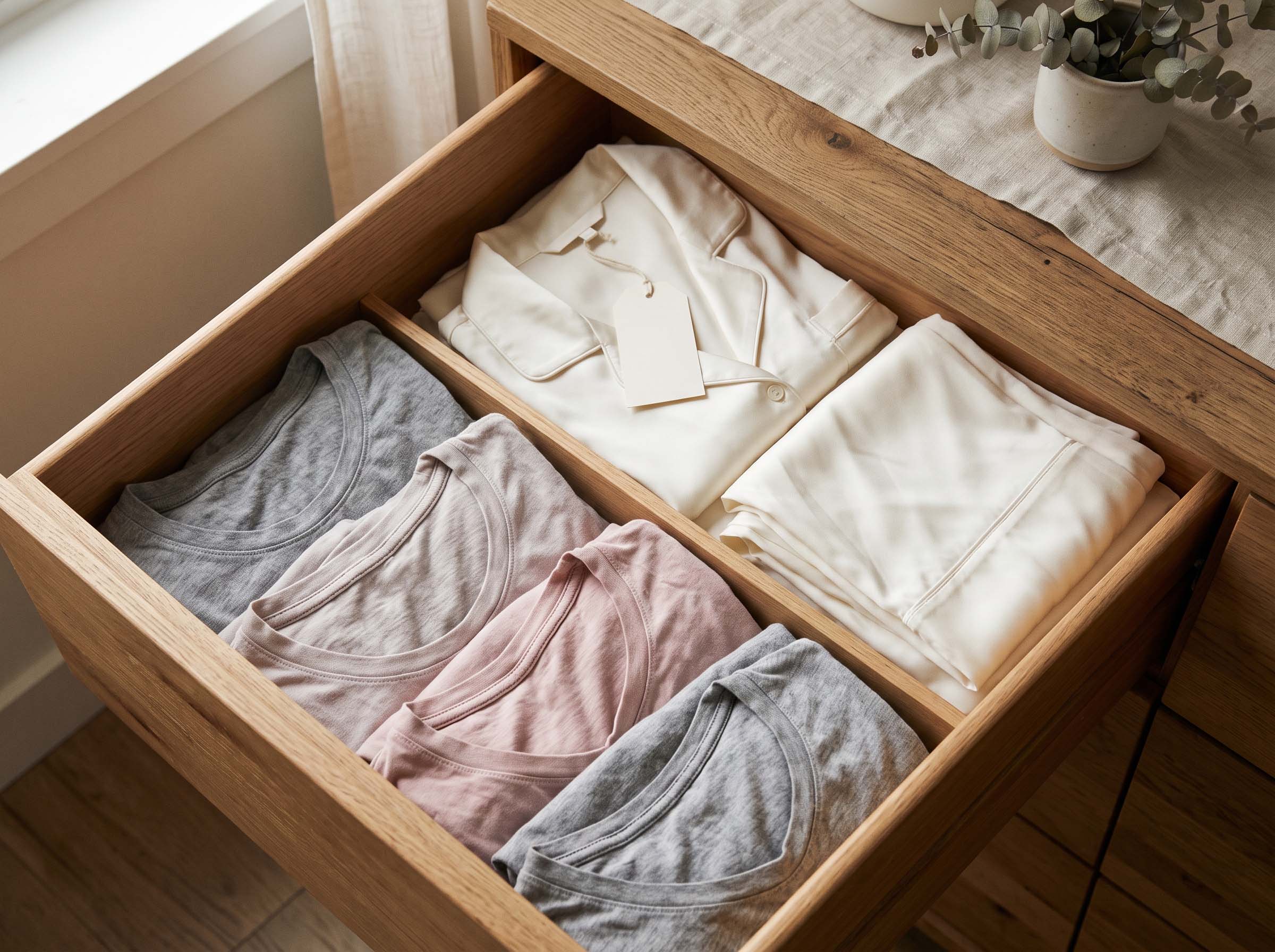
We asked 263 readers what they had actually worn to bed the night before. The bias-cut slip — the garment any film would put in that room — came fourth, selected by 15%. The oversized shirt did well, at 29%. But the outright winner, and this is the part nobody scripts, was the plain two-piece pyjama set: 36%, more than a third of the room, wearing the single most domestic item in the drawer. A smaller group skips fabric altogether, a habit explored in the growing case for sleeping without clothes, and they report no particular drama about it either way.
What is interesting is not that the silk slip lost. It is how badly it lost, how quietly, and how rarely anyone says so out loud.
In Brief
The silk slip is a costume department decision, not a description of how women sleep. We asked 263 readers what they had worn to bed the previous night, and the slip finished fourth — chosen by 15%. The winner was the least photogenic garment in the drawer: an ordinary two-piece pyjama set. This is a look at how the bedtime wardrobe became a performance, why it stopped being one, and what happens when comfort finally wins an argument it had been losing for a century.
“The neckline has gone soft in a way that took years to achieve and cannot be bought.”
What the Drawer Actually Holds
Open the drawer and there is an archaeology to it. Near the front sits the working collection — the shirts, the leggings with the waistband that gave up, the flannel bottoms that arrived as a gift and became a fixture. Further back, undisturbed, is the aspirational layer. Matching sets still folded along their original creases. A robe with the tag on. The gift from a bridal shower that was received with genuine delight and has been worn twice, both times on purpose, both times for about eleven minutes.
Neither layer is a mistake. They are simply answering different questions. The front of the drawer answers how do I want to spend the next eight hours. The back answers how do I want to be seen for the four minutes before them. Those are not the same question, and a garment that tries to answer both tends to answer neither well.
The Shirt Is an Artifact
Ask a woman why that shirt and the answer is almost never about the shirt. It came from a trip. It belonged to someone. It was there during a hard year. Nightwear occupies a strange category of clothing — it is the only thing worn daily that is never evaluated by anyone, which means it gets to accumulate meaning instead of style points. A blazer earns its place by looking correct. A twelve-year-old t-shirt earns its place by being the softest object in the house.
There is also the matter of fabric itself. Cotton and linen behaved a certain way for several thousand years before synthetics arrived, and what happens against skin overnight is a question the fabric comparison between silk, cotton and bamboo takes up in more detail. The short version is that women were not imagining the difference. The soft old shirt won on merit before it won on sentiment.
How Comfort Became the Secret
Here is the odd part. The shirt is not embarrassing. Nobody has ever been genuinely scandalised by cotton. And yet women describe their real sleepwear with the sheepishness usually saved for a confession — a small apologetic laugh, a qualifier, an assurance that there are nicer things in the drawer, honestly.
The apology is doing something. It is acknowledging a rule that nobody stated out loud but everybody absorbed: that a woman is meant to be presentable at all hours, including the ones she spends unconscious. The rule has commercial origins and considerable staying power. It survives in gift-giving, where nightwear is bought for how it photographs rather than how it sleeps, and it survives in the quiet assumption that choosing comfort is a step down from something. Yet when 263 women answered without their names attached, more than eight in ten named something practical. The performance was largely being staged for an audience that was already asleep.
Did You Know?
The word lingerie comes from the French linge, meaning linen — a reference to the plain washable underlayer, not to anything ornamental. The term picked up its current associations centuries after it picked up its meaning. For most of its life it described laundry.
The Nothing-At-All Camp
A steady share of women skip the question entirely, and they tend to be the least apologetic group in any survey. The reasoning offered is rarely romantic. It is about waking up tangled, about a waistband that migrates, about the specific irritation of a seam that has spent six hours in one place. Warmth is managed with bedding instead of clothing, which is a distinction worth noting — the temperature problem gets solved at the duvet layer rather than the fabric layer.
That approach has its own history. Household nudity is far more ordinary across cultures than English-speaking countries tend to assume, a pattern examined in the wider look at nudity at home around the world. What reads as daring in one living room is unremarkable in another, and the boundary between the two turns out to be cultural rather than natural.
Research on sleep and temperature regulation has explored how the body sheds heat overnight and why a cooler sleeping environment is generally associated with less disrupted rest, a topic covered in accessible detail by the Sleep Foundation's overview of bedroom temperature and sleep quality. What that body of work does not settle is the sleepwear question specifically — the evidence there is thin, and mostly consists of women reporting what works for them.
Source: Vagina Institute reader poll, 263 participants. Each respondent selected the single option describing what they wore the previous night.
The Long-Marriage Wardrobe
Something predictable happens over years together, and it is widely misread. The silk gets worn less. The shirt gets worn more. Somewhere in the middle of that transition, a woman usually decides — privately, and often with a flicker of guilt — that this means the relationship has entered a quieter phase.
The habit data suggests a different reading. What changes is not desire but audience anxiety. Early on, the bedroom is a place where impressions are still being formed and clothing is doing communicative work. Later, the impressions are formed. The clothing gets to go back to being clothing, and its job description narrows to one line: do not wake me up. This is the same negotiation that plays out over blankets and thermostats and who gets the window side, catalogued in the survey on sleep compatibility and the two-duvet marriage.
Comfort winning is not a romance problem. It is closer to a sign that the room has stopped being a stage.
By the Numbers
36%
wore a pyjama set or separates — the outright winner
29%
reached for an oversized shirt or tee
15%
chose the nightgown or slip that film treats as standard
263
women answered anonymously, one response each
Vagina Institute reader poll. Figures rounded; 11% wore nothing at all and 10% chose loungewear.
The Verdict Nobody Needed to Reach
There is no correct answer here, which is exactly why the question is fun. Some women love the silk and wear it because they love it, not because anyone asked — and one in seven still does. Some have not owned a matching set since a wedding they were in. Some solved the whole problem by removing the variable. All of these are working systems, and the only thing they have in common is that the woman inside them stopped consulting an imaginary audience.
The bedtime wardrobe lie was never really about fabric. It was about the suggestion that even the eight hours a woman spends unconscious should be styled for someone else's benefit. Two hundred and sixty-three women answered anonymously, and more than eight in ten voted against that idea without ever discussing it with each other.
The shirt from 2016 came second. It did not seem to mind.
Take the revised poll.
Questions Readers Keep Asking
Disclaimer: All content on this website—including articles, educational materials, and interactive calculators—is for informational, educational, and entertainment purposes only. The calculations, percentiles, and outputs generated by tools on this site are based on general statistical data and mathematical models; they do not constitute medical data, a clinical assessment, or a diagnosis.
Nothing contained on this website is a substitute for professional medical advice, diagnosis, or treatment. Always seek the guidance of a qualified healthcare professional or urologist with any questions you have regarding physical development, anatomy, or health conditions. Reliance on any information or tools provided by this website is solely at your own risk.