English
  Español


For roughly fourteen centuries, the finest medical minds in Europe agreed on a single elegant idea about the female body: it was a male body that had never finished the job. Not a different design. Not a parallel system. The same organs, in the same order, simply turned inward and held there — like a glove that had never been pulled right-side out.
The theory had a name in medical Latin, an anatomical logic, and the endorsement of nearly every physician who mattered. It also happened to be wrong in almost every particular, and it took the Renaissance — the century of dissection, of drawing from the corpse rather than the book — an astonishingly long time to say so.
The story of how that idea took hold, survived the sharpest anatomists in history, and finally collapsed is one of the strangest chapters in Western medicine. It sits alongside the wandering womb as evidence of how long a beautiful theory can outlive the evidence against it.
The one-sex model held that female reproductive organs were male organs retained inside the body for want of sufficient heat.
It came from Galen in the second century, entered medieval and Renaissance teaching almost untouched, and shaped anatomical vocabulary for over a thousand years.
Historians still disagree sharply about how completely doctors actually believed it — and that argument is one of the liveliest in medical history.
A Body Measured Against Another Body
The architect of the theory was Galen of Pergamon, physician to the Roman imperial court, writing around the second century. Galen was not careless. He dissected extensively, reasoned rigorously, and produced a body of work so internally consistent that European medicine simply adopted it wholesale and stopped asking questions for a millennium.
His argument ran on the physics available to him. Bodies were governed by heat. Heat drove development outward and completed it. A body with abundant heat pushed its generative organs into the open air; a cooler body kept them tucked within. From this it followed — and Galen said so plainly — that the ovaries were testicles that had stayed inside, the uterus was a scrotum that had never descended, and the vaginal canal was an inverted phallus. He invited his readers to perform the transformation mentally: fold the male structures inward, unfold the female ones outward, and the correspondence would be exact.
Aristotle had reached a related conclusion by a different route, describing the female as a form of the male that had fallen short of complete development. The two frameworks were not identical, and scholars have spent careers separating them, but the cultural residue was similar. A woman's body was legible only by reference to a man's.
When Language Does the Arguing For You
Here is the detail that historians find most revealing, because it shows how deeply the model had settled in: for most of this period, several major female organs had no names of their own.
The ovaries were testes muliebres — women's testicles. There was no separate anatomical word, because in the framework there was no separate anatomical thing. The vaginal canal was rarely named at all; texts referred to the neck of the womb, or borrowed a word for the male organ and noted that this one was inverted. The Latin term now in universal use, meaning sheath, only entered anatomical writing as a proper name for that structure in the seventeenth century.
Vocabulary is not a neutral container. When a student learned that the ovary was a testicle held inside, the terminology confirmed the theory every time it was spoken aloud, and the theory justified the terminology in return. Breaking the loop required more than a better drawing. It required someone to insist that a thing was different enough to deserve a name.
There was no separate word for the ovary, because in the theory there was no separate thing.
1543: The Year Someone Finally Looked
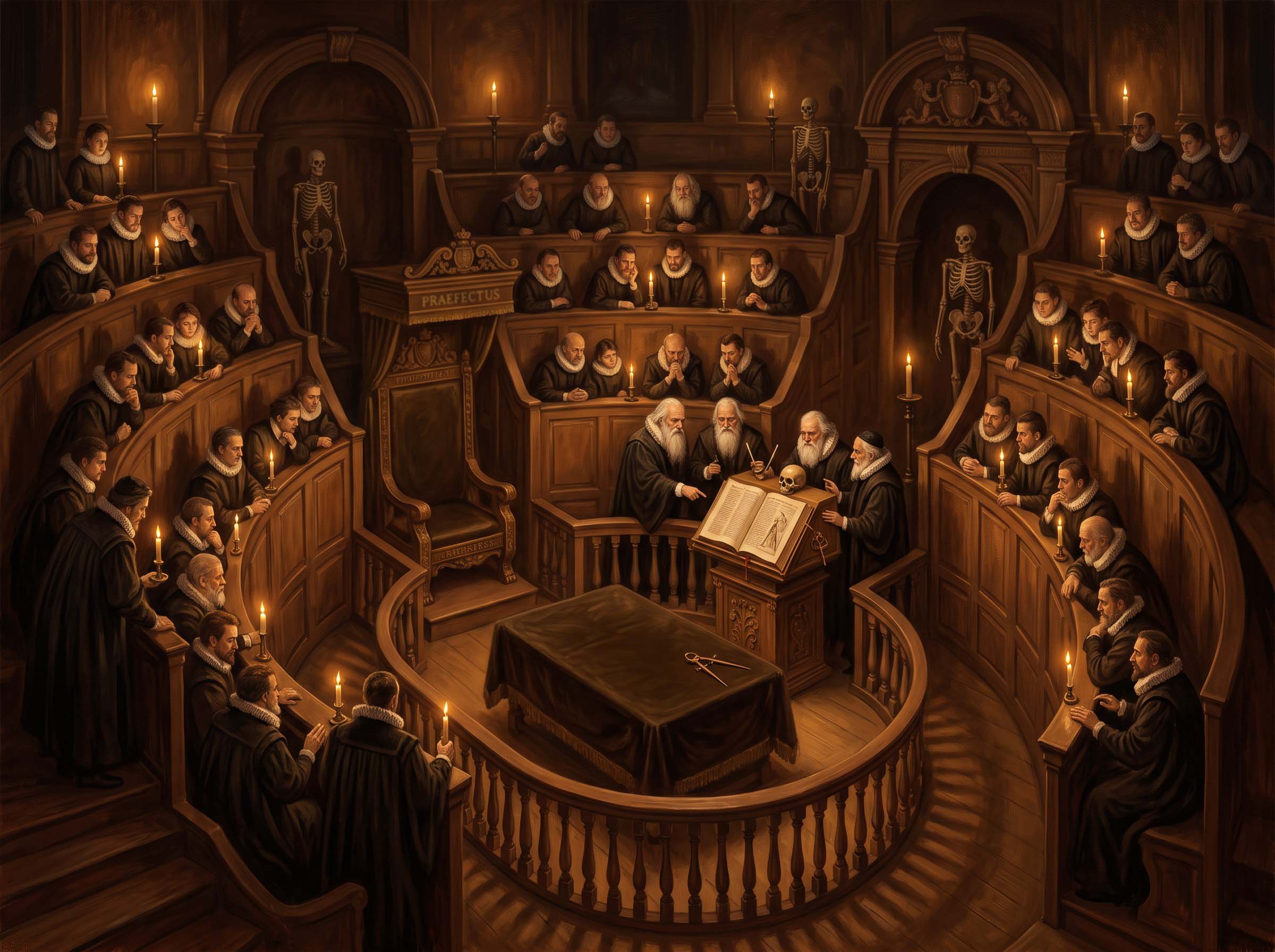
Andreas Vesalius, teaching at Padua, published De humani corporis fabrica in 1543 and changed the discipline permanently. He did his own dissecting rather than reading aloud while an assistant cut. He corrected Galen on hundreds of points — the structure of the jaw, the liver, the vessels of the heart — and made a public sport of demonstrating that Galen had been describing animal bodies and generalising to human ones.
And on the female reproductive organs, he largely held the line.
The plates in the first edition of Vesalius's 1543 anatomical atlas render the uterus and vaginal canal as a single elongated structure that a modern eye reads immediately as a phallus. Whether Vesalius drew what he saw, drew what he expected, or drew what his audience needed to recognise is a genuinely open question. He softened some of it in the 1555 revision. But the man who dismantled Galenic anatomy in a dozen other regions of the body left this particular arrangement standing, which tells us something about how firmly the idea was fixed — and how little of it depended on evidence in the first place.
The Findings That Would Not Fit
The model began to strain not through argument but through accumulation. Anatomists kept encountering structures the framework had no room for.
In 1559 the Padua anatomist Realdo Colombo published a description of the clitoris and claimed it as a discovery. Two years later Gabriele Falloppio, his contemporary and rival, described the tubes that still carry his name and disputed the claim vigorously. Later writers pointed out that both men were rather late to the party, since the structure appears in Hippocratic, Arabic and medieval sources — a case of European anatomy rediscovering something it had read past for centuries. That pattern of finding, forgetting and finding again would repeat: three hundred years later the same structure would quietly vanish from the pages of a standard anatomy textbook without comment.
Then came the naming. In 1667 the Danish anatomist Nicolas Steno proposed that the female structures called testicles were something else entirely, and produced eggs. Five years later Regnier de Graaf published a detailed study of the follicles within them. Once those organs had a function nothing in the male body performed, the old word stopped fitting, and the new word — ovary — carried an argument inside it. A structure with its own purpose is not a version of anything.
The Century the Picture Changed
The replacement was slower and messier than any single date suggests. Through the eighteenth century, European medicine gradually reorganised itself around the premise that male and female bodies were distinct in design rather than in degree of completion. Anatomical illustration registered the shift plainly: separate female skeletons began appearing in atlases from the 1750s onward, drawn as their own subject rather than as annotations on a male standard.
| Approx. Date | Development | Effect on the Model |
|---|---|---|
| c. 170 AD | Galen sets out the heat-and-inversion argument in his work on the usefulness of the parts | Establishes the framework |
| c. 500–1400 | Galenic texts transmitted through Arabic scholarship and medieval European universities | Reinforced by repetition rather than testing |
| 1543 | Vesalius corrects Galen extensively — but not here | Survives its most dangerous critic |
| 1559–1561 | Colombo and Falloppio publish descriptions of structures with no male counterpart | First serious strain on the framework |
| 1667–1672 | Steno and de Graaf establish the egg-producing function of the ovary | The old vocabulary becomes unusable |
| c. 1750–1800 | Female skeletons and organ systems illustrated as subjects in their own right | A two-body picture becomes standard teaching |
What Historians Are Still Arguing About
This is where an honest account has to slow down, because the tidy version of the story is itself contested.
The framing most readers have encountered comes from the historian Thomas Laqueur, whose 1990 study argued that Western culture ran on a one-sex model until roughly the eighteenth century, when a two-sex model displaced it for reasons as much social as scientific. The book was enormously influential and remains the reference point for the whole subject.
It has also drawn sustained criticism from classicists and early modern historians, most prominently Helen King, who has argued that the one-sex model was never as dominant as the account requires — that classical and Renaissance writers routinely described female bodies as different in kind, that the inversion image functioned as an explanatory analogy rather than a literal claim, and that a neat before-and-after story flattens centuries of genuine disagreement. Katharine Park and others have raised related objections about the evidence base.
The reasonable position is that both things were true at once. The inversion image was widely taught, embedded in vocabulary, and reproduced in illustration. It was also disputed, qualified and ignored by practitioners who had looked at actual bodies and knew better. Medical history rarely moves in clean successions, and the temptation to write it as though it does is one that historians police in each other constantly.
The one-sex framework produced a stubborn side effect in European folk belief: stories of women who were said to have become men after sudden exertion. If the male form was simply the same body with more heat, a spontaneous conversion was theoretically possible — and sixteenth-century writers, including the surgeon Ambroise Paré, recorded such accounts in all seriousness. No case ran in the other direction. The theory only allowed the ladder to be climbed upward.
Why a Dead Theory Still Matters
The one-sex model is gone as science. Its habits proved more durable.
Anatomical language kept its inherited asymmetries long after the reasoning behind them was abandoned — female structures named for the men who described them, described by their correspondence to male structures, or given diminutive forms of male terms. Research practice carried a related assumption forward: for much of the twentieth century, the standard human subject in clinical trials was a male one, with female physiology treated as a variation requiring separate justification rather than as half the population. That is a policy question with its own literature and its own reform history, and it has moved considerably.
What the Renaissance episode really demonstrates is narrower and more interesting than a grievance. A theory that is elegant, internally consistent and endorsed by authority can survive an enormous amount of contradicting evidence, provided the evidence arrives one piece at a time and the vocabulary keeps restating the theory. Vesalius cut open more bodies than almost anyone alive and still drew what the framework told him to expect. The correction required not sharper eyes but a different question — and several generations willing to ask it. The longer history of how history misunderstood the female form is largely a record of how long that takes.

Questions Readers Ask About the One-Sex Model
Disclaimer: All content on this website—including articles, educational materials, and interactive calculators—is for informational, educational, and entertainment purposes only. The calculations, percentiles, and outputs generated by tools on this site are based on general statistical data and mathematical models; they do not constitute medical data, a clinical assessment, or a diagnosis.
Nothing contained on this website is a substitute for professional medical advice, diagnosis, or treatment. Always seek the guidance of a qualified healthcare professional or urologist with any questions you have regarding physical development, anatomy, or health conditions. Reliance on any information or tools provided by this website is solely at your own risk.