English
  Español



The human body runs two separate sweat systems, and only one of them was built for cooling. The other — the apocrine system — sits in a narrow set of places: the underarms, the areolae, and the sub-pelvic and perineal region. It stays dormant through childhood, switches on at puberty, and produces a secretion that has almost nothing in common with the salt water released across the rest of the skin.
Anyone who has read our earlier explainer on the two sweat glands and how intimate body scent is produced will recognise the outline. What follows is the next question researchers have spent five decades circling: whether that lipid-rich secretion carries information relevant to reproduction, and if so, how much of the popular story survives close inspection.
In Brief
- Apocrine glands sit in a few specific regions, activate at puberty, and secrete an oily, protein-rich fluid that serves no cooling function.
- The secretion is nearly odourless when released; skin bacteria convert it into the volatile molecules that carry scent.
- Immune-gene compatibility and fertility signalling are the two leading reproductive hypotheses — one partially supported, one built on small and inconsistent effects.
- The strongest human evidence for scent recognition comes from mothers and newborns, not from studies of attraction between strangers.
A Second Sweat System, Built for Something Else
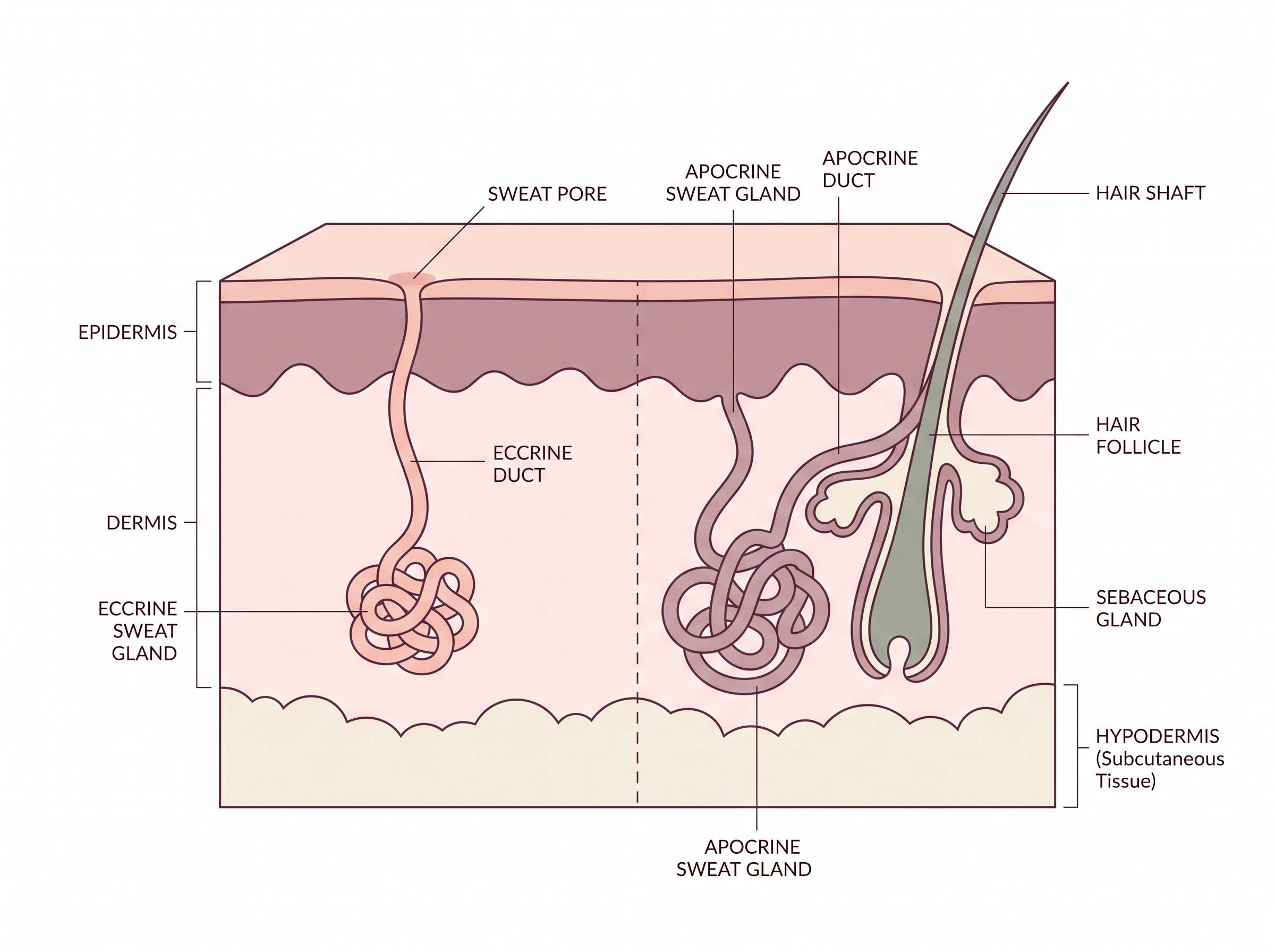
Eccrine glands open directly onto the skin surface and release a dilute, largely watery fluid used for thermoregulation. Apocrine glands do something structurally different. They are coiled deeper in the dermis and empty into the hair follicle rather than onto the skin itself, which is why their distribution maps so closely onto the regions where terminal hair develops after puberty. Their output is viscous, milky, and loaded with lipids, proteins, steroid precursors and sugars.
That composition matters. A watery secretion evaporates and leaves little behind; an oily one lingers on hair shafts, holds volatile molecules in place, and releases them slowly. In comparative biology, this is the signature of a scent-marking apparatus rather than a cooling one. Apocrine glands in other mammals are used for territorial and reproductive signalling, and human anatomy retains the same architecture in a reduced form — dense in a few zones, absent almost everywhere else.
Two Sweat Systems, Side by Side
| Feature | Eccrine | Apocrine |
|---|---|---|
| Distribution | Nearly the whole body surface | Underarms, areolae, sub-pelvic and perineal region |
| Outlet | Duct opens onto the skin surface | Duct empties into the hair follicle |
| Secretion | Dilute, watery, largely salt and water | Viscous and milky; lipids, proteins, steroid precursors, sugars |
| Becomes active | Functional from infancy | At puberty, with rising adrenal and gonadal steroids |
| Primary role | Temperature regulation | Not thermal; studied as a scent-signalling system |
| Source of odour | Minimal on its own | Produced by skin bacteria acting on the secretion |
The Bacterial Step Nobody Expected
Fresh apocrine secretion is close to odourless. The scent associated with it is manufactured afterwards, outside the body, by resident skin bacteria that metabolise the secretion's larger molecules into small, volatile ones. Corynebacteria and certain staphylococci carry the enzymes that cleave odour precursors into volatile fatty acids, steroid derivatives and sulphur-containing thioalcohols — the last of which are detectable at extraordinarily low concentrations.
Human scent, in other words, is a collaboration. The gland supplies raw material; the skin's bacterial population determines the finished chemistry. Two women with similar gland activity and different microbial communities produce measurably different odour profiles, which is one reason scent has proven so difficult to reduce to a single molecule. It also explains why the same skin smells different across a week, a season, or a change in clothing habits. Skin surface chemistry runs on a related logic to the acidic environment described in our piece on what the vaginal pH scale actually measures, though the two systems are governed by different populations and different fuels.
The Immune Advertisement
The most durable hypothesis in this field concerns the major histocompatibility complex — in humans, the HLA genes — a cluster that governs how the immune system recognises pathogens. Because these genes are inherited from both parents and expressed together, offspring of parents with dissimilar immune-gene profiles theoretically inherit a broader recognition range.
The famous demonstration came from Switzerland in the mid-1990s, when researchers had male students wear plain cotton shirts for two nights and then asked women to rate the odour of shirts worn by men with immune profiles similar or dissimilar to their own. Women who were not taking oral contraceptives tended to rate the dissimilar shirts more pleasantly; women taking the pill showed the reverse pattern. The finding was published in the Royal Society's 1995 study on immune-gene odour preferences and has been retold ever since as settled biology.
It is not settled. Replication attempts have produced mixed results across populations, and the effect sizes reported in the original work were modest with small samples. Some later studies found the pattern; others found nothing, or found it only under particular scoring conditions. What survives the scrutiny is narrower than the popular version: human body odour does appear to carry some information related to immune genotype, and women's ratings of that odour are not random. Whether that information meaningfully shapes who marries whom in a modern society — where scent competes with introduction, family, faith, proximity and preference — remains open.
The Ovulation Question
A second line of research asks whether odour changes across the cycle in ways others can detect. The biological rationale is straightforward: apocrine and sebaceous activity is sensitive to circulating steroids, and those levels shift substantially between the follicular and luteal phases, as set out in our breakdown of the four phases of the menstrual cycle. Estrogen alters skin lipid composition and hydration; progesterone alters it again in the second half.
Odour-rating studies have generally reported that samples collected near the fertile window are rated slightly more pleasant or more attractive than samples collected in the luteal phase. The effects are small, the samples are usually students, and the studies rarely replicate each other's exact methods. There is no evidence for anything resembling the conspicuous advertisement seen in other primates. If human females signal fertility through scent at all, the signal is faint, unreliable, and easily buried — which several researchers argue is itself the interesting finding, consistent with the concealed ovulation that distinguishes the human line.
What Happens on the Other Side
The male side of the question has attracted more press than data. Small laboratory studies have reported modest rises in salivary testosterone in men exposed to odour samples collected near ovulation, alongside shifts in risk-taking and courtship behaviour. The samples in these studies are typically tiny, the measured differences small, and independent replication thin.
A larger problem sits underneath. Much of the commercial and popular literature refers to human pheromones as an established category, usually naming a handful of steroid molecules. A 2015 review published in Proceedings of the Royal Society B on the search for human pheromones argued that none of those molecules has been established by the standards routinely applied to other mammals, and that decades of positive findings are better explained by small samples, publication bias and absent replication. The author's position was not that humans lack chemical communication — it was that the field would need to start again from first principles to prove it. That caution has not reached the marketing.
“Scent in human life behaves less like a trigger and more like a memory. The chemistry supplies the marker; attachment supplies the meaning.”
Scent as Something Learned
The strongest human evidence for scent mattering does not come from strangers rating shirts. It comes from families.
Newborns orient toward the odour of their own mother's areolar region within days of birth, and mothers identify their infants by scent at rates well above chance after very brief contact. Secretions from the areolar glands during lactation appear to elicit orientation and suckling responses in newborns generally — one of the few candidate human signals that survives the sceptics' criteria comparatively well. Long-married couples show a similar pattern: familiar scent is rated as calming rather than as attractive in the initial sense, and the response looks conditioned by association rather than driven by any molecule.
This is the least glamorous finding in the literature and probably the most consequential. Scent in human life behaves less like a trigger and more like a memory. The chemistry supplies a stable individual marker; attachment supplies the meaning. A woman's own family recognises her by an odour profile that no laboratory panel would rate as remarkable.

Hormones, Fabric and the Signal Modern Life Produces
Apocrine output tracks hormonal life stages. The glands remain inactive until adrenal and gonadal steroids rise in adolescence, run at their highest through the reproductive years, change in pregnancy and lactation alongside altered blood flow and gland activity, and diminish after menopause as circulating estrogen falls and skin lipid production declines.
Everything downstream of the gland is modern. Synthetic fabrics with low moisture transport hold secretion against skin at body temperature; occlusion raises local humidity and shifts which bacterial populations dominate. Friction and repeated washing act on the skin's lipid barrier, and a compromised barrier changes both the surface environment and what grows on it. Layered fragrance adds molecules that interact with the existing ones rather than covering them. What a given woman smells like on a Tuesday in 2026 is the product of a gland, a bacterial community, a wardrobe and a laundry routine — a combination no evolutionary account was designed to predict.
A single common variant in a gene called ABCC11 changes how much odour precursor reaches the skin. The variant also determines earwax type, which is why the two traits travel together. It is carried at high frequency across much of East Asia and at low frequency in Europe and Africa — one of the clearest cases in human biology where a single letter of genetic code shows up in something as ordinary as body scent.
The Honest Limits
Three claims hold up reasonably well: apocrine secretion is chemically distinct from ordinary sweat and serves no thermal function; skin bacteria, not the gland, generate the odour; and individual odour profiles are stable enough to be recognised by people who know them. Beyond that, the ground softens quickly. The immune-compatibility hypothesis is plausible and partially supported. The fertility-signalling hypothesis rests on small effects that have not consistently reproduced. The pheromone claims, in the strict sense the word carries in zoology, remain unproven.
Research on human apocrine chemistry and female reproductive biology is younger and thinner than its popular reputation suggests — an unusual position for a subject this old. Women have been told for centuries that their scent means something. Science is still working out what.
Questions Readers Ask
Disclaimer: All content on this website—including articles, educational materials, and interactive calculators—is for informational, educational, and entertainment purposes only. The calculations, percentiles, and outputs generated by tools on this site are based on general statistical data and mathematical models; they do not constitute medical data, a clinical assessment, or a diagnosis.
Nothing contained on this website is a substitute for professional medical advice, diagnosis, or treatment. Always seek the guidance of a qualified healthcare professional or urologist with any questions you have regarding physical development, anatomy, or health conditions. Reliance on any information or tools provided by this website is solely at your own risk.