English
  Español



Every travel guide tells a woman what to pack, where to eat, and which side of the train catches the morning light. Very few tell her where she is going to find a bathroom. The omission is strange, because it is the question quietly running underneath almost every itinerary a woman plans, from a three-hour hike to a cross-country drive with two children in the back seat.
Men and women plan trips differently in a hundred small ways, but this is the one that shapes the day. A man on a highway can pull over behind a pickup and be back on the road in forty seconds. A woman on the same highway is counting miles to the next town, wondering whether the gas station restroom is for customers only, and deciding whether that second coffee was a mistake. We covered the airborne version in our long-haul flight comfort plan. This is the ground-level guide: trails, long drives, festivals and trains, written plainly.
On the Trail: Where to Pee on a Hike as a Woman
The honest answer to where to pee on a hike as a woman is "somewhere off the trail, behind something, with a plan for what happens afterward." That sounds obvious until the trail runs along an open ridge with no trees, or through a canyon where every bend has another group coming around it.
What it is actually like: a woman walks off the path, looks for cover, checks uphill and downhill, finds a spot where the ground slopes away from her boots, and squats. Experienced hikers learn to face downhill, keep their pack on for balance on steep ground, and pull their pants forward and down rather than all the way to the ankles. None of this is taught. Most women learn it from an older sister, a camp counselor or one memorable mistake.
The etiquette is more settled than the technique. The Leave No Trace guidelines on disposing of waste properly ask hikers to urinate about 200 feet from trails, campsites and water, roughly 70 to 80 adult paces, and note that rocks, gravel and pine needles attract less wildlife than open vegetation. Toilet paper is the real problem. Left on the surface it becomes the white flags that line the first quarter-mile off many popular trailheads, and the same guidelines ask that it be buried in a proper hole or carried out. In desert country, packing it out is the stated preference.
This is why many long-distance hikers carry a bandana clipped to the outside of a pack, used only for this purpose and left to dry in the sun. Others carry a small opaque bag for used paper. Funnel-shaped devices that allow a woman to urinate standing up have existed in one form or another since at least the early twentieth century, and they have a devoted following among climbers and anyone hiking above the tree line, where cover simply runs out.
Season changes everything. Summer foliage gives privacy in the forest that vanishes by November. Winter adds a problem nobody mentions until they are standing in it: snow records every footprint and every stop, and the walk of 200 feet becomes a slow wade. There is a reason the moment everyone is waiting for you on the trail has become a running joke among women who hike in groups. The pressure is social as much as physical.
The Long Drive: Bathroom Breaks on a Long Road Trip
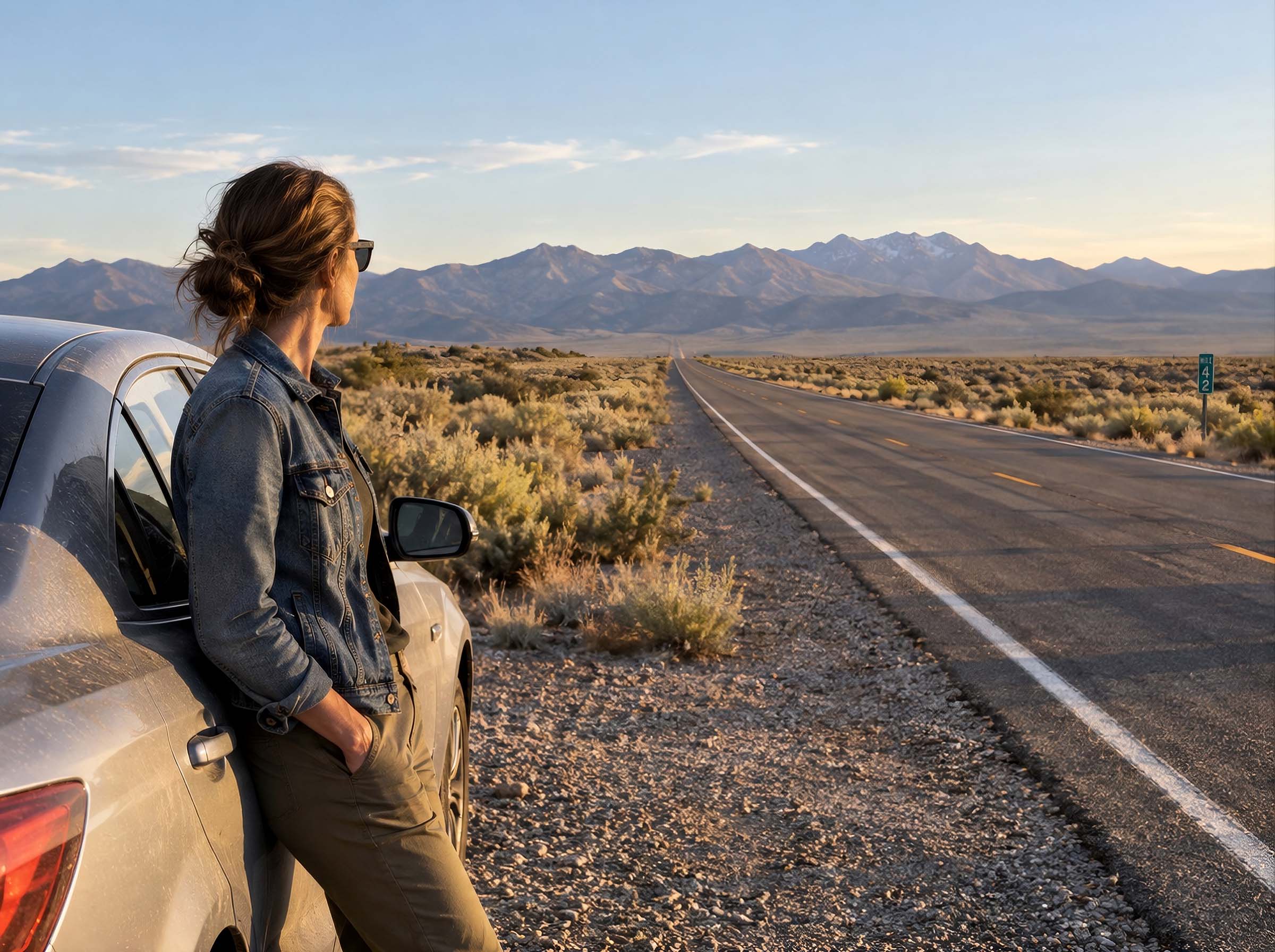
U.S. Route 50 across central Nevada earned the name "The Loneliest Road in America" from a 1986 magazine piece, and the label stuck because it is accurate. Between Fallon and Ely the road crosses basin after basin, and the towns along it, Austin and Eureka among them, sit far enough apart that a driver can go well over an hour without passing a building. It is a beautiful drive. It is also a perfect classroom in planning bathroom breaks on a long road trip, because the road offers no second chances.
The practical detail that makes or breaks a drive like this is not the distance between towns but the hours of the businesses in them. A small-town café that closes at two in the afternoon is not a restroom at four. Gas stations on remote highways often keep their facilities open, but not always, and some lock them after dark. Rest areas are less reliable than the maps suggest. Several states have closed or seasonally shuttered roadside rest stops over the years to save on maintenance, and a rest area icon on an older map is no promise of an unlocked door.
Many women report the same strategy: stop at every reasonable opportunity, whether or not the need is pressing, and treat a clean restroom the way a desert driver treats a gas pump. Truck stops, for all their reputation, tend to have the best-kept facilities on many interstates, because professional drivers depend on them.
Driving alone changes the arithmetic again. A dim rest area at eleven at night is a different place from the same rest area at noon, and plenty of women who are perfectly comfortable on the road will drive an extra thirty miles to a lit, staffed gas station instead. That calculation belongs to the same family of habits covered in our guide to planning solo travel safely as a woman.
Then there are mothers. Anyone who has taken a road trip with a newly potty-trained three-year-old knows that the child's timetable governs the whole family's. Generations of mothers kept a coffee can or a small potty seat in the back of the station wagon. Many still do, with a roll of paper towels and a bag of spare clothes beside it. It is not glamorous, and it is the reason a lot of family vacations went as smoothly as they did.
Where the Restroom Question Changes
| Setting | What is usually there | Where it gets difficult | What seasoned travelers plan around |
|---|---|---|---|
| Day hikes | A vault toilet at the trailhead, nothing after | Open ridges, canyons, winter snow, group pace | Stopping at the trailhead regardless; a way to carry out paper |
| Remote highways | Gas stations, small-town cafés, occasional rest areas | Business hours, closed rest stops, driving after dark | Stopping at every good opportunity, not only when needed |
| Music festivals | Banks of portable toilets, some flushing units | Queues between sets; supplies run out by day two | Going mid-set, carrying paper and hand sanitizer |
| Long-distance trains | Onboard restrooms, often several per car | Motion, small cubicles, regional trains with none | Checking the train type in advance; going early in the morning |
Festivals: The Arithmetic of the Queue
The line outside the women's restroom is not a matter of women being slower or chattier. It is structural. One widely cited 1988 study at Virginia Tech timed restroom visits and found women took roughly twice as long as men on average, about 79 seconds against 39. Clothing, the need to sit, purses with nowhere to hang, and the simple fact that a stall takes longer to use than a urinal all add up. Give men and women the same floor space and the same number of fixtures, and the women's line will be longer every time.
At a multi-day music festival this math is multiplied by thousands of people and by heat. The busiest moments are predictable: the ten minutes after a headliner finishes, and the stretch between sets on the main stage. Women who go to festivals every summer tend to settle into the same habit of slipping away during a popular set, when the lines are shortest, rather than after it. Paper runs out. Hand sanitizer dispensers empty. By the second afternoon, the women who brought their own small supply are the ones who look unbothered.
Organizers have noticed. Several large British festivals have trialed women's urinals in recent years, open-fronted units designed to be used in a squat, which take a fraction of the time a cubicle does. Reactions have been mixed and fiercely debated, which says something about how long the problem has gone unaddressed.
Give men and women the same floor space and the same number of fixtures, and the women's line will be longer every time. The Bathroom Question
Trains: Comfort, With Conditions
Long-distance trains are, for most women, the gentlest way to travel when it comes to restrooms. Amtrak's California Zephyr runs roughly 2,400 miles between Chicago and the San Francisco Bay Area over about two days, and nobody aboard spends that time calculating the next stop. Sleeper cars and most coach cars have their own facilities.
The conditions are worth knowing. A train restroom is a small room that moves, and the swaying that is pleasant in a seat is less pleasant standing in a cubicle on a curve through the Rockies. Facilities on a long-distance train are usually at their cleanest early in the morning, before the dining car fills. And not every train is a long-distance train. Short regional services in parts of Europe and elsewhere sometimes have no restroom at all, a detail that tends to be discovered forty minutes into a ninety-minute ride.
✦ Did You Know?
For most of the railway age, train toilets emptied straight onto the tracks, which is why older carriages carried signs asking passengers not to flush while standing in a station. Britain did not finish retiring its last open-discharge carriages until around 2020.
A Short History of Women Who Went Anyway
The problem is old, and for a long stretch of history it kept women home. In Victorian cities, public lavatories for men were built decades before any for women. Historians of the period have used the phrase "the urinary leash" to describe the effect: a respectable woman's range from home was limited by how long she could go without a facility, which in practice meant shops, tearooms and the homes of friends.
Campaigns for women's public conveniences met real resistance. One of the better-known episodes took place in the London borough of St Pancras around the turn of the twentieth century, where George Bernard Shaw, then serving on the local vestry, supported a proposal for a women's lavatory in Camden. Local opponents objected, and according to accounts of the dispute, a wooden mock-up placed on the site to test the idea was repeatedly struck by cart drivers. The facility was eventually built.
Meanwhile women traveled regardless. In August 1888, Bertha Benz took her husband's experimental motor car, without telling him, and drove roughly 66 miles from Mannheim to Pforzheim with her two teenage sons. Along the way she bought fuel at a pharmacy in Wiesloch and cleared a blocked fuel line with a hatpin. It was the first long-distance automobile journey in history. Twenty-one years later, Alice Ramsey, a 22-year-old from New Jersey, drove across the United States from New York to San Francisco with three women companions, a trip of about 3,800 miles that took 59 days on roads that were often little more than wagon tracks. Neither woman left a memoir about where she stopped along the way. Both clearly managed.
Modern building codes caught up slowly. From the late 1980s onward, American states and cities began passing what are informally called "potty parity" laws, requiring more fixtures for women in new stadiums, theaters and public venues. The gap has narrowed in new buildings. It remains wide almost everywhere else.
What to Know Before Going
The women who travel most comfortably tend to have one thing in common, and it is not equipment. It is that they think about the restroom question at the planning stage instead of the moment of need. On a trail, that means knowing whether the trailhead has a toilet and whether the land managers in that area ask visitors to carry out paper. On a long drive, it means looking at a remote stretch and noting which towns have businesses open in the afternoon, rather than trusting that something will appear.
At a festival, it means knowing when the main stage turns over. On a train, it means checking whether the service is a long-distance train with facilities or a regional one without. None of this is complicated. It just rarely gets said out loud, because a whole category of travel writing prefers sunsets to logistics.
Plenty of men will read this and wonder why it needed an article. Plenty of women will read it and wonder why it took so long.
Your Questions, Answered Plainly
Disclaimer: All content on this website—including articles, educational materials, and interactive calculators—is for informational, educational, and entertainment purposes only. The calculations, percentiles, and outputs generated by tools on this site are based on general statistical data and mathematical models; they do not constitute medical data, a clinical assessment, or a diagnosis.
Nothing contained on this website is a substitute for professional medical advice, diagnosis, or treatment. Always seek the guidance of a qualified healthcare professional or urologist with any questions you have regarding physical development, anatomy, or health conditions. Reliance on any information or tools provided by this website is solely at your own risk.