English
  Español



Every woman carries a small, self-regulating laboratory that she never has to think about. It measures its own acidity, adjusts its own chemistry, and maintains a setting so specific that scientists can express it as a single number.
That number is pH, and understanding the science of pH balance is one of the most satisfying ways to appreciate just how deliberate the female body actually is. Far from being fragile, this system runs on a steady biochemical logic that has kept women healthy for as long as there have been women.
The word "pH" simply describes how acidic or alkaline a watery environment is, on a scale from 0 to 14. Pure water sits neutral at 7. Anything below that is acidic; anything above is alkaline. Lemon juice lives near 2. Household soap climbs toward 9 or 10. The reproductive-age female body holds its intimate environment firmly on the acidic side, generally between 3.8 and 4.5. To put that in kitchen terms, it is roughly as acidic as a tomato or a glass of black coffee — and that tartness is exactly the point.
A healthy reproductive-age body keeps its most private ecosystem on a narrow acidic setting, roughly 3.8 to 4.5 on the pH scale. That number is not an accident. It is the visible result of a quiet chemistry lesson happening every day, powered by beneficial bacteria, tissue-stored sugar, and the rise and fall of a single hormone. Here is how the female body writes its own recipe for balance — and what that has to do with the way it naturally smells.
The Lactic Acid Factory
The acidity does not appear on its own. It is manufactured, in real time, by a population of beneficial bacteria that live along the vaginal wall. These are the Lactobacillus species — chiefly L. crispatus, L. jensenii, L. gasseri, and L. iners — and they behave less like invaders and more like resident staff. Learning how these microbes shape the wider vaginal microbiome reframes the whole conversation about intimate health.
Their fuel source is glycogen, a stored form of sugar packed into the cells lining the vaginal wall. When those surface cells naturally shed, they release their glycogen into the surrounding fluid. An enzyme already present in that fluid, called alpha-amylase, snips the large glycogen molecule into smaller, digestible sugars. The Lactobacillus then feed on those sugars and release lactic acid as a byproduct. That lactic acid is the single biggest reason the environment stays acidic. Research consistently finds that the more lactic acid these bacteria produce, the lower — and more protective — the pH becomes. For readers who enjoy the primary science, the peer-reviewed literature on the physiologic role of vaginal lactobacilli maps this cascade step by step.
| 7.0 | Neutral — the pH of pure water, for comparison |
| 3.8–4.5 | The typical reproductive-age vaginal range |
| 4 | The main Lactobacillus species that do most of the work |
| 2× | Roughly how much more acidic 3.8 is than 4.5 (each step on the scale is tenfold) |
Estrogen: The Silent Architect
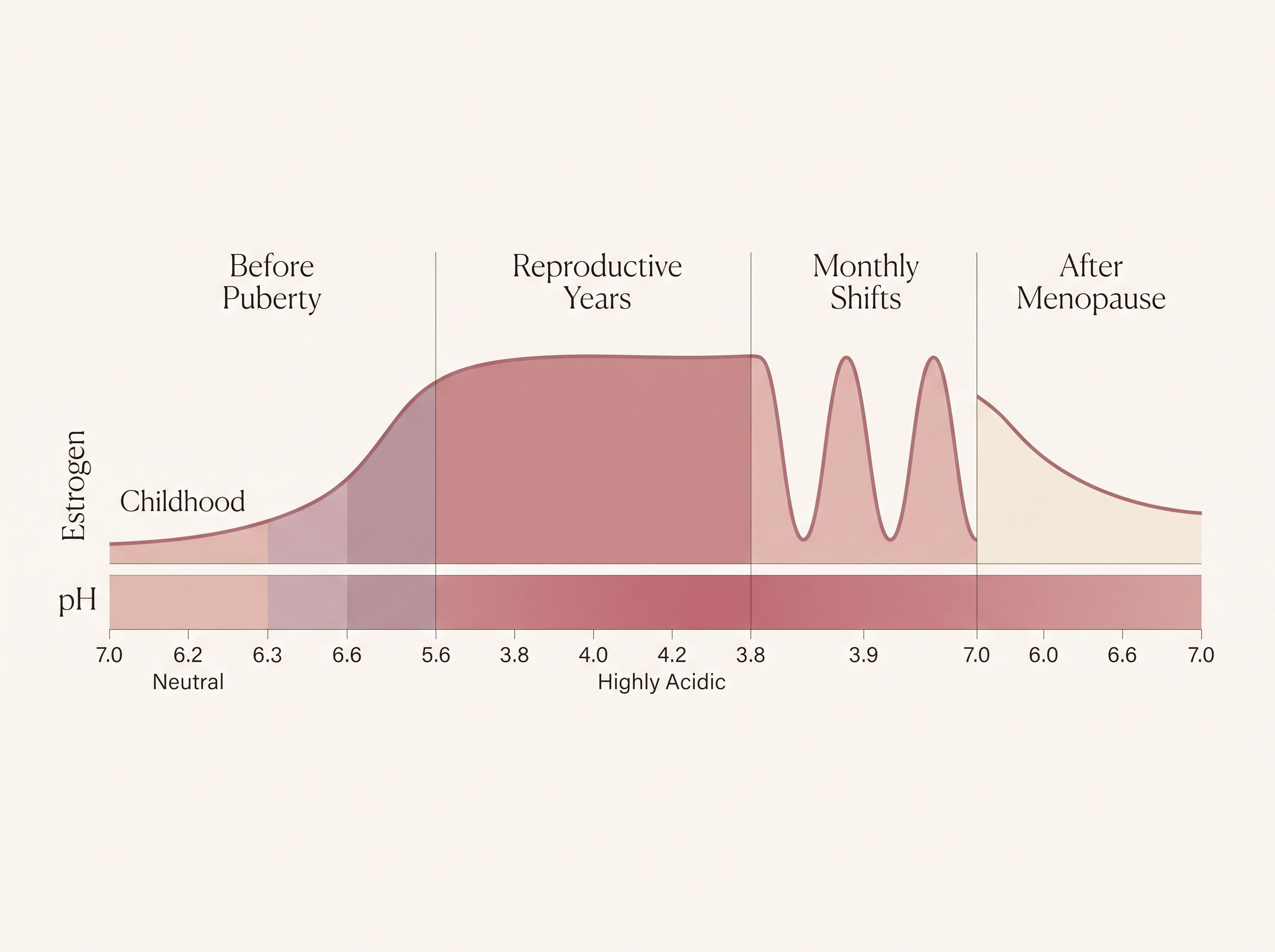
If Lactobacillus are the factory workers, estrogen is the architect who decides how much raw material they receive. Estrogen is the hormone that instructs the vaginal wall to build up thick, sugar-rich cells in the first place. When estrogen is plentiful, the wall grows sturdier and stores more glycogen, the bacteria eat well, lactic acid flows, and the pH settles into its comfortable acidic band. When estrogen is low, the whole supply chain slows.
This is why the reading naturally shifts across a woman's life, and why those shifts are a matter of ordinary biology rather than concern. The pattern tracks estrogen from the first years through the reproductive decades and beyond. Understanding how hormones quietly govern the way vaginal tissue functions makes these changes far less mysterious.
General educational patterns drawn from published physiology research. Individual readings vary from woman to woman.
“The acidity is not the body being delicate. It is the body being precise.”
Where Scent Actually Comes From
Because this environment is chemically active, it also carries a natural scent — and that scent is simply the aroma of a working ecosystem. The lactic acid itself contributes a faintly tangy note, the same family of smell you would recognize in plain yogurt or sourdough, both of which are made by close bacterial relatives. On top of that sit two different kinds of sweat glands in the surrounding skin. Eccrine glands, found nearly everywhere on the body, produce a light, watery sweat mainly for cooling. Apocrine glands, concentrated in areas such as the underarms and the sub-pelvic region, release a thicker, lipid-rich secretion that resident skin bacteria break down into the warmer, muskier notes unique to each woman.
Everyday variables layer on top of the chemistry. Textile science matters more than most women realize: breathable natural fibers let moisture evaporate, while tight synthetic fabrics trap warmth and humidity against the skin, gently concentrating scent through simple physics. Friction, movement, and the way water and salts pass across the skin's natural lipid barrier through osmosis all play supporting roles. None of this is a flaw in the design. It is the same reason freshly showered skin smells different by evening — a living surface simply reacts to its day. Readers curious about fabric's role can compare notes with our guide to vulva-friendly fabrics.
What Shifts the Balance — and What Doesn't
Because the acidity is manufactured, anything that changes the workforce or its fuel supply can nudge the number. Introducing strongly alkaline substances, over-washing with products that strip the surface, or the natural drop in estrogen at either end of the reproductive years can all move the reading toward the neutral side. Many women also report subtle day-to-day differences tied to their monthly cycle, exercise, and even wardrobe choices. These are ordinary variations in a responsive system, not signs of a system failing.
The broader lesson is one of restraint. A setting this well engineered rarely needs help staying where it belongs. The body's own maintenance crew — glycogen, enzymes, Lactobacillus, and lactic acid — handles the daily work with a consistency any factory manager would admire.
The pH scale is logarithmic, which means each whole number is a tenfold change. A reading of 3.8 is not slightly more acidic than 4.8 — it is about ten times more acidic. That is how a difference of a single decimal point can meaningfully shift an entire microscopic environment.
Seen up close, the vaginal pH scale stops being an abstract health term and becomes something closer to a signature — a number that captures the daily collaboration of hormones, bacteria, and biochemistry. It is a small window into a body that was built to look after itself, quietly and well, on a schedule all its own. For anyone who wants the deeper science, the published work on glycogen and vaginal flora shows just how much research has gone into understanding this everyday chemistry.
Reader Questions, Answered
Disclaimer: All content on this website—including articles, educational materials, and interactive calculators—is for informational, educational, and entertainment purposes only. The calculations, percentiles, and outputs generated by tools on this site are based on general statistical data and mathematical models; they do not constitute medical data, a clinical assessment, or a diagnosis.
Nothing contained on this website is a substitute for professional medical advice, diagnosis, or treatment. Always seek the guidance of a qualified healthcare professional or urologist with any questions you have regarding physical development, anatomy, or health conditions. Reliance on any information or tools provided by this website is solely at your own risk.