English
  Español



Beneath the surface of the vaginal wall, a handful of bacterial species run one of the most efficient chemical operations in human biology. Researchers have spent the last two decades learning their names — and discovering that the community they build is far less uniform than textbooks once claimed.
In Brief
Four species of Lactobacillus — crispatus, gasseri, iners and jensenii — account for most of the bacterial communities identified in reproductive-age women in large sequencing studies.
These bacteria feed on glycogen stored in the vaginal lining and release lactic acid, which holds the local environment at an acidic reading.
Estrogen sets the terms. Where the hormone rises and falls across a lifetime, the glycogen supply — and the bacterial population that depends on it — follows.
A census that rewrote the textbook
For most of the twentieth century, what was known about vaginal bacteria came from what would grow in a laboratory dish. That method has an obvious blind spot: many of the organisms living in the human body refuse to grow outside it. The picture only changed when researchers began reading bacterial DNA directly from samples rather than trying to culture it, using the 16S ribosomal RNA gene as a kind of barcode.
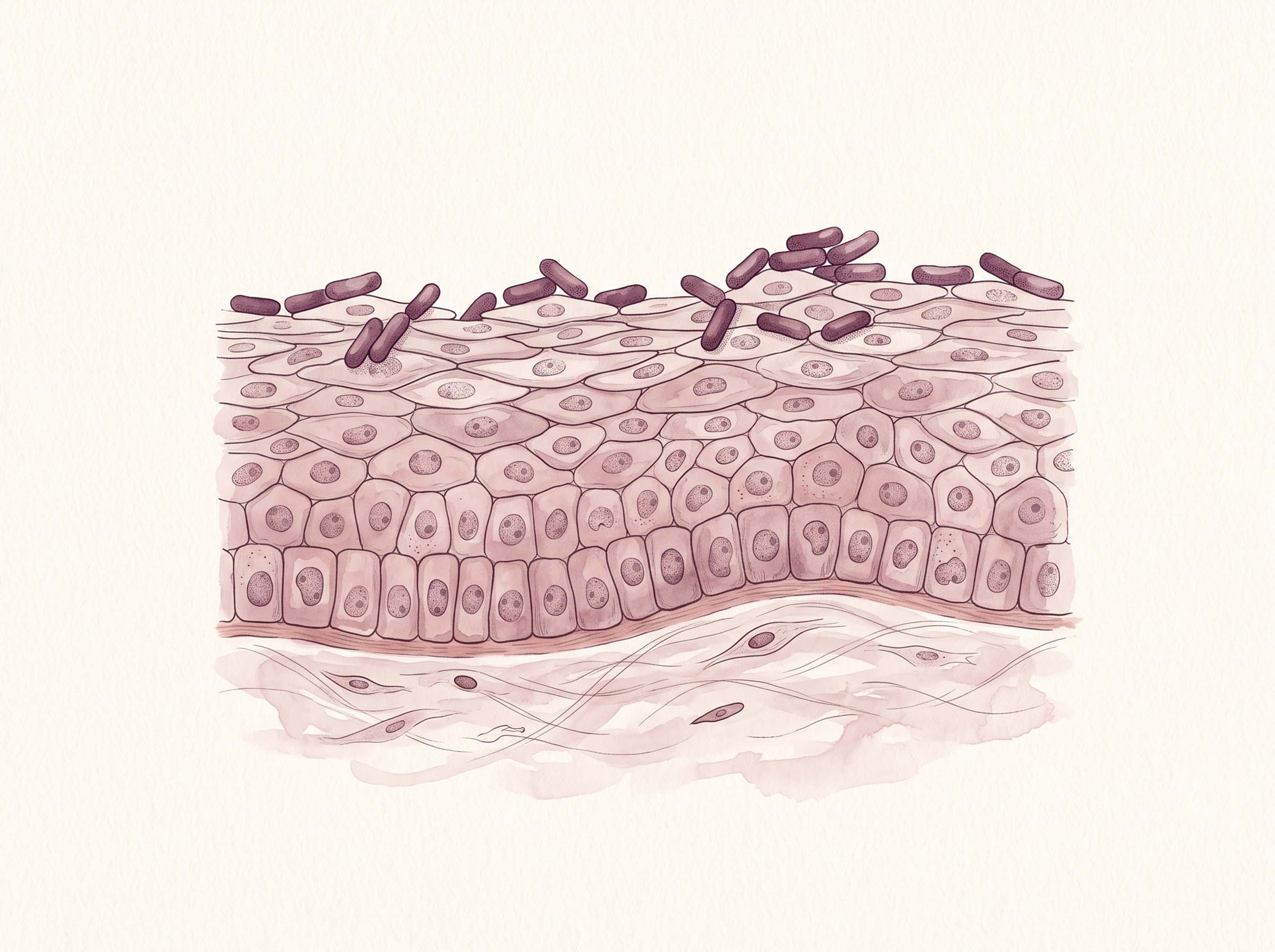
The landmark survey came in 2011, when a team led by Jacques Ravel sampled 396 North American women who reported no symptoms and sequenced what they found. Rather than one universal "healthy" community, the analysis sorted the samples into five recurring patterns, since referred to as community state types. Four were governed by a single species of Lactobacillus. The fifth contained no dominant lactobacillus at all — instead a mixed population of anaerobic organisms. That fifth pattern appeared in women who were not unwell, which raised a question the field is still working through: whether a mixed community represents a different kind of normal, or a state that carries different risks. The honest answer, more than a decade later, is that researchers do not fully agree.
The naming is worth pausing over. These bacteria were first described in 1892 by the German obstetrician Albert Döderlein, who observed rod-shaped organisms in vaginal secretions and noticed they produced acid. For generations they were simply called Döderlein's bacilli. Only genetic sequencing separated them into the distinct species now studied individually.
The sugar underneath
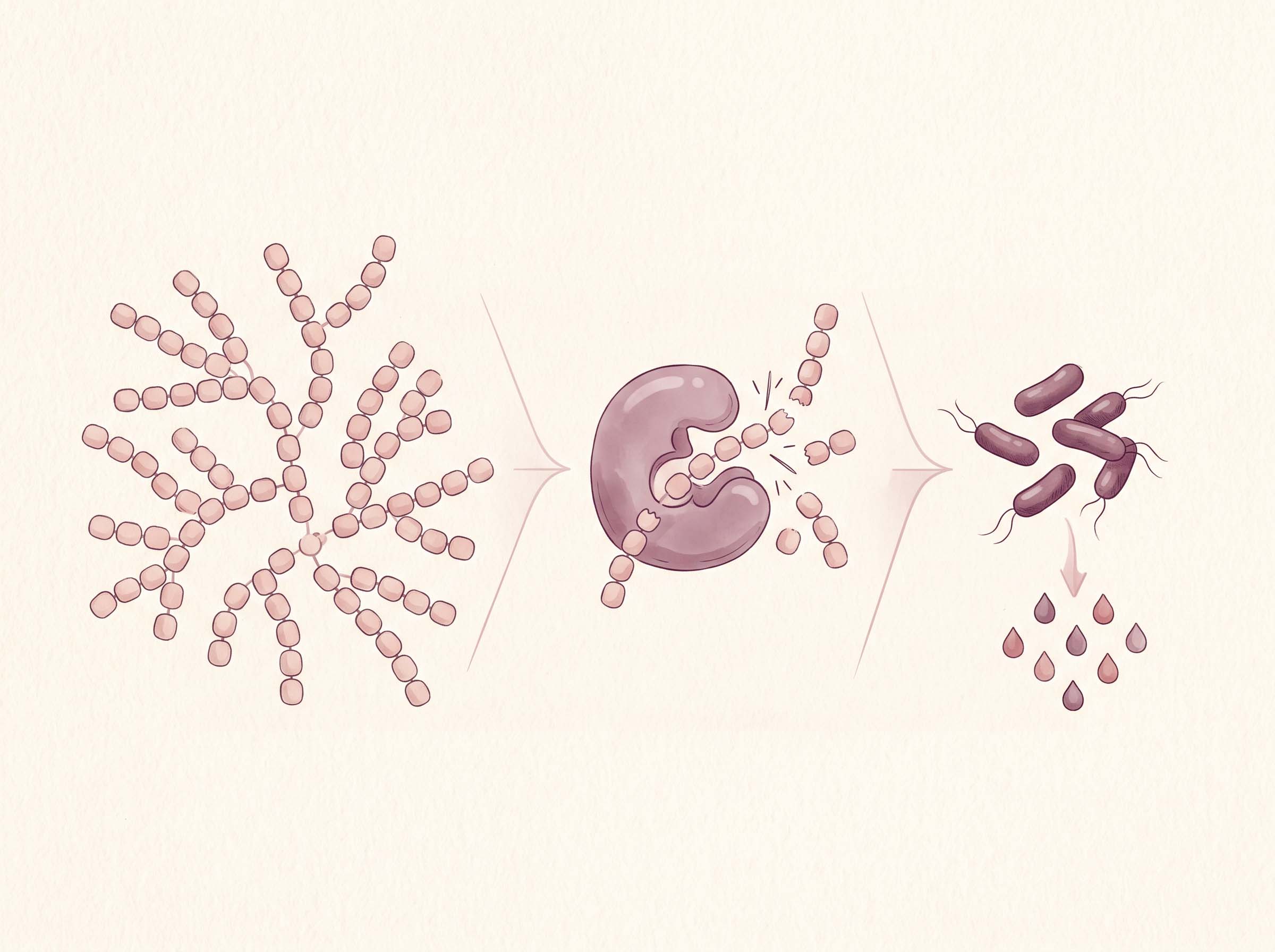
The whole arrangement rests on a storage molecule. Estrogen instructs the cells of the vaginal lining to thicken and to stockpile glycogen, a branched chain of glucose units that plants would store as starch. As surface cells mature and shed, that glycogen is released into the surrounding fluid.
Bacteria cannot swallow a molecule that large. An enzyme called alpha-amylase, present in vaginal fluid and produced by the host rather than the bacteria, cuts the glycogen into shorter sugar fragments — maltose, maltotriose and similar pieces. Lactobacilli take up those fragments and ferment them. The waste product is lactic acid, and the accumulation of that acid pulls the local reading down to roughly 3.8 to 4.5 during the reproductive years, comparable to tomato juice or black coffee.
This is the detail most popular explanations miss: the bacteria are not making the environment acidic as a favour to the body. They are eating, and acid is what eating produces. The body supplies the food; the bacteria supply the chemistry. Anything that changes the food supply changes the chemistry along with it. Readers following what the vaginal pH scale actually measures will recognise this as the mechanism sitting underneath the number.
Four species, four different personalities
Grouping them all as "good bacteria" flattens real differences. Sequencing studies have found that the four common species behave distinctly, and that the communities they build are not equally stable over time.
Lactobacillus crispatus is the species most closely studied as a marker of a settled, strongly acidic community. It produces both mirror-image forms of lactic acid, known as the D- and L-isomers, and research has explored whether the D-form carries additional properties in the tissue environment. L. jensenii and L. gasseri appear less often but form recognisably similar communities.
L. iners is the odd one. It carries a notably small genome, produces only the L-form of lactic acid, and turns up in communities that shift composition more readily than the others. Some researchers describe it as a transitional organism — present during periods of change rather than causing them. Whether it should be read as protective, neutral, or something in between remains genuinely unsettled in the literature.
| Species | Community pattern | Noted in research |
|---|---|---|
| L. crispatus | Type I | Produces both D- and L-lactic acid; associated with the most acidic and most compositionally stable communities recorded |
| L. gasseri | Type II | Less frequently dominant; also found in the digestive tract, which has drawn research interest in how the two sites relate |
| L. iners | Type III | Unusually small genome; produces only L-lactic acid; found in communities that change composition more readily |
| L. jensenii | Type V | The least common of the four dominant patterns in the surveys published to date |
| No single dominant species | Type IV | A mixed anaerobic population; recorded in women reporting no symptoms, and the subject of ongoing scientific disagreement |
Community state types as described in published 16S rRNA sequencing surveys. Categories describe populations studied, not individuals.
How acid governs scent
The connection between an acidic environment and the absence of strong odour is a matter of straightforward chemistry rather than cleanliness. Many of the compounds responsible for pungent smells in biological systems are amines — molecules such as trimethylamine, putrescine and cadaverine, released when certain anaerobic bacteria break down proteins.
Amines are volatile, meaning they evaporate into the air where the nose can detect them. But volatility depends on their chemical state. In an acidic environment, amines pick up a hydrogen ion and become charged, and charged molecules stay dissolved in fluid rather than escaping into the air. Raise the acidity and those compounds are effectively held in place. Lower it, and the same molecules are released.
This explains a pattern that has been documented in the research literature: noticeable shifts in scent tend to accompany shifts in the local chemistry rather than shifts in hygiene. Menstrual fluid, for instance, sits at a near-neutral reading and temporarily buffers the acidic environment. Seminal fluid is alkaline for reasons of its own biology. Both alter the chemistry for a period of hours before the resident bacteria restore it. The pattern also runs alongside the sweat gland biology explored in the study of eccrine and apocrine gland function in the pelvic region, which produces its own separate set of scent compounds.
The bacteria are not making the environment acidic as a favour to the body. They are eating, and acid is what eating produces.
What the bacteria do besides make acid
Acid production is the headline, but it is not the only mechanism researchers have described. Lactobacilli occupy physical space on the surface of the epithelium, binding to receptor sites that other organisms would otherwise use — a strategy microbiologists call competitive exclusion. Many strains also release bacteriocins, small proteins that suppress the growth of unrelated bacteria. Some form thin protective films across the tissue surface.
One long-standing claim has weakened considerably under scrutiny. Older literature placed heavy emphasis on hydrogen peroxide, which certain lactobacilli produce in laboratory conditions and which kills competing organisms in a dish. Subsequent work questioned whether this matters inside the body at all: the environment there contains little oxygen, and components of cervicovaginal fluid appear to neutralise hydrogen peroxide before it can act. The current position in much of the literature is that lactic acid itself, not peroxide, does the meaningful work — an example of a mechanism that looked convincing in glassware and did not survive translation to living tissue.
Did You Know?
The human vaginal environment is unusual among primates. Surveys of other primate species have found bacterial populations that are considerably more mixed and far less acidic — lactobacillus dominance of this degree appears to be largely a human characteristic. Why the human lineage diverged in this way is an open question, with hypotheses ranging from dietary starch consumption to the demands of a long gestation.
A population that changes with the decades
Because glycogen supply depends on estrogen, the bacterial community is not a fixed feature. It has a chronology.
A newborn girl carries maternal estrogen in her circulation for a few weeks after birth, and during that brief window the environment is acidic and lactobacillus-rich. As the hormone clears, the picture reverts. Through childhood the tissue is thin, glycogen is scarce, and the resident organisms more closely resemble the mixed population found on skin, at a near-neutral reading.
Puberty reverses this within a couple of years. Rising estrogen thickens the epithelium, glycogen accumulates, lactobacilli expand into the new food supply, and the acidic environment establishes itself. Through the reproductive decades the community fluctuates in a rhythm keyed to the menstrual cycle, generally most lactobacillus-dominated in the luteal phase when progesterone is elevated, and least so around menstruation. During pregnancy, studies have described communities that are markedly more stable and less varied in composition than at any other point. After childbirth, particularly during lactation, estrogen falls sharply and the pattern loosens again. The tissue architecture behind these changes is examined in more detail in the guide to the layered structure of the vaginal wall.
The menopausal transition returns the environment to something resembling the pre-pubertal state. Estrogen declines, the lining thins, glycogen storage drops, lactobacilli lose their food source, and the reading rises toward neutral. Research into what constitutes a typical community in older women is comparatively recent — the classification systems in wide use were built from data on reproductive-age women, and work is ongoing to determine how well they describe anyone else.
Schematic representation of the relationship between estrogen availability and environmental acidity across life stages. Values are illustrative of the general pattern described in the research literature, not measured data.
What outside conditions do to the arrangement
The community is chemical, and chemistry responds to physical conditions. Textile science matters here in a way that sounds trivial and is not. Fabrics differ in how readily they move water vapour away from the skin; synthetic fibres with low permeability hold humidity and warmth against the tissue, and warm damp conditions favour a different mix of organisms than dry ones. Friction from close-fitting garments affects the lipid barrier of the surrounding vulval skin, which is structurally different from the vaginal lining and does not host the same bacterial population at all.
Water is its own variable. Prolonged immersion changes the concentration of dissolved substances across the tissue surface by simple osmosis, temporarily diluting the fluid in which all this chemistry takes place. These are not dramatic effects, and the system generally returns to its baseline. But they are measurable, and they explain why laboratory readings taken from the same woman at different moments do not always match.
What is still unknown
Considerable uncertainty remains. Researchers cannot yet say with confidence why one woman's community settles on L. crispatus and another's does not. The surveys published to date have recorded different proportions of each community type across the populations studied, and the reasons behind those differences — genetic, environmental, behavioural, or some combination — have not been resolved. Whether the mixed community type should be understood as a variant of normal or as a state warranting attention is actively contested among the researchers who study it.
What the sequencing era has settled is the shape of the question. The old model of a single correct microbial arrangement, uniform across all women, did not survive contact with the data. What replaced it is a picture of several stable configurations, governed by hormone availability, running on a sugar the body manufactures for the purpose.
Further reading from primary sources: the original community state type analysis, Ravel and colleagues' 2011 survey of the vaginal microbiome in reproductive-age women, published in the Proceedings of the National Academy of Sciences; and a later overview of vaginal microbiota, host defence and reproductive physiology in The Journal of Physiology.
Editorial Glossary
Glycogen — a storage form of sugar built from linked glucose units, the same molecule animals hold in liver and muscle tissue.
Lactic acid — the by-product of bacterial sugar fermentation, and the compound behind the sour note in yoghurt and sourdough.
Epithelium — the layered sheet of surface cells lining the vaginal canal, which thickens or thins according to hormone availability.
Community state type — a research shorthand for the recurring bacterial patterns identified in sequencing surveys.
16S rRNA sequencing — a technique that identifies bacteria by reading a signature stretch of their genetic code rather than growing them in a dish.
Reader Questions
Disclaimer: All content on this website—including articles, educational materials, and interactive calculators—is for informational, educational, and entertainment purposes only. The calculations, percentiles, and outputs generated by tools on this site are based on general statistical data and mathematical models; they do not constitute medical data, a clinical assessment, or a diagnosis.
Nothing contained on this website is a substitute for professional medical advice, diagnosis, or treatment. Always seek the guidance of a qualified healthcare professional or urologist with any questions you have regarding physical development, anatomy, or health conditions. Reliance on any information or tools provided by this website is solely at your own risk.