English
  Español


Picture a kettlebell — the kind you would grip with both hands and swing for a workout — hanging in mid-air. No hands touch it. No strap holds it. It is suspended entirely by a set of muscles you cannot see, cannot flex on command without practice, and probably have never thought about. This is not a magic trick. It is a woman named Tatyana Kozhevnikova, and the muscles doing the lifting belong to her pelvic floor.
The internet crowned her "the woman with the world's strongest vagina," and the title has followed her for more than a decade. It is a genuinely astonishing feat. It is also, as records go, a slippery thing — because the most famous claim attached to her name turns out not to be true. Sorting the documented fact from the viral myth is where this story gets interesting, and where the ordinary biology behind an extraordinary feat starts to show.
The woman who lifts with muscle you cannot see
Kozhevnikova is a Russian gymnast and a mother, and by her own account she was not born with any unusual gift. After giving birth, she noticed her pelvic floor had weakened — a common experience many women report after childbirth. Rather than accept it, she went looking for a way to rebuild the area, and found her answer in old body-training traditions that used weighted objects held internally.
Two decades of steady practice followed. On the British television program The Body Shocking Show, she demonstrated the result: lifting a 14-kilogram kettlebell — close to 31 pounds — using only her pelvic muscles. The method itself is almost startlingly simple. She holds a smooth wooden egg internally, gripping it with the same muscles used to stop the flow of urine, then attaches a cord and weights to the egg. What looks impossible is really a trained voluntary muscle doing a very deliberate job.
"She was not born with a super-strong body. What looks like a freak talent is really an ordinary muscle, trained for twenty years to do an extraordinary thing."
The record that doesn't officially exist
Here is the part almost every headline gets wrong. For years, article after article has reported that Kozhevnikova holds a Guinness World Record for vaginal weightlifting. She does not. When journalists checked directly with Guinness, the organization confirmed it has no such category at all. There is no sanctioned title, no ratified number, and no official book entry — only an informal reputation that grew louder each time it was repeated. Perhaps they should consider it a new category.
That distinction matters for a magazine that takes accuracy seriously. Calling her "the world's strongest" is a popular shorthand, not a certified fact. It also reframes the obvious question — can the record be broken? — because strictly speaking, there is no official record to break. What exists is a widely shared claim and a well-documented demonstration. Anyone hoping to top it would be competing against a number, not a governing body.
Did You Know?
Despite thousands of articles claiming otherwise, there has never been a Guinness World Records category for vaginal weightlifting. The "world's strongest vagina" is a media title — impressive, widely repeated, and entirely unofficial.
How is this even possible? The biology behind the feat
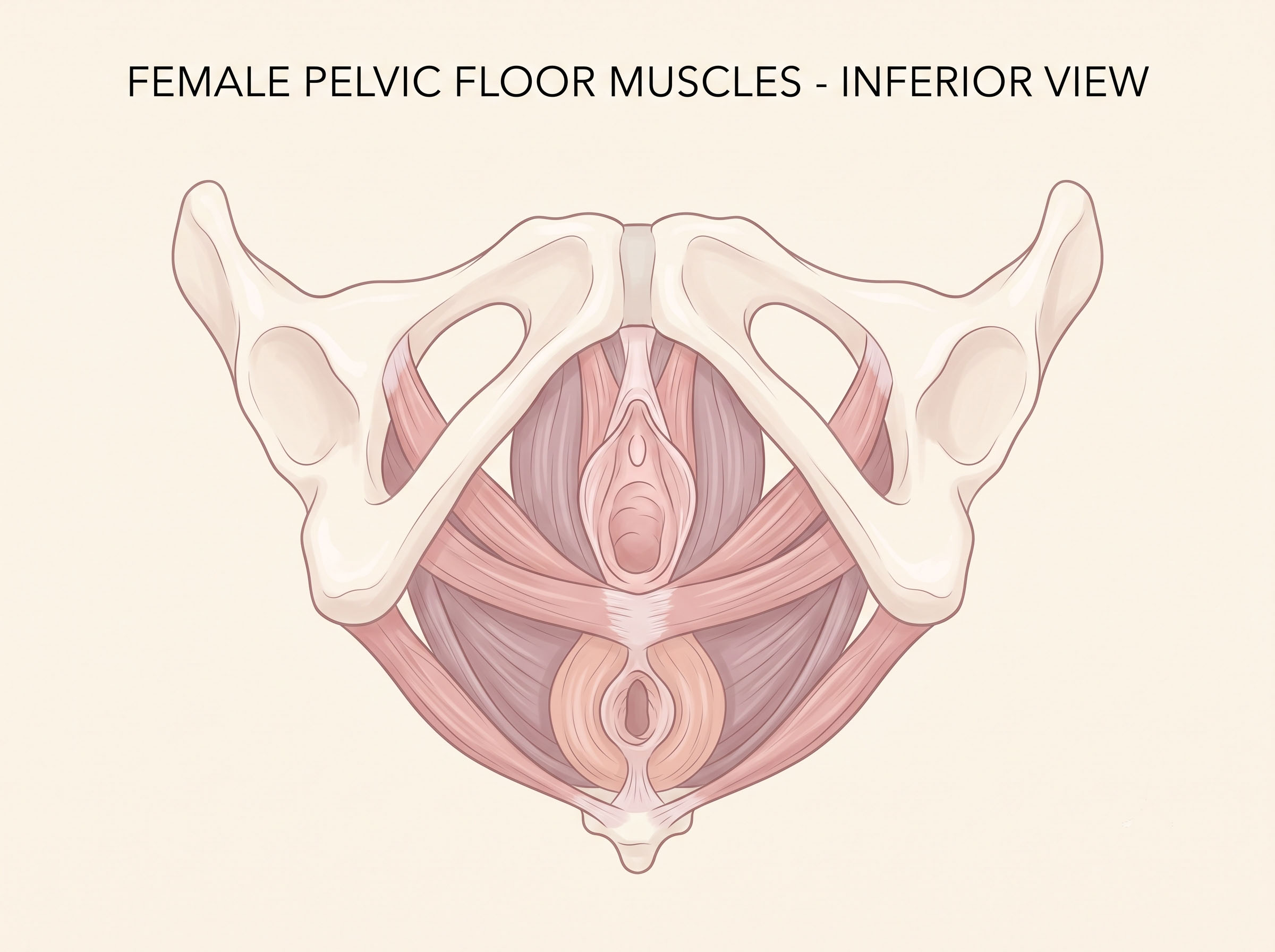
The pelvic floor is not one muscle but a group of them, forming a broad sheet that slings across the base of the pelvis and holds the bladder, bowel, and other organs in place. The main players belong to a group called the levator ani — the pubococcygeus (often shortened to the "PC muscle"), the puborectalis, and the iliococcygeus — with the coccygeus completing the set. You can read a plain-language breakdown of these muscles from the Cleveland Clinic's guide to the pelvic floor.
The important detail is this: these are striated, voluntary muscles — the same category as the biceps or the muscles in your hand. That means they respond to training the way any skeletal muscle does. Squeeze against resistance, rest, repeat, and over months the muscle grows stronger and the control grows finer. Kozhevnikova's feat is not evidence of a rare anatomy. It is evidence of what a completely normal set of muscles can do when someone trains them with the same patience an athlete brings to the gym.
The other top contenders
Kozhevnikova is the most famous name, but she is not the only woman who has turned pelvic-floor strength into a public spectacle. The best-known modern practitioner is Kim Anami, a Canadian-born coach who splits her time between California and Bali and calls her practice "Vaginal Kung Fu." Where Kozhevnikova chased a single dramatic number, Anami built an entire brand around variety, documenting her lifts on Instagram under the hashtag #thingsiliftwithmyvagina.
Her method uses a jade egg tied to a cord, with everyday objects fastened to the other end — a surfboard on a beach, a chandelier in Venice, a coconut, a bowl of couscous on a Moroccan hillside. The images are theatrical by design. Anami makes broad claims about the practice's benefits that reach well beyond what the evidence supports, and readers should treat the wellness promises with healthy skepticism. But as a demonstration of trained pelvic control, her feats belong in the same conversation as Kozhevnikova's kettlebell.
Both traditions borrow from something much older than either woman. Historically, societies in East Asia understood the pelvic floor as something that could be trained, and passed down techniques using smooth weighted eggs. A related art of internal muscular control appears in other cultures too — the practice known as pompoir has its own long lineage. What reads today as a viral stunt is really the loud, modern edge of a very old body of knowledge.
By the Numbers: The Contenders
Figures reflect widely reported demonstrations, not officially ratified records.
So — can the record be broken?
The honest answer has two halves. Biologically, almost certainly yes. Because the pelvic floor is ordinary trainable muscle, there is no hard wall at 14 kilograms. The real ceiling is set by the equipment and the technique — how securely an internal anchor can grip, how the weight is distributed, and how safely a person can train — rather than by some fixed limit of the female body. A dedicated athlete could plausibly train past Kozhevnikova's number.
Officially, though, the "record" cannot be broken because it was never certified. Without a sanctioning body measuring under agreed conditions, "the strongest in the world" stays a claim rather than a title. That is not a knock on the women who do it; it is simply how records work. It also means the door is technically open — the next demonstration could quietly reset the informal bar, and no one would need permission to try.
Worth Remembering
Feats like these are demonstrations by trained practitioners, not everyday routines. Clinicians and coaches alike caution that pelvic-floor training is best learned with proper guidance — and that the goal for most women is healthy function, not a headline number.
What the extreme tells us about the ordinary
The most useful thing about a record-breaker is what it reveals about the rest of us. Every woman has the same muscles Kozhevnikova trained. Most simply never work them, which is why weakness after childbirth is so common and so quietly accepted. Her story is remarkable less because her anatomy is unusual and more because it is not — she took a standard-issue muscle group and, through years of patient effort, pushed it to the far edge of what it can do.
That reframes the whole spectacle. The woman who can lift 31 pounds with muscles you cannot see is not a curiosity from the far end of biology. She is a very loud illustration of a capacity every woman carries and few ever test. The record may be unofficial, the methods may look strange, and the wellness promises may run ahead of the evidence — but the underlying truth is simple, and it is real: the strongest muscle most women never think about is one they have always had.
Quick Questions, Answered
Disclaimer: All content on this website—including articles, educational materials, and interactive calculators—is for informational, educational, and entertainment purposes only. The calculations, percentiles, and outputs generated by tools on this site are based on general statistical data and mathematical models; they do not constitute medical data, a clinical assessment, or a diagnosis.
Nothing contained on this website is a substitute for professional medical advice, diagnosis, or treatment. Always seek the guidance of a qualified healthcare professional or urologist with any questions you have regarding physical development, anatomy, or health conditions. Reliance on any information or tools provided by this website is solely at your own risk.