English
  Español



There is a question almost no one thinks to ask, yet the answer turns out to be quietly extraordinary: what does mother's milk actually taste like? Not in a clinical sense, not reduced to its macronutrient chart — but as something a woman makes, something alive and warm and variable, a substance shaped by what she eats for breakfast, how she slept, even the season of the year.
Researchers who study human lactation have spent decades mapping the biology of breast milk, and what they keep finding surprises them. It is not a static liquid. It changes hour by hour, feed by feed, month by month. And threaded through all that science is something more personal, something that mothers across every culture and century have sensed without needing a laboratory to confirm it: that what flows between a mother and her nursing child is not simply nutrition. It is relationship, translated into taste.
“ Mother's milk is not a fixed formula. It is a conversation — one that adjusts in real time to whatever her baby needs most.— Elena Mireau
The Flavor Profile of Human Milk
If you were to taste human breast milk — and curious researchers, lactation scientists, and frankly many mothers have — the first thing you would notice is sweetness. Not cloying, not the sharp sweetness of refined sugar, but soft and mild, something like diluted whole milk with a warm, slightly creamy undertone. Many describe it as closer to almond milk or oat milk than to cow's milk, with a clean, gentle finish.
That sweetness comes primarily from lactose, the sugar unique to mammalian milk. Human milk contains more lactose than the milk of almost any other mammal — roughly seven percent, compared to about four to five percent in cow's milk. Lactose drives brain development in infants and helps establish the gut microbiome, so the sweetness is not incidental. It is purposeful.
Beyond sweetness, the flavor of breast milk is more complex than most people expect. Research suggests the fat content — which varies considerably across a single feeding, starting lower and rising toward the end — contributes a creaminess that thickens and mellows as a feed progresses. The milk at the beginning of a nursing session (foremilk) is watery and lighter; the milk at the end (hindmilk) is richer, almost buttery. A baby who nurses long enough experiences something like a multi-course meal within a single sitting.
Human breast milk contains over 200 distinct sugars called human milk oligosaccharides (HMOs) — far more than any infant formula. Remarkably, most of these sugars cannot be digested by the baby at all. They exist entirely to feed and shape the infant's gut microbiome, essentially acting as a prebiotic garden planted by the mother inside her child.
How Diet Changes the Taste
Here is where things get genuinely fascinating: what a mother eats changes the flavor of her milk. Studies have shown that the volatile flavor compounds from food — garlic, vanilla, carrots, mint — pass into breast milk within hours of being consumed. A mother who eats garlic will produce milk with a garlicky note. One who drinks carrot juice for several days in a row will have milk with a faint carrot sweetness.
This is not a flaw in the system. Many researchers believe it is a feature. The thinking goes that by sampling flavors through milk first — in a safe, warm context, with no risk and no hunger — babies begin building flavor preferences and tolerances long before solid food arrives. Studies conducted at the Monell Chemical Senses Center in Philadelphia found that infants who were exposed to a variety of flavors through breast milk were more willing to accept new foods when weaning began. The breast milk years may, in a real sense, be the beginning of a child's food education.
This is an idea ancient cultures seemed to understand intuitively, even without the research to explain it. Many traditional cuisines across Central Asia, the Mediterranean, and South Asia include specific postpartum foods believed to flavor the milk favorably — warming spices, fennel, fenugreek, cumin — foods thought to make milk both more plentiful and more palatable. The science today suggests those traditions were not merely superstition.
In Ayurvedic tradition, postpartum mothers were given ghee, saffron, and warming spices not only for recovery but specifically to enrich the flavor and quality of their milk — a practice unchanged for more than 3,000 years.
In Bedouin communities across the Arabian Peninsula, breast milk has historically been treated as a kinship bond — a child suckled by a woman other than her mother becomes, in Islamic tradition, a "milk sibling," a relationship with real social and legal standing.
In medieval Europe, the milk of a wet nurse was evaluated for taste, color, and smell before she was hired — sweetness was prized, bitterness was considered a sign of illness or poor character. Milk was understood as a moral and physical transfer.
The Science of What's Inside
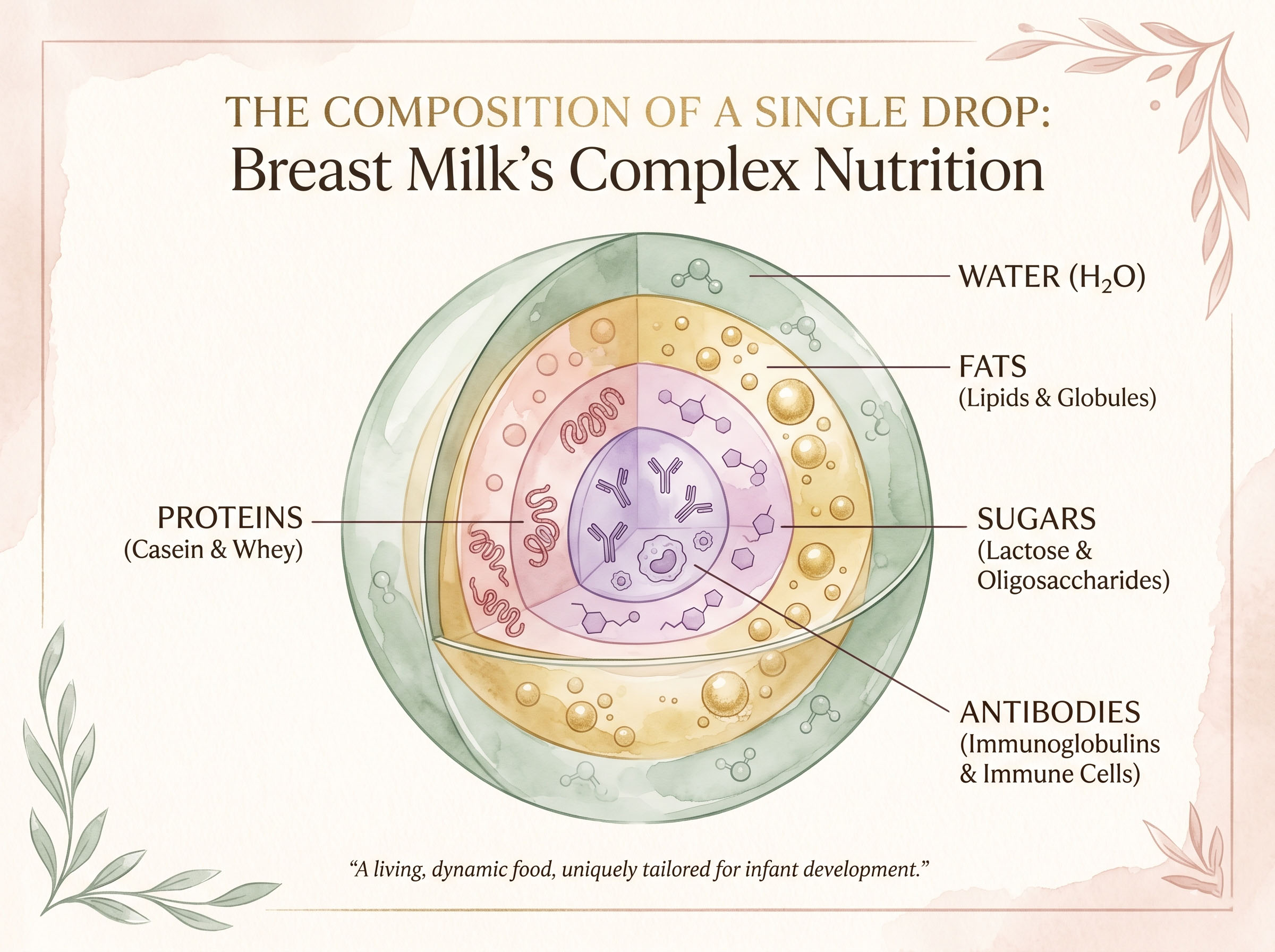
Taste is only the surface of the story. What breast milk carries nutritionally is a subject that has occupied scientists for decades, and each new study adds another layer of complexity. The basic architecture of human milk includes water (about 87%), fat, lactose, and protein — but those categories contain multitudes.
The fats in breast milk are rich in long-chain polyunsaturated fatty acids, particularly DHA (docosahexaenoic acid), which plays a documented role in infant brain development. Research suggests the fatty acid profile of breast milk shifts based on what the mother eats, with mothers consuming more oily fish or omega-3-rich foods tending to produce milk with higher DHA levels.
The protein fraction is equally remarkable. Breast milk proteins are not merely structural — many are functional. Lactoferrin, one of the most studied, has documented antimicrobial properties and helps regulate iron absorption in the infant gut. Secretory immunoglobulin A (sIgA) is an antibody the mother produces and deposits into the milk, offering the infant a form of borrowed immunity against the specific pathogens she has encountered. In this way, a nursing mother effectively passes a portion of her immune history to her child with every feeding.
Colostrum: The First Taste of Life
Before milk comes colostrum — the thick, golden, intensely concentrated fluid that arrives in the days immediately following birth. Colostrum is often called liquid gold, and the nickname is earned. Compared to mature milk, it is lower in volume but dramatically higher in antibodies, white blood cells, and protein. A single teaspoon of colostrum delivers an astonishing payload of protective compounds.
Many women who taste their own colostrum describe it differently from mature milk — less sweet, slightly saltier, with a more complex, almost savory quality. The salt comes from higher sodium levels, and the different flavor profile reflects a fundamentally different purpose: colostrum is not primarily fuel. It is the first immune education a newborn receives, coating the gut lining, introducing protective proteins, and beginning the long work of establishing healthy microbial communities.
Historically, some cultures discouraged the feeding of colostrum, considering it impure or insufficient, and directed mothers to pre-milk infants with herbal preparations or other liquids for several days postpartum. We now understand this practice was harmful — colostrum is precisely what a newborn needs most in those first hours and days. The knowledge was always there, in the biology; it simply took time for cultural practice to catch up with what the body already knew.
| 200+ | Distinct sugars (HMOs) found in human breast milk |
| ~87% | Water content in mature human milk |
| 7% | Lactose concentration — higher than most other mammals |
| 2–5 days | Window when colostrum is produced before transitional milk arrives |
| 1–2 hours | Time for dietary flavors (garlic, vanilla) to appear in breast milk |
| 1,000+ | Distinct proteins identified in human breast milk to date |
How the Milk Changes Over Time
One of the most remarkable features of breast milk is that it does not stay the same. A mother's milk at two weeks postpartum is biologically different from her milk at two months, and different again at six months or a year. As the baby grows and its needs shift — more fat for a growth spurt, more immune support during a viral season — the milk adjusts accordingly.
Research has found that when a baby is unwell, the concentration of immune-active cells and antibodies in a mother's milk increases. The working hypothesis is that the infant's saliva, which enters the breast duct during feeding, may carry signals about the baby's immune status that the mother's body reads and responds to. The science here is still young, but the implication is striking: a nursing mother may be actively producing a customized immune response inside her own body, triggered by contact with her sick child.
This is one reason why many researchers who study lactation speak of breastfeeding not as a one-way transfer but as a biological dialogue. The baby communicates need; the mother's body answers. Taste is part of that answer — but so is everything else the milk carries.
The Emotional Geography of Milk
There is a reason nursing mothers almost universally describe the experience as more than physical. Oxytocin — the hormone that triggers milk release, called the let-down reflex — is also a primary bonding hormone. It produces feelings of warmth and calm. Studies have found that oxytocin levels rise in both mother and infant during breastfeeding, creating a shared hormonal experience that many researchers believe contributes to the depth of the mother-infant bond.
Many women report that the act of nursing changes them — not metaphorically, but neurologically. Research on matrescence (the psychological and neurological transformation that comes with becoming a mother) has documented measurable changes in the brains of new mothers, particularly in regions associated with empathy, emotional recognition, and motivation. Some researchers believe breastfeeding, with its repeated oxytocin surges, may be one of the mechanisms that accelerates and deepens this transformation.
Culturally, societies across history have recognized this dimension even without the neuroscience to name it. In many traditional societies, the nursing relationship was considered sacred — protected by social norms, celebrated in art, honored as one of the defining acts of womanhood. Medieval and Renaissance painters returned again and again to the image of a nursing mother, not merely because it was domestic, but because it was understood as the image of love made visible, made edible, made life-giving.
In more than a dozen studies reviewed by researchers at the National Institutes of Health, children who were breastfed and exposed to dietary flavor variety through milk showed consistently greater willingness to accept vegetables and varied foods at weaning — suggesting that the table is set long before the first spoonful.
A Global Language
Across the world and across recorded history, breast milk has occupied a place of cultural significance that goes well beyond nutrition. In ancient Egypt, breast milk was used in medical preparations and considered a healing substance. Roman physicians wrote of its properties in detail. In parts of sub-Saharan Africa, a mother's milk has traditionally been associated with the transfer of ancestral knowledge — a spiritual as well as physical inheritance.
The Islamic concept of milk kinship, in which a woman who nurses an unrelated infant creates a familial bond that carries legal weight, speaks to how deeply many cultures have understood breastfeeding as relational, not merely biological. Traditional Chinese medicine has long classified breast milk as a tonic substance, not simply food, and assigned it properties specific to the mother's constitution and season of life.
What is striking, looking across this span of cultures and centuries, is how consistent the core intuition has been: that breast milk is not interchangeable, not generic, not a commodity. It is particular. It carries the mark of the woman who made it.
📋 Table: Colostrum vs. Mature Breast Milk — Key Differences
What the Research Is Still Learning
Science has mapped the broad architecture of breast milk, but the work is far from finished. Researchers at institutions around the world continue to identify new compounds and new functions — stem cells were first identified in human breast milk only in the early 2000s, a discovery that startled the field. The role of those cells remains under study. The full catalog of breast milk's bioactive compounds is still being compiled.
What studies have made increasingly clear is that breast milk is not a simple biological product but something closer to a living system — responsive, adaptive, and individualized. Research published through the National Institutes of Health has documented the enormous scope of what breast milk carries, noting that the full range of its immunological, neurological, and developmental effects on infants may not be fully understood for decades to come. And for researchers exploring the deeper questions of the female brain during and after pregnancy, lactation represents one of the most significant — and least studied — periods of neurological change in a woman's life.
That feels right, somehow. The body that produces this substance has been doing so since long before we had words for what it contained. What it gives is older than science, older than culture, older than language itself. Taste is just the beginning.
Questions Women Ask About Breast Milk
Disclaimer: All content on this website—including articles, educational materials, and interactive calculators—is for informational, educational, and entertainment purposes only. The calculations, percentiles, and outputs generated by tools on this site are based on general statistical data and mathematical models; they do not constitute medical data, a clinical assessment, or a diagnosis.
Nothing contained on this website is a substitute for professional medical advice, diagnosis, or treatment. Always seek the guidance of a qualified healthcare professional or urologist with any questions you have regarding physical development, anatomy, or health conditions. Reliance on any information or tools provided by this website is solely at your own risk.