English
  Español



There is a line on many women's bodies that has nothing to do with age and everything to do with habit: the place where the evening routine stopped. Serum, cream, and sunscreen are worked carefully up to the jaw, and then the hands go back into the sink. Below that line sits a stretch of skin that has spent four hundred years as one of the most looked-at regions in Western dress, and it has spent most of the last thirty being ignored by the products aimed at the face directly above it.
That neglect is not universal. Beauty writers rediscover the neck and chest roughly once a decade, usually when fashion pushes the neckline back into view — as it has again, in the current run of open collars, bodysuits and structured lingerie that critics have been calling the return of the visible silhouette. What follows is not a set of instructions. It is a look at what is actually known about this stretch of skin, what dermatologists distinguish between when they examine it, and where the research thins out into guesswork dressed up as expertise.
- The skin across the chest is described in dermatology literature as thinner than facial skin, with fewer oil glands and less fat beneath it.
- Sun exposure is the most consistently documented driver of visible change in the area, and glass filters less of it than most drivers assume.
- Vertical chest lines are attributed largely to nightly compression rather than to expression, and the research on this is younger than the research on facial lines.
- Most of what is sold for stretch marks has performed poorly in review, and the honest summary is that the evidence remains thin.
The Frame Came Before the Care
The décolletage is a fashion invention before it is anything else. The word comes from French tailoring, and the region it names only exists because clothing decided where to stop. Court dress in Renaissance Europe drew the eye there deliberately; portraiture of the period treats the upper chest as a display surface for pearls, powder and light. What is interesting for anyone tracing beauty standards is that the care practices arrived with the exposure, not before it — cosmetic attention followed the neckline downward, and retreated when hemlines and collars rose.
By the middle of the twentieth century the framing had gone architectural. The bullet bra of the 1950s and the engineered push-up of the 1990s were both structural garments, designed to reshape a silhouette rather than to tend the skin covering it. The marketing language of that era focused almost entirely on the outline. Skin quality — texture, tone, the fine crosshatching that catches light in a photograph — stayed outside the conversation until high-definition photography and front-facing cameras dragged it in.
Thinner Skin, Fewer Reserves
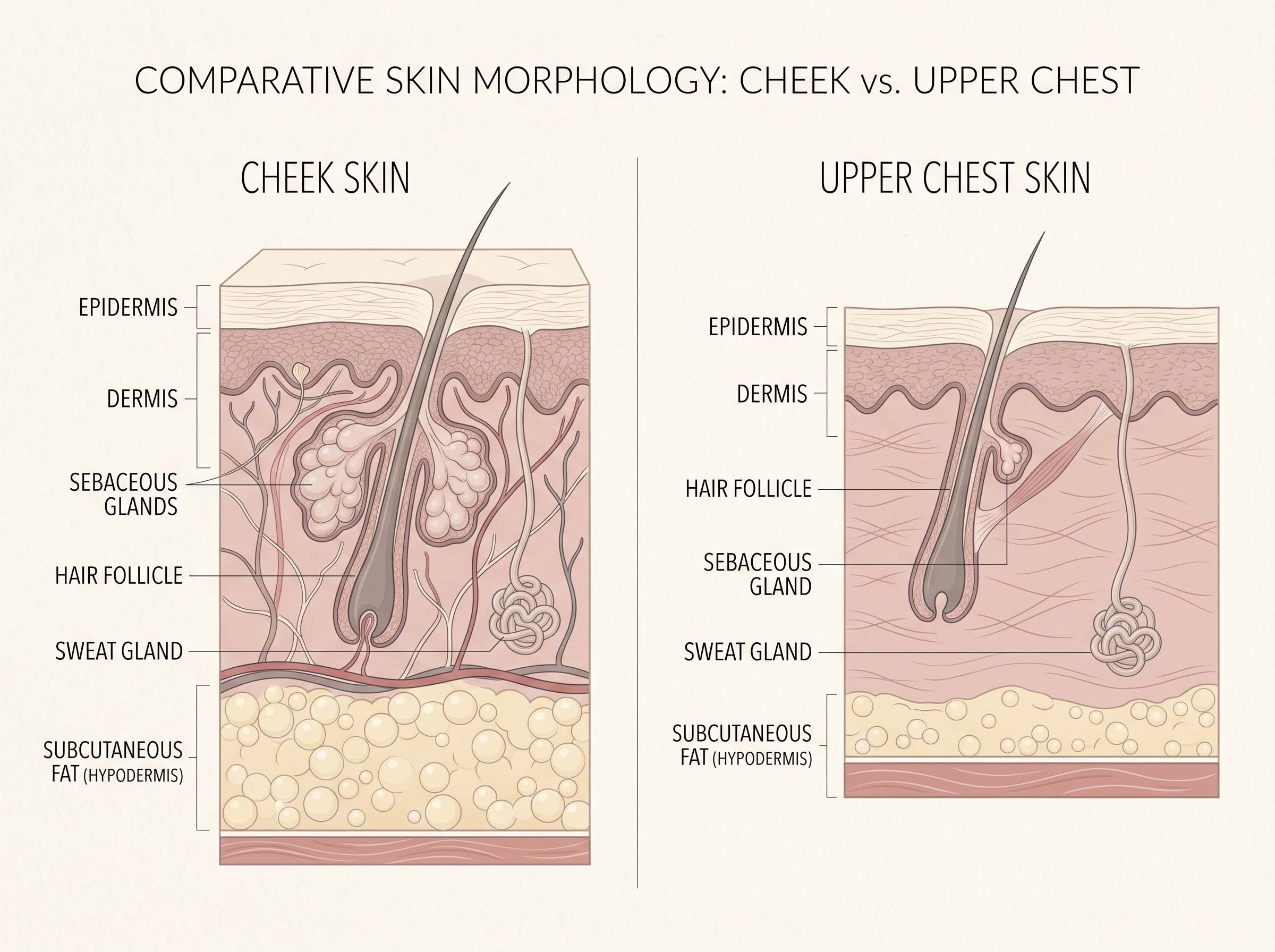
Ask why the chest ages differently from the face and the answer given in dermatology teaching is structural. The skin across the upper chest and breast is generally thinner than facial skin. It carries fewer sebaceous glands, which means less of the oil that helps facial skin hold moisture through a dry winter. It sits over less fat and less muscle, so it drapes rather than supports. And it moves constantly — with breathing, with arm position, with every shift of posture during sleep.
Sun exposure compounds all of it. The upper chest is a region that gets intermittent, unplanned exposure: an open collar on a spring afternoon, a swimsuit, a long drive. Window glass filters much less ultraviolet light than most people assume, which is why dermatologists have long documented a distinctive mottled pattern of reddish-brown discoloration on the sides of the neck and upper chest in people with decades of cumulative exposure — a pattern first described in the medical literature in the 1920s, and one that tends to spare the shaded area under the chin. That sparing is the clue. It is also the reason the region is treated as a record of exposure history rather than of chronological age.
How the Chest Differs from the Face
General characteristics described in dermatological literature. Individual variation is wide.
The Lines That Expression Did Not Make
Facial wrinkles have a familiar explanation: repeated movement of the muscles underneath eventually leaves a mark in the skin above. Vertical chest lines do not fit that model, because there is no expressive muscle beneath the sternum doing the folding. The explanation that has gained ground over the past decade involves mechanics rather than emotion.
A 2016 review in the Aesthetic Surgery Journal examined how compression, shear and tension forces act on skin during sleep, and argued that sleep wrinkles differ from expression wrinkles in origin, location and direction. Side and stomach positions press tissue against the sleep surface for hours at a stretch, night after night, with the skin distorted in whatever direction the position dictates. The authors were studying the face. The chest, however, is subject to the same forces in side-lying, where breast tissue folds inward across the midline and holds that fold for the duration of the position. The extension is logical and widely repeated by clinicians. It is worth stating plainly that the chest-specific research is far thinner than the facial research, and that the review's own authors were cautious about how much of overall aging sleep position explains.
The same caution applies to "tech neck," the term coined for the horizontal creasing attributed to hours spent looking down at a phone. The mechanism is plausible — skin folded repeatedly at the same angle behaves like any material creased in the same place — but the term arrived through beauty marketing rather than through a body of published evidence, and the studies that would separate device use from ordinary sun exposure and aging have not really been done.
“Cosmetic attention followed the neckline downward — the care practices arrived with the exposure, not before it.”
What Topical Products Are Actually Doing
The shelf of creams marketed for the neck and chest is large, and the categories behind it are simpler than the packaging suggests. Moisturizing ingredients are grouped in dermatology into humectants, which draw water into the outer layer; emollients, which sit between skin cells and smooth the surface; and occlusives, which slow the rate at which water escapes. Most products combine all three and differentiate themselves on texture, scent and price rather than on mechanism.
Antioxidant ingredients occupy a different category. Topical vitamin C in its most studied form is notoriously unstable, degrading with light and air, which is one reason formulation and packaging matter more than the number printed on the front. Retinoids have the strongest evidence base of anything sold for photoaged skin — and nearly all of that evidence comes from trials conducted on faces. On thinner skin with fewer oil glands, dermatologists report irritation more readily, which is why the region is generally discussed as a place where tolerance differs rather than a place where the same routine simply extends downward. Pigment behaves differently here too, responding to friction, hormonal shifts and accumulated exposure in ways explored in more depth in this look at why intimate and body skin changes tone over time.
What no topical product has demonstrated is a change in structural support. The drape of the chest is determined by the elastic and collagen framework in the dermis, by breast tissue and ligament, and by weight change and time. A cream that improves surface texture is doing something real and something limited, and the honest version of that sentence rarely appears on the label.
Eighteenth-century Englishwomen wore bosom bottles — slim glass vials of water, curved to sit flat against the body and tucked into the front of a low bodice. Fresh flowers were arranged in them so that a nosegay appeared to bloom at the neckline for the length of an evening. The chest, in other words, has been styled, scented and decorated for a very long time. Attending to the skin itself is the newer idea.
The Marks of Expansion
Few subjects attract more marketing and less evidence than stretch marks. What they are is well established: rapid stretching of skin ruptures the collagen and elastin that support it, and the healing that follows leaves a scar. Pregnancy, puberty and rapid weight change are the periods when they most commonly appear, and family history seems to carry real weight in who develops them.
The American Academy of Dermatology's review of the topic is unusually blunt for consumer-facing material. It reports that many creams, lotions and oils sold for stretch marks have not performed well in study, that no single approach works for everyone, and that the marks — being scars — are permanent, though they fade in color over months and years. A small number of ingredients have shown modest effects on early marks in trials, and the effect sizes involved are far more modest than the category's advertising implies. The oils passed between women for generations sit in an interesting position here: widely used, warmly recommended, and not supported by the evidence that has been gathered to test them.
Breast tissue changes across pregnancy and nursing in ways the skin has to accommodate quickly, which places the region among the most common sites alongside the abdomen and hips. Asymmetry, in the same category of ordinary variation, is close to universal and rarely discussed — a woman's account of that particular silence is worth reading alongside the science.
What the Region Reveals
Beauty categories tend to follow visibility, and the chest is the clearest example on the female body. It received cosmetic attention when court dress exposed it, lost that attention when collars rose, regained it when photography went high-resolution, and now supports an industry built around a stretch of skin that most routines had been skipping entirely. Very little of that cycle was driven by new knowledge about the skin. Nearly all of it was driven by what clothing and cameras happened to be doing.
There is something clarifying in noticing that. The structural facts about this skin have not changed in four hundred years: it is thin, poorly supplied with oil, sun-exposed in an irregular pattern, and folded nightly. What changes is whether anyone is looking. Different cultures have read the maturing female form in strikingly different ways — a subject explored in this account of how societies have interpreted a woman's changing silhouette — and the reading has always said more about the observers than about the skin.
The most defensible summary of the current science is also the least marketable one. Sun exposure matters more than any product. Sleep position appears to matter, though the chest-specific evidence is young. Surface texture responds to topical care while structural support largely does not. And a great deal of what is sold in this category has been tested somewhere else on the body, if it has been tested at all.
Questions Readers Ask About This Region
Disclaimer: All content on this website—including articles, educational materials, and interactive calculators—is for informational, educational, and entertainment purposes only. The calculations, percentiles, and outputs generated by tools on this site are based on general statistical data and mathematical models; they do not constitute medical data, a clinical assessment, or a diagnosis.
Nothing contained on this website is a substitute for professional medical advice, diagnosis, or treatment. Always seek the guidance of a qualified healthcare professional or urologist with any questions you have regarding physical development, anatomy, or health conditions. Reliance on any information or tools provided by this website is solely at your own risk.