English
  Español



For most of the last century, science had a quiet habit. When researchers wanted to understand how the human body burns energy, they studied men — usually young, usually healthy — and assumed a woman’s body worked the same way, only on a smaller scale.
Shrink the man down, adjust for size, and you supposedly had the female version. That assumption held for decades. It was also wrong.
Research over the past thirty years has shown that the female body does not run a miniature copy of male metabolism. It reaches for a different fuel strategy, stores and releases energy on its own schedule, and responds to exercise, hunger, and even cold in ways a size adjustment cannot explain. Some of these differences trace back to muscle and fat. Others trace to estrogen, a hormone that shapes far more than reproduction. And a surprising amount of it stayed hidden simply because, for years, the default research subject was male. For any woman curious about building lean muscle and how her own energy actually works, the real story turns out to be far more interesting than “smaller.”
More Muscle, More Fat, and Why the Math Isn’t Simple
On average, men carry more skeletal muscle and less body fat than women, while women carry a higher percentage of body fat — a pattern that appears early in life and holds across populations. Muscle tissue is metabolically expensive: it burns more energy at rest than fat does. So when you compare a man and a woman of the same weight, the man usually has a higher resting metabolic rate, the number of calories the body spends simply staying alive.
Here is where the old assumption breaks. When researchers adjust for lean body mass — measuring energy use per kilogram of fat-free tissue rather than per kilogram of total weight — most of that gap shrinks dramatically. A large share of the “men burn more” story is really a “men carry more muscle” story. Yet even after that correction, studies have found small residual differences that body composition alone does not fully account for. Something beyond size and muscle is clearly at work.
A Different Fuel Mix
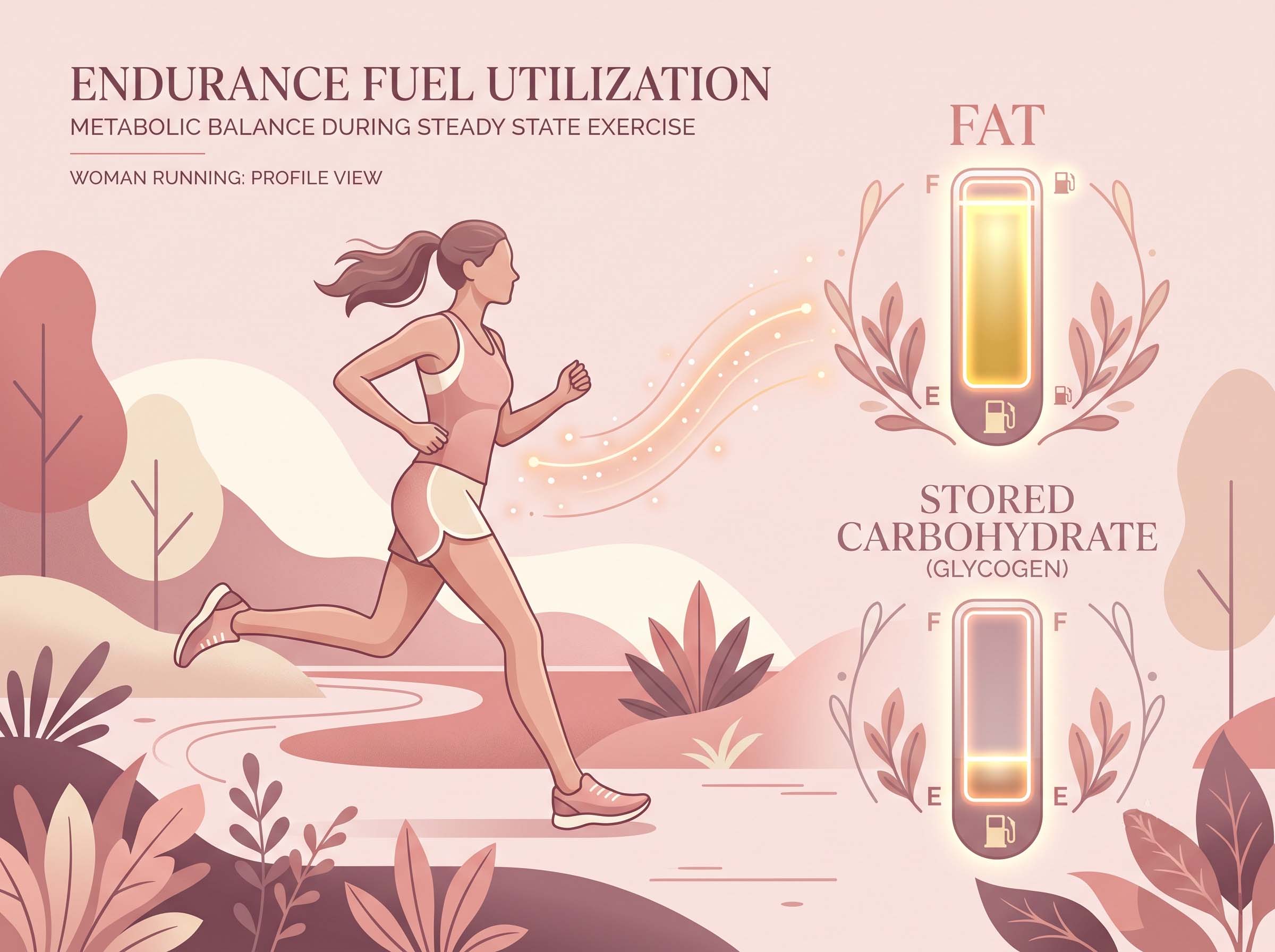
The clearest example shows up during exercise. Give a man and a woman the same moderate, steady effort — a brisk walk, a long jog — and their bodies reach for different fuels. Research on sex differences in exercise metabolism has consistently found that women oxidize more fat and less carbohydrate during endurance exercise, sparing the muscle glycogen (stored carbohydrate) that men tend to burn through faster. Women also break down less protein for fuel during the same effort.
There is an irony worth pausing on. Women carry more body fat, yet burn proportionally more fat during exercise. The effect is modest, but it is steady, and it points to a genuine difference in how the female body manages its energy reserves rather than a quirk of size. Studies have even found that women’s muscles contain higher amounts of the enzymes that break fat down for fuel — the biological machinery matches the behavior. For anyone experimenting with combining cardio and strength work, it helps to know the female body already treats fat as a reliable, slow-burning fuel source.
| Energy factor | Female pattern | Male pattern |
|---|---|---|
| Fat used for fuel | Higher proportion | Lower proportion |
| Stored carbohydrate (glycogen) | Spared / used more slowly | Used more quickly |
| Protein broken down for fuel | Less | More |
| Fat-burning enzymes in muscle | Higher levels | Lower levels |
“Women carry more body fat, yet burn proportionally more fat during exercise — a small, stubborn detail that size alone can’t explain.”
The Estrogen Thread
So why the difference? A large body of research points to estrogen — specifically 17-beta-estradiol, the main form of the hormone in women of reproductive age. In studies, estrogen shifts the body toward burning fat and away from burning stored carbohydrate, and it appears to protect glycogen reserves during long efforts. In one striking line of research, when men were given estradiol, their metabolism began drifting in the same direction, edging toward the female pattern. The hormone, in other words, isn’t incidental to the difference — it helps create it.
Estrogen’s reach doesn’t stop at the gym. It runs through the whole daily rhythm of hormones and energy, rising and falling across the monthly cycle, climbing through pregnancy, and declining during menopause. As estrogen drops in the menopausal transition, several of these metabolic differences between women and men appear to narrow — a shift many women notice in how their bodies handle energy in midlife. This is one reason researchers now treat female metabolism as something that moves across a lifetime rather than a single fixed setting.
Did You Know?
The metabolic differences between women and men are strongest during the reproductive years, when estrogen levels are highest. After menopause, when estrogen falls, some studies find the gap in how women and men burn fuel during exercise grows noticeably smaller.
What Science Is Still Working Out
Some of the most interesting research is happening at the extremes. In ultra-endurance events — races lasting many hours or even days — the female tendency to spare carbohydrate and lean on fat may offer a real advantage, and the performance gap between the top men and women tends to shrink as distances grow. Researchers studying soldiers through long, punishing field exercises have found that women preserve lean muscle mass better than men under the same strain, drawing more of their energy from fat stores.
Cold, hunger, altitude, sleep loss — in each of these, early findings suggest female physiology has its own responses that don’t map neatly onto the male template. Much of this work is genuinely new, because for a long time the questions simply weren’t on the table. What’s emerging isn’t a story of one sex being better or worse, but of two bodies solving the same problem — staying alive and staying in motion — in meaningfully different ways.
The Body Has Its Own Logic
The point isn’t that women should train, eat, or live by some entirely separate rulebook. It’s that the female body follows its own logic, tuned across a lifetime by hormones and built on its own balance of muscle and fat. “Male metabolism, smaller” was always a shortcut — a convenient guess from an era when the science had barely looked. The closer researchers look now, the more remarkable the real design turns out to be. Understanding why female metabolism is different from male metabolism isn’t about comparison at all. It’s about finally seeing the female body clearly, on its own terms.
Questions Women Often Ask
Disclaimer: All content on this website—including articles, educational materials, and interactive calculators—is for informational, educational, and entertainment purposes only. The calculations, percentiles, and outputs generated by tools on this site are based on general statistical data and mathematical models; they do not constitute medical data, a clinical assessment, or a diagnosis.
Nothing contained on this website is a substitute for professional medical advice, diagnosis, or treatment. Always seek the guidance of a qualified healthcare professional or urologist with any questions you have regarding physical development, anatomy, or health conditions. Reliance on any information or tools provided by this website is solely at your own risk.