English
  Español



A change of address does not reliably produce desire. The research on holidays finds small average gains in wellbeing that fade soon after ordinary life resumes. The research on women's desire keeps returning to conditions — sleep, quiet, the absence of low-grade vigilance — rather than to scenery.
Many women come home from a long-planned trip having felt less drawn toward closeness than they did in their own kitchen, and read that as evidence of something wrong in the marriage. Often it is evidence of an expectation that was sold rather than observed. The way desire shifts across a woman's life has never tracked neatly with postcodes.
The expectation is specific, and it is recent. Somewhere in the last hundred years the holiday stopped being a rest and became a repair — a scheduled window in which a marriage is supposed to remember itself. Couples book flights on that assumption. Some of them spend the first three days quietly frightened that it isn't working.
In Brief
- Holiday research finds small average improvements in mood and stress that fade once normal life resumes.
- The one study to measure sleep and next-day desire directly followed 171 women — a narrow sample, and the only clear signal available.
- Researchers distinguish between spontaneous and responsive desire; which model describes whom is still disputed.
- The private romantic honeymoon dates from the late 1800s. Before that it was a chaperoned round of family visits.
The promise was written by an industry
Look at how a resort sells a room. Two people, no luggage in the frame, no timetable, no receipts, no child on a folding cot at the end of the bed. The image is not describing a place; it is describing a mood, offered as an amenity. Travel marketing has sold that mood so consistently and for so long that most couples now arrive carrying it as a private expectation neither of them has said out loud.
What makes the promise unusual is how thoroughly it has been backdated. Ask most women where the honeymoon came from and the answer involves antiquity, or at least something older than the aeroplane. The private romantic retreat is younger than the sewing machine.
What a trip actually disturbs
Travel is not rest. Travel is a series of transitions performed on a deadline, and the ordinary conditions that support intimacy tend to be the first things it takes apart.
Sleep is the clearest example, and the one that has been measured directly. A 2015 pilot study in The Journal of Sexual Medicine followed 171 women through fourteen consecutive days of sleep diaries and daily reports. Longer sleep on a given night predicted greater sexual desire the following day, and each additional hour of sleep corresponded to roughly a fourteen per cent increase in the odds of partnered sexual activity. The sample was small and drawn from a single university population, which is worth holding onto — this is a signal, not a settled law. But it is a signal that points away from the destination and toward the alarm clock.
Trips are constructed to shorten sleep. The early departure. The connection. The row of hours in a dry cabin that leaves a woman arriving with a headache and a suitcase, which is why the long-haul comfort plan matters more than the itinerary waiting at the other end. Then a strange mattress, an unfamiliar temperature, and a partner whose sleeping habits are suddenly unbuffered by the second spare room at home.
Novelty is the second disturbance, and it is nearly always described as the cure rather than the cost. A new place asks for constant small decisions — where to eat, which train, whether the water is fine, how much that cost in real money. Unfamiliarity is stimulating and it is also work. A woman running that calculation all day is not moving toward ease by evening; she is moving toward a chair.
Then there is the ledger. A trip that took eleven months to save for carries a quiet accounting with it, and money watchfulness is difficult to switch off at a door. Add thin walls, in-laws down the corridor, or children sharing the room, and the practical privacy the brochure assumed simply isn't in the booking.
A week in another country was never engineered to repair a connection. It clears a room.
Two accounts of how desire arrives
Beneath the vacation myth sits an older assumption about sequence: that desire appears first, on its own, and everything else follows. That model came out of mid-century laboratory work and treats desire as a drive that surfaces spontaneously.
From around 2000, the Canadian researcher Rosemary Basson proposed a different shape. In her circular account, many women — particularly women in long marriages — don't begin from spontaneous wanting at all. They begin from something closer to neutrality, and desire arrives responsively, after closeness and context have already done some work. Emotional intimacy, willingness and the surrounding conditions come before the wanting rather than after it.
This is not a settled matter, and it would be dishonest to present it as one. Survey research comparing the two models has found that the older linear description still fits a great many women's experience, and researchers continue to argue about which account describes whom. What both models share is more useful than what divides them: neither treats a plane ticket as an input. Under the responsive account in particular, the question a holiday raises is not whether the setting is romantic but whether the conditions preceding closeness have improved or degraded. Most trips degrade them for at least forty-eight hours.
| The Promise | What Research or History Describes |
|---|---|
| A change of setting restores closeness. | Pooled studies find small average gains in mood and stress that fade after the return to work. |
| Rest arrives automatically. | Travel compresses sleep, and sleep length is the one variable shown to predict next-day desire in a direct study. |
| Novelty works on the couple. | Novelty also arrives as unfamiliar rooms, altered mealtimes and constant small decisions — stimulation that asks for effort. |
| Desire should appear first, and on schedule. | Researchers distinguish spontaneous from responsive desire; under the responsive account, context precedes wanting. Which model fits whom remains disputed. |
| The honeymoon has always been a private retreat. | The 1800s bridal tour was a chaperoned round of visits to relatives. Seclusion came later. |
What holidays measurably do
The wider research on vacations is not discouraging, but it is modest. A meta-analysis published in the Journal of Occupational Health pooled the available studies and found that holidays improved health and wellbeing by a small margin, and that the improvement faded once ordinary work resumed. A later reanalysis, extending the search through 2020, reported a similar picture — real gains in mood and stress, no meaningful change in overall life satisfaction, and a fade-out afterwards.
Note what that literature does not contain. The same meta-analysis observed that the specific activities and experiences of a holiday have barely been studied at all. Which means the confident claims in circulation — that a beach outperforms a city, that ten days beats five, that a second honeymoon restores what a first one started — rest on almost nothing. They are marketing positions wearing the clothes of findings.
Where the record is genuinely thin
There is very little direct research on desire during travel. Sleep and desire have been examined. Holidays and wellbeing have been examined. The specific question a woman types into a search bar at eleven at night in a hotel bathroom — why does this feel further away here than it did at home — has not been studied with anything like the confidence the internet's answers imply.
What exists instead is a large body of reported experience. Women describe the same pattern with striking consistency: a flat first few days, a suspicion that the trip is failing, and then, somewhere around the middle, a shift that has less to do with the place than with the fact that nothing was scheduled that morning.
What the trip is actually good at
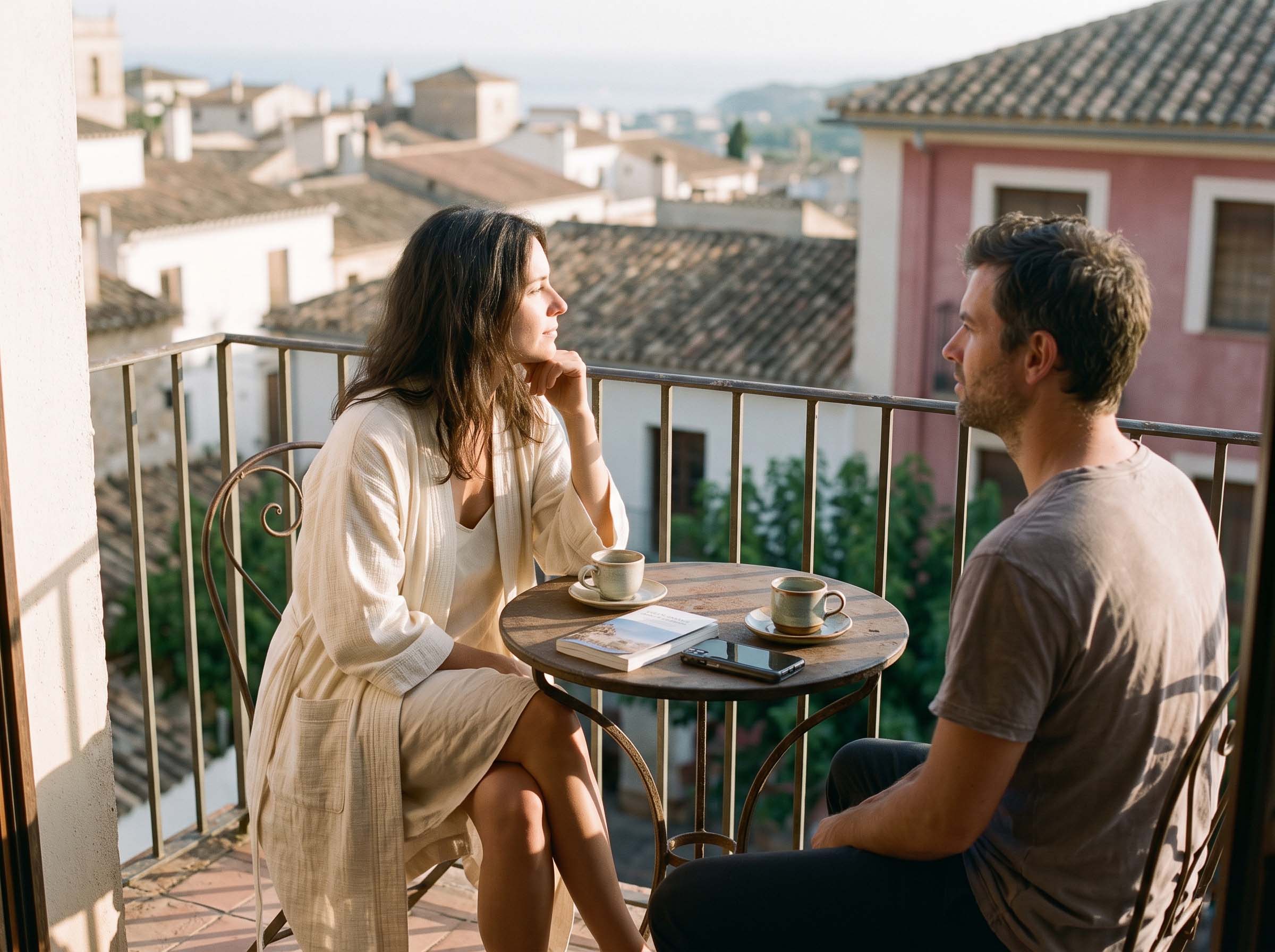
A holiday removes interruption. That is its real mechanism, and it is not a small one. No laundry cycle running, no school email, no neighbour at the door, no ninety-minute evening broken into fragments by other people's needs. Uninterrupted hours are rare in a working marriage and hard to manufacture at home, where the undone tasks are all still visible from the sofa.
But interruption is removed on the trip's schedule, not on the couple's. Booked tours, transfers and a list of things that must be seen because they were paid for can rebuild the same fragmentation the couple flew away from, with better weather. The women who describe their best trips rarely lead with the destination. They describe the second Tuesday, when the plan had run out.
Quick Start
Planning Around the Conditions, Not the Brochure
Worth Packing
- Eye mask and moulded earplugs — hotel curtains and corridors are the two variables you cannot book around.
- A printed itinerary with the unscheduled days marked in advance, so they don't quietly fill up.
- A travel kettle or the equivalent, if the morning at home starts with something specific.
- Enough local currency for the first day, so the arrival isn't spent doing arithmetic.
Do
- Book fewer places for more nights. Every change of accommodation restarts the adjustment.
- Leave the first evening empty and eat early.
- Build a day of margin before anything fixed — a booked dinner, a ferry, an anniversary date.
- Sort children's sleeping arrangements at the booking stage, where the budget allows, rather than on arrival.
Don't
- Treat the first forty-eight hours as representative of the trip.
- Book the holiday as the venue for a conversation that hasn't happened at home.
- Take the overnight flight and expect the evening after it to count.
- Fill the calendar because the flights were expensive. The fullest itinerary rebuilds the fragmentation you left behind.
The older arrangement
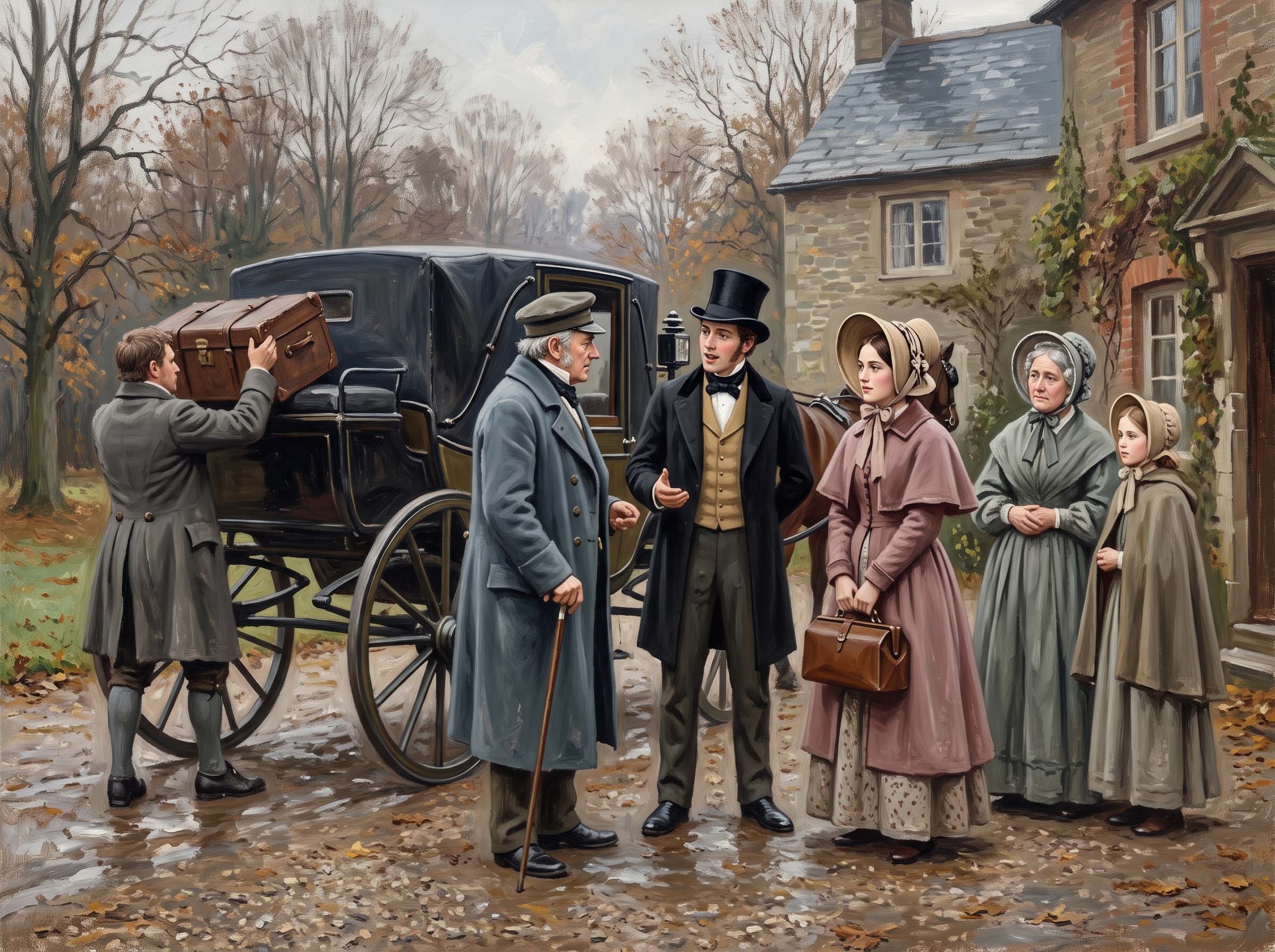
It is worth sitting with how strange the modern expectation would have looked to a bride in 1830. Her post-wedding travel was a round of visits to relatives who had missed the ceremony, often with friends or family riding along. The point was to bind the couple into a wider family, not to seal them off from it. Privacy as the organising principle of the honeymoon only arrived later in the century, when Victorian households began treating the married pair as a unit standing somewhat apart from everyone else.
What that history suggests is not that the private trip is a mistake. It is that the emotional job the modern holiday is asked to perform is a recent assignment, given to an institution that was originally designed to do something else entirely. A week in another country was never engineered to repair a connection. It clears a room. What happens in the room was always going to be built out of ordinary Tuesdays at home — the ones nobody photographs, and nobody books eleven months in advance.
Questions Women Ask About This
Disclaimer: All content on this website—including articles, educational materials, and interactive calculators—is for informational, educational, and entertainment purposes only. The calculations, percentiles, and outputs generated by tools on this site are based on general statistical data and mathematical models; they do not constitute medical data, a clinical assessment, or a diagnosis.
Nothing contained on this website is a substitute for professional medical advice, diagnosis, or treatment. Always seek the guidance of a qualified healthcare professional or urologist with any questions you have regarding physical development, anatomy, or health conditions. Reliance on any information or tools provided by this website is solely at your own risk.