English
  Español



The grocery receipt is longer than it used to be, and the total at the bottom is the part she reads twice. Eggs, coffee, the children's cereal: all of it costs noticeably more than it did four years ago. That evening a news segment about a crime downtown plays while she folds laundry. A month later she votes exactly as she did last time, and the time before that.
From the outside, that looks like a puzzle, and for many conservative readers it looks like a frustrating one. Why do people vote against their own interests, or at least against what an observer believes those interests are? In our first look at why women lean left, the answer ran through marriage, repetition and belonging. This follow-up asks the next question: once a woman has picked a side, what keeps her there, even when the results seem to argue for leaving?
What critics see
The case conservatives make is not hard to state. Inflation in the United States peaked at 9.1 percent in June 2022, the highest in four decades, and households run by women, who still do most of the family shopping, felt it at the checkout first. Critics point to rising tax and spending commitments, to scandals that seem to carry few consequences, to years of record border crossings and doubts about how thoroughly new arrivals were screened, and to fears about public safety, especially for women walking alone at night. If a party delivers all that, they ask, why would women keep voting for it?
Some of those concerns rest on solid ground; the cost-of-living squeeze was real and widely measured. Others are harder to pin down, and the difficulty is itself part of this story. Violent crime and murder fell nationally in 2023 and 2024, yet in 2024 roughly nine in ten Republicans told Gallup that crime was rising. On immigration, a 2020 study in PNAS by Michael Light and colleagues used Texas arrest records to argue that undocumented immigrants in Texas had lower felony arrest rates than native-born citizens; the Center for Immigration Studies has countered that the same data undercounts offenders whose status is identified later. Reasonable people still argue over those numbers for hiding actual violent crime by undocumented immigrants for political reasons. What is not in dispute is that voters on both sides read the same headlines and come away convinced of opposite things.
The screen in front of the eyes
In 1960 a team of University of Michigan researchers led by Angus Campbell published The American Voter, one of the most cited books in political science. Their central finding was that party identification works less like an opinion and more like a lens. They called it a perceptual screen: once a person belongs to a party, information that flatters the team passes through easily, and information that embarrasses it gets filtered, discounted or explained away.
Princeton political scientist Larry Bartels later put numbers on the screen. During Ronald Reagan's presidency, inflation fell from double digits to around four percent. Yet when the American National Election Studies asked voters in 1988 whether inflation had improved, a majority of strong Democrats said it had gotten worse. They were not lying. They were seeing the economy through their team's eyes.
The screen works in every direction, and Gallup's crime surveys show it beautifully. For three decades, Americans have tended to say crime is rising when the other party holds the White House. After the 2024 election, with crime still falling, the share of Republicans who said crime was increasing dropped by 36 points in a single year, according to Gallup's 2025 crime perceptions report. The streets had not changed that much. The person in the Oval Office had.
When the evidence argues back
In 1954 a young psychologist named Leon Festinger and two colleagues quietly joined a small group in suburban Chicago whose leader had predicted the world would end in a flood on a specific December night. The researchers wanted to see what would happen when the flood did not come. The result, published in 1956 as When Prophecy Fails, surprised them. Many of the most committed members did not abandon the belief. They doubled down and began recruiting.
Festinger's explanation became the theory of cognitive dissonance. Holding two clashing ideas, such as "I am a sensible person" and "I supported something that went badly," is uncomfortable, and the mind relieves the discomfort by whichever route is cheapest. Changing a deeply held commitment is expensive. Reinterpreting the evidence is cheap. So the price rise becomes the fault of corporations, the crime story becomes a media exaggeration, the scandal becomes a smear. The same reflex shows up in voters of every stripe, which is why it deserves to be understood rather than mocked.
Changing a deeply held commitment is expensive. Reinterpreting the evidence is cheap.
The team behind the vote
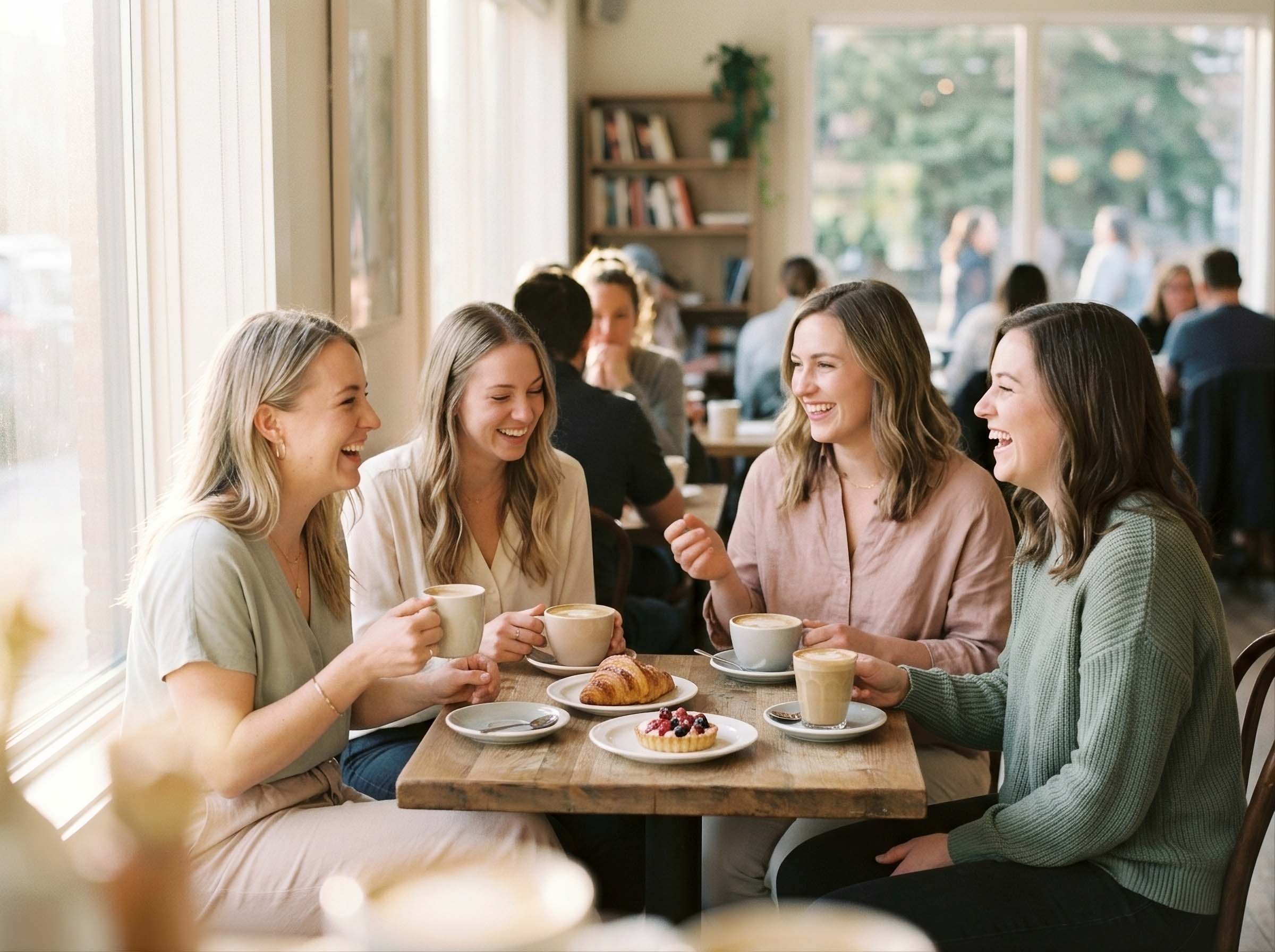
The cost of switching is not only mental. University of Maryland political scientist Lilliana Mason, in her 2018 book Uncivil Agreement, argues that party labels in America have absorbed so many other identities, religious, regional, cultural and generational, that a vote now functions like a membership card. Leaving the party can feel like leaving a circle of friends.
For many young women that circle is literal. Surveys in recent years have found growing numbers of young adults unwilling to date or befriend someone with opposing politics. A twenty-eight-year-old woman whose friends, coworkers and social feeds all lean one way faces a real social price for voting the other way, and the thinking brain weighs that price automatically, long before she reaches the polling station. Our piece on how algorithms amplify what we already click on shows how quickly a feed can narrow what feels normal.
Why a loyal brain makes sense
It is easy to call this stubbornness. It is closer to economy. A brain that reopened every allegiance with each new headline would spend its days in exhausting deliberation, and its owner would be an unreliable friend, neighbor and ally. For most of human history, sticking with your group through bad seasons was how you survived them. Groups that dissolved at the first disappointment did not last.
Loyalty also protects against manipulation. A voter who changes sides every time a frightening story trends is easy to steer. A degree of stubbornness is the mind's defense against being pushed around by whoever shouts loudest this week, just as the brain's habit of tidying memory at a threshold, explored in our piece on why you walk into a room and forget why, is a feature that occasionally feels like a flaw.
When loyalty does bend
The picture of women voting the same way over and over is not quite accurate. In 2020, women backed Joe Biden by about fifteen points in the national exit poll. In 2024 they backed Kamala Harris by about eight, a meaningful shift in a single election. Married women moved into the Republican column. Pocketbook pressure appears to be what moved them; in exit polls the economy topped the list of voters' concerns.
Princeton's Christopher Achen and Larry Bartels, in Democracy for Realists (2016), argue that voters punish incumbents for hardship they can feel directly, sometimes even hardship no government could control.
Did you know?
Achen and Bartels found that after a string of shark attacks along the Jersey Shore in the summer of 1916, beach towns gave President Woodrow Wilson a noticeably smaller share of the vote that November. Voters, it seems, will hold a leader responsible even for sharks.
The pattern points to a quieter truth about the screen. It filters what arrives secondhand, through news and commentary, far more easily than what arrives firsthand, at the checkout or on the walk home. A grocery bill is hard to reinterpret. A statistic about a distant city is not. Loyalty tends to bend first where life is felt directly.
Where the evidence pushes back
An honest account has to note that the loyalty machinery is not a women's problem or a left-wing problem. The Gallup crime data shows Republican perceptions swinging just as sharply with the White House as Democratic ones. Many conservative voters stayed loyal through their own party's scandals and disappointments for exactly the reasons described here.
Women who keep voting left would also dispute the premise. Many would say they weighed the cost of living and still judged the other side's answers worse, or that abortion law, health care or the character of a candidate mattered more to them that year. A mind that reaches a different conclusion from the same facts is not necessarily a mind that failed to see them. The disagreement is often about causes and priorities, not about what the receipt says.
Return to the woman with the long receipt. She noticed the price of eggs. She heard the crime story. Her vote stayed put not because she missed either one, but because a mind built for loyalty was doing its ancient work: protecting her place among the people she trusts and explaining away what threatened it. Every voter at every kitchen table runs that same machinery. The more useful question for any of us is not why the other side cannot see what we see, but what evidence, arriving at our own front door, would be strong enough to move us.
Questions Readers Ask
Disclaimer: All content on this website—including articles, educational materials, and interactive calculators—is for informational, educational, and entertainment purposes only. The calculations, percentiles, and outputs generated by tools on this site are based on general statistical data and mathematical models; they do not constitute medical data, a clinical assessment, or a diagnosis.
Nothing contained on this website is a substitute for professional medical advice, diagnosis, or treatment. Always seek the guidance of a qualified healthcare professional or urologist with any questions you have regarding physical development, anatomy, or health conditions. Reliance on any information or tools provided by this website is solely at your own risk.