English
  Español



Somewhere around 1:40 in the morning, in a bedroom that looks entirely unremarkable from the street, a woman is performing a manoeuvre she has never once described out loud. Slowly, in increments, using the weight of one shin as an anchor, she is reclaiming eleven inches of duvet. Her husband is asleep. He will remember nothing. She will remember everything, and she will not bring it up at breakfast.
This happens in millions of homes every night, and almost nobody talks about it. Marriage advice covers money, in-laws and how often couples argue about the dishwasher. It rarely covers the eight hours in which two adults, unconscious and unsupervised, negotiate territory, temperature and blankets — regardless of whether either of them sleeps in flannel, in an old college t-shirt, or in nothing at all. Yet ask a married woman about her sleeping arrangement and she will usually laugh before she answers. There is a story there. There is always a story there.
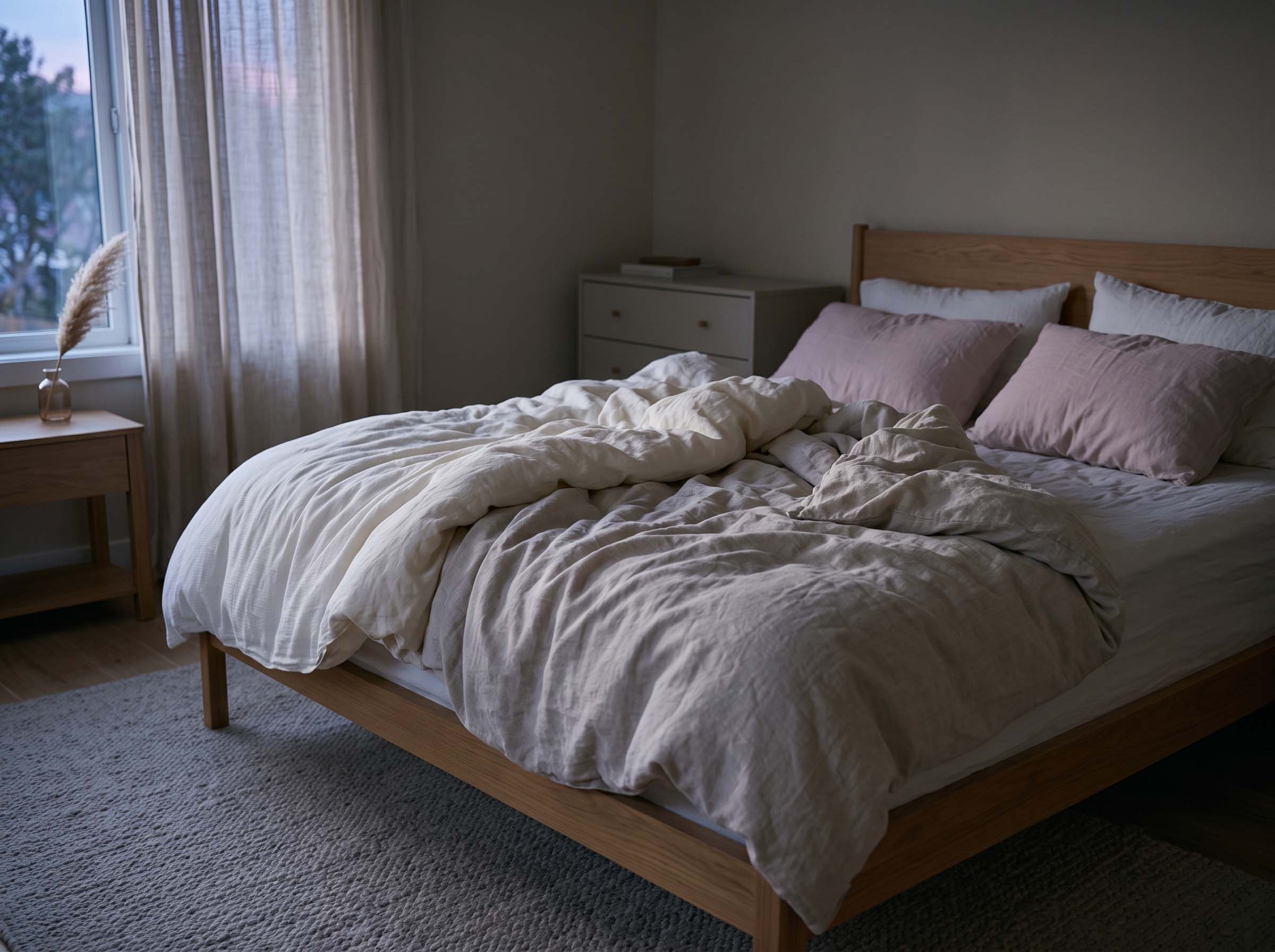
Before the Duvet, There Was the Draught
The idea that a devoted couple must share one mattress is younger than most people assume. Cultural historian Hilary Hinds traced the rise and fall of the twin bed among married couples in Britain and America between 1870 and 1970, and what she found runs against every modern assumption. Twin beds did not begin as a sign of a cooling marriage. They began as a health measure — late-nineteenth-century domestic reformers worried about what one sleeper might pass to another through exhaled breath in a closed room. By the 1920s the twin bed had become something else entirely: a marker of a modern, prosperous, forward-looking household. Furniture catalogues sold them as aspirational. The middle classes bought them proudly.
Then the meaning inverted. Over the second half of the twentieth century, the double bed reclaimed its position as the emblem of a happy marriage, and the twin bed acquired the faint smell of failure — the arrangement of couples who had run out of things to say. Same object, opposite reading, inside a single lifetime. What changed was not the furniture but the story a society had agreed to tell about it.
That reversal matters, because it means the shame attached to separate blankets, separate beds or separate rooms is not a fixed moral fact. It is a fashion, and a fairly recent one.
The Nordic Solution Nobody in North America Adopted
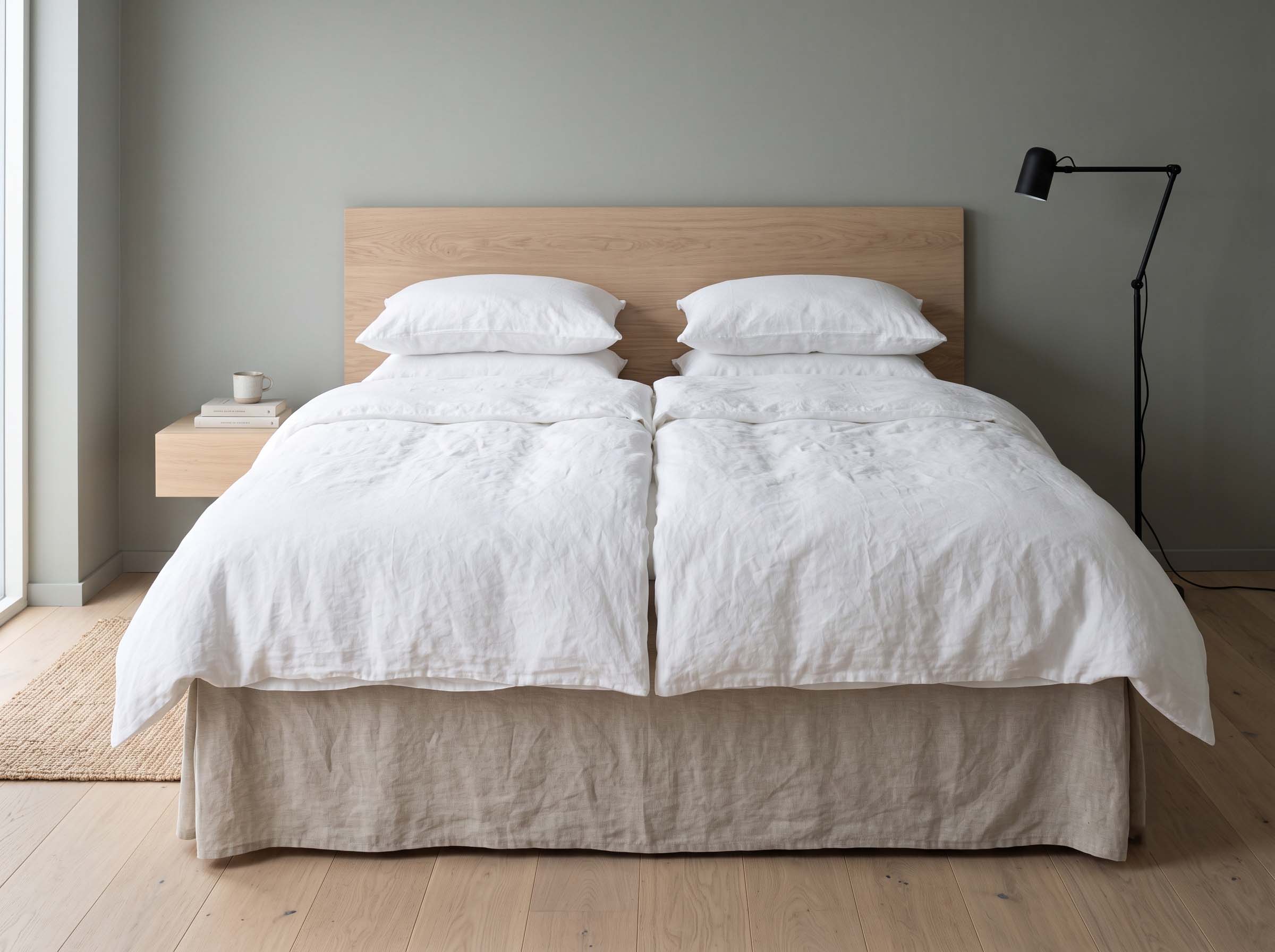
Across Scandinavia, Germany and Austria, a shared bed is routinely made up with two single duvets side by side rather than one large one. The bed is shared. The bedding is not. Travellers from English-speaking countries often mistake this for a hotel error and ask the front desk to fix it.
The arrangement quietly removes the most common nighttime dispute in marriage without anyone leaving the room — which may explain why the phrase "Scandinavian sleep method" keeps resurfacing online every few winters, presented as a discovery rather than as somebody's grandmother's ordinary linen closet.
The Temperature Line
Ask couples what they actually argue about after dark and blankets come second. Temperature comes first.
Human sleep onset is tied to a drop in core body temperature, which is why a room that feels pleasant at nine in the evening can feel wrong at midnight, and why the thermostat setting is rarely a neutral household decision. Two adults sharing one room have one thermostat and two different thresholds — and when those thresholds diverge by even a few degrees, someone spends the night compensating. Extra socks. A cardigan over the pyjamas. A leg extended out from under the covers like a rudder. Women very often report being the colder partner, and the household solutions they describe tend to be layered, improvised and entirely undiscussed.
Sleep clinicians who study bed partners list room temperature alongside ambient light and noise as the ordinary, unglamorous reasons couples adjust their sleeping arrangements. Not resentment. Not distance. Thermostats.
31%
of U.S. adults have slept in another bed or another room to accommodate a bed partner, according to survey data from the American Academy of Sleep Medicine.
39%
of adults aged 35 to 44 — the peak parenting years — report the same arrangement, the highest of any age group. Among adults 65 and older, it drops to 18%.
37%
say they go to sleep at a time they did not actually want to, purely to accommodate the person beside them.
36%
of Vagina Institute readers told us they sleep in the nude on hot summer days.
The Numbers on Sleeping Apart
The phrase that has attached itself to this arrangement is "sleep divorce," which is a terrible name for something that is very often a courtesy. The same national survey work found that roughly 13% of respondents used a separate bed within the same bedroom, while 21% moved to another room entirely — and men reported doing so considerably more often than women, which upends the tidy cultural image of the exiled husband on the sofa being punished for something.
The generational split is the detail worth sitting with. Younger married couples are far more willing to sleep apart than their grandparents were, and the oldest respondents — the ones who have been married longest — are the least likely of anyone to do it. That could be habit. It could be smaller houses and fewer spare rooms. It could be that a generation raised on the double bed as the emblem of a good marriage simply will not concede the territory.
What the Sleep Lab Found
Here is where the story stops being simple. If shared beds are such a battleground, the obvious expectation is that everyone would sleep better alone — and the research does not cooperate.
In a sleep-laboratory study of bed-sharing couples published in Frontiers in Psychiatry, German researchers wired up twelve young, healthy couples for four nights each, recording them both together and apart with simultaneous polysomnography. Sharing a bed was associated with more REM sleep, and with REM sleep that held steadier through the night. The partners' sleep stages also synchronised to a measurable degree — two nervous systems drifting into the same phase at roughly the same time, without either person deciding to.
The same nights showed more limb movement and more brief awakenings. Both things were true at once: physically more disrupted, architecturally more restorative. The study was small, the couples were young and healthy, and the authors said plainly that it is unclear how far the pattern extends to older couples, to longer marriages, or to anyone whose partner is unwell. What it does suggest is that the body may register a familiar person nearby as a reason to relax its guard, and that this counts for something even when an elbow arrives at 3 a.m.
Physically more disrupted, architecturally more restorative. Both things are true on the same night, in the same bed.
The Screen Version and the Real One
Most of the private embarrassment around sleep habits comes from a comparison nobody agreed to. Film and television have supplied one continuous image of how married people sleep: face to face, motionless, artfully lit, one arm draped and apparently never losing circulation. It is a composition, not an observation. Nobody sleeps like that, and anyone who has tried it for a full night knows exactly how long the pose survives.
| The Screen Version | What Women Describe |
|---|---|
| Spooning, uninterrupted, until sunrise | Eleven minutes of spooning, then a mutual and wordless retreat to opposite edges |
| Matching silk sets, freshly pressed | A stretched t-shirt from a charity run nobody remembers entering |
| One duvet, elegantly draped across both | Two duvets, or one duvet and a border held by a knee |
| Waking in the same position they fell asleep in | The diagonal drift — one sleeper at a forty-degree angle, occupying two-thirds of the mattress |
| A room temperature both parties find perfect | A room set for one of them, and socks for the other |
The Signals Nobody Taught Them
What tends to go unrecorded in all of this is how much communication happens after the light goes out, without a single word. Couples develop private systems: the foot that stays touching an ankle after the rest of the body has turned away, the two taps on the shoulder that mean you're snoring, roll over, the arm that gets returned to its owner with a pat rather than a shove. These signals are invented at home, taught to nobody, and understood perfectly by exactly one other person on earth.
They also carry more freight than the arrangement of the blankets does. Something in the same family as the wordless vocabulary couples build through touch keeps operating while both parties are unconscious — which is a strange and rather lovely thing to consider about a marriage.
Sleep compatibility in a relationship, then, is not really about matching preferences. Two people who need the same temperature and the same blanket and the same bedtime have been spared a negotiation, not granted a stronger bond. The couples who move a spare duvet into the room in November, or who agree that one of them will read in the guest room until midnight, have done the same work that shows up in the daylight in the small daily rituals that hold a marriage together. It is accommodation, performed nightly, by people who are too tired to be strategic about it.
Which may be the honest reason the blanket wars are worth talking about at all. At two in the morning nobody is putting on a performance. What happens then — the retreat, the return, the eleven reclaimed inches, the hand that finds a shoulder in the dark — is closer to the truth of a marriage than most of what happens at dinner.
Questions Readers Keep Asking
Disclaimer: All content on this website—including articles, educational materials, and interactive calculators—is for informational, educational, and entertainment purposes only. The calculations, percentiles, and outputs generated by tools on this site are based on general statistical data and mathematical models; they do not constitute medical data, a clinical assessment, or a diagnosis.
Nothing contained on this website is a substitute for professional medical advice, diagnosis, or treatment. Always seek the guidance of a qualified healthcare professional or urologist with any questions you have regarding physical development, anatomy, or health conditions. Reliance on any information or tools provided by this website is solely at your own risk.