English
  Español


Somewhere in deep time, long before the first primate climbed into a forest canopy, a small organ began a very slow move. The clitoris, in many early mammals, appears to have sat inside the copulatory canal itself. In women today it sits outside, at a distance from the vaginal opening.
Researchers who study comparative anatomy now think that shift was no accident of shape. It tracks one of the biggest changes in mammal reproduction: the moment eggs stopped waiting for a mate and started keeping their own calendar. For anyone who has ever wondered why the clitoris sits where it does, the answer may begin with a rabbit.
A rabbit's ten-hour countdown

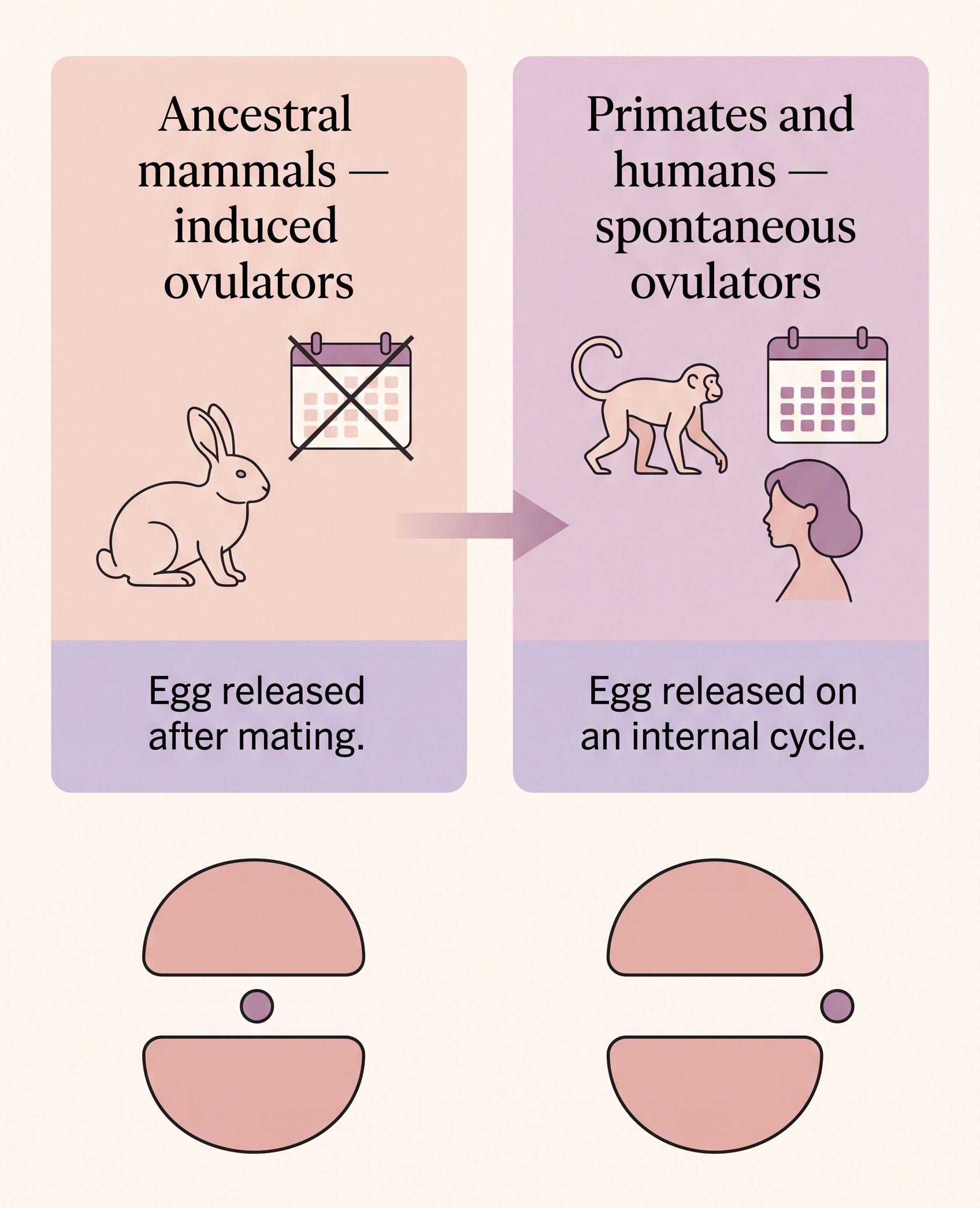
A doe rabbit does not run on a monthly schedule. Her eggs ripen and then simply wait. Only after mating does the signal come, and roughly ten hours later the ovary lets go.
Biologists call this induced ovulation. The trigger is physical. Nerves carry a message from the reproductive tract up to the brain, and the brain answers with a sudden flood of hormones that tells the ovary to release its eggs. No contact, no surge. No surge, no egg.
For a system like that to work reliably, the sensitive tissue has to be exactly where mating will reach it. In many induced ovulators, that is precisely where the clitoris sits: within the canal or right at its entrance. Position, in this case, is function.
Rabbits are not alone. Cats, ferrets, and camels all lean on some version of this strategy, and the comparison across species is where the story gets interesting.
Cycle lengths are typical ranges, not fixed rules. Individual animals and individual women vary.
The day the calendar took over
Women, along with other primates and many rodents, belong to the second camp. These are spontaneous ovulators. Their bodies release eggs on an internal timetable set by a regular hormonal cycle, whether or not mating happens at all.
Over a lifetime, that adds up. Estimates commonly put the total somewhere around 400 to 500 ovulations for a woman, though the real number differs widely with cycle length, pregnancies, and years spent nursing. Each one arrives on schedule, prompted by nothing but the body's own chemistry.
Comparative studies suggest induced ovulation came first. Spontaneous ovulation is the newer invention, and it appears to have arisen more than once in separate mammal lineages. One of those arrivals, researchers speculate, took place in the shared ancestor of primates and rodents, tens of millions of years before anything resembling a human walked the earth.
How a body part changes its address
The link between these two facts came from Mihaela Pavličev and Günter Wagner, evolutionary biologists then at Cincinnati Children's Hospital and Yale University. In their 2016 paper in the Journal of Experimental Zoology, they compared the reproductive anatomy of many mammal species and found a pattern. Where spontaneous ovulation had evolved, the distance between the clitoris and the copulatory canal tended to grow.
Their reading is elegant. Once eggs no longer needed a physical trigger, there was no longer anything holding the clitoris in place inside the canal. Over countless generations, its position shifted outward and away.
Once eggs no longer needed a physical trigger, nothing held the clitoris in place inside the canal.
It is worth pausing on what the clitoris is made from. In every mammal embryo, the same small bud of tissue, the genital tubercle, gives rise to the clitoris in females and its counterpart in males. Evolution was not building something new. It was moving something very old.
Why outward, specifically, rather than staying put? That part of the story is less settled. Some biologists see simple drift once the old pressure disappeared. Others suspect additional forces shaped the final position. The comparative pattern is clear; the full explanation for it is still being worked out.
The echo that remained
Evolution rarely erases things cleanly. It tends to leave traces.
In women, the reflex once responsible for ovulation appears to still exist, still accompanied by a brief rush of hormones that includes prolactin and oxytocin. Pavličev and Wagner noticed that this surge closely resembles the hormonal burst that triggers egg release in induced ovulators. Their proposal, often called the ovulatory homolog hypothesis, is that the human reflex and the rabbit's trigger are the same ancient trait, inherited from a shared ancestor. In rabbits it still releases an egg. In women, it has been freed from that duty.
A follow-up experiment in 2019 tested the idea in the animals themselves. The team gave rabbits a medication known to dampen this same reflex in humans, then compared how many eggs the animals released after mating. The treated rabbits ovulated noticeably less, which is what the hypothesis would predict if the two reflexes truly share a root.
The news was picked up widely, including by Yale's Department of Ecology and Evolutionary Biology, because it offered something unusual. Instead of asking only what this reflex does in women today, it asked where the reflex came from in the first place.
Camels, cats and the beautiful exceptions
Nature resists tidy categories, and the induced-versus-spontaneous divide is no exception. Domestic cats are classic induced ovulators, yet some individuals release eggs without mating. In llamas and alpacas, a protein in the male's seminal fluid turns out to play a large part in the trigger, a chemical message working alongside the physical one.
Rodents add another twist. Mice and rats ovulate on their own cycle, but mating still sets off hormonal changes that matter for what follows. The line between the two strategies is less a wall than a gradient.
Did you know?
Spontaneous ovulation did not appear just once. Comparative studies suggest it evolved repeatedly in separate branches of the mammal family tree, and in lineage after lineage the clitoris tends to sit farther from the canal.
That repetition is part of what makes the pattern persuasive. One coincidence is easy to dismiss. The same shift turning up again and again is harder to ignore.
What science still cannot say
Soft tissue almost never fossilizes. No one can dig up an ancestral mammal and measure the position of her clitoris. The evidence comes instead from comparing living species and reconstructing the family tree backward, a careful method but an indirect one.
Not every researcher accepts the ovulatory homolog idea in full. Some argue the reflex in women has taken on roles of its own that matter as much as its origins. Others question how far a correlation across species can be pushed. The hypothesis is well regarded, carefully argued, and still debated.
Human anatomy adds its own variety. Anatomical studies show that the distance between the clitoral glans and the vaginal opening differs considerably from one woman to the next. There is no single measurement every body shares, and evolution never required one.
The rabbit in her meadow still waits for a mate before her eggs move. The woman reading this article carries the same ancient tissue, built from the same embryonic bud, now sitting at a new address and answering to a calendar of its own. For the full story of that calendar, from the first rise of estrogen to the egg's release, our guide to the hormonal cycle week by week picks up where the rabbits leave off.
Questions readers ask
Disclaimer: All content on this website—including articles, educational materials, and interactive calculators—is for informational, educational, and entertainment purposes only. The calculations, percentiles, and outputs generated by tools on this site are based on general statistical data and mathematical models; they do not constitute medical data, a clinical assessment, or a diagnosis.
Nothing contained on this website is a substitute for professional medical advice, diagnosis, or treatment. Always seek the guidance of a qualified healthcare professional or urologist with any questions you have regarding physical development, anatomy, or health conditions. Reliance on any information or tools provided by this website is solely at your own risk.