English
  Español



Every woman carries two entirely separate sweat systems beneath her skin, and they behave nothing alike. One is a plain cooling mechanism that keeps the body from overheating. The other is a slower, richer, more curious system that clusters in only a handful of places — the underarms, the area around the breasts, and the folds of the sub-pelvic region.
Understanding the difference between the two explains one of the most common questions women quietly ask themselves: why does the skin of the intimate area carry a scent so different from the skin of the forehead or the forearm? The answer has nothing to do with cleanliness and everything to do with cell biology. For a broader look at how the body's natural scent takes shape day to day, the story begins with two glands that could hardly be more different.
Two Systems, One Skin
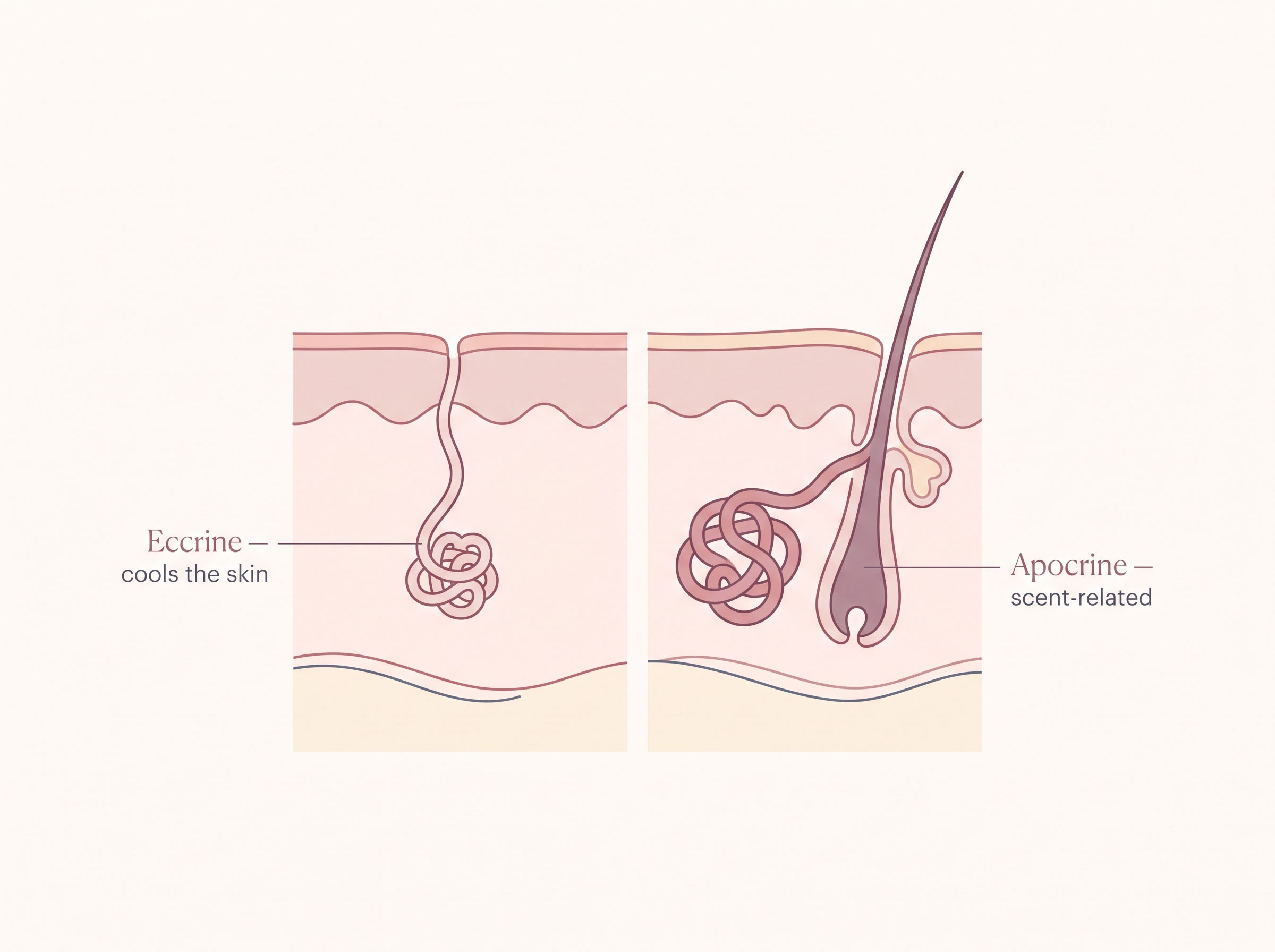
Research on human skin has long recognized two kinds of sweat glands, and they were formally separated into categories more than a century ago. They differ in almost every way that matters: where they sit, what they release, when they switch on, and what happens to their output once it reaches the surface.
- Eccrine glands are the body's everyday coolers. Studies estimate that a single human body holds somewhere between two and five million of them, spread across nearly the entire skin surface, with the densest packing on the palms and soles. They open straight onto the skin and release a thin, watery, mostly odorless fluid.
- Apocrine glands are the specialists. They are far larger, far fewer, and clustered in restricted zones — the underarms, the areola, the outer ear canal, and the perineal and external genital region. Rather than opening onto the surface, they empty into hair follicles, and their secretion is thick, lipid-rich, and slow to arrive.
That second gland is the reason a warm afternoon smells one way on the arm and another way closer to the body. The long-tail truth many women search for — why the intimate area smells different from the rest of the body — sits entirely inside apocrine biology.
The Cooling System: How Eccrine Glands Stay Quiet
Eccrine sweat is, in a sense, the least interesting fluid on the body — and that is exactly its strength. It is close to plain water, carrying a small amount of salt because it is drawn from the same plasma that runs through the blood. When the core temperature rises, the nervous system signals these glands to release fluid onto the skin, where evaporation carries heat away. In extreme heat, human beings can produce staggering volumes this way, which is why humans, unlike most mammals, can stay cool through open activity rather than panting.
Because this fluid is thin and reaches the surface directly, there is little for bacteria to feed on. Fresh eccrine sweat is largely scentless. Research also suggests it plays a quiet protective role, contributing to the faint acidity of the skin's outer surface. This is the sweat of the forehead on a summer walk — abundant, cooling, and forgettable.
The Scent System: Why Apocrine Glands Read Differently
Apocrine glands tell a different story, and it is here that the science becomes genuinely fascinating. Their secretion is not designed to evaporate. It is thick, oily, and packed with lipids and proteins — and, when it first leaves the gland, it is odorless. The scent that many women notice arrives only in a second step. Skin naturally hosts communities of harmless microflora, and these microbes break down the fatty compounds in apocrine sweat into smaller molecules. Those smaller molecules are what the nose detects. In other words, the gland supplies the raw material and the skin's own microbial residents finish the job.
This two-stage process explains why the underarms and the sub-pelvic region behave as a pair. Both are apocrine-dense zones, both are warm, and both tend to hold hair follicles that give the secretion somewhere to gather. It is also why the scent shifts after exercise — heat and movement bring more of that lipid-rich fluid to the surface, giving the skin's microflora more to work with. None of this signals a problem. It is simply a chemistry set doing what it has always done.
Did You Know?
The dense pairing of apocrine and eccrine glands found in the human underarm is called the axillary organ. Among all animals, only three species possess it: humans, gorillas, and chimpanzees. It is considered one of the most distinctive features of human skin.
The Sub-Pelvic Region, Textiles, and the Skin's Own Barrier
The skin of the intimate area is not only apocrine-rich; it is also warm, folded, and often covered. That combination changes how the surface behaves. The skin maintains a thin protective layer built from natural oils and lipids — a barrier that holds moisture in and keeps the surface balanced. Everyday variables interact with that barrier in ways textile scientists have studied closely.
Friction is one. Repeated rubbing from movement or close-fitting fabric warms the skin and encourages more apocrine output. Moisture is another. Some fabrics pull dampness away from the skin, while synthetics tend to trap it, raising local warmth and humidity. Even osmosis plays a small part, as the balance of salts and water at the surface shifts with what sits against the skin. This is why the choice of fabric is more than a comfort question — breathable natural fibers allow the surface to stay cooler and drier, which keeps the whole apocrine-and-microflora exchange quieter.
What emerges from all of this is a picture of a system that is self-regulating by design. The lipid barrier, the microflora, the apocrine glands, and the fabric against the skin form a small, responsive loop. When women report that their scent changes with the seasons, with activity, or across the month, they are noticing that loop adjusting in real time — not a flaw, but feedback.
“The gland supplies the raw material, and the skin’s own microflora finish the job. Scent is a two-step conversation, not a single act.”
A Timeline Written by Hormones
One detail sets apocrine glands apart from nearly every other structure in the skin: they wait. Eccrine glands are working within the first weeks of life, but apocrine glands stay dormant through childhood and switch on only when the hormonal shifts of puberty arrive. This is why the scent profile of the body changes so noticeably in adolescence — a whole gland system comes online at once.
From there, hormones continue to shape the surrounding tissue across a woman's life. Estrogen, in particular, influences the thickness, moisture, and resilience of the skin and mucosal tissue in the intimate region. Historically, women have described the body feeling different through the reproductive years, during pregnancy, and again in the years around menopause, when shifting estrogen levels gradually change the structure of these tissues. The glands themselves do not vanish, but the environment around them — its moisture, its cell layers, its balance — is continually rebuilt. The body, in short, keeps revising its own architecture.
Questions Women Often Ask
A Body That Regulates Itself
Seen up close, intimate scent stops being a mystery and becomes a small marvel of design. Two gland systems, built for two different purposes, working alongside a lipid barrier and a community of microflora that has lived on human skin for as long as there have been humans. The eccrine system keeps the body cool and quiet. The apocrine system carries the oldest signal in biology — a scent that once helped animals recognize one another and that persists in refined form today. Understanding the difference gives women something more useful than a rule to follow: a clear picture of a body that was designed to look after itself.
Editorial Glossary
Eccrine gland — the common, full-body sweat gland that releases a watery fluid to cool the skin.
Apocrine gland — a larger, less common gland found in a few warm zones of the body that releases a thick, oily fluid into hair follicles.
Lipid — a natural fatty substance; part of both apocrine secretion and the skin's own protective surface layer.
Microflora — the community of harmless microbes that naturally live on the skin.
Skin barrier — the thin outer layer of oils and lipids that holds moisture in and keeps the surface balanced.
Readers curious about the wider science can explore the Encyclopædia Britannica overview of the two types of sweat glands, or its detailed entry on sweat glands within human skin.
Disclaimer: All content on this website—including articles, educational materials, and interactive calculators—is for informational, educational, and entertainment purposes only. The calculations, percentiles, and outputs generated by tools on this site are based on general statistical data and mathematical models; they do not constitute medical data, a clinical assessment, or a diagnosis.
Nothing contained on this website is a substitute for professional medical advice, diagnosis, or treatment. Always seek the guidance of a qualified healthcare professional or urologist with any questions you have regarding physical development, anatomy, or health conditions. Reliance on any information or tools provided by this website is solely at your own risk.