English
  Español



For close to fifty years, one number did all the work. Eight thousand nerve endings: printed in magazines, repeated in health pamphlets, handed out in classrooms, quoted by physicians on television, and eventually absorbed into the general knowledge of an entire culture. It had the clean, settled sound of something that had been measured.
It had not been. The figure traces back to a single sentence in a 1976 book, and behind that sentence sat a study of cattle. The organ in question had already survived a strange career in print, having vanished from the pages of a major anatomy textbook for decades before anyone thought to ask why. The nerve count turned out to have a similar problem. Nobody had checked.
In October 2022, a surgical team finally did. What they found reset a number that had gone unexamined since the year of the American Bicentennial, and the way they found it says as much about how anatomical knowledge gets made as the figure itself does.
- The widely repeated figure of 8,000 nerve endings was never the result of a human study. It came from a 1976 book that extended a cattle finding to women.
- The first actual count of human clitoral nerve tissue was presented in October 2022 and published in a peer-reviewed journal in early 2023.
- Researchers counted an average of 5,140 myelinated fibres in one nerve, giving an estimated 10,280 for the pair.
- The authors describe their own figure as a floor rather than a ceiling, because several categories of nerve fibre were not counted at all.
A Number Borrowed From a Cow
The 8,000 figure appears to originate in The Clitoris, a 1976 volume by physician Thomas P. Lowry and Thea Snyder Lowry. In it, the authors referred briefly to work done on cow clitorises and carried the result across to human anatomy. It was not presented as a landmark finding. It was a passing line in a book that few people outside a narrow specialty ever read.
What happened next is the ordinary mechanics of citation. One writer quoted the book. The next quoted the writer. Somewhere in the chain the qualifiers dropped away, the cattle disappeared, and a rough extrapolation hardened into a fact with a decimal-point air of precision. By the 2010s the number was everywhere, and its origin was nowhere. Blair Peters, the surgeon who eventually led the count, has pointed out in interviews that the source was not even a scientific paper.
That is a mundane failure rather than a sinister one, which is arguably what makes it interesting. No one suppressed the correct figure, because no correct figure existed. For nearly half a century, the question of how many nerve fibres reach one of the most densely wired structures in the human body simply sat on nobody's desk.
What Was Actually Counted
The work came out of Oregon Health & Science University. Maria Uloko, Erika Isabey and Blair Peters presented their results at a joint meeting of the Sexual Medicine Society of North America and the International Society for Sexual Medicine in October 2022, when the university announced the first known count of human clitoral nerve tissue. The peer-reviewed paper followed in The Journal of Sexual Medicine in early 2023.
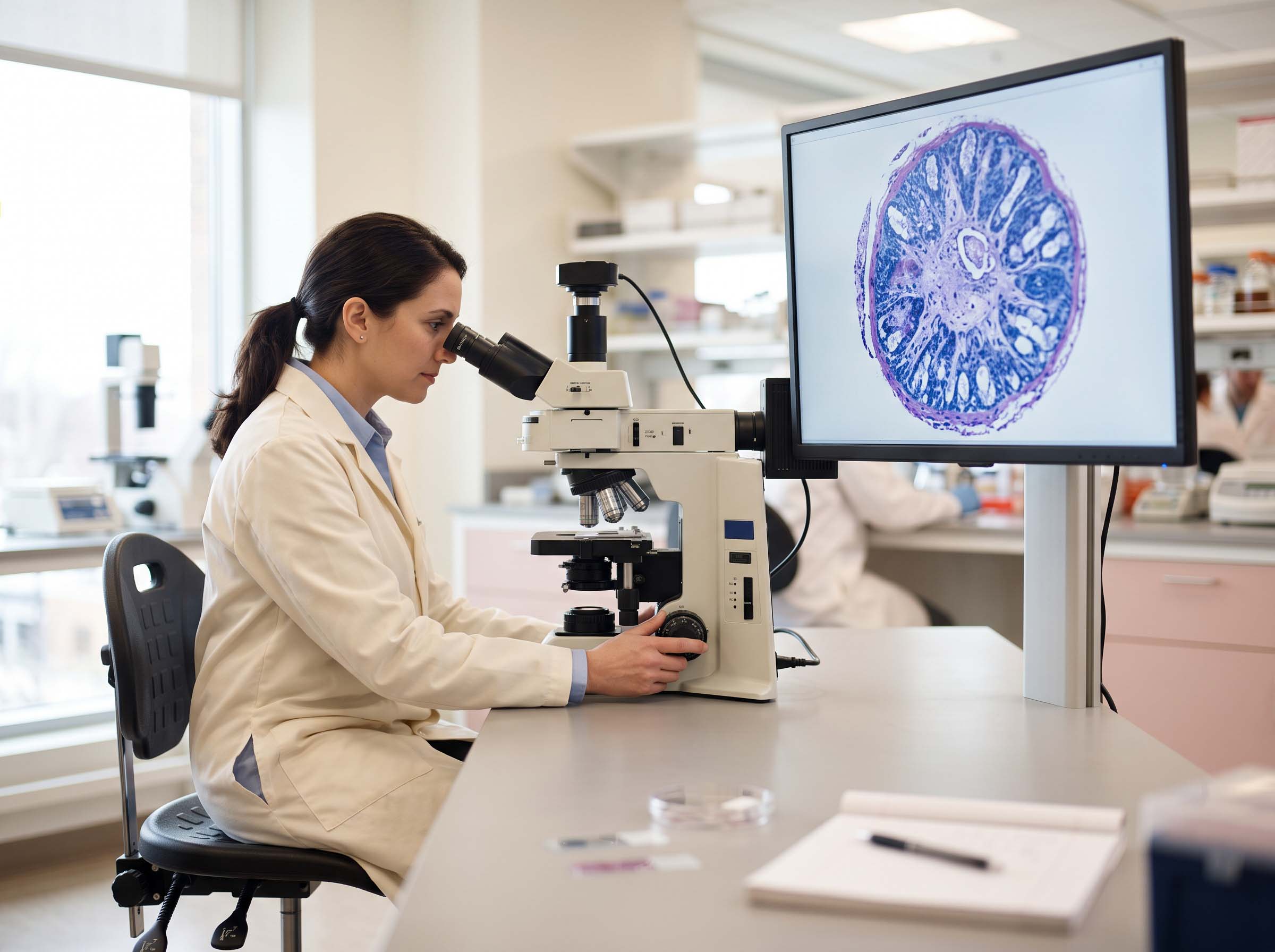
The method matters. Seven adult volunteers undergoing gender-affirming genital surgery consented to donate nerve tissue. The clitoris is served by two dorsal nerves, one on each side, and the operation these patients were already having requires only one of them; the segment that would otherwise have been discarded went to the laboratory instead. Each sample was chemically fixed, set in resin, sliced into cross-sections one micrometre thick, stained, then examined at a thousand times magnification while imaging software counted individual fibres.
The samples held between 4,926 and 5,543 fibres each, averaging 5,140. Because the structure is symmetrical, doubling that average produces the headline figure of 10,280, with a full range across the seven samples of roughly 9,852 to 11,086.
The authors were careful about what their own number does not include. They counted only myelinated fibres — those wrapped in a fatty insulating sheath. Unmyelinated fibres were not captured, and neither were the cavernosal nerves that supply the erectile tissue. Their conclusion was therefore stated as a minimum: whatever the true total is, it is well above eight thousand.
| Figure | What it refers to | Where it came from | Year |
|---|---|---|---|
| 8,000 | "Nerve endings," widely quoted in popular media | A line in a book extending a cattle study to humans | 1976 |
| 5,140 | Mean myelinated fibres in one dorsal nerve of the clitoris | Seven surgical samples, histological count | 2022–23 |
| 10,280 | Estimated total for both dorsal nerves | The mean doubled, assuming left-right symmetry | 2023 |
| 9,852–11,086 | Full range across the seven donated samples | Same study, lowest and highest counts | 2023 |
| ~7,076 | Estimated myelinated total for the two dorsal nerves of the penis | Cadaver samples, same counting technique | 2024 |
| ~18,000 | Median nerve, which serves much of the hand | Long-standing figure in nerve literature, cited for scale | — |
Figures rounded as reported by the research teams. Counts reflect myelinated fibres only.
How Ten Thousand Fibres Do Their Job
A nerve fibre count is not a pleasure score. It is a description of bandwidth, and the mechanics behind it are worth following.
The dorsal nerve of the clitoris is a branch of the pudendal nerve, which rises from the sacral segments of the spinal cord at the base of the spine. Sensory information travels from receptors in the tissue along these fibres, into the sacral cord, and upward to the thalamus and the sensory cortex, where the brain assigns it a location and a quality. Different receptors specialise: some respond to light contact, others to pressure, others to vibration or stretch, and they fire at different thresholds and different speeds.
Myelin is the reason speed varies. Fibres sheathed in it conduct signals rapidly and carry sharply localised information — this spot, this pressure, this instant. Unmyelinated fibres run slower and carry the diffuse, warm, poorly-localised sensations that researchers associate with pleasant touch and temperature. The 2023 study counted the fast lane and left the slow lane uncounted, which is precisely why its authors framed the result as conservative.
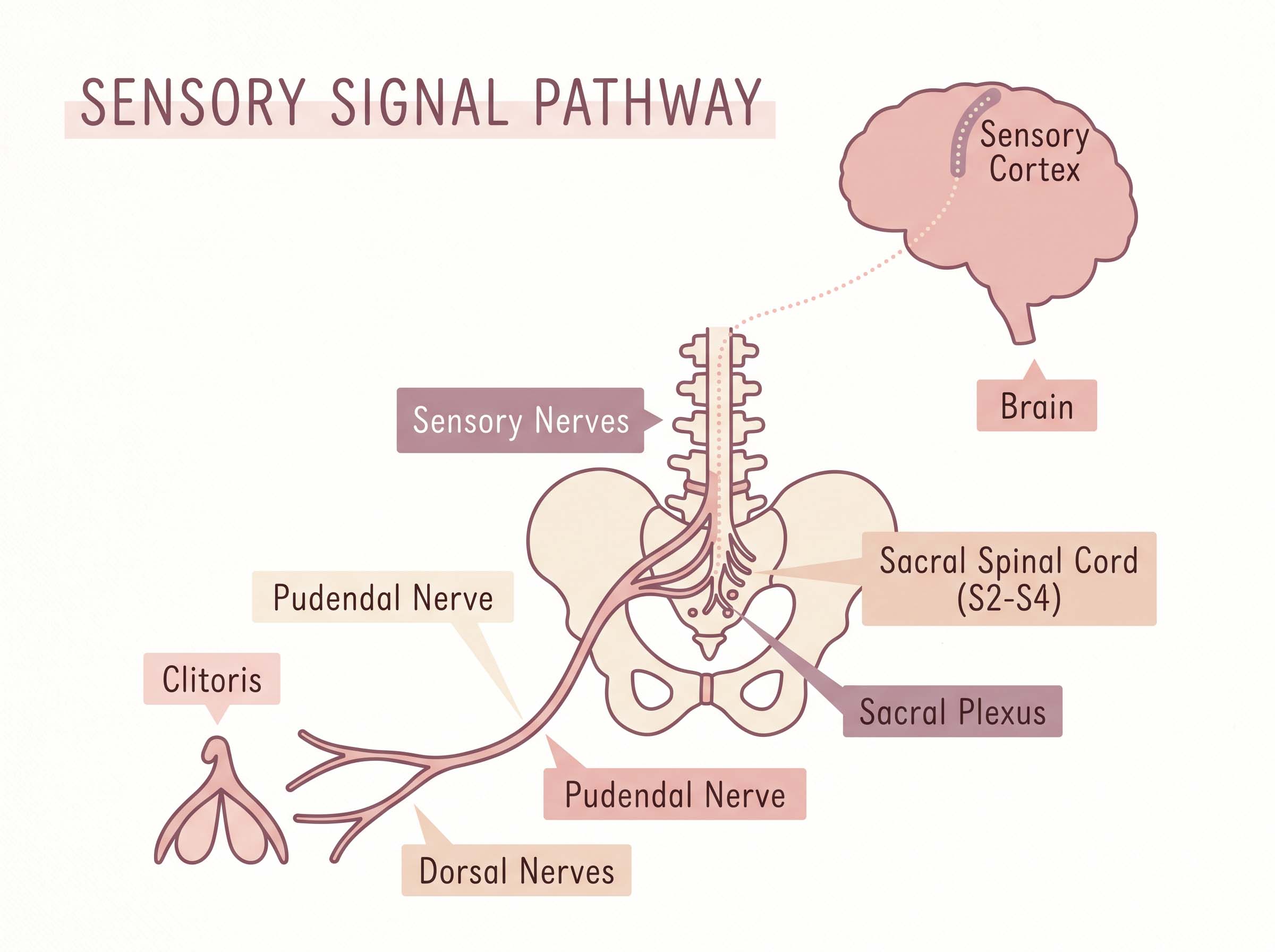
Running alongside the sensory wiring is a separate system entirely. Autonomic nerves govern blood flow to the erectile tissue, the paired bulbs and crura that make up most of the organ's mass and sit well below the visible surface. Arousal involves those vessels widening and the tissue filling; sensation involves the dorsal nerves reporting upward. Two mechanisms, one destination. Neither was counted in full by the 2023 work.
The comparison that gives the number its weight is one of density rather than volume. The median nerve, which supplies a large share of the hand, carries somewhere around 18,000 fibres. The hand is enormous by comparison. Concentrating more than ten thousand fibres into a structure whose visible portion is a few millimetres across produces a signal density that has few rivals anywhere in the body — which is why the surrounding wishbone-shaped structure hidden beneath the surface is now treated as surgically hazardous territory rather than an afterthought.
What the count cannot tell anyone is how sensation feels. Fibre numbers varied by roughly six hundred between the seven samples, and there is no established formula converting axon counts into intensity, threshold or subjective experience. Many women report wide differences in sensitivity across a lifetime, through childbirth and after menopause, and none of that is explained by a histological slide. The count establishes a baseline. It does not describe a feeling.
A figure nobody had ever measured travelled through half a century of print on the strength of being repeated.
Why the Question Waited So Long
The delay had less to do with taboo than with how the profession divided its attention. Detailed mapping of the whole organ arrived remarkably late: the Australian urologist Helen O'Connell published dissection findings in 1998 and a full anatomical review in 2005, work that established how much of the structure lies internally, wrapped around the urethra and the vaginal walls.
Before that, the vulva fell into a gap between specialties. Obstetrics and gynaecology organised itself around conception, pregnancy and the uterus. Urology grew up around the male tract. The clitoris belonged squarely to neither, and medical curricula reflected that. Peters has described learning the anatomy properly only during a surgical fellowship, years after qualifying.
Add to that a research culture where funding follows disease. A nerve count answers no immediate clinical emergency, and until reconstructive genital surgery created a practical need for precise nerve maps, no one had a professional reason to spend a laboratory year on it. Medicine has a long record of confident wrong answers about the female body, but this particular gap looks less like doctrine and more like neglect by default.
The Tissue Problem Nobody Talks About
Here is the part of the story that tends to get skipped. The first count of human clitoral nerve fibres did not come from a donated body. It came from living surgical patients, because that was where usable tissue could be found.
Histology of this kind is demanding. Counting individual axons requires tissue that is fresh, undamaged, and preserved by a specific chemical process almost immediately after removal. Conventional anatomical donation delivers something quite different: bodies preserved in formalin, often stored for extended periods, and drawn overwhelmingly from older donors. O'Connell noted this limitation about her own 1998 material, observing that fixed tissue shrinks and that most of her specimens came from elderly women, while the one younger specimen showed a noticeably larger structure.
The consequence is easy to miss and hard to overstate. Anatomical illustration through much of the modern era took the male figure as the standard and presented female structures mainly in reproductive chapters, and the collections that supplied teaching material were built to match. Research-grade female tissue, donated with consent for study and preserved properly, remains scarce. Whole-body donation programmes run by university medical schools accept registrations from living donors and maintain their own criteria for what they can use; several of the researchers working in this area have said openly that the shortage of suitable material is one reason so many basic questions about female anatomy still carry the word "estimated" in front of the answer.
Where the Science Stands Now
The 10,280 figure is not the end of the argument. In 2024 a separate research group published fibre counts taken at different points along the nerve and reported numbers that do not line up neatly with the Oregon results, which suggests that where along the nerve a sample is taken changes what gets counted. The same Oregon team later applied their technique to the dorsal nerve of the penis and estimated roughly 7,076 myelinated fibres in total, unsettling a different piece of received wisdom that had long circulated in the opposite direction.
Seven samples is a small foundation, and the volunteers were adults of similar age. Whether fibre counts shift across a lifetime, whether childbirth alters them, whether they vary by ancestry or build — none of that has been measured. Researchers describe the current figure as a first fixed point on a map that is still mostly blank.
What has changed is practical. Surgeons operating anywhere in the pelvic region — bladder procedures, cosmetic labiaplasty, abdominal reconstruction — now have published coordinates for a nerve bundle they were previously working near without a chart. That, more than the headline number, is what a corrected textbook actually buys. And the next correction will depend on tissue that somebody, somewhere, decided to leave to science.
Questions Readers Ask
Disclaimer: All content on this website—including articles, educational materials, and interactive calculators—is for informational, educational, and entertainment purposes only. The calculations, percentiles, and outputs generated by tools on this site are based on general statistical data and mathematical models; they do not constitute medical data, a clinical assessment, or a diagnosis.
Nothing contained on this website is a substitute for professional medical advice, diagnosis, or treatment. Always seek the guidance of a qualified healthcare professional or urologist with any questions you have regarding physical development, anatomy, or health conditions. Reliance on any information or tools provided by this website is solely at your own risk.