English
  Español



Nature was supposed to be restful. Somewhere around the second switchback, it turned into a logistics operation.
Why does the urge always arrive at the exact moment four other people are standing still, waiting?
The group has stopped for a photo. Someone is adjusting a pack strap. Someone else is reading the trail marker out loud, slowly. And that — precisely then, not twenty minutes earlier at the trailhead with its perfectly good facilities — is when the thought arrives, fully formed and unwilling to be negotiated with.
Anyone who has planned an outfit around nine hours in a dry aircraft cabin already understands the principle: travel comfort is decided long before departure. The trail simply removes every convenience and leaves the planning intact.
The Unglamorous Explanation
Most of it is water, and the rest is architecture.
Hikers drink more than they usually do. That water has somewhere to go. Beyond that, physiologists have described a well-documented response to cold exposure: as surface blood vessels narrow and blood shifts toward the core, the kidneys respond by producing more urine. Researchers have observed a similar pattern at altitude. Cool morning air, a shaded ridge, a breeze that arrives with the view — the conditions that make a hike pleasant are the same ones that quietly move the timetable up.
Then there is the built environment, or the complete absence of one. A trail offers no doors, no queue, no attendant. It offers a tree of uncertain width and an audience of people who love the outdoors and would very much like to reach the summit before the light goes.
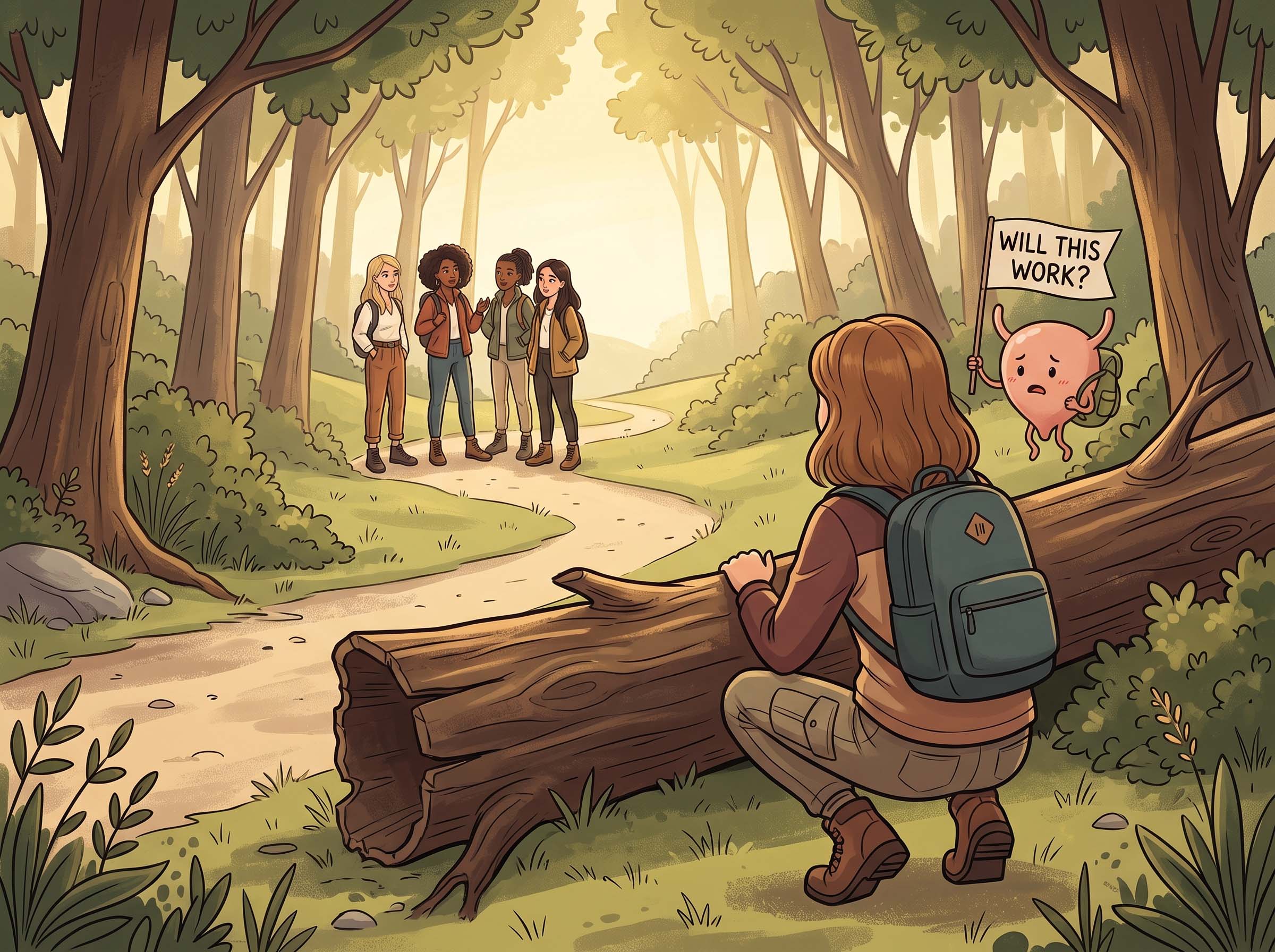
The Part Nobody Prints in the Trail Guide
What happens next is announced with four confident words: I'll be right back.
What follows is a site survey. The first candidate tree is too narrow and knows it. The second sits above a lower switchback with an unobstructed view of everything, which is charming in a landscape photograph and less charming here. The third is on a slope steep enough that physics develops opinions. Somewhere in the middle distance, a bush that looked entirely private from twelve paces away reveals itself, on approach, to have a viewing gallery.
Back at the trail, concern builds on a reliable schedule.
Field Notes: One Trail Stop, Minute by Minute
| Elapsed | What the Group Says | What Is Actually Underway |
|---|---|---|
| 0:00 | "Take your time!" | Reconnaissance. Nothing has been selected. |
| 1:30 | (silence, water bottles) | Candidate one rejected. Insufficient trunk. |
| 4:00 | "Are you okay back there?" | Removal of a hip belt, a fleece and a hydration hose, in an order that made sense at home. |
| 7:00 | "Should someone go check?" | Quadriceps discovering a load-bearing role they did not train for. |
| 9:30 | "There she is!" | Return to trail, entirely composed, mentioning none of it. |
Four Observations Most Women Will Recognize
The timing is uncanny. The signal rarely arrives at the trailhead, where a building exists for this purpose. It waits until roughly two hundred metres past the last one, then introduces itself.
Layers are the enemy of speed. A hip belt clips over a jacket, which sits over a base layer, which is tucked into something with a drawcord. Every item made perfect sense in a warm hallway at 6 a.m. None of them cooperate now. This is also where the question of which fabrics hold moisture and which release it stops being theoretical and becomes the most interesting subject on the mountain.
Privacy is a moving target. Trails switch back. A slope that appears deserted from above tends to be directly overlooked from below, a fact rediscovered independently by generations of hikers.
The dog always finds her. Somebody's retriever, off leash, delighted, arriving at speed with news.
Nature has never once been in a hurry. The four people at the switchback checking their watches are a different matter entirely.
A Problem With a Very Long History
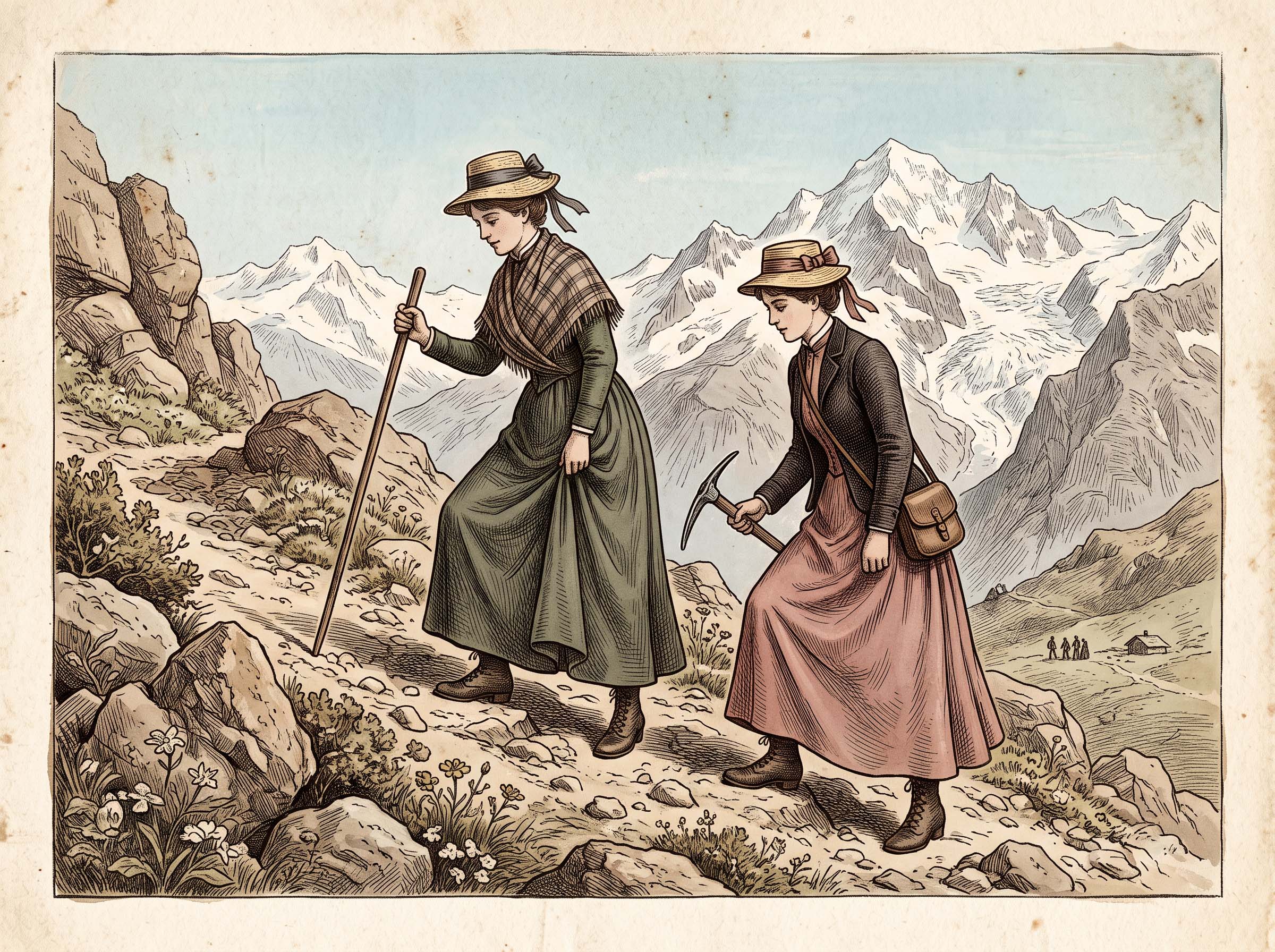
The Women Who Climbed in Skirts
Lucy Walker became the first woman to reach the summit of the Matterhorn in 1871, wearing the long skirts of her era. She was not an outlier — Victorian and Edwardian women were climbing, rambling and cycling in full-length dress throughout the period.
The Rational Dress Society, founded in London in 1881, argued for divided skirts and lighter undergarments. The bicycle craze of the 1890s did more to settle the argument than any pamphlet ever managed. Today's hiking trouser is the quiet descendant of that debate.
The awkward trail stop is not a modern invention. It is a very old design problem that women solved, for roughly a century, in a way that startles most people who learn about it.
Nineteenth-century women's drawers were generally made as two separate legs joined only at a waistband, with the crotch seam left open. Costume historians are direct about why: beneath a corset, a crinoline and three or four petticoats, removing an undergarment was close to impossible. The open seam was not a curiosity. It was the practical answer of its day, and it stayed in production into the 1920s.
Which means the Victorian mountaineer, whatever else she was contending with in twelve pounds of wool, had one part of the arrangement handled rather more efficiently than her great-granddaughter in technical trousers with a hip belt, a base layer and a jacket zipped over all of it. Progress, as usual, moved sideways before it moved forward.
Museum collections in North America and Europe hold hundreds of examples of open-seam drawers from the 1830s through the early 1900s — often trimmed with lace and fine whitework. Closed-crotch versions only became standard as skirts shortened and corsetry loosened.
Why the Walk Takes So Long
Part of the delay is not indecision. It is compliance.
The framework most hiking clubs teach is the seven principles published by the Leave No Trace Center for Outdoor Ethics, and the relevant one asks that waste be dealt with well away from water, trails and campsites — a distance commonly given as around 200 feet. The United States National Park Service publishes the same guidance, adding that paper and hygiene items are packed out rather than left behind. Some parks require everything to be carried out, with no exceptions.
Two hundred feet is most of a football field. Off-trail. Frequently uphill. The distance is the entire point of the exercise, and it is also why a woman who says she will be right back is being sincere and optimistic in equal measure.
What Turns Up in Trail Packing Lists
- A lightweight trowel — the single most-mentioned item in long-distance trail journals
- A sealable bag kept separate from everything else in the pack
- Hand sanitiser, stored somewhere reachable without unpacking
- A bandana, which appears on outdoor club lists for approximately nine unrelated reasons
- Trousers or shorts chosen for how fast they come apart, not how they photograph at the summit
The Reality Check
The physiology behind the trail stop is unremarkable and well described. Water consumption rises during exertion. Cold exposure and altitude are both associated with increased urine output in the research literature. None of that is mysterious, and none of it is a malfunction.
What no study has ever measured — and this is worth stating plainly — is whether the urge really does arrive at socially inconvenient moments more often than at convenient ones. It almost certainly does not. Memory is simply an unreliable record-keeper. The forty uneventful stops on quiet stretches of trail leave no impression at all; the one that coincided with a group photo and a passing school outing is filed permanently, in high resolution, and retold at dinner parties for a decade.
Frequency also varies enormously between individual women, and no figure anywhere qualifies as the correct one. The comparison a hiker makes against whoever in the group has apparently not needed to stop since 2019 is a comparison against a sample size of one.
For a woman planning a route on her own, incidentally, the entire calculation changes — no audience, no timeline, no commentary. Several long-distance hikers have observed that this is a genuinely underrated feature of walking alone.
The Closing Observation
The mountain has stood there for several million years without once glancing at a watch. The trees are unbothered. The marmot on the rock has no notes.
The pressure, it turns out, was never coming from nature at all. It was coming from four people at a switchback, holding trekking poles, being wonderfully, unbearably patient.
Questions Women Actually Search
Disclaimer: All content on this website—including articles, educational materials, and interactive calculators—is for informational, educational, and entertainment purposes only. The calculations, percentiles, and outputs generated by tools on this site are based on general statistical data and mathematical models; they do not constitute medical data, a clinical assessment, or a diagnosis.
Nothing contained on this website is a substitute for professional medical advice, diagnosis, or treatment. Always seek the guidance of a qualified healthcare professional or urologist with any questions you have regarding physical development, anatomy, or health conditions. Reliance on any information or tools provided by this website is solely at your own risk.