English
  Español


There is a candle burning, the phone is face-down, and the water is exactly the right temperature. By every measure, this should be relaxing. So why does the mind keep sprinting?
Most of what gets sold to women as calm is really comfort — pleasant, well-earned, and worth having. But comfort and a settled nervous system are not the same thing, and the gap between them explains why so many women can do everything “right” and still lie awake at eleven o’clock with a heart that will not slow down. A warm bath soothes the mood. It does not always tell the body it is safe.
That distinction is the whole point of this piece. Learning to steady the body is a skill with its own tools — many of them built around breath, movement, and quick physical resets that work through touch and temperature. Research on the body’s automatic wiring suggests these levers reach something a scented candle cannot: the ancient system that decides, second by second, whether you are at ease or braced for trouble.
What an “Overactive” Nervous System Actually Means
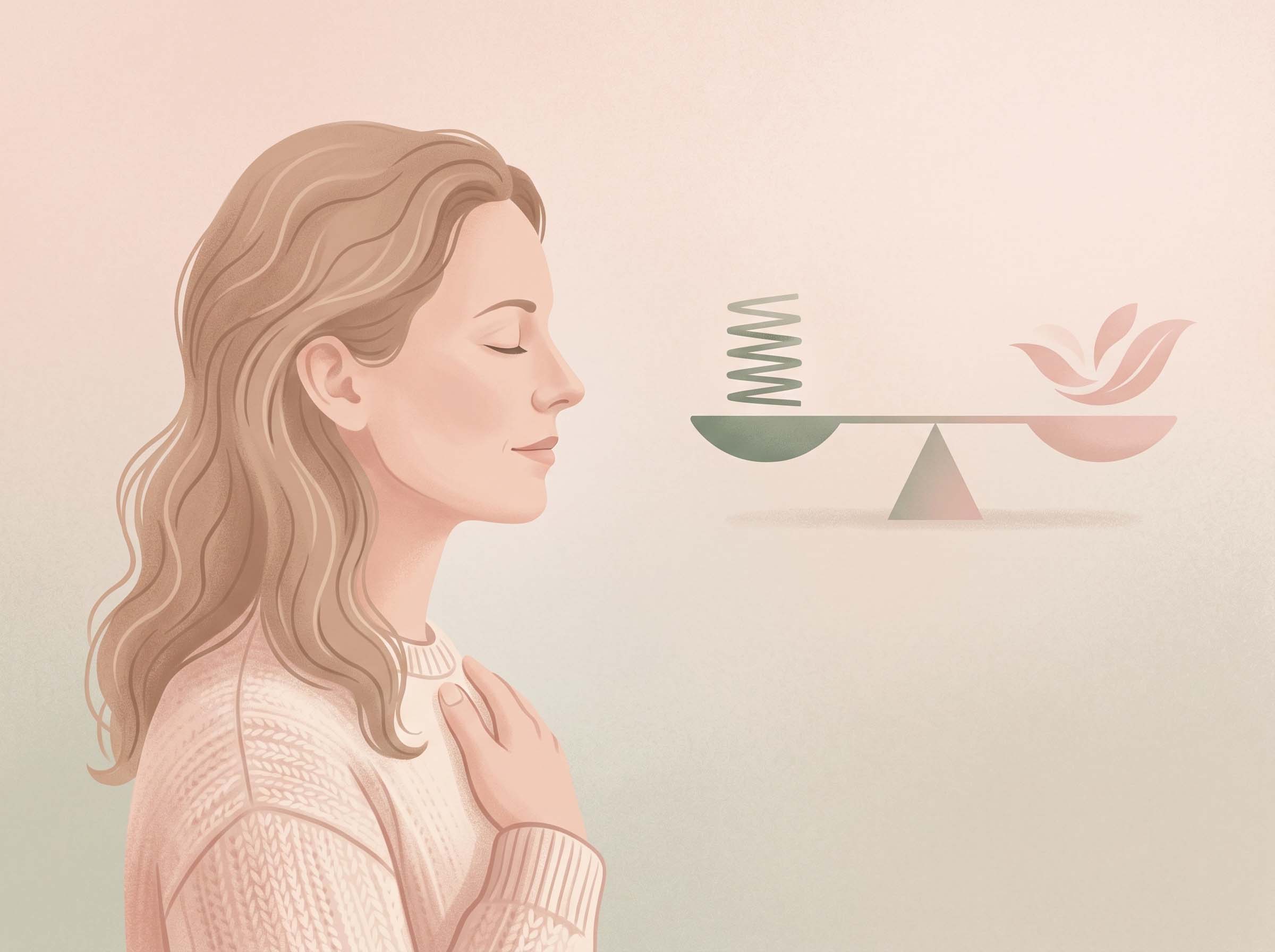
The phrase gets used loosely, so it helps to be precise. The part of the body doing the deciding here is the autonomic nervous system — the branch that runs without conscious effort, keeping the heart beating and the lungs moving. It has two settings that work like a seesaw. The sympathetic side speeds things up: heart rate climbs, breathing quickens, muscles ready themselves. Most women know it as “fight or flight.” The parasympathetic side does the opposite, easing the body back down into what researchers sometimes call “rest and digest.”
An overactive nervous system, in plain terms, is a seesaw that has gotten stuck on the fast side. The body keeps behaving as though a threat is present — jaw tight, stomach uneasy, sleep shallow — long after the actual stress has passed. Studies have explored how the modern day keeps this switch flipped: a full inbox, a crying toddler, a late text, and a calendar with no white space all read to the body a little like danger, even though none of them are.
The main line of communication on the calming side is the vagus nerve, a long pathway that runs from the brainstem down through the chest and belly. When it is doing its job well, the body drops out of high alert quickly and smoothly. Researchers even have a rough way of measuring how responsive it is, through small beat-to-beat changes in heart rate. The useful takeaway is not the anatomy lesson — it is that this system responds to physical signals far more than to good intentions.
The core idea: Self-care changes how a moment feels. Nervous-system regulation changes what the body is actually doing. They can overlap — but one is a comfort, and the other is a signal of safety sent straight to the wiring.
Why the Bubble Bath Isn’t the Answer (Even When It’s Lovely)
None of this is an argument against a good bath. A warm soak actually carries a small, real physical effect through heat and slowed breathing, and there is nothing wrong with pleasure for its own sake. The trouble starts when comfort is mistaken for a cure — when a woman buys the candle, runs the water, and then blames herself for still feeling wound tight afterward.
Much of what markets itself as “self-care” is really a pleasant distraction: it takes attention off the stress without discharging it. Regulation works from the body upward, giving the automatic system a clear physical cue that the emergency is over. The table below sorts the two, not to rank them, but to show which job each one is built for.
Why Women Feel This So Sharply
Men and women both share the same basic wiring, but research has explored some patterns that show up more often in women. One well-known line of work describes a “tend and befriend” response — a tendency, under pressure, to protect and to reach for others rather than simply to fight or flee. It is a reminder that connection has long been one of the body’s oldest calming strategies, and that a phone call with a steady friend or an afternoon caring for family can do real physical work.
Hormones add another layer. Many women notice that the same stressor lands differently depending on where they are in the month, and studies have looked at how shifting hormones across the month can raise or soften the body’s reactivity. Over the long run, a nervous system stuck on high has knock-on effects worth respecting — researchers have documented how sustained stress works on a woman’s body, from sleep and digestion to hormonal rhythm. For a broader view, the American Psychological Association keeps a plain-language summary of the documented physical effects of sustained stress.
What ties these threads together is an old truth in new language. The women who seemed to weather hard seasons best were rarely the ones with the most leisure. They were the ones with rhythm, company, and a body they knew how to bring back down — often without ever naming the science behind it.
What Actually Settles the Body
Here is the reassuring part. The tools that reach the automatic system are simple, free, and portable. None of them require a spare hour or a single purchase. Each works by sending the body a physical message that the coast is clear.
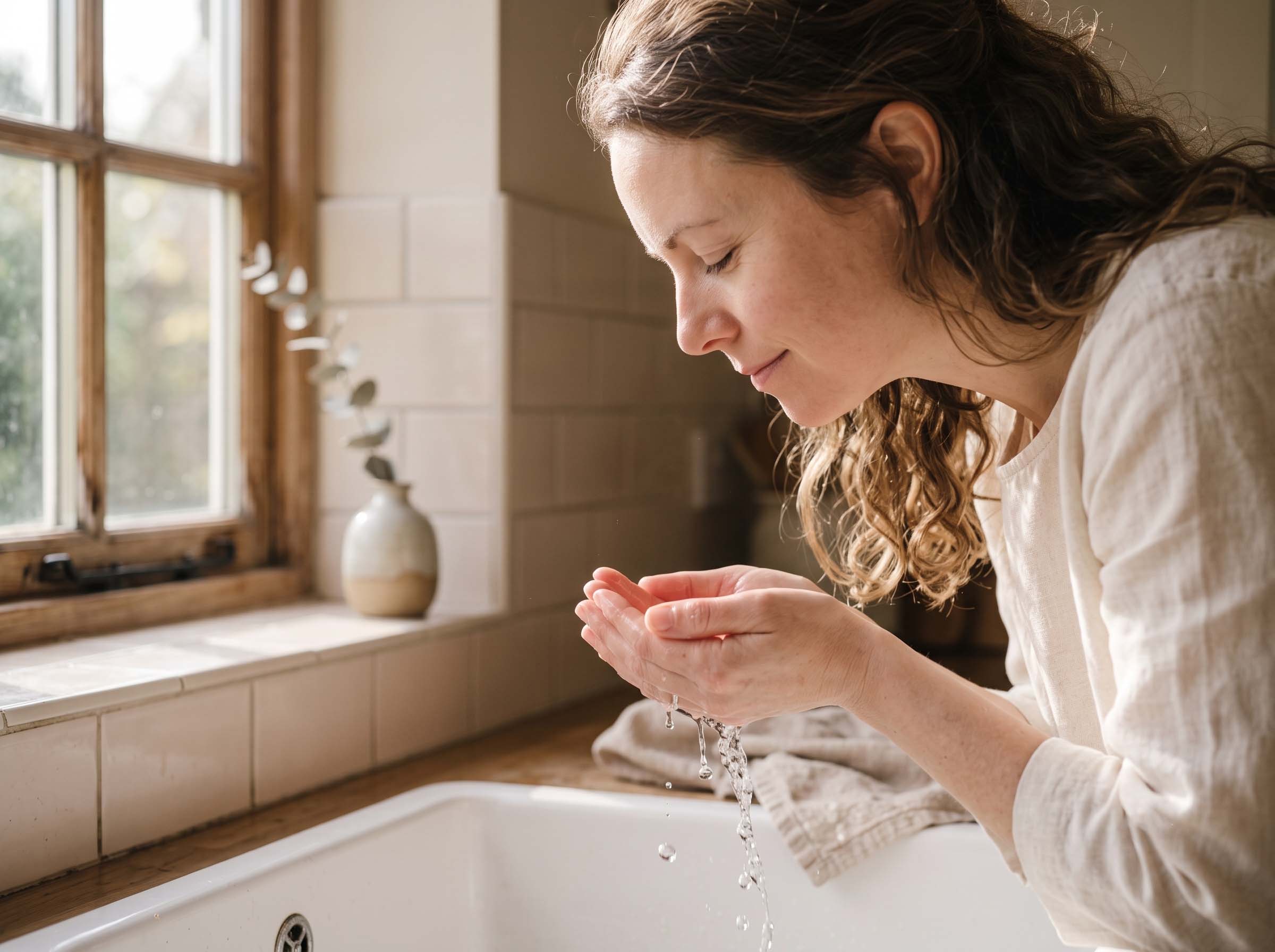
Did you know? A splash of cool water on the face can trigger a reflex the body shares with diving mammals — the heart rate dips and the system eases almost at once. It is one of the fastest calming cues available, and it costs nothing but a cold tap.
The most studied lever is breath, specifically the exhale. Slow breathing with a long, unhurried out-breath is one of the few voluntary actions that reliably tips the seesaw toward calm. Harvard Health has a readable primer on how slow, controlled breathing quiets an overactive stress response. Movement matters too: a brisk walk or a few flights of stairs gives a keyed-up body somewhere to put the energy, letting a stress response finish its arc instead of simmering. And touch closes the loop — a hand on the chest, a hug held a beat longer, the company of someone whose own calm the body can borrow.
“Calm is not something you buy for the evening. It is something you teach the body to find again.”
The other quiet secret is dosage. A settled nervous system is built the way fitness is — through small, frequent reps, not a single grand gesture on Sunday night. Sixty seconds of long exhales before the school run, a cold rinse at the sink, a real hug at the door: repeated often, these teach the body a new default. Many women report that the racing feeling loosens its grip not after one big reset, but after a fortnight of very small ones.
Try This at Home: The 90-Second Reset
No equipment, no privacy required — usable at the sink, in the car, or at your desk.
Steps
- Breathe in for a count of four.
- Breathe out slowly for a count of six or more — the long exhale is the active part.
- Repeat for six rounds, letting the shoulders drop each time.
- Finish with a splash of cool water on the face or wrists.
Do
Keep it short and frequent. Pair it with something you already do daily so it sticks.
Don’t
Wait until you are already overwhelmed. These work best as a daily habit, not a rescue.
A Gentler Way to Think About It
The bubble bath was never the villain. The problem was the promise attached to it — the quiet suggestion that if a woman just relaxed hard enough, the tension would lift on its own. It rarely does, because comfort and safety live in different parts of the body. One is felt in the mind; the other is spoken in the older language of breath, movement, and touch.
Learning that language is not a grand project. It is a handful of small, repeatable moves that fit inside an ordinary day — the kind a busy mother can do between the laundry and the pickup line. Keep the candle. Run the bath. Then, when the mind is still racing in the warm water, you will have something more than comfort to reach for: a real way to tell the body that the day is done, and it is safe to come back down.
Common Questions
Disclaimer: All content on this website—including articles, educational materials, and interactive calculators—is for informational, educational, and entertainment purposes only. The calculations, percentiles, and outputs generated by tools on this site are based on general statistical data and mathematical models; they do not constitute medical data, a clinical assessment, or a diagnosis.
Nothing contained on this website is a substitute for professional medical advice, diagnosis, or treatment. Always seek the guidance of a qualified healthcare professional or urologist with any questions you have regarding physical development, anatomy, or health conditions. Reliance on any information or tools provided by this website is solely at your own risk.