English
  Español


Let's begin with a scene you know well. You're standing in the shaving aisle of your local drugstore, razor in each hand, squinting at the price tags like you're defusing a bomb. In your left hand: a five-blade men's razor with a "precision trimmer" and a name that sounds like a sports car — the Mach Turbo Pro Elite, or something equally ridiculous. Price: $8.49. In your right hand: the women's version, almost identical in every meaningful way, except it comes in "Blush Rose" and features a "moisture ribbon" (water and aloe). Price: $11.29.
You buy the women's one anyway. Because the handle curves slightly differently and your shower caddy is, let's be honest, already a work of art.
Congratulations. You've just paid the Pink Tax.
"The Pink Tax isn't a conspiracy. It's just economics wrapped in a very feminine, very overpriced bow." — Clara Voss
The Pink Tax — the unofficial name for the price premium placed on products marketed to women — has been documented, debated, and complained about for decades. It's not technically a tax in the legal sense (though some states do still tax tampons as "luxury items," which is a comedic tragedy for another day). It's more of a cultural surcharge. A market-driven toll you pay at the checkout for the privilege of a product that smells like "ocean breeze" instead of "sport fresh."
And it's everywhere. Razors, shampoo, deodorant, dry cleaning, haircuts — even toys. Studies have found that products marketed to girls and women cost more than nearly identical products marketed to men and boys across virtually every consumer category. A Consumer Reports analysis of gender-based pricing found women regularly pay 7–13% more for comparable goods. Some researchers put the annual cost per woman even higher.
📊 By the Numbers
- 7–13% — average price premium women pay for comparable products
- ~$1,300+ — estimated annual extra cost per woman in the U.S.
- 40 states — still taxed tampons as non-essential goods at some point
- $0.48 — the average extra cost on a women's razor vs. the men's equivalent
- Personal care — the category with the most consistent gender-based pricing gap
Now, in fairness — and we are going to be fair here, because that's what makes satire actually sting — companies have a few explanations. Women's razors require different tooling, they say. The packaging costs more. Women's products have smaller production runs. There's research and development behind that moisture ribbon. Marketing to women is expensive because women, apparently, require more convincing to buy things.
Some of this is even partially true. But only partially. And "partially true" doesn't quite cover the full absurdity of the situation, which becomes clearest when you look at history.
A Brief, Humiliating Tour of Vintage Advertising
If you want to understand how we got here, a quick trip through the archives of 20th-century advertising is both instructive and deeply, deeply funny. Advertisers in the 1940s and 1950s were remarkably direct about their feelings toward women as consumers. Women, the ads told us, were sentimental, easily influenced by color, and incapable of resisting anything described as "new" or "fresh." They bought things because of how those things made them feel, not because of specifications or value.
So marketers leaned in. Pink it up, soften the edges, add a floral motif, and women will pay more. It worked then. And — here's the uncomfortable part — the data suggests it's still working now.
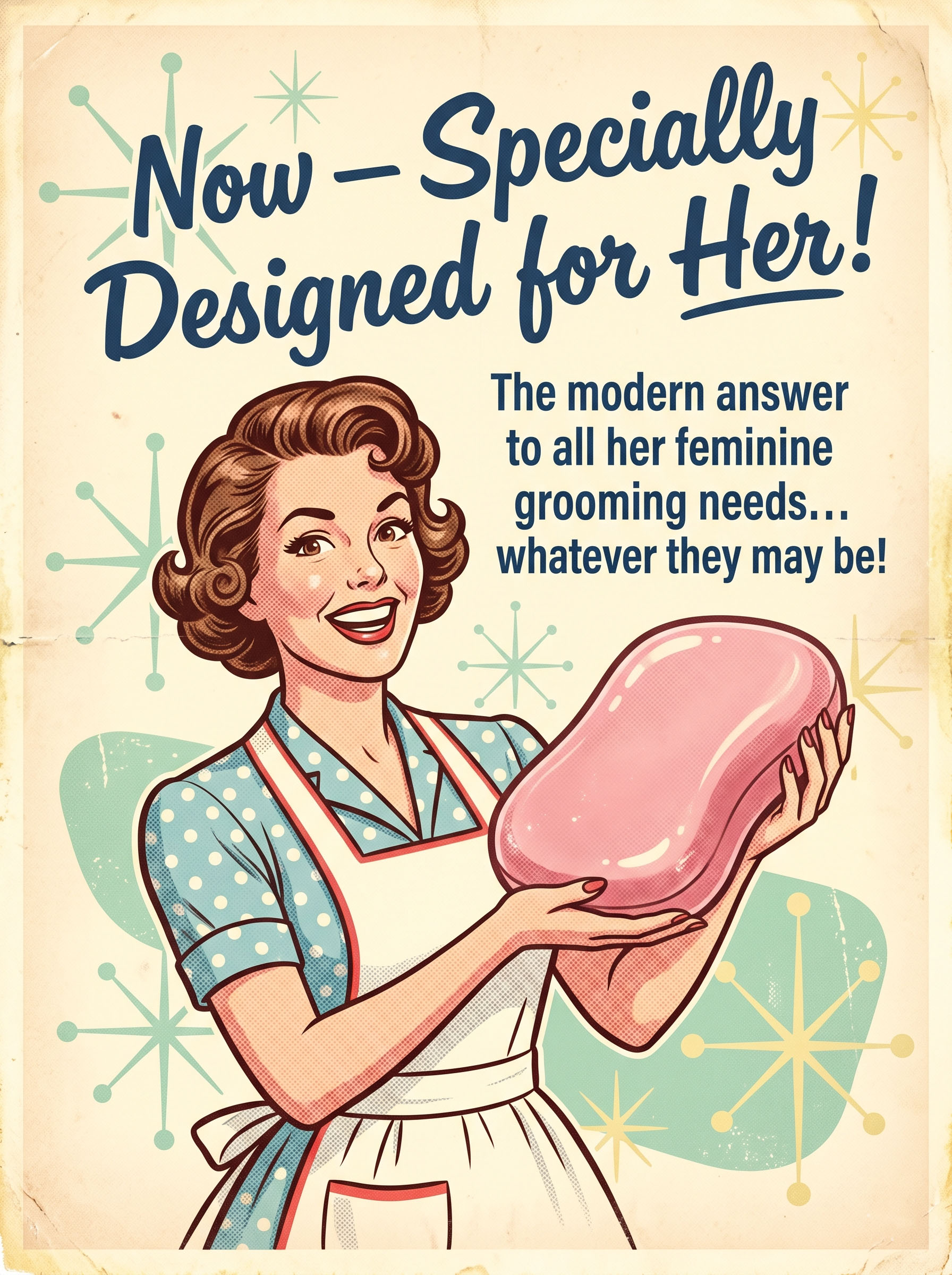
One 1953 Gillette ad aimed at women boasted that their new razor was "designed for a woman's hand" — it was slightly lighter and came in pink. The men's version of the same razor cost less. Women were thrilled. They had their own razor now. It was theirs. It was pink.
We have learned nothing, and we have also learned everything.
🌍 Cultural Insight
France made waves in 2016 when its government pushed retailers to eliminate gender-based pricing disparities. The EU has also taken steps to address gender-based VAT inequities on period products. Meanwhile, in the U.S., states have moved at their own pace — some eliminating the tampon tax, others still debating whether menstrual products constitute a "luxury." The global conversation is ongoing — and only slightly less maddening than the problem itself.
The modern Pink Tax is subtler than its vintage counterpart, but no less reliable. Walk into any big-box store and try this exercise: find the "men's health" aisle and the "women's health" aisle. Compare the products. Count the price differences. Then go home and make a cup of tea, because you will need it.
Dry cleaning is a particularly egregious case. Women's blouses frequently cost more to launder than men's dress shirts — despite being smaller, lighter, and requiring less fabric to make. The standard explanation is that women's clothing is more varied in style and harder to machine-press. Which is true. And also which explains everything about why women's fashion has always been more complicated, more expensive, and more inconvenient than men's — and why that inconvenience has historically been passed on to women at every possible stage.
The Razor Is Just the Messenger
Here's the thing about the Pink Tax that gets lost in all the outrage: the razor isn't the enemy. The razor is just a razor. What's actually being sold — what has always been sold to women — is the idea that products specifically for us are worth more. That femininity, as a quality, has a premium attached. That feeling pretty, smelling nice, and having soft skin is a luxury that costs extra.
💡 Worth Knowing
Some brands have started marketing "gender-neutral" versions of personal care products at lower prices. If you're curious whether the men's version of your shampoo, deodorant, or razor is a functional equivalent — it very often is. Reading the ingredient label takes about 45 seconds and can save you real money over a year.
And women have been told this so consistently, for so long, that many of us genuinely prefer the pink version. Not because it's better. But because it feels like ours. Because the marketing worked. Because soft-focus advertising featuring women laughing in meadows is, against all logic, still extremely effective on most of us — including the ones writing articles about it.
This is not a character flaw. It is the result of approximately 80 years of targeted consumer psychology, and honestly, it's impressive in a deeply depressing sort of way.
| Product | Men's Price (avg.) | Women's Price (avg.) | Difference |
|---|---|---|---|
| Disposable Razor (5-pack) | $8.49 | $11.29 | +33% |
| Deodorant (same brand) | $4.79 | $5.49 | +15% |
| Shampoo (comparable volume) | $5.99 | $7.49 | +25% |
| Dry Cleaning (button-down shirt) | $2.25 | $4.95 | +120% |
| Haircut (comparable length/style) | $18–$25 | $35–$65 | +50–160% |
*Prices are approximate averages for illustrative purposes based on commonly reported retail data.
What Can You Actually Do About It?
Complaining of course, we always do it, is the first and most satisfying option. Complaining loudly, at dinner, to people who also use women's deodorant, creates a sense of community that no amount of "ocean breeze" scent has ever managed to replicate. But if you'd like to also save money — actual, real money — there are a few practical moves worth considering.
First: read labels. Many men's personal care products — shampoos, body washes, face moisturizers, even razors — are functionally identical to their women's counterparts. The active ingredients are the same. The blade count is the same. The only meaningful difference is the packaging, the scent, and the price. If you can live with "Arctic Rush" instead of "White Peach Blossom," the men's version will cost you less and do the same job. A good first step is checking the Federal Trade Commission's consumer guidance on deceptive pricing practices — it's a useful lens for understanding when marketing crosses into manipulation.
Second: buy generic. Store-brand versions of personal care products have improved dramatically in quality over the past decade. The store-brand razor is not glamorous, but it shaves. That's the job. It does the job.
Third: shop men's sections without guilt. There is nothing on earth stopping you from buying a men's deodorant if it costs less and works the same. Nothing. The checkout clerk will not say anything. The razor will not know. The only person who will care is you, and you can get over it in approximately twelve seconds.
🌸 Did You Know?
The term "Pink Tax" was popularized in the U.S. following a 2015 New York City Department of Consumer Affairs study that compared pricing on nearly 800 products and found women's items cost an average of 7% more than similar products for men. The study covered toys, accessories, clothing, personal care, and home health goods — and the price gap existed in every single category.
The Part Where We All Laugh and Then Feel Slightly Sad
Here's the honest conclusion: the Pink Tax is absurd. It is also, for the moment, real. It exists because companies found that women would pay more for products positioned as "for them," and because that pattern repeated itself often enough to become standard practice across entire industries. It persists partly because of legitimate cost differences in some cases, partly because of inertia, and partly because — and we must be honest here — women have kept buying the pink one.
That doesn't make it our fault. Knowing a system is rigged doesn't mean you have the time and energy to fight it every Tuesday afternoon in the drugstore aisle. Most of us have children to pick up, dinners to plan, and approximately four minutes of personal shopping time. We grab the familiar product and move on.
But every now and then, it's worth pausing for a moment in the shaving aisle. Looking at both razors. Doing the math. And choosing — at least occasionally — to put the pink one back.
Or not. Maybe you really like how that handle curves.
Either way, you're doing it knowingly now. And that counts for something.
Your Questions, Answered
Disclaimer: All content on this website—including articles, educational materials, and interactive calculators—is for informational, educational, and entertainment purposes only. The calculations, percentiles, and outputs generated by tools on this site are based on general statistical data and mathematical models; they do not constitute medical data, a clinical assessment, or a diagnosis.
Nothing contained on this website is a substitute for professional medical advice, diagnosis, or treatment. Always seek the guidance of a qualified healthcare professional or urologist with any questions you have regarding physical development, anatomy, or health conditions. Reliance on any information or tools provided by this website is solely at your own risk.