English
  Español



Some museum pieces arrive in glass cases. This one arrived as a sentence, carried home from Philadelphia in the memory of a 26-year-old mother in the spring of 1887. The doctor who spoke it was Silas Weir Mitchell, the most celebrated nerve specialist in America.
The patient was Charlotte Perkins Stetson, a young wife from Providence, Rhode Island, whose daughter was barely two. Decades later, writing as Charlotte Perkins Gilman, she set down what she remembered him telling her: to "live as domestic a life as far as possible," to "have but two hours' intellectual life a day," and "never to touch pen, brush or pencil again" as long as she lived.
The prescription was never filed in a medical journal. It survives because the patient kept it, and because she spent the next five years turning it into one of the most widely read short stories in American literature. The treatment it answered, known simply as the rest cure, now sits as a small exhibit in a much larger collection: the long history of confident medical theories about women that once passed for settled science, a collection that reaches all the way back to the ancient notion of the wandering womb.
In Brief
- In 1887, the celebrated neurologist S. Weir Mitchell prescribed his famous rest cure to a young mother named Charlotte Perkins Stetson, later known as Charlotte Perkins Gilman.
- The cure called for weeks in bed, separation from family, heavy feeding and a near-total ban on reading and writing.
- Five years later she published The Yellow Wallpaper, a short story widely read as her answer to the doctor.
- The rest cure faded in the early twentieth century as medicine's ideas about nerves, work and the mind changed.
The Doctor Who Treated Tired Nerves
It would be easy to cast Weir Mitchell as a villain, and the record does not support it. Born in Philadelphia in 1829, he made his name during the Civil War at Turner's Lane Hospital, where he and his colleagues studied soldiers with gunshot injuries to the nerves. That work was genuinely groundbreaking, and Mitchell became one of the most respected figures in early American neurology. He also published novels and poetry, which made him something rarer than a famous doctor: a famous doctor whom literary Philadelphia wanted at its dinner table.
Among the wounded soldiers, Mitchell saw that rest, careful feeding and quiet often helped broken bodies mend. After the war he carried the same logic into a different consulting room. His new patients were mostly well-to-do women who arrived exhausted, low in spirits and unable to carry on with ordinary life. The fashionable diagnosis was neurasthenia, a term popularized by the New York physician George Miller Beard in 1869 to describe nerves that had simply run out of strength.
Beard and his followers pictured the nervous system as something like a battery holding a limited charge. Modern life, with its railways and its telegraph wires, drained it faster than earlier generations had known. Women, the theory held, started out with a smaller supply. Within that framework, a woman who read too much or worried too long was spending capital she did not have.
Mitchell's 1871 book Wear and Tear warned that girls pushed too hard at school risked lasting harm to their constitutions. His 1877 volume, bluntly titled Fat and Blood: And How to Make Them, laid out the remedy. If the battery was empty, the physician's job was to stop every drain on it and let it recharge. Seen from inside the nineteenth century, it was a tidy piece of reasoning. The trouble lay entirely in the premise.
Six Weeks in a Quiet Room
The rest cure, as Mitchell described it, typically ran six to eight weeks. The patient was separated from her household, often including her husband and children, and placed in the care of a hired nurse. She was kept in bed, at first not permitted to sit up, read, write or feed herself. Her diet began with milk in small, frequent servings and grew steadily into large, rich meals. Daily massage and mild electrical stimulation stood in for exercise, intended to keep her muscles from weakening while she lay still. Visitors and letters were restricted.
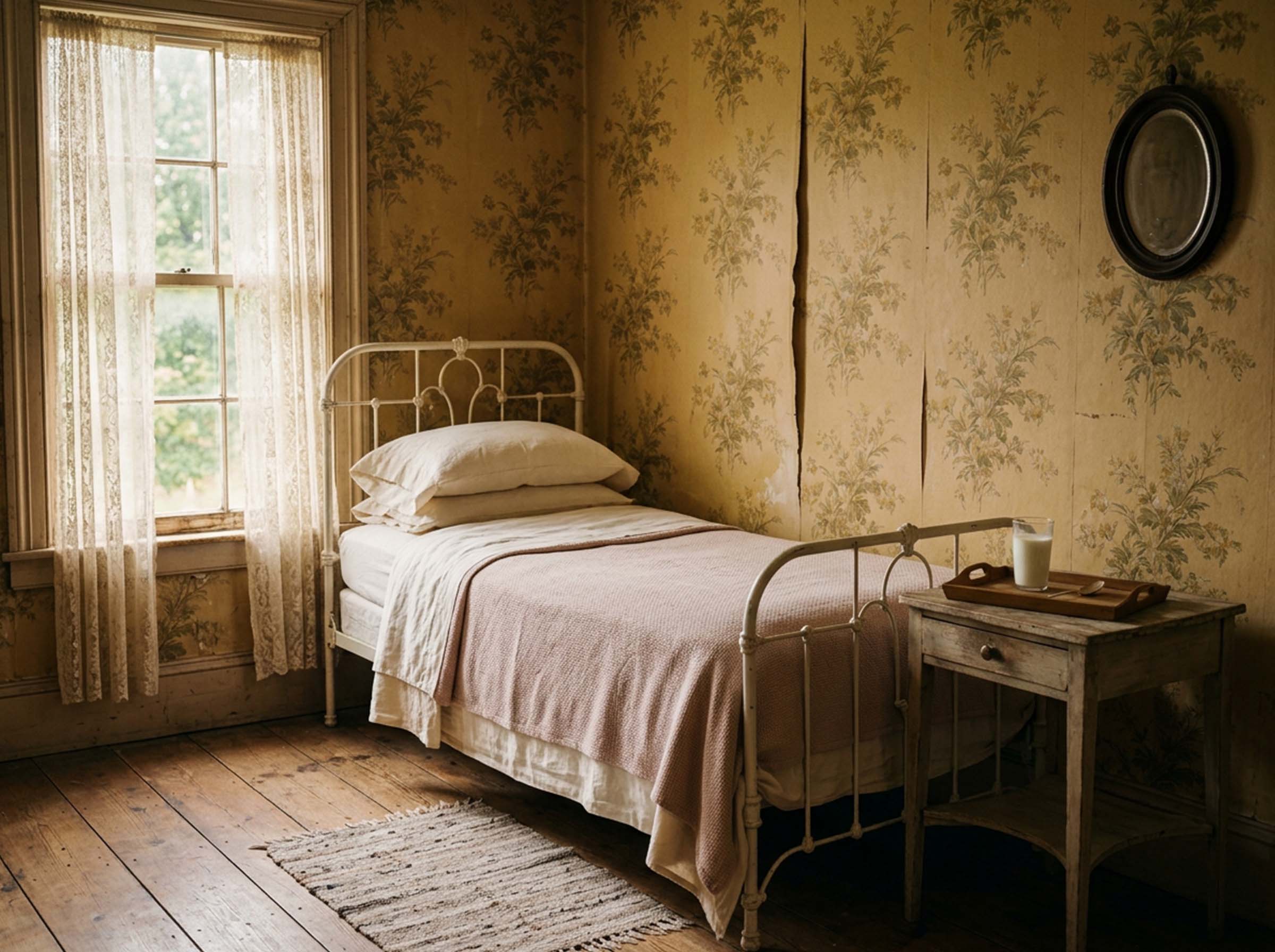
Mitchell's own writings treated obedience as part of the treatment rather than a side effect of it. The patient was expected to set aside her own judgment in favor of the physician's, and the enforced idleness was meant, in part, to make ordinary activity look appealing again. By many accounts a good number of his patients credited him with their recovery, and the method spread to Britain and continental Europe.
Men diagnosed with the very same exhausted nerves were often handled quite differently. Rather than confinement, some were sent outdoors to ranches and open country in the American West, to ride and work with their hands. The novelist Owen Wister, whose family Mitchell knew well, went to Wyoming in 1885 on the doctor's advice, and the experience later fed into his classic western The Virginian. Historians have since nicknamed this approach the "West cure." Same diagnosis, opposite prescription.
One Diagnosis, Two Prescriptions
| The Rest Cure | The "West Cure" | |
|---|---|---|
| Usually prescribed to | Women, most of them affluent | Men, most of them affluent |
| Setting | A closed room, away from home and family | Ranches and open country in the West |
| Daily activity | Bed rest; reading and writing forbidden | Riding, outdoor labor, often writing letters and journals |
| Underlying idea | Stop all drain on depleted nerves | Rebuild vigor through strenuous living |
| Best-known literary result | The Yellow Wallpaper (1892) | The Virginian (1902) |
Generalized for comparison; individual treatment varied from patient to patient.
The Patient Writes Back
Charlotte Stetson spent about a month under Mitchell's care in Philadelphia and went home with the instructions quoted above. She followed them faithfully. By her own later account, the months that followed brought her closer to complete collapse than she had ever been. The National Library of Medicine's exhibition on Gilman and the rest cure traces this period in detail, setting her letters and later recollections beside Mitchell's published methods.
In 1888 she and her husband, the painter Charles Walter Stetson, agreed to separate. She moved with her young daughter to Pasadena, California, and began to write and lecture for a living. Work, the very thing she had been told to give up, was what she later credited with bringing her back. The decision carried a real cost. After the divorce became final in 1894, her daughter Katharine went east to live with her father and his new wife, Grace Ellery Channing, who had been Charlotte's close friend. The press of the day was unsparing toward a mother who let her child go, and the arrangement remained one of the more painful chapters of her life.
Over two days in June 1890, she wrote The Yellow Wallpaper. Its narrator is a young mother, recently delivered of a baby, whose husband John is a physician. He rents a colonial mansion for the summer and settles her in an upstairs room, once a nursery, covered in peeling yellow paper. She is forbidden to work or write. She writes anyway, in secret, and the journal entries she hides from him make up the story. With nothing else to occupy her mind, she grows fixed on the wallpaper's pattern and on a figure she begins to see behind it. On the final page, her husband walks into the room and faints at what he finds.
"The doctor's prescription survives only because the patient remembered it, and then spent the rest of her life answering it."
Gilman made the target unmistakable. Early in the story the narrator mentions that if she does not improve faster, John will send her "to Weir Mitchell in the fall." The line lands as a threat, and readers in 1892 would have recognized the name at once. Getting the piece into print took some persistence. The editor of The Atlantic Monthly turned it down, and it finally appeared in The New England Magazine in January 1892. The story is short enough to read in a single evening, and the full text of The Yellow Wallpaper is freely available through Project Gutenberg.
Did You Know?
Horace Scudder, the Atlantic editor who rejected the story, explained his decision in a single line: "I could not forgive myself if I made others as miserable as I have made myself!"
Nearly three decades later, the novelist William Dean Howells included it in his 1920 anthology The Great Modern American Stories, an early sign of the reputation it would eventually earn.
Gilman sent a copy to Mitchell. He never acknowledged it. In a short essay published in 1913, "Why I Wrote The Yellow Wallpaper," she said the story had been meant to spare other women the same treatment. She added that she had been told, many years afterward, that the great specialist had privately admitted to altering his methods since reading it. No independent record confirms that claim, and historians treat it with caution. It may have been true. It may also have been the kind of news a writer is glad to believe.

From Prescription to Page: A Short Timeline
1869
George Miller Beard popularizes "neurasthenia," the diagnosis of exhausted nerves.
1877
Weir Mitchell publishes Fat and Blood, setting out the rest cure.
1885
Owen Wister heads to Wyoming on Mitchell's advice.
1887
Charlotte Perkins Stetson takes the rest cure in Philadelphia.
1892
The Yellow Wallpaper appears in The New England Magazine.
1913
Gilman publishes "Why I Wrote The Yellow Wallpaper." Mitchell dies the following year.
1917
Occupational therapy is organized as a profession, built on the opposite idea: purposeful work.
Why the Cure Lost Its Patients
The rest cure did not vanish overnight. Variations were still being prescribed in London in the early 1900s, when the young Virginia Woolf was ordered to bed, fed generously and kept from writing during several periods of illness. She repaid the favor in Mrs Dalloway (1925), whose fashionable physician Sir William Bradshaw prescribes rest and "a sense of proportion" with perfect, chilling confidence.
What changed was the theory underneath. The battery model of the nerves gave way as new ideas about the mind took hold, among them the "talking cure" emerging from Vienna and a growing conviction that a troubled mind needed engagement more than silence. In Massachusetts, the physician Herbert J. Hall began promoting what he called the work cure in the early 1900s, giving patients handicrafts such as weaving and pottery in place of bed rest. That movement helped give rise to occupational therapy, formally organized in 1917. Neurasthenia itself slipped out of favor in American medicine in the years between the wars, its sprawling list of complaints divided among newer, narrower categories.
Mitchell died in 1914, honored at home and abroad, his standing as a neurologist intact. It is one of the quieter ironies in this archive that the patient he told never to write recovered by writing, and that the approach medicine eventually adopted looked rather more like her busy life in California than like his quiet room in Philadelphia.
What Historians See Now
Enforced isolation and a ban on reading or work are no longer regarded as restorative, and the rest cure is studied today mainly as a historical artefact. Historians of medicine tend to read it less as cruelty than as a coherent system built on mistaken premises: the notion of a fixed store of nervous energy, of which a woman supposedly held less, and the assumption that the doctor's authority was itself a kind of medicine. Both made sense to educated men and women of the 1870s. Neither survived the century that followed, and the cure now takes its place in the long record of how history misunderstood the female form.
The phrase most worth lingering over in Mitchell's prescription may be the one least often quoted: live as domestic a life as possible. Generations of women have found deep meaning in home and family, and Gilman's story is not an argument against either. Its complaint is narrower and harder to wave away. A household chosen is a life. A household prescribed, with the books taken away and the pen forbidden, was a treatment, and the woman in the yellow room is what that treatment looked like from the inside.
Questions Readers Ask About the Rest Cure
Disclaimer: All content on this website—including articles, educational materials, and interactive calculators—is for informational, educational, and entertainment purposes only. The calculations, percentiles, and outputs generated by tools on this site are based on general statistical data and mathematical models; they do not constitute medical data, a clinical assessment, or a diagnosis.
Nothing contained on this website is a substitute for professional medical advice, diagnosis, or treatment. Always seek the guidance of a qualified healthcare professional or urologist with any questions you have regarding physical development, anatomy, or health conditions. Reliance on any information or tools provided by this website is solely at your own risk.