English
  Español



For more than a century, nearly everyone agreed on the story: the vibrator was built so Victorian doctors could relieve their female patients of "hysteria." It is a wonderful story. It is also, according to the documented record, mostly untrue — and the real history is far stranger.
- The first electromechanical vibrator was invented in the early 1880s by British physician Joseph Mortimer Granville — as a nerve-and-muscle tool, primarily for men.
- Granville openly refused to use his device on women he considered "hysterical," and said so in print.
- The famous claim that Victorian doctors routinely used vibrators to bring women to climax was popularized in 1999 — and largely debunked by historians in 2018.
- The device's later life as a tool of personal pleasure was a twentieth-century story, not a Victorian one.
Few objects carry as much cultural mythology as the electric vibrator. The tale usually goes like this: overworked physicians in tightly corseted Victorian clinics were treating an epidemic of "hysteria" by hand, grew tired, and gratefully adopted a new machine that did the job faster. It is repeated in documentaries, a hit film, a Broadway play, and hundreds of books. It is tidy, scandalous, and satisfying. It is also a useful reminder of how easily medicine has misread the female body across the centuries — because in this case, it was later historians who did the misreading.
An ancient diagnosis with a wandering explanation
To understand the machine, first understand the disease it supposedly treated. "Hysteria" was one of the oldest diagnoses in Western medicine, and one of the most elastic. The word itself comes from the Greek hystera, meaning womb. Ancient physicians proposed that a woman's uterus could shift position inside the body, producing a bewildering range of complaints — anxiety, breathlessness, irritability, fainting, insomnia, and much more.
For roughly two thousand years, "hysteria" served as a catch-all label pinned onto women whose symptoms doctors could not otherwise explain. By the nineteenth century it had become a booming diagnosis in Europe and America, applied to everything from restlessness to unhappiness in marriage. That vagueness matters. A condition defined this loosely could absorb almost any treatment — herbal, electrical, mechanical, or otherwise — without anyone being able to prove it worked.
The machine that was never meant for women
The first electromechanical vibrator appeared in the early 1880s, invented by the British physician Joseph Mortimer Granville and manufactured by the London instrument maker Weiss. Granville called it a percuteur — colloquially, "Granville's hammer." It was a battery-powered handheld device with a small motorized head that delivered rapid, adjustable taps to the body.
Granville had a theory. He believed the nervous system ran on a kind of vibration, and that rhythmic mechanical stimulation could restore depleted "nerve force," easing pain from neuralgia, sciatica, rheumatism, and muscular fatigue. Crucially, he designed and promoted the tool for these somatic complaints — and largely for male patients. His own writing on the subject, the 1883 volume Nerve-Vibration and Excitation, is where the myth quietly collapses.
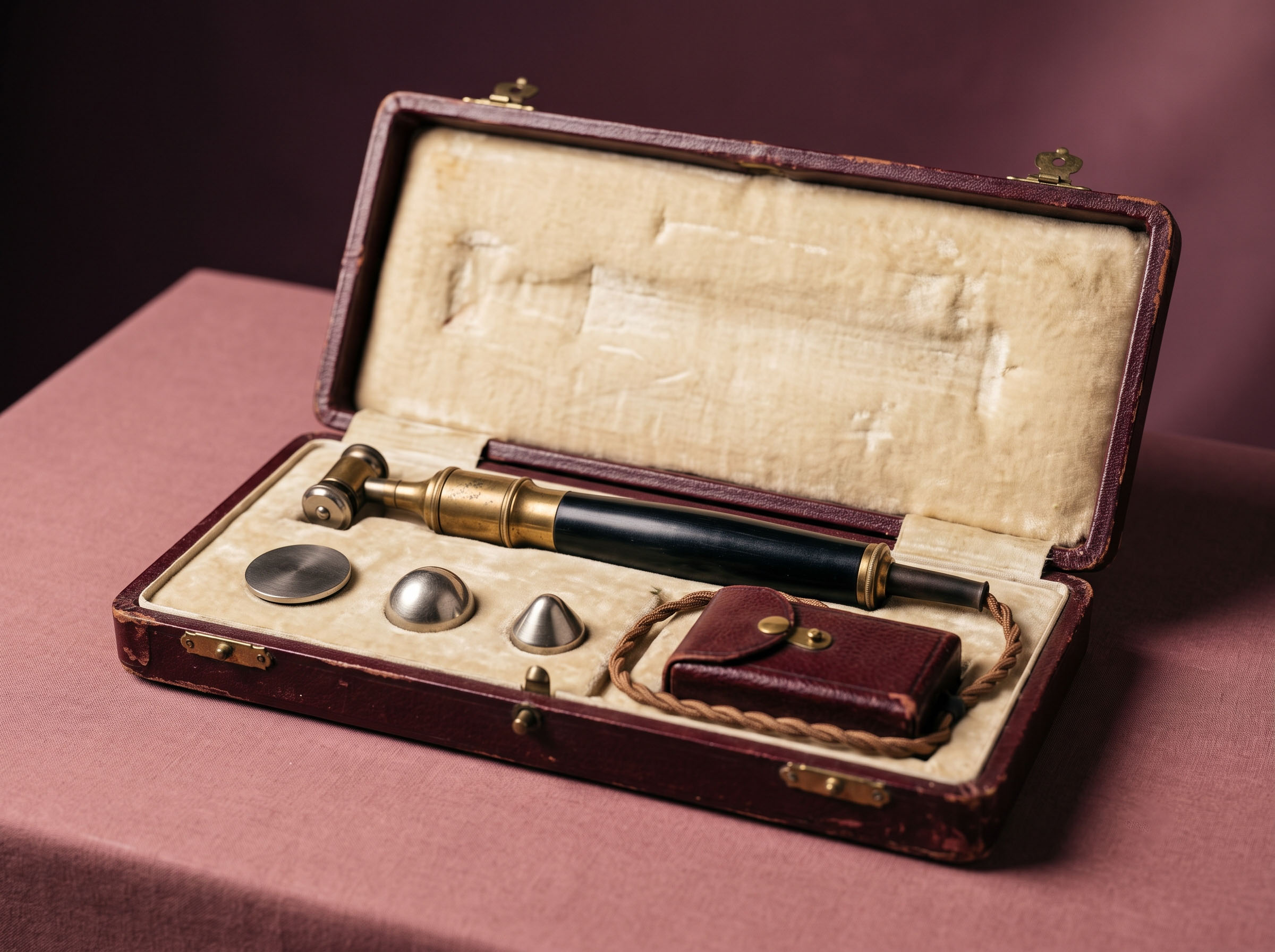
Far from championing his device as a treatment for hysteria, Granville explicitly refused to use it on such patients. He wrote that he had never percussed a female patient, and made plain that he did not want his instrument associated with what he regarded as the unreliable theatrics of the hysterical diagnosis. When later practitioners began using his invention in ways he disapproved of, he distanced himself from it. You can still see one of his original devices, preserved in the Smithsonian's National Museum of American History collection, catalogued exactly as what it was: an instrument for nerve vibration.
The inventor of the vibrator wanted nothing to do with treating women. Granville considered the "hysterical state" too unpredictable to study honestly, and reserved his device for muscular and nerve complaints — the polar opposite of the story most of us have been told.
The vibration craze — and the parlour appliance
Whatever Granville intended, vibration therapy became a genuine medical fashion. Between the 1880s and the 1920s, "mechanotherapy" swept through clinics and spas on both sides of the Atlantic. Doctors and entrepreneurs marketed vibrating devices as cures for an astonishing list of ailments — poor circulation, digestion, headaches, hair loss, fatigue. It was, in the language of the era, a wonder therapy, and like most wonder therapies it promised far more than it could deliver.
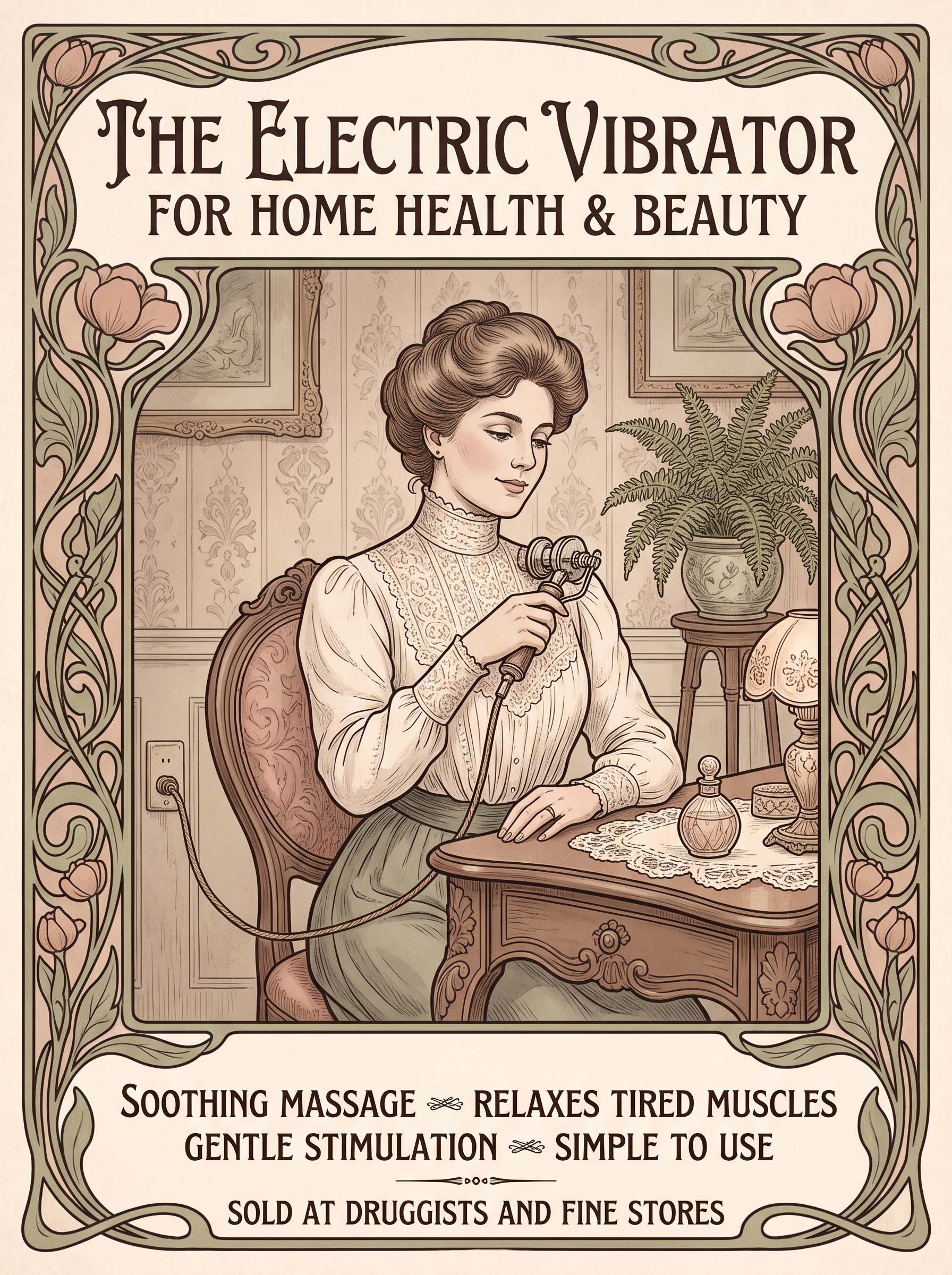
By the early 1900s the vibrator had moved out of the clinic and into the home. American mail-order giants sold electric vibrators as respectable household appliances, advertised in mainstream publications and even in the Sears catalogue, sitting comfortably beside toasters and sewing machines. The marketing was carefully veiled. Companies promoted the devices for aches, "vigor," beauty, and general wellbeing — while a quieter subtext, and a range of suggestive attachments, hinted at other uses. Historians who have studied these advertisements describe a deliberate strategy of respectable cover, one that let a sexually adjacent product circulate freely in an age of strict obscenity laws.
That careful cover held until the late 1920s, when vibrators began appearing in early pornographic films. Once the private use was made public and undeniable, the social camouflage failed. Respectable catalogues dropped them, and the device retreated from polite view for decades.
"The device did not fall from the clinic into the bedroom. It was carried there, slowly, by advertising, invention, and a century of quiet demand."
The story that was too good to check
So where did the familiar legend come from? In 1999, the historian Rachel Maines published The Technology of Orgasm, arguing that Victorian physicians had routinely treated hysteria by manually stimulating female patients to what they primly called a "hysterical paroxysm" — and that the vibrator was adopted as a labour-saving device to speed up the task. The claim was electric. It won a prestigious history award, inspired the 2011 film Hysteria and a celebrated stage play, and was repeated in dozens of books and articles as established fact.
There was only one problem. In 2018, historians Hallie Lieberman and Eric Schatzberg went back through every primary source Maines had cited to support her central claim. They found that none of them actually documented physicians using vibrators to induce orgasm in patients as a treatment. Their paper, published in the Journal of Positive Sexuality, argued that a captivating narrative had passed into scholarship and popular culture without anyone verifying its foundation. Maines herself later acknowledged that her idea had always been, in her words, "an interesting hypothesis" — not a proven fact.
This is the genuinely fascinating part of the history, and it belongs squarely in the long tradition of myths written onto women's bodies. The reason the story spread was not evidence. It was appeal. It flattered modern readers as enlightened, cast the Victorians as comically repressed, and offered the frisson of a doctor-patient scandal dressed in academic respectability. Journalists have a phrase for claims like this: too good to check. As the historian Hallie Lieberman has documented in tracing the device's real path, the vibrator's history is messier, quieter, and more commercial than the myth allows.
The rediscovery — a twentieth-century chapter
The device's transformation into an openly personal object came much later, and it was driven not by physicians but by women themselves. When the Japanese company Hitachi introduced its plug-in Magic Wand to the American market in 1968 — sold, officially, as a body massager — a new generation quietly rediscovered its possibilities. Sex educator Betty Dodson championed the wand in her workshops, and by the mid-1970s a wave of women-run shops in San Francisco and New York were selling it frankly, for pleasure rather than paroxysm.
The corporate awkwardness lingered for decades. Hitachi continued to market the wand strictly as a massager, and did not publicly acknowledge its best-known use until 2013 — long after everyone else had. In that gap between the official product and its actual life, you can read the whole strange arc of this history in miniature: a device forever described as one thing while functioning as another.
What the history reveals
Strip away the legend and a quieter, more honest picture remains. The vibrator was invented as a sincere, if mistaken, medical instrument. It rode a wave of Victorian enthusiasm for electricity and vibration. It slipped into the home under a veil of respectable marketing, vanished when that veil was torn, and was reclaimed generations later as an object of personal life.
The most revealing thread is not the machine at all. It is the human appetite for tidy stories about women's bodies — an appetite so strong that even careful scholars, prize committees, and filmmakers embraced a narrative that the sources never supported. For two thousand years, confident men explained the "wandering womb." For two decades, confident readers repeated a Victorian sex myth. The details change; the pattern is remarkably durable. The real history of the vibrator is worth knowing precisely because it shows how a good story, told often enough, can quietly become the thing we call the past.
Questions Readers Ask
Disclaimer: All content on this website—including articles, educational materials, and interactive calculators—is for informational, educational, and entertainment purposes only. The calculations, percentiles, and outputs generated by tools on this site are based on general statistical data and mathematical models; they do not constitute medical data, a clinical assessment, or a diagnosis.
Nothing contained on this website is a substitute for professional medical advice, diagnosis, or treatment. Always seek the guidance of a qualified healthcare professional or urologist with any questions you have regarding physical development, anatomy, or health conditions. Reliance on any information or tools provided by this website is solely at your own risk.