English
  Español



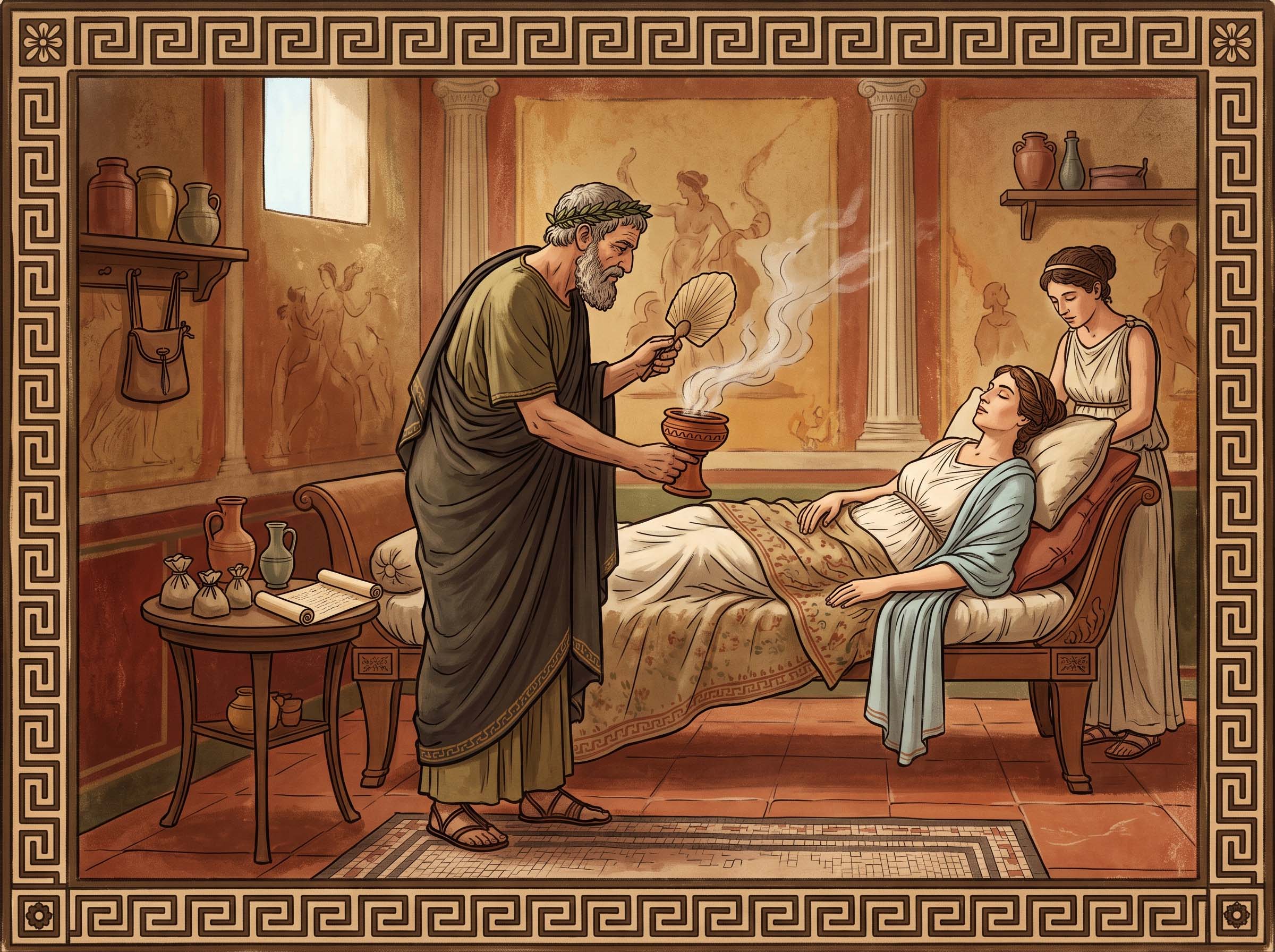
Picture a physician in ancient Athens kneeling beside a patient who cannot speak. Her chest feels tight, her limbs have gone still. He reaches not for her heart or her lungs but for a small clay pot of sweet-smelling herbs, which he sets near her feet. His reasoning is careful by the standards of his training: the woman’s womb has drifted upward and lodged where it should not be, and a pleasant scent placed low on the body will coax it back down.
This was not a fringe idea whispered at the margins of medicine. It was the mainstream, taught in the leading schools and written into the leading textbooks — one of the most durable myths about the female body ever put to paper.
For most of recorded history, physicians believed a woman’s uterus could roam her body at will. The story of how that idea rose, mutated, and finally fell is one of medicine’s strangest chapters.
The theory even carried the organ’s name. The Greeks called the womb hystera, and from it we still get the word hysteria. For roughly two thousand years, the belief that the uterus could wander shaped how doctors understood, diagnosed, and treated women. The history of the wandering womb theory is not a tidy tale of villains and victims. It is something stranger: a wrong idea so useful, so flexible, and so well-defended by authority that it outlived empires.
- Ancient Egyptian and Greek physicians taught that the womb could detach and travel upward through the body, causing illness.
- The Greek word for womb, hystera, gives us the word “hysteria.”
- Even after Renaissance anatomists proved the uterus is anchored in place, the belief survived by changing its shape.
- Careful measurement — much of it by early women physicians — is what finally retired the theory.
Where the idea began
The oldest written traces reach back to Egypt. Medical papyri from nearly four thousand years ago describe a range of complaints attributed to a displaced womb and prescribe fragrant fumigations to draw it back into position. Egyptian healers seem to have pictured the uterus as a restless thing that could press on other organs and had to be lured, by scent, into staying put.
Greek physicians inherited the notion and gave it a fuller theory. The writings gathered under the name of Hippocrates, composed in the fifth and fourth centuries BC, held that the womb could grow dry or light — often, they thought, when a woman went too long without marriage or childbearing — and would then move toward the moisture of other organs, obstructing breath and speech along the way. Around 360 BC, Plato described the uterus in his dialogue Timaeus as a living creature within the body, eager for children, which grew discontent when it remained barren and wandered about, blocking the body’s passages and provoking disease. A few centuries later the physician Aretaeus put it more vividly still, writing that the womb behaved “like an animal within an animal,” drawn toward fragrant smells and repelled by foul ones.
These men were not careless. Working without the ability to dissect the human body — a practice long restricted for religious and social reasons — they built the best model they could from the outside in. Their error was reasoned, and within its own framework it explained a great deal. That is precisely what made it so hard to dislodge.
The theory that refused to die
The great turning point came with Galen, the second-century physician whose authority would rule European and Islamic medicine for more than a thousand years. Galen rejected the literal picture of a womb roaming like a creature. Anatomy, he argued, would not allow it. Yet he kept the essential claim intact by relocating it: the womb, he taught, could still poison the whole system when menstrual blood or reproductive fluids were retained and turned corrupt, producing a condition he called “hysterical suffocation.”
This is the quiet secret of the wandering womb’s long life. It did not survive by staying the same. It survived by adapting. When one version met resistance, another took its place, always keeping the uterus at the center of a woman’s health and a wide sweep of her ailments. Beliefs about the womb travelled alongside beliefs about menstruation, and the two histories are difficult to separate; readers curious about that parallel story can follow how societies have viewed menstruation through history.
The Wandering Womb Through the Centuries
| When | Who | What they held |
|---|---|---|
| c. 1800 BC | Egyptian papyri | A displaced womb causes illness; scent draws it back. |
| 5th–4th c. BC | Hippocratic writers | A dry or light womb moves toward moisture, blocking breath. |
| c. 360 BC | Plato | The womb is a “living creature” that wanders when barren. |
| 2nd c. AD | Aretaeus | The uterus is “an animal within an animal,” led by smell. |
| 2nd c. AD | Galen | Not a roaming animal, but retained fluids poison the body. |
| 1543 | Vesalius | Dissection shows the uterus is held by ligaments; it cannot roam. |
| 1603 | Edward Jorden | Argues these symptoms are natural illness, not witchcraft. |
| 1680s | Thomas Sydenham | Notes the condition is common and affects men too. |
| late 1800s | Jean-Martin Charcot | Studies it as a disorder of the nervous system. |
| 1895 | Freud & Breuer | Reframe it as a matter of the mind, not the womb. |
| 1980 | Psychiatric authorities | “Hysteria” is removed from the standard diagnostic manual. |
When the evidence finally arrived
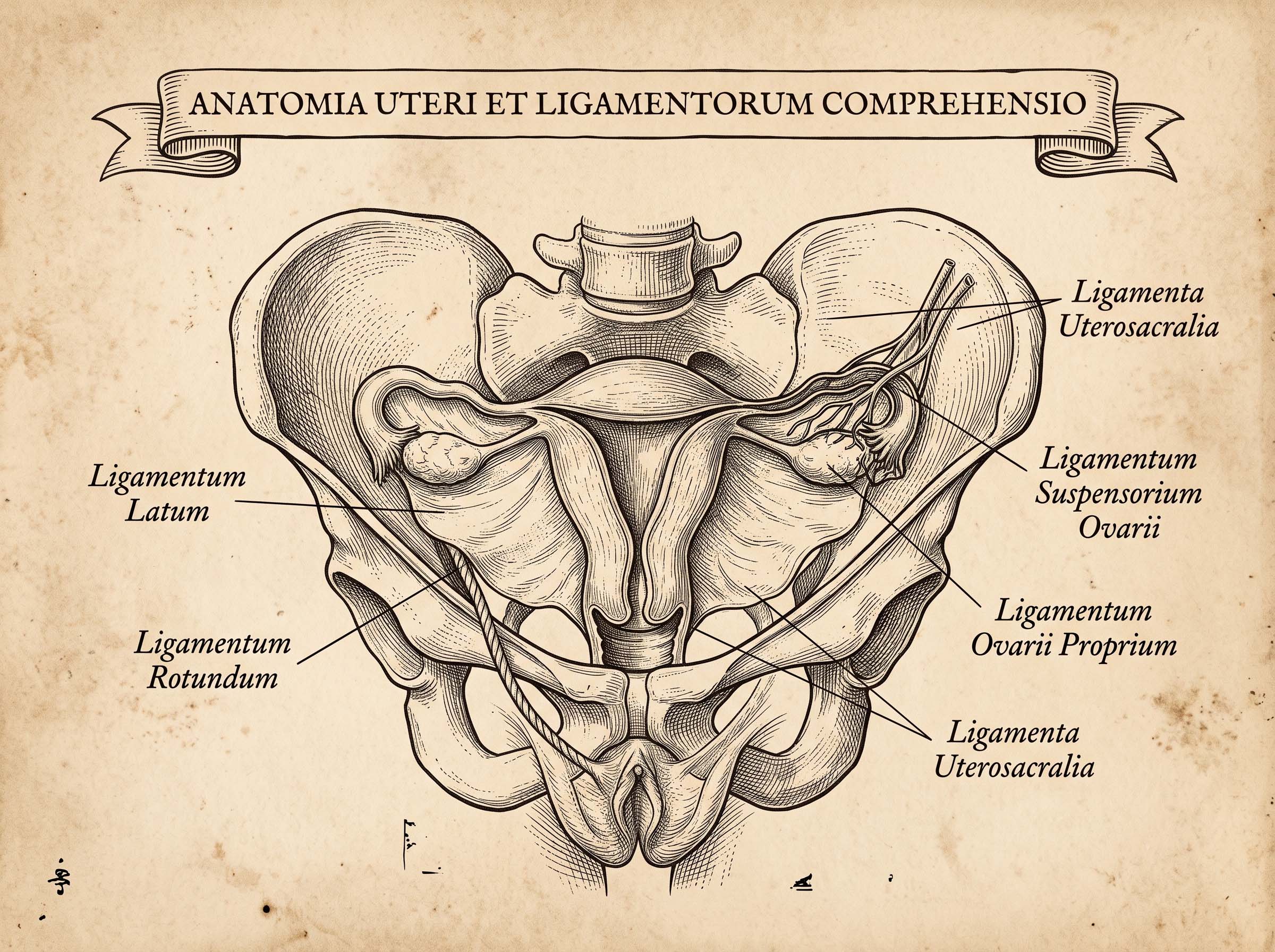
In 1543, the anatomist Andreas Vesalius published his landmark study of the human body, built on direct dissection rather than inherited texts. His plates showed plainly that the uterus is held firmly in place by ligaments. It does not, and cannot, wander through the torso. By any reasonable standard, that discovery should have ended the story. Much of the drama of medical history lies in how earlier generations misread the female form, and here was the correction in ink and copperplate.
It did not end the story. The literal claim quietly retreated, but the functional belief — that the uterus was the hidden engine behind a woman’s physical and emotional troubles — carried on under new names. In the following centuries it was recast as “the vapors,” then as a disorder of the nerves. This is the point where a fair reading has to hold two thoughts at once. It would be unjust to mock the ancient Greeks, who worked with almost no anatomical evidence. It would be equally wrong to wave away the centuries after Vesalius as merely a product of their time. Once the anatomy was known, continuing to govern women’s care by a roaming organ was not innocent ignorance. It was a failure to update on the evidence.
“It did not survive by staying the same. It survived by adapting.”
From the womb to the nerves
The slow migration of the theory away from the uterus is one of the more human parts of the account. In 1603, the English physician Edward Jorden wrote a treatise arguing that women accused of being bewitched were often suffering from a recognizable natural illness, not the work of the devil — a small, brave step toward treating the body rather than punishing the woman. Later in the century, Thomas Sydenham observed that the condition was extraordinarily common and, tellingly, that men could show the same symptoms. If men could have it too, the womb could hardly be the whole answer.
By the late nineteenth century, the famous neurologist Jean-Martin Charcot was studying it at the Salpêtrière hospital in Paris as a disorder of the nervous system, staging clinical demonstrations that drew crowds. Soon after, Freud and Breuer moved the whole question into the mind. The organ that had defined the diagnosis for two millennia had, at last, been written out of it. A cruder version lingered in the Victorian “rest cure,” which prescribed months of enforced idleness for nervous women — a regime the writer Charlotte Perkins Gilman skewered in her 1892 story The Yellow Wallpaper.
“Hysteria” remained a formal medical diagnosis far longer than most people assume. It was only removed from the standard psychiatric manual in 1980 — meaning a word rooted in the ancient Greek theory of the womb survived, on paper, into living memory.
The women who insisted on measurement
The final chapter belongs, fittingly, to careful research — a good deal of it done by the first generation of women admitted to the medical profession. The standout figure is Dr. Mary Putnam Jacobi, a working physician who was also a wife and mother, and one of the most rigorous American doctors of her era. In 1873, a Harvard professor named Edward Clarke had published a widely read book claiming that education and mental exertion during menstruation could damage a woman’s health and even leave her infertile — a modern echo of the old idea that the reproductive organs quietly governed everything else.
Jacobi answered not with indignation but with data. For her 1876 essay The Question of Rest for Women during Menstruation, she gathered physiological measurements from hundreds of women — pulse readings, strength tests, records taken across the whole cycle — and showed there was no basis for the claim that the menstruating body required rest or was rendered incapable. Her paper won Harvard’s Boylston Prize, making her the first woman to receive it. You can read the National Library of Medicine’s biography of Dr. Mary Putnam Jacobi for the full account. Her example carries a lesson that has nothing to do with slogans: an old assumption, however respectable, falls fastest when someone bothers to count.
For readers who want the long view of female hysteria in medical history, a widely cited review of hysteria across four thousand years of medicine traces the same arc through the scholarly record.
Why it lasted so long
The endurance of the wandering womb is not explained by malice alone. The theory offered something a busy physician values: a single, flexible cause for a long list of symptoms, from breathlessness to fainting to silence. It fit the anatomical knowledge available for most of its life, and it was backed by the most respected names in medicine. Ideas like that do not die on the day they are disproved. They die slowly, as evidence accumulates and as a profession decides that measurement outranks tradition.
That is the thread worth carrying out of this history. The wandering womb held on longest where observation was thin and authority was heavy, and it lost its grip wherever men and women chose to test the claim instead of repeating it. The story reads as strange from here, and it should. It is also a quiet argument for the habit that eventually ended it — looking, counting, and being willing to say that a famous old answer is simply wrong.
Common Questions
Disclaimer: All content on this website—including articles, educational materials, and interactive calculators—is for informational, educational, and entertainment purposes only. The calculations, percentiles, and outputs generated by tools on this site are based on general statistical data and mathematical models; they do not constitute medical data, a clinical assessment, or a diagnosis.
Nothing contained on this website is a substitute for professional medical advice, diagnosis, or treatment. Always seek the guidance of a qualified healthcare professional or urologist with any questions you have regarding physical development, anatomy, or health conditions. Reliance on any information or tools provided by this website is solely at your own risk.