English
  Español



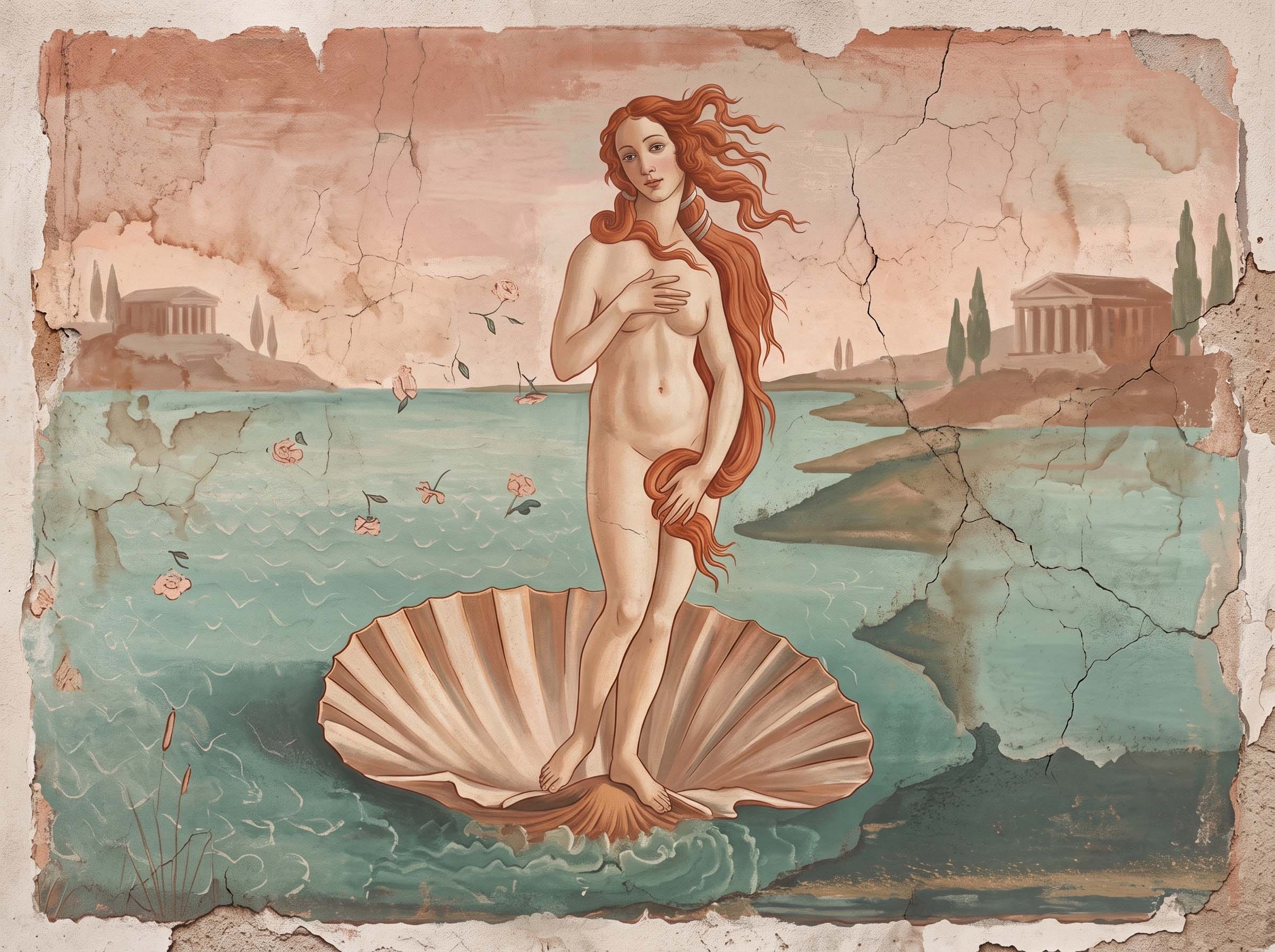
Almost everyone recognizes the painting, even those who cannot name it. A young woman stands nude on a giant scallop, her hair streaming, carried toward shore on the sea foam. Sandro Botticelli finished The Birth of Venus around 1485, and it has stood ever since as one of the most familiar images in the Western world.
What far fewer people know is that Botticelli did not invent that picture. He was reviving something already old in his own day — a habit of mind that reaches back thousands of years, in which men and women across widely separated cultures looked at an ordinary seashell and saw the feminine, the beginning of life, and the goddess herself. The seashell is one of the oldest sacred symbols of the generative female body that we can still trace in the archaeological record, and its story runs from the tombs of Egypt to the temples of Greece to the beaches where children still fill their pockets today.
To understand seashell goddess symbolism in ancient cultures, it helps to set aside the modern beach-souvenir version of a shell and look at what these objects meant to the people who first collected, carved, and buried them.
The Scallop and the Goddess of Love
The Greek poet Hesiod, writing around the eighth century B.C., gave the classical world its founding image of the goddess of love. In his telling, Aphrodite was not born as a child but rose fully grown from the sea, formed from the foam, and was carried on the waves to the shores of Paphos on Cyprus, which became the great center of her worship. Roman writers took up the same story, calling her Venus and honoring her as the ancestral mother of their people.
Around 330 B.C., the celebrated painter Apelles produced a work known as the Aphrodite Anadyomene — "Aphrodite Rising from the Sea." The painting itself is lost, but it was so admired that the Roman writer Pliny the Elder described it in his Natural History, and later artists spent centuries trying to match it. Roman households kept the image close: a fresco from the House of Venus at Pompeii, buried in A.D. 79, shows the goddess reclining in a great open shell. When Renaissance masters rediscovered Pliny's account, they raced to outdo the ancients. Botticelli gave us the standing figure on the half-shell, while Titian, around 1520, painted a quieter version of Venus rising from the sea now held by the National Galleries of Scotland, with a small scallop drifting on the water as a reminder of her origin.
Why a scallop, specifically? Art historians have long read the bivalve as an emblem of the female body. The shell opens like a cradle, it comes from the sea that mythology treated as the source of all life, and its rounded, folded form was widely understood as a sign of the feminine. Research on classical iconography suggests the scallop functioned less as decoration than as a visual shorthand: a way of saying, without words, that this figure embodied birth, beauty, and generation.
The Cowrie: An Older, Wider Story
The scallop of the Greeks and Romans was, in fact, a latecomer. Long before Aphrodite, another shell carried much the same meaning across an enormous stretch of the ancient world: the cowrie. Small, glossy, and remarkably durable, the cowrie was collected, traded, and treasured from prehistoric times, and its association with women is one of the more consistent patterns archaeologists have documented.
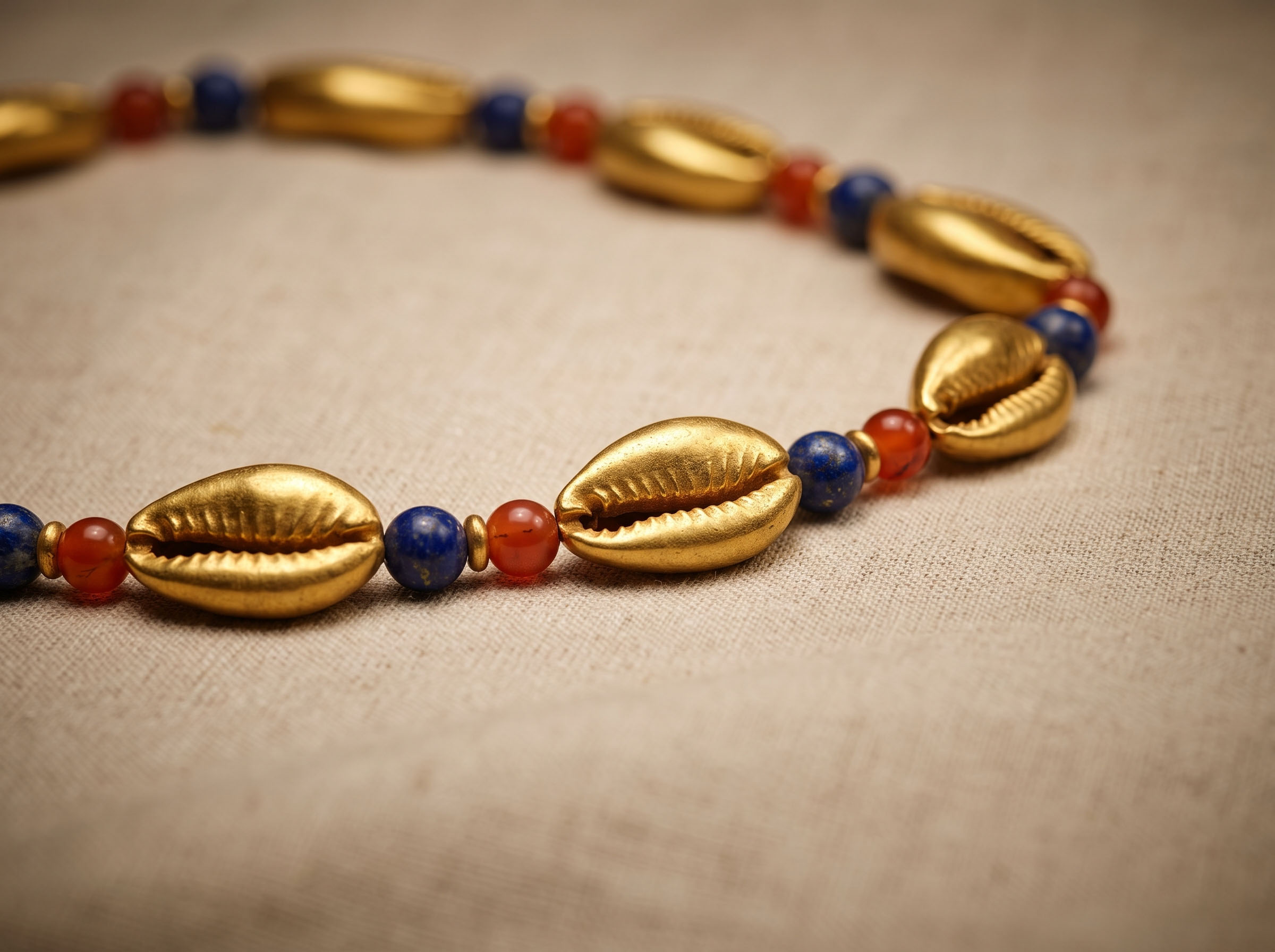
In ancient Egypt, women wore cowries strung into girdles that rested low on the hips. One of the most exquisite examples belonged to a princess named Sithathoryunet and dates to roughly 1887–1813 B.C.; its cowries were crafted in gold, some hollowed and filled with tiny pellets so they chimed softly as she moved. You can see the golden cowrie girdle of Sithathoryunet in the Metropolitan Museum of Art's collection, a piece that shows just how seriously this symbolism was taken among the elite.
The reasoning behind the cowrie shell fertility symbol history is something scholars can reconstruct with unusual confidence, because the ancients were fairly direct about it. The shell's rounded back suggested a swollen, pregnant belly. Its underside, a long narrow slit, was understood to resemble the female anatomy. Turned on its side, the same shape looked like a squinting eye — which is why cowries were also worn as protection against the "evil eye" thought to threaten mothers and children. Egyptian girls wore cowrie girdles to guard their future fertility, and expectant mothers kept them on through pregnancy in hope of a safe delivery. The small nude female figurines found in homes and tombs, once misread as mere ornaments, are now understood as objects tied to the household goddess of fertility, Hathor.
Why a Shell at All?
The logic that turned a shell into a symbol of the feminine follows an old and widespread pattern of thought: an object shaped like a part of the body was believed to carry that part's power. Herbalists once searched for plants shaped like the organs they hoped to heal; in the same spirit, a shell shaped like the female form was treated as a charm for fertility and safe birth. Layered on top of that was the sea itself. Water was the source of life in countless creation stories, so an object plucked from the sea already carried associations with origin and renewal.
There was one more quality that made shells irresistible to the ancient imagination: the pearl. A hidden treasure, formed slowly and secretly inside a closed shell and then revealed, was an almost perfect natural image of gestation and birth. A shell that could produce a pearl was a shell that could stand for the womb.
Shell Symbolism Across Cultures
| Culture & Era | Shell | Associated Meaning |
|---|---|---|
| Ancient Egypt (from c. 2000 B.C.) | Cowrie | Fertility, safe childbirth, protection from harm |
| Greece & Rome (from c. 8th c. B.C.) | Scallop | Birth of the goddess of love; beauty and generation |
| West Africa & the Pacific | Cowrie | Womanhood, wealth, adornment; used as currency |
| South Asia (Hindu tradition) | Conch (shankha) | Prosperity; linked to the goddess Lakshmi, born of the sea |
Echoes Around the World
The instinct to connect shell, sea, and the feminine was not confined to the Mediterranean. In Hindu tradition, the goddess Lakshmi, who brings fortune and abundance, is said to have emerged during the churning of the cosmic ocean, and the conch shell became one of her enduring emblems. Across West Africa and the Pacific islands, cowries were sewn onto clothing and woven into jewelry worn chiefly by women, a practice that carried both beauty and meaning. Many of these older customs survive in the living traditions of African adornment, where the cowrie remains a recognized sign of womanhood and prosperity.
The shell even worked its way into sacred architecture. Greek and Roman builders framed statues of the gods inside a curved niche shaped like a scallop, its ridges fanning out behind the figure. That same shell-niche later appeared in Christian churches, framing images of the Virgin Mary. The visual language quietly carried forward: a shell became a fitting frame for a revered woman and mother, a thread of continuity linking the classical world to the traditions that followed it.
Cowrie shells have been found in ancient graves hundreds of miles from any coast — carried inland along trade routes at real cost. People did not haul them that far for decoration alone. The distance a shell traveled is one measure of how much meaning it carried.
A Word of Caution
It is tempting to gather all of this into a single grand theory — to declare that the ancient world worshipped one universal "Great Goddess," and that every shell is proof of it. Some twentieth-century writers argued exactly that. Most historians and archaeologists today are more careful. The evidence does not support a single, unbroken goddess religion spanning every culture, and reading one meaning into every artifact risks flattening real differences between peoples who never met.
What the record does show, again and again, is a pattern of independent cultures arriving at similar associations: the shell tied to fertility, to birth, to protection, and to the feminine. That recurrence is remarkable enough on its own terms, and it belongs to the long history of the feminine form in art that runs from prehistoric figurines to the present day.
A shell that could produce a pearl was a shell that could stand for the womb — a hidden treasure, formed in secret, and then revealed.
The Shell That Endures
From a princess's golden girdle sealed in an Egyptian tomb, to a fresco on a Pompeian wall, to a masterpiece hanging in Florence, the same small object kept its hold on the human imagination for the better part of four thousand years. The shell endured because it joined together the things ancient men and women most wanted to honor: the sea as the source of life, the woman as the bearer of it, and the quiet miracle of one life emerging from another. The next time a shell turns up underfoot on the sand, it is worth remembering that people once saw a goddess in it — and that they had their reasons.
Questions Readers Ask
Disclaimer: All content on this website—including articles, educational materials, and interactive calculators—is for informational, educational, and entertainment purposes only. The calculations, percentiles, and outputs generated by tools on this site are based on general statistical data and mathematical models; they do not constitute medical data, a clinical assessment, or a diagnosis.
Nothing contained on this website is a substitute for professional medical advice, diagnosis, or treatment. Always seek the guidance of a qualified healthcare professional or urologist with any questions you have regarding physical development, anatomy, or health conditions. Reliance on any information or tools provided by this website is solely at your own risk.