English
  Español
  Português


There is a small limestone figurine, barely four inches tall, that has been sitting in a Vienna museum for over a century. Carved roughly 25,000 years ago somewhere in what is now Austria, the Venus of Willendorf has no face. Scholars have long argued about her meaning — a fertility idol, a good-luck charm, a self-portrait carved by a woman looking down at her own body. What is beyond argument is the deliberate, careful attention the unknown sculptor paid to the female form: rounded belly, generous hips, and clearly articulated anatomy.
She was not unusual. Across prehistoric Europe, figurines of women with similarly explicit anatomical detail have been discovered from Spain to Siberia. Long before there were written languages, before there were governments or organized religions as we understand them, there were artists — and they were carving, painting, and shaping the feminine body.
The story of how vulvas have appeared in art across history is, in many ways, a story about what any given civilization has feared, revered, and tried to control. It is a story worth knowing — not as political argument, but as cultural record. Because the relationship between art, the female body, and the societies that produced that art tells us something honest and complicated about what it has meant to be a woman across the centuries.
Cultural Insight
The Sheela-na-Gig
Carved stone female figures displaying their genitalia appear on hundreds of medieval churches across Ireland, Britain, France, and Spain. Known as Sheela-na-gigs, their precise meaning remains debated among historians. Some scholars believe they were apotropaic — placed above doorways to ward off evil and death. Others suggest they carried fertility significance or were remnants of pre-Christian belief folded into Church architecture. Whatever their origin, the fact that explicitly female anatomical imagery was built into the walls of Christian churches for centuries is a detail that tends to surprise modern audiences considerably.
The Ancient World: Sacred, Not Shameful
In ancient Mesopotamia, the goddess Inanna — later known to the Babylonians as Ishtar — was celebrated in hymns that described her body in frank, reverent terms. Temple priestesses participated in rituals connected to feminine sexuality understood as sacred rather than scandalous. Scholars studying Sumerian and Akkadian texts have noted that the ancient Near East had a remarkably different framework for understanding the female body than the one that would emerge in later Western thought.
Ancient Egypt offers a similarly layered picture. Fertility figures found in domestic contexts — small painted clay or faience women — were personal objects, likely connected to hopes for healthy pregnancies and births. The goddess Hathor, associated with love, beauty, and music, was depicted nursing, dancing, and radiating sensual warmth. Eroticism and divinity were not considered opposites.
In ancient Greece, the relationship grew more complicated. Greek art produced some of the most enduring images of the nude female form in Western history — the Venus de Milo, for instance, or the countless sculpted goddesses found across the Mediterranean. Yet the Greek ideal was often sanitized: female genitalia in classical sculpture tend to be smooth, abstract, almost unmarked — what art historians call a "pudenda" convention, meaning the visible detail was deliberately minimized. The male nude, by contrast, was anatomically explicit.
This asymmetry is itself a cultural record. Historically, societies have understood female anatomy as something simultaneously powerful and in need of regulation — something to be honored in the abstract and managed in the particular.
"Long before there were written languages, before governments or organized religions as we understand them, there were artists — and they were carving, painting, and shaping the feminine body."
— Amara Leclerc, Vagina Institute
The Middle Ages and Renaissance: Between Devotion and Concealment
Medieval European art is, on its surface, a world of covered bodies — robes, veils, drapery. The Christian theological framework that dominated artistic production from roughly the fifth century onward treated the body as something to be transcended rather than celebrated. And yet the Sheela-na-gig figures on church walls (see sidebar) remind us that the picture was never entirely simple.
The Renaissance brought the female nude back to the center of Western art — but on particular terms. Sandro Botticelli's Birth of Venus (c. 1484–1486) is perhaps the most famous example: the goddess of love emerging from the sea, her body luminous and idealized, her hand modestly positioned. Titian's Venus of Urbino (1538) is more directly erotic, the recumbent goddess gazing out at the viewer with calm self-possession. These paintings were made for wealthy male patrons, and their conventions — the passive pose, the idealized form — reflected the tastes and power of those patrons.
Research in art history has traced how the "reclining Venus" convention established in the Renaissance became one of the most replicated compositions in Western painting for the next four centuries. It also became one of the most critically analyzed, precisely because the figure on the canvas so rarely seems to be the subject of her own story.
The 19th Century: Scandal as Artistic Statement
If one painting marks a decisive rupture in this long history, it may be Gustave Courbet's L'Origine du monde — The Origin of the World — painted in 1866. Commissioned by a private collector, it was kept largely hidden for over a century. The painting is exactly what its title suggests: an unflinching, close-up depiction of the female body, painted with the same careful realism Courbet applied to landscapes and still lives.
The painting eventually entered the collection of the Musée d'Orsay in Paris in 1995, where it now hangs in a main gallery. Visitors' reactions, recorded by journalists and researchers over the decades, have ranged from shock to reverence to tears. What strikes many people is how matter-of-fact it is — not pornographic in intent, but documentary. It is a picture that says: this is a body. This is real. This exists.
Courbet's near-contemporary Édouard Manet caused his own scandal with Olympia (1865) — not for explicit anatomy, but for attitude. His model, widely understood to be a sex worker, gazes directly at the viewer without apology or submission. The painting was rejected at the Salon, mocked in the press, and is now considered a cornerstone of modern art. The problem, art historians have noted, was not the nudity. It was the refusal to pretend.
Timeline: Key Works in the Cultural History of Feminine Anatomy in Art
| Era / Date | Work or Tradition | Cultural Context |
|---|---|---|
| c. 25,000 BCE | Venus of Willendorf | Prehistoric Europe; possible fertility ritual significance |
| 3000–500 BCE | Inanna/Ishtar hymns & temple art | Mesopotamia; feminine anatomy as sacred and divine |
| c. 500 BCE – 400 CE | Classical Greek & Roman sculpture | Idealized female nude; anatomy deliberately minimized |
| 900–1400 CE | Sheela-na-gig carvings | Medieval Europe; explicit female figures on church walls |
| 1484–1538 | Botticelli, Titian — Venus paintings | Renaissance Italy; idealized female nude for wealthy patrons |
| 1866 | Courbet, L'Origine du monde | France; realist depiction, kept private for 130 years |
| 1920s–1940s | Georgia O'Keeffe — flower paintings | USA; botanical abstraction with debated anatomical reading |
| 1960s–1970s | Judy Chicago, The Dinner Party | USA; explicitly female-centered monumental installation |
| 2000s–present | Contemporary art, sculpture, digital art | Global; anatomy in art increasingly subject of cultural debate |
Georgia O'Keeffe and the Art of Plausible Deniability
Georgia O'Keeffe is the artist most often cited in any discussion of feminine anatomy and art — and she spent most of her life insisting that the connection was in the eye of the beholder, not the hand of the painter.
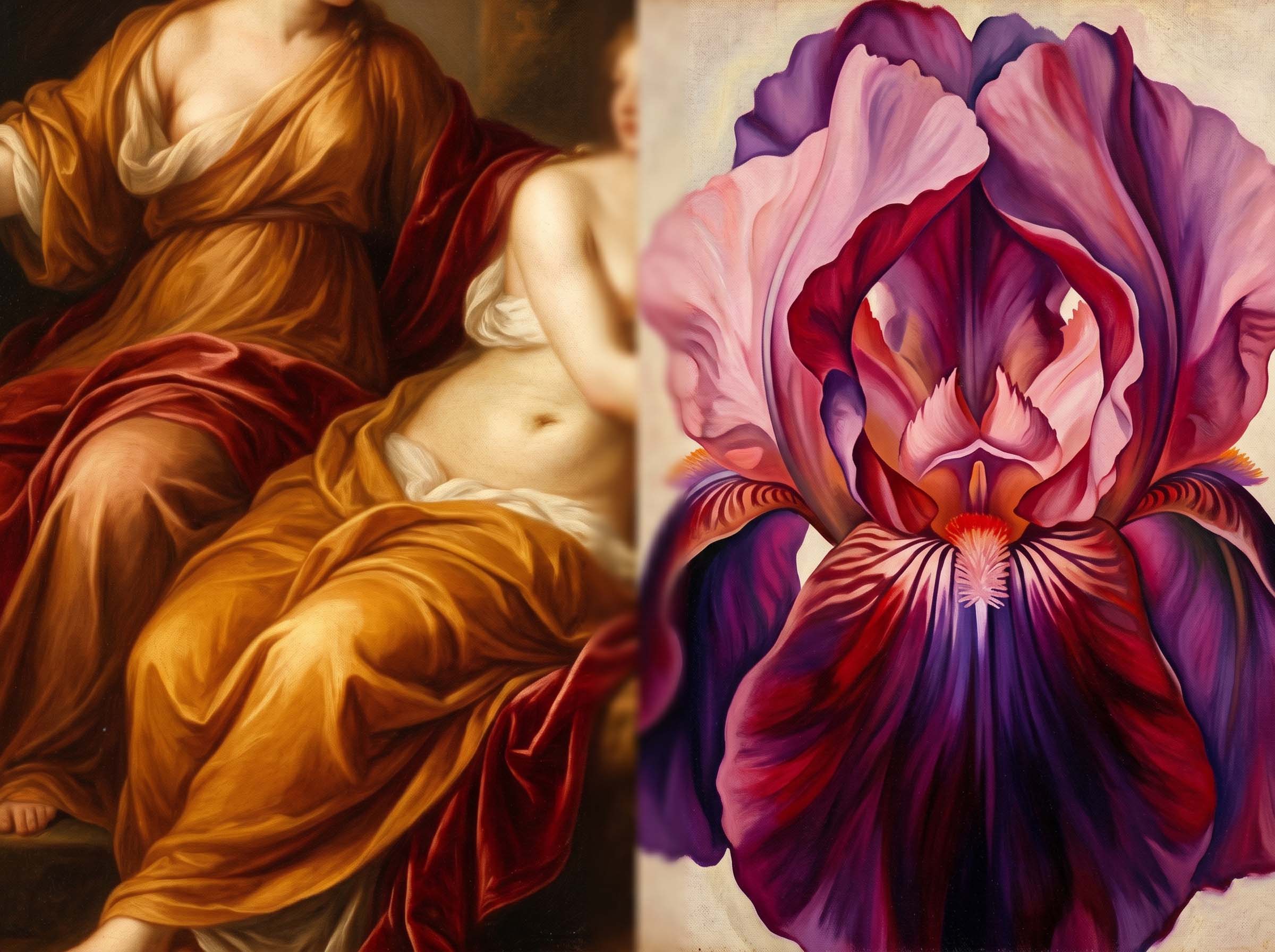
O'Keeffe began her large-scale flower paintings in the 1920s. Works like Black Iris III (1926) and Red Canna (1919) expanded the interior of a bloom to fill the entire canvas — petals curving inward, forms opening into shadowed depths, colors shifting from palest cream to deep crimson. Her longtime partner and gallerist Alfred Stieglitz actively encouraged audiences to read the paintings as erotic. O'Keeffe bristled at this. She said the paintings were about flowers. About looking closely. About the way Americans rushed past beauty without truly seeing it.
The debate has never fully settled. What art historians have noted is that the question itself is revealing: why do flower paintings by a woman immediately invite anatomical interpretation, when landscape paintings by men are rarely subjected to the same reading? The paintings, whatever their original intent, became cultural objects in a conversation much larger than any single artist's biography.
O'Keeffe's later career — spent largely in the high desert of New Mexico, painting sun-bleached animal skulls and abstract washes of earth and sky — showed a different kind of body awareness: the land itself as feminine, as bone-deep and enduring. She lived to 98, on her own terms, in one of the most austere and beautiful landscapes in North America. There is something to admire in that, whatever one makes of the flowers.
Did You Know?
The Oldest Known Art May Be Feminine
Among the oldest confirmed examples of deliberate human art are not just figurines — they include carved and painted symbols found in cave sites across Europe and Africa that some researchers interpret as female anatomical representations. A 2017 study in the Cambridge Archaeological Journal proposed that certain recurring abstract marks in Upper Paleolithic cave art may be symbolic female imagery. While the field debates specifics, the idea that feminine forms were among humanity's earliest artistic subjects continues to generate serious scholarly attention.
Judy Chicago and the Monument Question
In 1979, an installation opened at the San Francisco Museum of Modern Art that had taken five years to produce and involved the labor of hundreds of volunteers and craftspeople. The Dinner Party by Judy Chicago consisted of a triangular banquet table with 39 place settings, each representing a woman from history or mythology. Many of the ceramic plates featured imagery that was directly, explicitly modeled on female anatomy — stylized, abstracted, but unmistakable.
The public reaction was polarized in ways that have barely changed in the decades since. Supporters argued it was a monumental reclamation of feminine imagery for a feminine narrative — art history from the perspective of the women who had so often been its subject rather than its author. Critics found it heavy-handed, or simply obscene. The U.S. Congress debated whether public funds should support a permanent home for the piece.
The Dinner Party now has a permanent installation at the Brooklyn Museum, where it draws steady visitors. Whether one finds it powerful or overwrought, it demonstrated something about audience psychology: explicit female imagery in a fine art context produces reactions, decade after decade, that equivalent male imagery rarely generates. Historically, that asymmetry has been consistent enough to be worth noticing.
Non-Western Traditions: A Different Relationship
Much of the art history discussed in Western academic contexts defaults, almost automatically, to European lineage. But feminine anatomy has been depicted — with varying degrees of reverence, anxiety, and celebration — in virtually every artistic tradition in the world.
Indian temple sculpture, particularly the traditions associated with certain Hindu temples from roughly the fifth through twelfth centuries, included frankly erotic carvings of both male and female figures. The Khajuraho temple complex in Madhya Pradesh, built between 950 and 1050 CE, is among the most famous examples — and remains a UNESCO World Heritage Site. Scholars studying the tradition have proposed that the erotic carvings at temple exteriors were connected to cosmological ideas about the transition between the profane and sacred realms, though interpretations remain varied.
In West African sculptural traditions, female figures with emphasized breasts and rounded abdomens were produced across many cultures — less focused on explicit genital depiction than on the generative, nurturing female form as a cultural anchor. Maori ta moko (traditional tattooing), certain Aboriginal Australian bark paintings, and pre-Columbian ceramics from across the Americas all contain traditions of representing the female body that developed entirely independently of European conventions.
The recurring pattern, across cultures and continents, is that the female body — its capacity to generate life, to sustain it, to transform — was recognized as extraordinary long before the word "art" existed in any language. What varied was the framework: sacred, erotic, cosmological, domestic, apotropaic, or simply beautiful.
The Digital Age and Censorship's New Shape
Social media platforms have generated their own version of a very old argument. Instagram's policies on nudity, for years enforced more rigorously against female nipples than male ones, sparked ongoing debate about contemporary censorship and its implicit assumptions. Artists who created work depicting the female body — including medical illustrators, sculptors, and painters working in fine art traditions — found their accounts restricted or removed.
In 2022, Meta updated its policies to allow more explicit depictions of nudity in artistic contexts, though enforcement has remained inconsistent. The Musée d'Orsay in Paris ran a temporary campaign in which it attempted to advertise Courbet's L'Origine du monde on Facebook — and was blocked. The museum's response was to take Meta to court in France. The case drew international attention partly because of the absurdity it revealed: a 150-year-old painting hanging in a national museum was deemed inappropriate for a social platform that freely circulates considerably more graphic material, provided it is framed differently.
Research into platform content moderation has found consistent patterns: female anatomy in artistic contexts is flagged at significantly higher rates than comparable male imagery. The algorithms enforcing these rules were trained on human decisions, which means they reflect — and potentially entrench — existing cultural assumptions about which bodies require more careful management.
Further Reading
The Metropolitan Museum of Art's European Paintings collection offers one of the most comprehensive publicly accessible archives of how the female form has been depicted across Western art history — including curatorial essays that place individual works in cultural context.
For the history of classical sculpture and its anatomical conventions, the British Museum's Ancient Greece and Rome collection provides detailed scholarship on how gender was represented in antiquity.
What the Long View Tells Us
Twenty-five thousand years is a long time to be depicting the same subject. What the long view of art history suggests is that feminine anatomy has never been a neutral subject — not in prehistoric caves, not in Renaissance palaces, not on social media platforms in the 2020s. Every era has had its own version of the debate about whether and how it should be shown, and every era's answer has reflected something true about the cultural anxieties and values of its time.
What has also been consistent is that women themselves have sought to be the authors of their own representation. The unknown carver of the Venus of Willendorf may or may not have been a woman — but she may well have been. Georgia O'Keeffe, whatever she intended, painted her flowers on her own terms. The contemporary artists working in ceramic, textile, painting, and digital media who draw on feminine anatomical imagery are, for the most part, women deciding for themselves what their bodies mean as art.
That is not a small thing. For most of recorded history, the image of the female body was produced largely by men, for men, within cultural frameworks determined by men. The shift — gradual, incomplete, contested, ongoing — toward women as the primary authors of feminine imagery in art is among the more significant cultural developments of the past century. It shows up quietly in a ceramic plate at the Brooklyn Museum, loudly in the work of an artist posting to an algorithm that may or may not let her stay visible, and everywhere in between.
The conversation is old. The participants are changing.
Frequently Asked Questions: Feminine Anatomy in Art History
You May Also Enjoy
Disclaimer: All content on this website—including articles, educational materials, and interactive calculators—is for informational, educational, and entertainment purposes only. The calculations, percentiles, and outputs generated by tools on this site are based on general statistical data and mathematical models; they do not constitute medical data, a clinical assessment, or a diagnosis.
Nothing contained on this website is a substitute for professional medical advice, diagnosis, or treatment. Always seek the guidance of a qualified healthcare professional or urologist with any questions you have regarding physical development, anatomy, or health conditions. Reliance on any information or tools provided by this website is solely at your own risk.