English
  Español


The spotted hyena stopped biologists cold for a reason. Here was an animal whose females were larger, more dominant, and anatomically so unusual that centuries of observers genuinely could not categorise what they were seeing. In our previous feature on the hyena matriarchy, we explored how high prenatal androgen levels shape the female hyena's body and behaviour from before birth. That article raised a question that many readers wrote in asking about, and it is a genuinely interesting one.
Could something similar ever happen in humans? And within normal human female anatomy — where considerable natural variation exists — does the same hormonal logic apply? Do women with higher androgen exposure show any of the biological patterns seen in species where androgens drive female form and behaviour?
These are questions that sit at the intersection of evolutionary biology, endocrinology, and what is sometimes called comparative anatomy. They deserve a thoughtful, evidence-based answer. The short version is: not in the dramatic way the hyena demonstrates, but the underlying biology is connected in ways that are worth understanding.
"Across all mammals, the same embryonic tissue has the potential to develop into either a clitoris or a penis — the direction depends almost entirely on the hormonal environment of early development."
— Lexi PierceThe Shared Developmental Blueprint
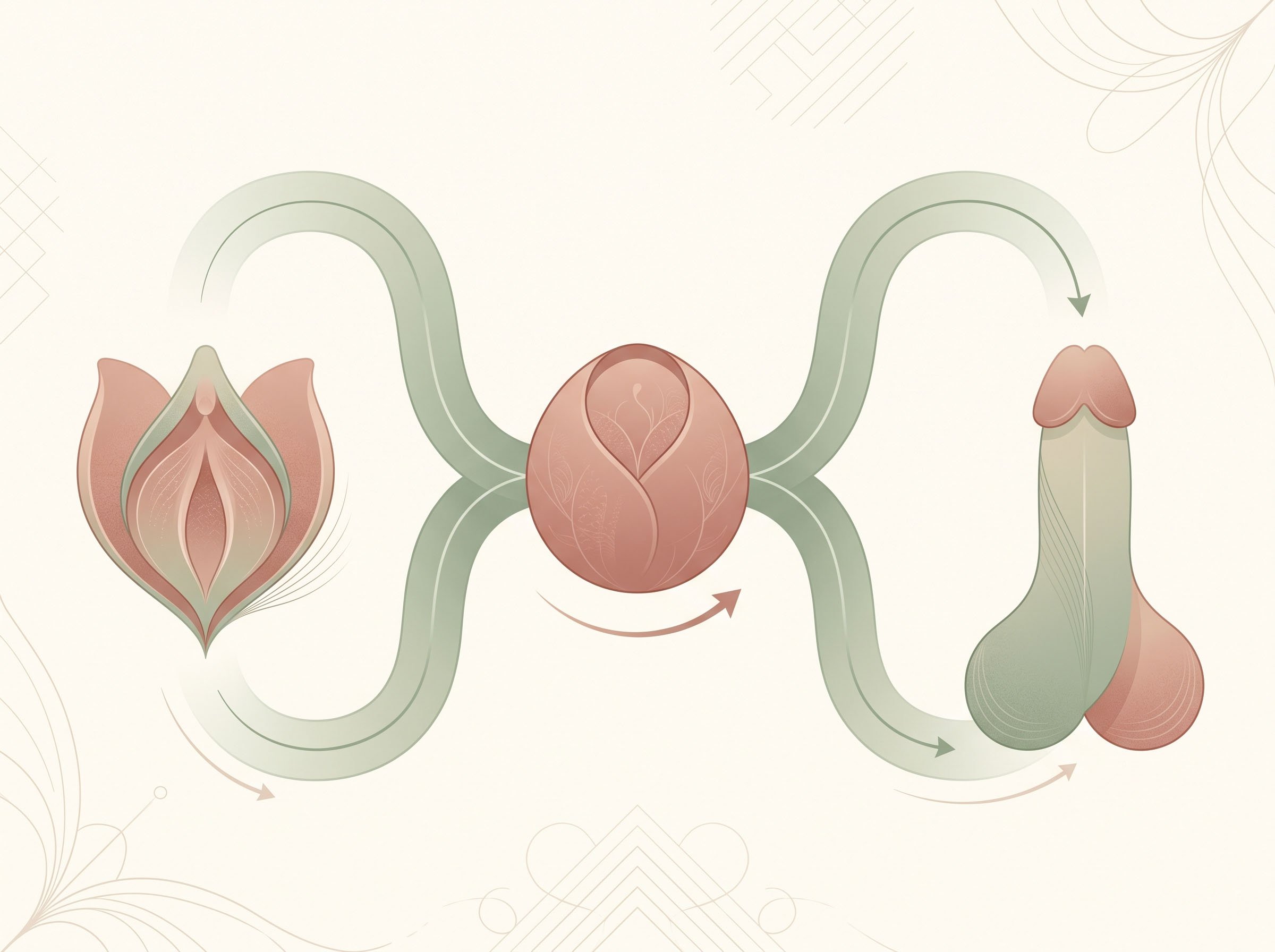
To understand why the hyena question is relevant to human biology at all, it helps to understand what developmental biology has established about mammalian anatomy. Research in embryology has long confirmed that, early in fetal development, male and female anatomy begins from the same undifferentiated tissue. The genital tubercle — a small structure present in every mammalian embryo regardless of sex — will eventually develop into either a clitoris or a penis, depending almost entirely on the hormonal environment it is exposed to during a critical developmental window.
In the absence of high androgen exposure, the tissue develops along the pathway that produces a clitoris. With significant androgen exposure — primarily testosterone — it develops into a penis. The structures are, at their root, the same tissue organised differently. This is why the hyena's pseudo-penis is not a mysterious anomaly. It is a predictable outcome when extremely high androgen levels are present during that developmental window in a species whose females are exposed to exactly that environment.
In humans, this same developmental logic applies — and it is why conditions involving unusually high prenatal androgen exposure, such as congenital adrenal hyperplasia, can produce anatomical variation in female infants. This is a clinical area entirely separate from normal variation, and not a topic for general health advice. But it does confirm that the hyena's biology is not alien to ours. The mechanism is shared. Only the degree differs.
Could Human Women Evolve a Pseudo-Penis?
The honest answer from an evolutionary biology standpoint is: it is theoretically possible for any mammalian species to evolve in that direction, but for humans, there is no evolutionary mechanism currently driving it and no evidence suggesting such a trajectory.
Evolution does not add traits because they are interesting, or even because they exist in related species. It maintains traits that improve survival and reproductive success over many generations. The hyena's pseudo-penis is maintained because the broader androgen-dominance system it is part of is highly effective for that species' particular social and ecological situation — clan-based competition for food, high cub mortality pressure, and a social structure where female rank directly determines offspring survival.
Human reproductive success is shaped by a very different set of pressures. Human females do not live in single-sex dominance hierarchies where food access depends entirely on social rank. Human infants require years of sustained care rather than the rapid independence of a hyena cub. The social, ecological, and reproductive context that makes extreme androgen-driven female anatomy adaptive in hyenas simply does not exist in our species.
Research in evolutionary biology consistently shows that traits evolve when they confer meaningful reproductive advantage over multiple generations. Without that pressure, the developmental machinery for a human pseudo-penis — which, as the embryology shows, is technically present in the shared mammalian blueprint — has no selection force pushing it into expression.
Worth Knowing
Human female anatomy already shows considerable natural variation — and that variation is entirely normal.
Studies of female anatomy consistently document a wide natural range in size, shape, and position across women. This variation is driven by genetics, individual development, and — as research increasingly suggests — hormonal influences during fetal development. None of this variation is pathological. It is simply the expression of a flexible biological system across a large population.
Androgens in Women: What the Research Actually Shows
Androgens are not exclusively male hormones. Women produce androgens too — primarily in the adrenal glands and ovaries — and these hormones play a documented role in female physiology. Research has explored connections between androgen levels in women and a range of traits including energy levels, muscle composition, body hair distribution, libido, and — relevant to this discussion — the development and sensitivity of external anatomy.
Studies have explored whether women with higher androgen levels show measurable anatomical differences. The research here is more nuanced than popular accounts suggest. Some studies have found associations between higher androgen exposure — particularly during fetal development — and anatomical variation. But the effect sizes in humans are modest compared to what is seen in species like the hyena, where androgen levels during pregnancy are dramatically elevated above any human range.
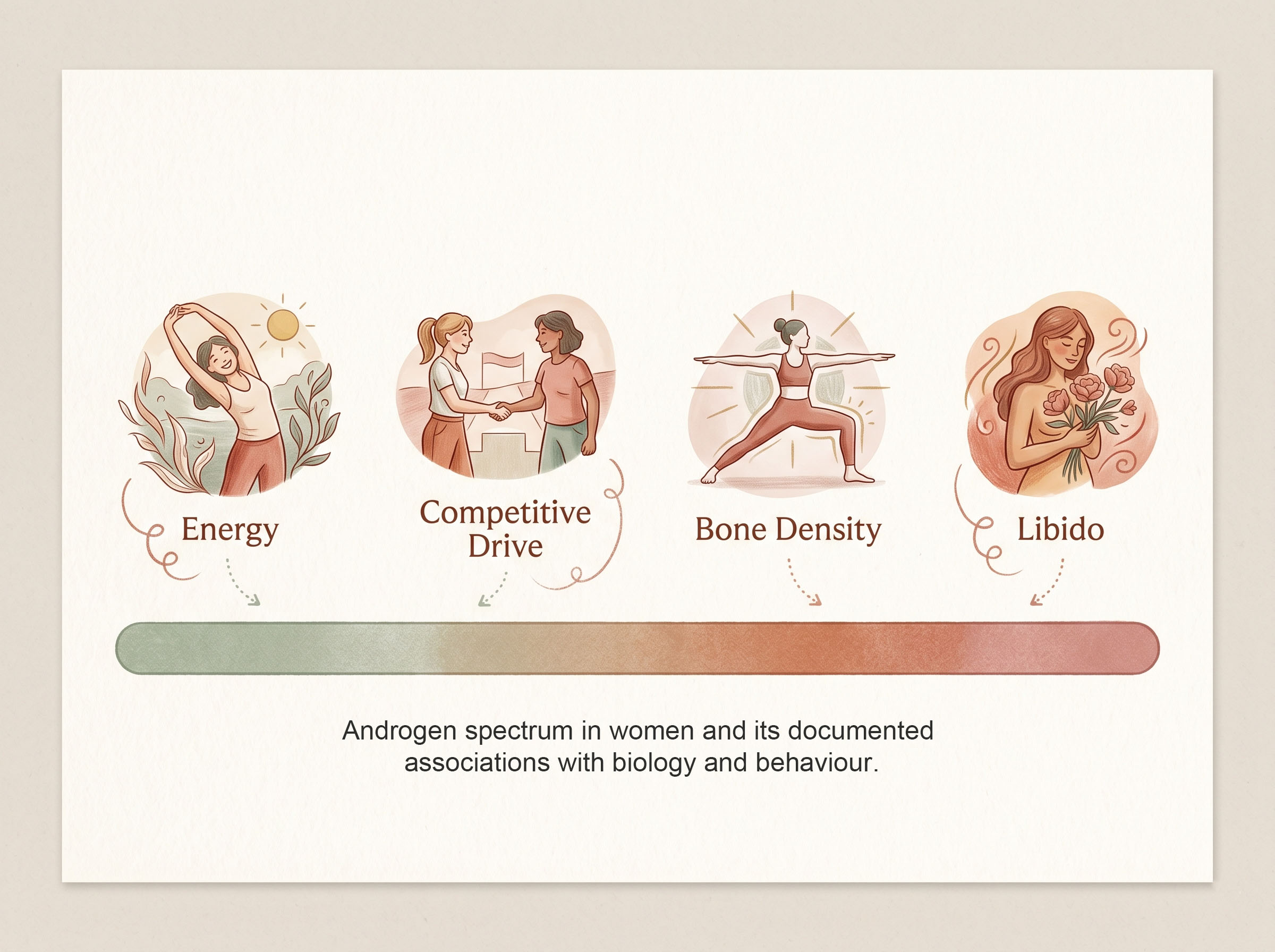
What is better established is the role of androgens in female behaviour and physiology more broadly. Research published in peer-reviewed endocrinology literature, and accessible through sources such as the Endocrine Society's hormone education library, has documented that androgens in women are associated with aspects of physical energy, competitive motivation, and sexual interest. The connection between androgens and these traits is real — but it operates within a much narrower hormonal range than the dramatic animal examples suggest.
Cultural Insight
Ancient Views on Female Anatomy & Temperament
Ancient Greek medical writers, including those in the Hippocratic tradition, believed that differences in female temperament and energy were related to the balance of internal humours — what we might loosely recognise today as something like hormonal influence. Women described as more assertive or energetic were often associated with drier, warmer constitutions — qualities linked in that system to what they called a more "male" humoral balance.
Across many traditional cultures, healers recognised that women varied considerably in temperament and physical energy in ways that did not map to simple social explanation. The biological understanding was crude, but the observation of individual variation was consistent. Modern endocrinology has since given that observation a mechanism.
Does Anatomy Reflect Androgen Levels?
This is the specific question the hyena comparison invites, and it is one that researchers have examined with mixed and often misrepresented results. To be clear about what the science does and does not show:
Studies have explored associations between prenatal androgen exposure — sometimes measured indirectly through the ratio of the second and fourth finger length, known as the 2D:4D ratio — and a range of physical and behavioural traits in women. Some research has found associations between markers of higher prenatal androgen exposure and certain anatomical and behavioural traits. But these associations are correlational, and the effect sizes are generally small. The science here is genuinely ongoing and not settled in the way that some popular articles suggest.
What can be said with more confidence is that anatomical variation among women is real, documented, and influenced by both genetics and developmental hormonal environment. But the jump from "higher androgen exposure may be associated with certain anatomical features" to "women with particular anatomical features are more dominant" is not one that current research supports cleanly. Dominance in human social contexts is shaped by personality, experience, culture, family, and a long list of factors that no single anatomical measurement predicts.
✦ Did You Know?
The 2D:4D finger ratio is used by researchers as a non-invasive marker for prenatal androgen exposure.
When testosterone levels are higher during fetal development, the ring finger (4th digit) tends to grow relatively longer than the index finger (2nd digit). This ratio — called the 2D:4D ratio — is established before birth and remains stable throughout life. Researchers use it as an indirect window into the prenatal hormonal environment, though it is a population-level marker rather than a precise individual measure.
The Spectrum of Androgen Influence in Women
A more accurate way to think about androgen influence in women is as a spectrum — one that runs from very low to relatively high within a distinctly female range, and that shapes a cluster of traits without determining any of them absolutely.
Women with higher endogenous androgen levels — whether from genetic variation, adrenal activity, or ovarian output — tend, on average in population studies, to show slightly higher scores on certain measures of competitive motivation, physical energy, and risk tolerance. Some studies have also found associations with certain physical traits. But these are population-level trends, not individual predictors. A woman with relatively higher androgen levels may be a devoted, gentle mother with no particular interest in competition. A woman with lower androgen levels may be extraordinarily assertive. The hormones create tendencies, not destinies.
This is, in fact, one of the more important lessons the hyena comparison offers. In the hyena, the androgen-dominance link is so powerful and consistent that it defines the species' entire social structure. In humans, that same biological link exists — but it operates within a system of complexity where culture, family, personality, and individual life experience all shape the final expression of who a woman is and how she moves through the world.
What the Hyena Really Teaches Us About Human Variation
The spotted hyena is useful not because it is a model for what humans are or could become, but because it strips away the assumption that female biology has a single, narrow template. Across the animal kingdom, females vary enormously — in size, anatomy, hormonal profile, social role, and reproductive strategy. The hyena is the most dramatic example, but it sits within a broad continuum of female biological variation across species.
Human women are part of that broader story. The natural variation in female anatomy, hormonal profile, and temperament that exists across the human population is not error or deviation. It is the expression of a biological system that has never been as uniform as older accounts suggested. Research published through sources such as the NIH's published research on female reproductive biology and hormone variation continues to build a more complete picture of just how wide that natural range is.
Historically, societies have often treated female variation — whether in anatomy, temperament, or energy level — as something requiring explanation or correction. The emerging picture from biology is rather different: variation is the system working as designed. The range of female hormonal profiles, anatomical expressions, and behavioural tendencies represents the natural output of a species adapting to a wide range of environments and social contexts across a very long history.
A Note on the Curiosity Itself
It is worth acknowledging that the question this article addresses — whether women's anatomical variation connects to hormonal profiles the way the hyena's does — is one that women ask out of genuine curiosity about their own bodies and biology. That curiosity is healthy and worth taking seriously.
What the evidence suggests is this: the biological connection between androgens and female anatomy is real across mammals, including humans. The degree to which it manifests as visible anatomical variation in normal human women is modest — far from the dramatic hyena example, but not zero. And the idea that any single anatomical feature reliably predicts personality, temperament, or social dominance in a human woman does not hold up against the full complexity of how human behaviour actually works.
What the hyena gives us is a window — an extreme biological case that makes visible a mechanism that operates more quietly in our own species. The mechanism is real. The extremity is not ours. And the variation that does exist among women is simply part of what it means to be human, female, and biologically individual.
Androgens in Women — What the Research Has Explored
| Area of Research | What Studies Have Found | Certainty Level |
|---|---|---|
| Prenatal androgen exposure & anatomy | Associations found in some studies; effect sizes modest in humans | Active research, not settled |
| Androgens & competitive motivation | Higher androgen levels correlate with greater competitive drive in population studies | Reasonably well supported |
| Androgens & libido in women | Documented association; androgens play a recognised role in female sexual interest | Well established |
| 2D:4D ratio as prenatal marker | Used as a proxy for prenatal testosterone exposure; population-level tool, not individual predictor | Accepted research method |
| Anatomy as dominance predictor | No reliable association between any single anatomical feature and social dominance in humans | Clear in the evidence |
Questions Readers Ask
Continue exploring: The Hyena Matriarchy | Body Science
Disclaimer: All content on this website—including articles, educational materials, and interactive calculators—is for informational, educational, and entertainment purposes only. The calculations, percentiles, and outputs generated by tools on this site are based on general statistical data and mathematical models; they do not constitute medical data, a clinical assessment, or a diagnosis.
Nothing contained on this website is a substitute for professional medical advice, diagnosis, or treatment. Always seek the guidance of a qualified healthcare professional or urologist with any questions you have regarding physical development, anatomy, or health conditions. Reliance on any information or tools provided by this website is solely at your own risk.