English
  Español



There is a small limestone figurine, barely four inches tall, that was carved roughly 25,000 years ago somewhere in what is now Austria. She has no face. Her arms are thin suggestions. But her belly, breasts, and hips are rendered with a sculptor's devotion — round, full, generous.
She has been studied, debated, and displayed in museums across the world. She is called the Venus of Willendorf, and for a quarter of a century she has quietly asked a question that modern women are only now beginning to answer: what if the body that grows life was never meant to be hidden or apologized for?
Across thousands of years and dozens of civilizations, cultures did not simply tolerate the maternal body — they worshipped it. They carved it in stone, painted it in ochre, and built temples in its honor. To understand this history is not to retreat into nostalgia, but to recover something that was always there: a far older, steadier story about what the female body actually means.
For tens of thousands of years, the body that carries and delivers life was considered the most sacred object on earth — not despite its fullness, but because of it.
— Amara LeclercStone, Clay, and the Grammar of the Sacred
The Venus of Willendorf is not an outlier. She is part of a continent-spanning conversation in stone. From the Venus of Lespugue (France) to the Venus of Dolní Věstonice (Czech Republic) to dozens of similar figurines scattered across Europe, the Near East, and Siberia, Paleolithic artists returned again and again to the same subject: a woman's body in its most generative state. These were not crude carvings. They were carefully made, often using materials that required significant effort to acquire and shape. Someone thought they were worth the trouble.
Archaeologists have long debated their purpose. Fertility totems? Goddess idols? Teaching aids for midwives? The honest answer is that we do not know exactly. What we do know is that these figures were kept, carried, and almost certainly revered. Several have been found with traces of red ochre — the same pigment associated across many ancient cultures with blood, life, and ritual. These were not casual objects. They were meaningful ones.
Cultural Insight
The Cretan Snake Goddess
On the island of Crete, Minoan civilization (c. 2700–1450 BCE) produced a remarkable class of faience figurines now called the Snake Goddesses. Bare-breasted, arms raised holding serpents, they stood as symbols of household protection, fertility, and female authority. The snake — later a symbol of danger in many Western traditions — was in Minoan culture a sign of regeneration, because it sheds its skin and is reborn.
These figurines were placed in domestic shrines, suggesting that the sacred was woven into ordinary household life — not kept separate from it.
By the time of the great river civilizations — Egypt, Mesopotamia, the Indus Valley — the symbols had grown more elaborate and the theology more articulate. In Egypt, Isis was not simply a goddess of magic. She was the great mother who assembled the dismembered body of Osiris and conceived Horus from what she recovered. Her image — arms spread wide like wings, nursing her infant son — became one of the most reproduced images in the ancient world. Scholars of early Christian iconography have noted striking similarities between Isis nursing Horus and later depictions of the Virgin Mary nursing the infant Jesus, suggesting that the archetype of the sacred nursing mother ran deeper than any single faith.
In Mesopotamia, the goddess Inanna (later called Ishtar by the Babylonians) held dominion over love, fertility, and war — a combination that might seem strange until you consider that ancient peoples understood creation and destruction as inseparable forces. Inanna's most celebrated myth involves her descent to the underworld and return: a death and resurrection cycle tied explicitly to the agricultural seasons. The female body, with its monthly rhythms and its capacity to sustain new life, was the walking symbol of that same cycle.
The Body as Cosmological Blueprint
What is striking across so many of these traditions is the refusal to separate the physical from the spiritual. The female body was not an inconvenient biological fact that the spirit had to endure. It was the pattern through which the universe expressed itself.
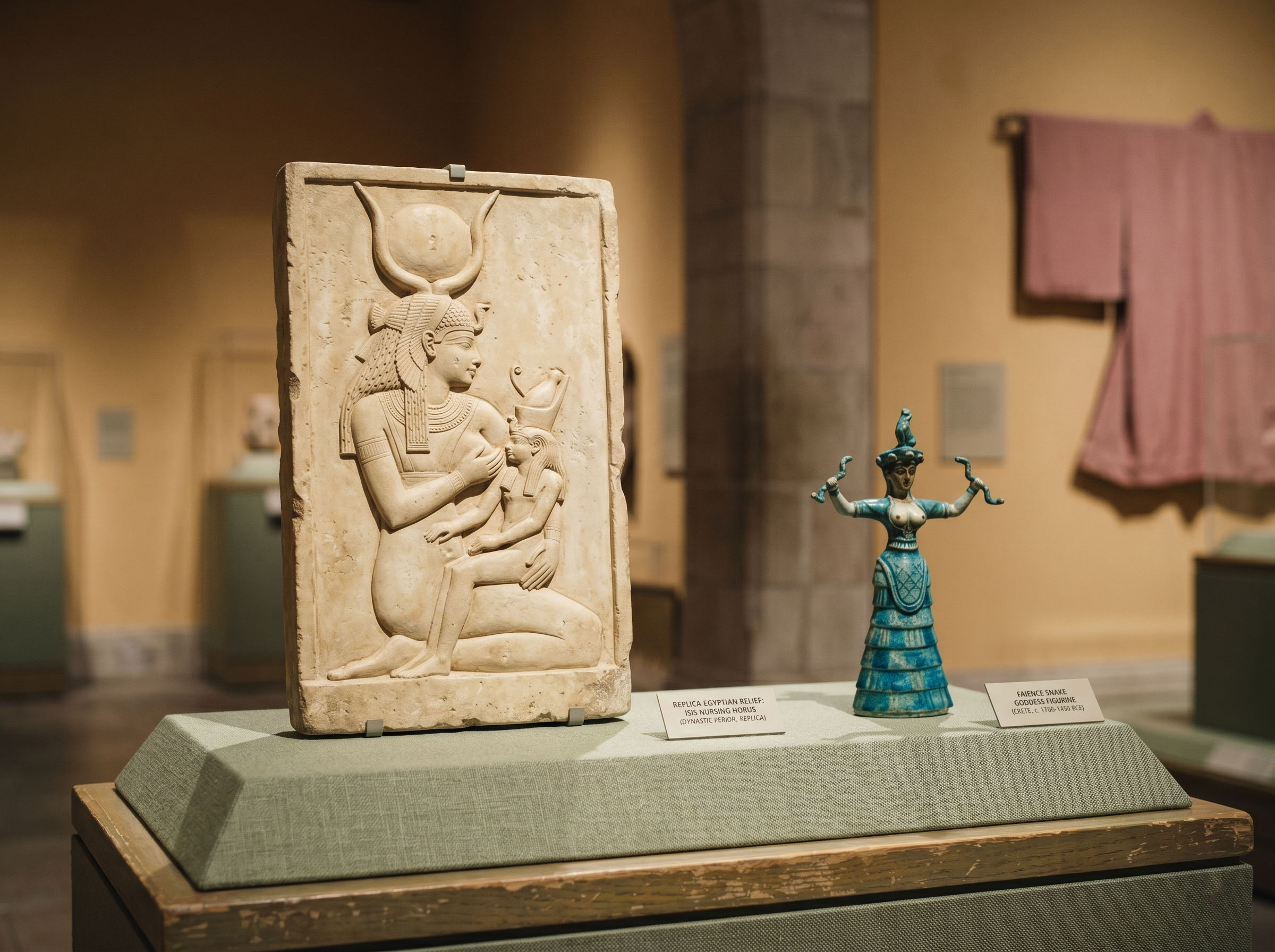
Gaia, the Greek personification of Earth herself, was not a goddess in the usual sense — she was the ground. Hesiod's Theogony, written around the 8th century BCE, describes her as the first being to emerge from Chaos, the mother of sky, mountains, and sea. She did not rule the earth. She was the earth. Her body and the planet's body were the same body. Fertility was not something she gave as a gift — it was an expression of her nature, as natural and constant as gravity.
The Hindu goddess Shakti operates within a similar logic. In Shakta traditions, the entire material universe is understood as her body in motion — every rock, river, woman, and child a form that she takes and releases. Shakti is not worshipped despite being embodied; embodiment is precisely what makes her powerful. The highest form of cosmic energy pours through flesh, and female flesh in particular was seen as especially transparent to that energy because of its monthly, gestational, and lactational rhythms.
The scholar Riane Eisler, writing about what she called "partnership" societies in the ancient world, noted that in many pre-patriarchal cultures, images of the generative female body were found not only in temples but in homes, markets, and burial sites. The sacred was everywhere — which is another way of saying that the ordinary body was never considered profane.
✦ Did You Know?
The earliest known human sculptures — dating back over 35,000 years — depict female figures, not male ones. Of all the figurative art from the Upper Paleolithic period, the overwhelming majority represents the female form, suggesting that for our earliest ancestors, the female body was the primary symbol through which humans made sense of existence itself.
Sacred Feminine Symbols Across Cultures — A Historical Overview
| Culture / Era | Goddess / Symbol | Body Association | What It Represented |
|---|---|---|---|
| Paleolithic Europe (35,000–10,000 BCE) | Venus figurines | Full belly, hips, breasts | Fertility, survival, abundance |
| Ancient Egypt (3000–30 BCE) | Isis, Hathor, Nut | Nursing, sky-spanning body | Cosmic order, resurrection, protection |
| Minoan Crete (2700–1450 BCE) | Snake Goddess | Bare torso, raised arms | Household protection, regeneration |
| Ancient Greece (800–146 BCE) | Gaia, Demeter, Aphrodite | Earth-body, harvest, beauty | Creation, seasonal cycle, love |
| Hindu Tradition (1500 BCE–present) | Shakti, Durga, Lakshmi | Full figure, multiple arms | Cosmic energy, abundance, power |
| Aztec Mexico (1300–1521 CE) | Coatlicue, Tlaltecuhtli | Earth-body, skull skirt, birth posture | Birth, death, and earthly renewal |
When the Sacred Became Shameful
Something shifted in many societies as centralized religious and political authority grew. The exact causes are still studied and contested by historians, but the broad pattern is legible: as male-dominated institutional religions rose to prominence across the Mediterranean and Near East, the goddess traditions receded. Their symbols were sometimes absorbed — Mary's blue mantle echoes Isis's wings; the Virgin's crown of stars appears in descriptions of the ancient goddess Cybele — and sometimes suppressed outright.
What followed, across centuries and continents, was a slow repositioning of the female body. Where once it had been the template for the divine, it became something to be managed, covered, and controlled. The roundness that Paleolithic sculptors celebrated with such care became, in later eras, something women were taught to be ashamed of. The belly that ancient Egypt associated with the goddess Nut — whose body arched across the sky, stars glittering across her form — became something to be cinched and hidden.
This is not a simple story and it does not have simple villains. Many of the societies that produced the most elaborate goddess traditions also had rigid social hierarchies and practices we would find deeply objectionable today. History rarely hands us clean moral lessons. But it does hand us evidence. And the evidence suggests that the shame attached to the maternal, generative body is historically recent, not biologically inevitable.
Worth Noting
Scholars at the British Museum's Ancient Egypt collection document how goddess imagery persisted in domestic and funerary contexts even after official religious traditions shifted — suggesting that ordinary women continued to hold these symbols meaningful long after institutions moved on.
The Body Remembers What the Mind Forgets
What does any of this have to do with a woman standing in front of her bathroom mirror in 2026, looking at a postpartum belly or the soft evidence of a life lived fully? More than you might expect.
The symbols and myths of the ancient world did not simply tell people what to think. They shaped how people felt about the material world — including their own bodies. When a woman in ancient Crete handled a Snake Goddess figurine, or when an Egyptian mother called on Isis during a difficult labor, those were not just religious acts. They were acts of identity. They placed the woman's body inside a larger story — one in which her body was not a problem to be solved, but a living continuation of something sacred.
We have, for the most part, lost that story. And its absence is not neutral. Research in psychology has shown that body image is profoundly shaped by cultural narratives — not just advertising images, but the deeper assumptions a culture carries about what bodies are for. Ancient cultures largely believed the female body was for creation, sustenance, and connection to the cosmic order. Many modern cultures have quietly replaced that belief with a commercial one: the body is for display, and its value is primarily aesthetic.
The most honest response to that shift is not to pretend we live in ancient Crete. We do not, and the past was never as uncomplicated as nostalgia makes it seem. But it is to recognize that the way we currently relate to the maternal, generative body is not the only way, and not the oldest way. Women throughout history have found meaning, dignity, and even joy in bodies that their own cultures would later decide were not good enough.
Bringing the Old Story Forward
There is a growing conversation in women's health and cultural studies about recovering precisely this kind of meaning. Not by returning to pre-modern religion — that is neither possible nor the point — but by understanding that the human need to situate the body inside a meaningful story is ancient and real. When women feel that their bodies are something to be ashamed of, they are not simply responding to magazine covers. They are swimming against a current of meaning — or rather, they have been left in a vacuum where meaning has been withdrawn and shame has rushed in to fill the space.
The Smithsonian's collection of ancient goddess artifacts — available to explore through the Smithsonian Human Origins project — spans continents and millennia, and what it reveals is not a single coherent religion but a persistent human intuition: that the body that carries, births, and feeds life is not ordinary. It is, by any reasonable definition, extraordinary.
That is worth sitting with. Not as ideology, but as simple historical fact. For most of human history, across most of the world, the body that grew you and fed you was considered the closest thing on earth to the sacred. The roundness, the fullness, the marks and changes that come with carrying a child were not flaws to be corrected. They were evidence of something remarkable.
A 25,000-year-old sculptor in Austria understood that. It is not too late for the rest of us to remember it.
Frequently Asked Questions
✦ In Brief
- Venus figurines carved 25,000–35,000 years ago are among humanity's earliest artworks — and they depict the generative female body.
- Across Egypt, Mesopotamia, Crete, Greece, India, and pre-Columbian Americas, goddesses were associated with the body's natural rhythms of fertility, birth, and sustenance.
- The Isis-nursing-Horus image influenced early Christian depictions of the Virgin Mary — the sacred nursing mother is among the most durable archetypes in human history.
- Goddess traditions were not erased but gradually absorbed or marginalized as centralized religions shifted cultural authority.
- The modern disconnection between the maternal body and a sense of its inherent value is historically recent — not universal or inevitable.
Disclaimer: All content on this website—including articles, educational materials, and interactive calculators—is for informational, educational, and entertainment purposes only. The calculations, percentiles, and outputs generated by tools on this site are based on general statistical data and mathematical models; they do not constitute medical data, a clinical assessment, or a diagnosis.
Nothing contained on this website is a substitute for professional medical advice, diagnosis, or treatment. Always seek the guidance of a qualified healthcare professional or urologist with any questions you have regarding physical development, anatomy, or health conditions. Reliance on any information or tools provided by this website is solely at your own risk.