English
  Español


Look closely at a lady's slipper orchid and the shape almost seems intentional. Soft folds, a curved opening, an interior kept half-hidden. For as long as men and women have walked past such things, they have seen in them a quiet reminder of the female body — the form from which every human life begins.
A flower. A shell turned up by the tide. A cleft in a sandstone canyon where the light falls in ribbons. Nature repeats a handful of shapes again and again, and human beings, who are pattern-seekers by instinct, have long treated those shapes as sacred.
This way of reading the feminine into the landscape is among the oldest habits in religious history. It appears in temple carvings and burial jewelry, in cave paintings and cathedral windows. And while modern eyes sometimes rush to a single explanation, the archaeological record is richer, older, and more careful than any quick reading allows. The story of these sacred feminine symbols in nature is really the story of how our ancestors honored the mother as the source of life.
The oldest sacred shape
In the traditions of India, the reverence takes a formal, recognizable form. The yoni — a smooth, disk-shaped stone emblem — is understood as the sign of the goddess Shakti, the feminine generative power. Research into Hindu iconography shows it is usually paired with the lingam, the emblem of Shiva, the two together standing for the union of the masculine and feminine principles and, in the traditional reading, the whole of creation. The yoni is deliberately abstract rather than literal. Historically, Hindu thinkers understood it as a symbol of the origin of life itself, not an image to be gawked at.
The reverence is ancient. Scholars trace yoni-like fertility figures on the Indian subcontinent back thousands of years, and the emblem is documented across many stone temples and reliefs. Readers who want a careful, non-sensational summary can consult the entry on the goddess Shakti's aniconic emblem at Encyclopaedia Britannica, which lays out the symbolism without the New Age gloss that often clouds the subject.
What matters, for a historian, is the restraint of the tradition itself. The yoni stone is smooth and simple. It points beyond the body to the idea of generation — birth, renewal, the passing of life from one generation to the next. That is a long way from the crude readings later travelers sometimes brought to it. When nineteenth-century visitors first described these emblems, many were scandalized, reading obscenity where devout communities saw only the sacred principle of motherhood. The gap between those two views is a useful warning for anyone studying symbols: what a shape means depends entirely on who is looking.
The shell that traveled the world
If the yoni is the most formal example, the cowrie shell is the most widely traveled. Small, glossy, and durable, the cowrie has a rounded back and a long, folded underside — and across a remarkable spread of cultures, men and women looked at that underside and saw both the female form and a watchful eye. The two readings traveled together, which is why the same little shell was worn both as a sign of fertility and as a guard against the evil eye.
The evidence is broad and old. In ancient Egypt, cowrie-shaped amulets were linked with the goddess Hathor and worn as protective charms, especially by women. Across the Near East, archaeologists have recovered cowries and imitation cowries carved from stone and precious metal at sites dating back thousands of years. In West Africa, the shells became currency and, at the same time, a lasting emblem of womanhood, birth, and wealth, woven into hair and stitched onto ceremonial dress. In the Pacific, a golden cowrie strung on a cord marked the rank of a chief. The scholarly study of these objects is well established; the J. Paul Getty Museum's catalog of ancient amber cowrie pendants notes plainly that the mature shell was likened both to the human eye and to the female form.
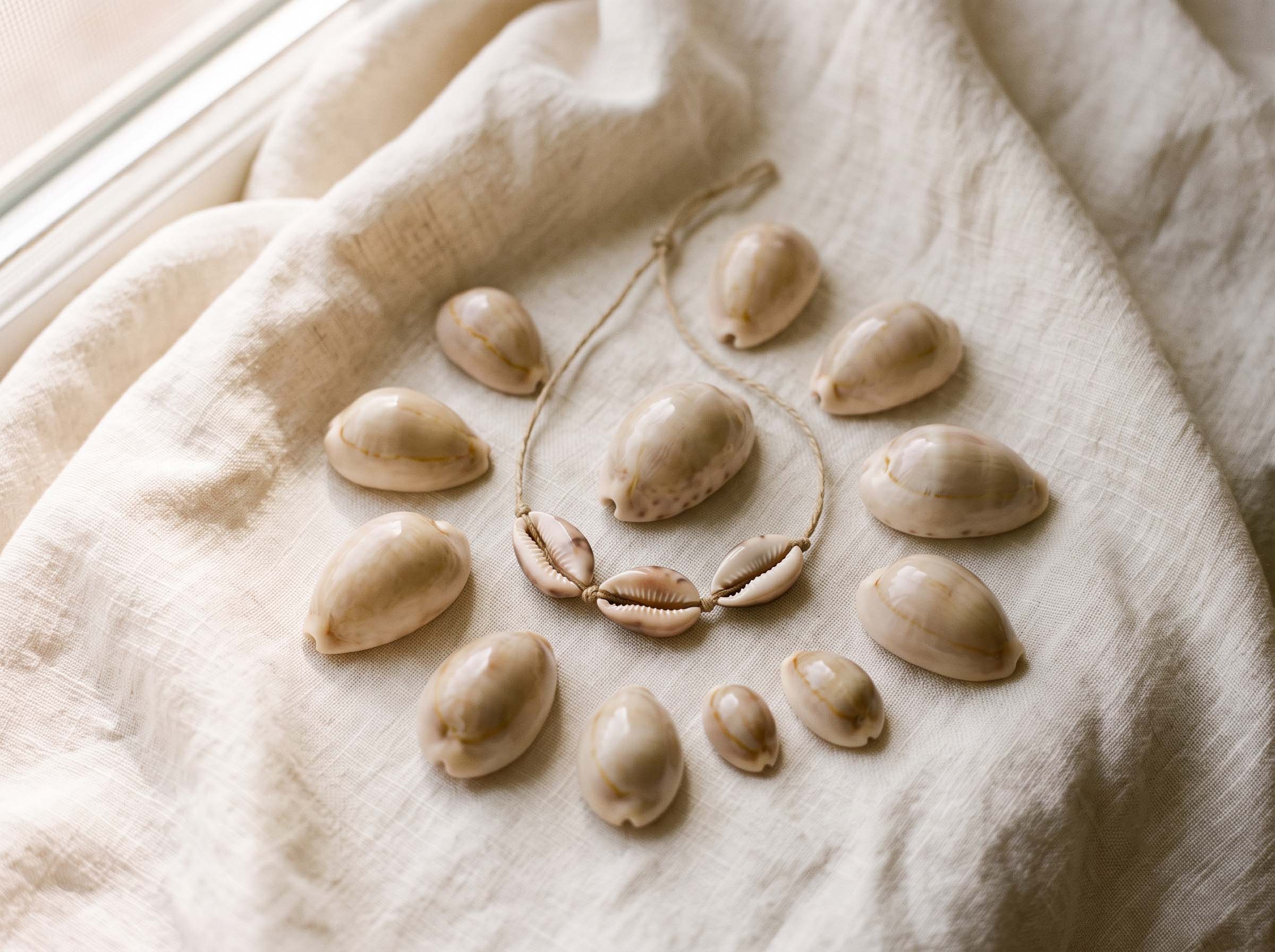
One shell, carried along trade routes from the Indian Ocean to the Atlantic, kept the same meaning in language after language. That kind of persistence is rare, and it tells us something plain: the association between the feminine form and the idea of life-giving abundance was not the invention of any single people. It was something many societies arrived at on their own — a shared reading of the same small, beautiful object.
Long before the first written scripture, the shape of the female body was already the shape of the sacred.
Flowers, and the danger of over-reading
Then there are the flowers — the part of this story where a careful historian slows down. Orchids, lilies, irises, and a dozen other blooms have been read as feminine forms in art for centuries. The modern imagination often reaches straight for the paintings of Georgia O'Keeffe, whose enormous close-up flowers hang in galleries around the world. Yet here the honest record pushes back against the easy interpretation. O'Keeffe herself firmly rejected the idea that her flowers were meant as images of female anatomy. She insisted she was painting what she saw — the flower, large enough that a hurried viewer would have to stop and truly look at it.
That refusal is worth keeping in mind. A shape that reminds one person of the female form may have been intended as nothing of the kind. Symbols are not fixed; they are read. A lily on an altar can mean purity in one century and fertility in another, and the flower does not change at all — only the eye that meets it does. Studies of religious imagery repeatedly show this pattern, which is why serious scholars are cautious about announcing what any given shape "really" means.
The earth as mother
The largest of these forms is the land itself. Caves, clefts, and the deep sandstone corridors we now call slot canyons have long been read as openings into the body of the earth — a place of emergence and return. The idea of the earth as mother, the ground as a womb from which life rises and to which it goes back, appears in traditions on every inhabited continent.

Some archaeologists have gone further, proposing that certain marks and signs in Paleolithic cave art were meant as feminine symbols, and that the painted caves themselves were treated as sacred interiors. That reading is plausible and widely discussed — but it is not settled. The signs are silent; no one who made them left an explanation. Responsible researchers present these ideas as interpretations, well argued but open to challenge, rather than as proven fact. It is one of the honest limits of studying a world that left images but no words.
What the record actually shows
Set side by side, these examples reveal a consistent pattern without forcing a single grand theory onto it. Across the table below, one thread holds: again and again, communities looked at the natural world and read into it a reverence for the feminine as the wellspring of life. That is not the same as claiming a single lost religion once united them all. The popular notion of one ancient "Great Goddess" worshipped everywhere remains contested among archaeologists, and the evidence for it is thinner than enthusiasts often suggest. What the record supports is smaller, and in some ways more moving: many separate peoples, without contact, honored motherhood and the origin of life through the shapes nature gave them.
There is something steadying in that conclusion. Strip away the grand theories and the modern spiritual marketing, and what remains is a simple, dignified thing that ordinary families would recognize: a reverence for the woman as the one who carries and gives life, expressed through the most beautiful shapes the world had to offer. The orchid, the shell, the canyon — they were never really about the body alone. They were about what the body makes possible. And that, more than any single interpretation, is why these forms have kept their hold on the human imagination for so very long.
Reader Questions
Disclaimer: All content on this website—including articles, educational materials, and interactive calculators—is for informational, educational, and entertainment purposes only. The calculations, percentiles, and outputs generated by tools on this site are based on general statistical data and mathematical models; they do not constitute medical data, a clinical assessment, or a diagnosis.
Nothing contained on this website is a substitute for professional medical advice, diagnosis, or treatment. Always seek the guidance of a qualified healthcare professional or urologist with any questions you have regarding physical development, anatomy, or health conditions. Reliance on any information or tools provided by this website is solely at your own risk.