English
  Español


Ask an older woman in your family how she kept her figure through decades of raising children, and she will rarely mention a number. She will talk about supper at a set hour, about bread that took time to rise, about not leaving the table hungry and not returning to it out of boredom.
She never learned how to maintain a healthy weight without dieting, because for her there was no other way to eat. The kitchen ran on rhythm, not arithmetic. Long before restriction became a lifestyle, women across the world stayed steady on the strength of habit alone — the same quiet knowledge you can still find in the world's oldest food traditions that fed the soul as much as the body.
The modern sense of the word "diet" — a temporary program of denial — is surprisingly young. For most of recorded history, a woman's eating was set by the household, the harvest, and the season. Research into traditional eating patterns keeps returning to the same unglamorous conclusion: the cultures with the steadiest bodies were rarely the ones thinking hardest about food. They were the ones who had simply built good habits into daily life and then stopped thinking about it at all.
For most of history, women kept a steady weight without weighing a single portion. The old wisdom was never about numbers — it was about real hunger, real food, and a table worth sitting at. Here is what our grandmothers understood that most diet plans quietly forgot.
Fullness Was the Original Measurement
Before scales and apps, the body kept its own ledger. A woman ate until she felt satisfied, then stopped — not because a chart told her to, but because her appetite had done its job. Modern studies have explored why this instinct works so well, and much of the answer comes down to the food itself. Meals built around whole ingredients — beans, grains kept close to their natural form, eggs, vegetables, a little good fat — signal fullness slowly and honestly. Fiber, in particular, has drawn research attention for the simple reason that it makes a meal feel like enough. You can read more about the role fiber plays in the sensation of feeling full from Harvard's nutrition researchers, but the lived version is older than any laboratory: a bowl of lentils and bread keeps you satisfied in a way that a handful of something engineered and airy never will.
This is the part diet culture tends to overlook. Hunger and fullness are not enemies to be outsmarted — they are instruments, and like any instrument they can be tuned by paying attention. Many women report that when they stop eating while distracted and start noticing the moment they feel content, the old signals return within weeks. The body remembers how to do this. It simply needs to be allowed.
The Table Did the Work
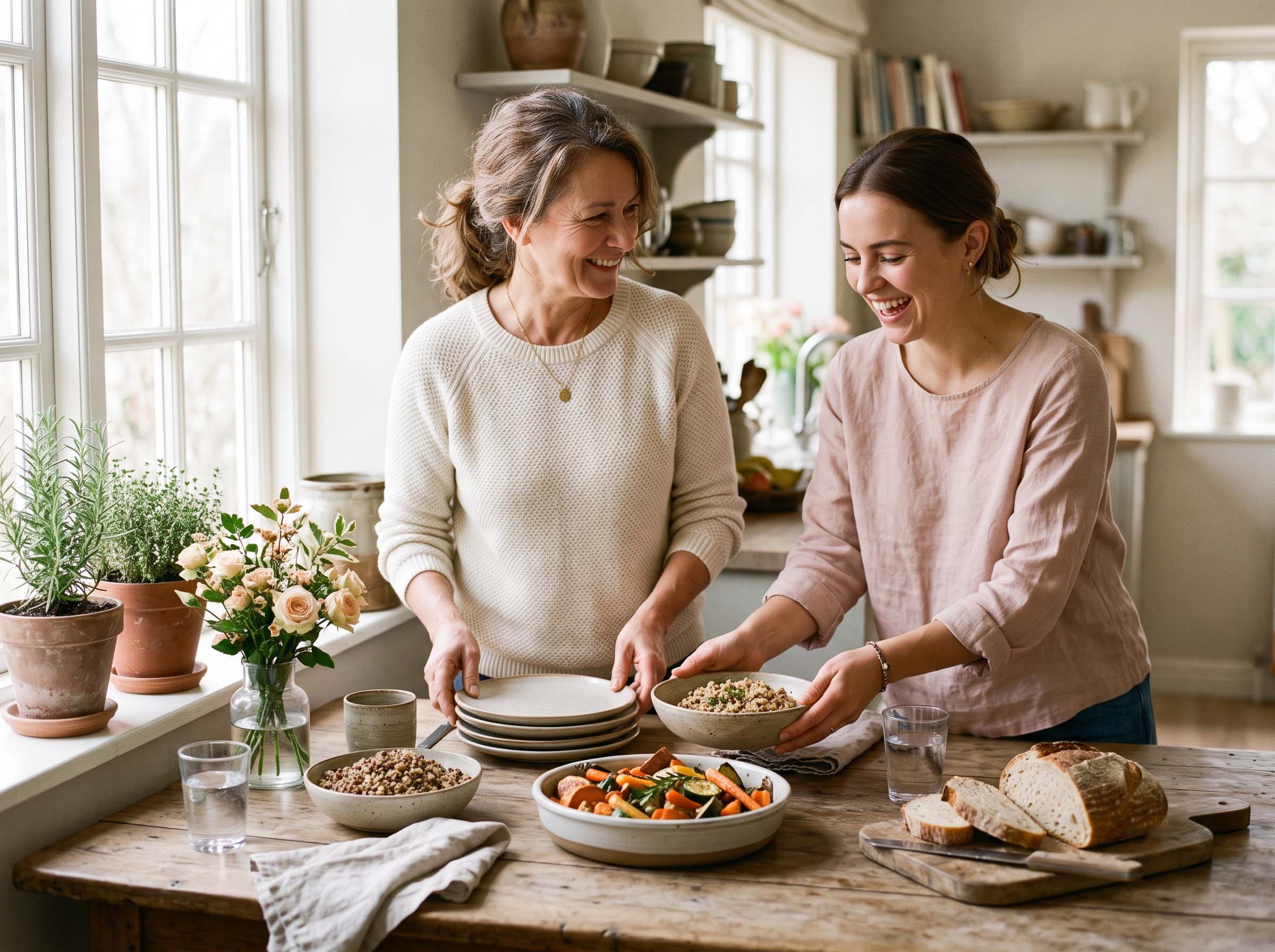
There is a reason nearly every culture with a reputation for steady, healthy bodies also has a strong tradition of the shared table. When a family sits down together, eating slows. Conversation stretches a meal across half an hour, and that half hour is precisely the window the body needs to register that it has had enough. A woman eating alone over a sink, or in a car, or in front of a screen, misses that signal almost every time.
Home cooking carries a second advantage, one that researchers have studied directly: when a woman cooks her own meals, she controls what goes into them. Studies have explored the eating habits of women who cook at home most nights and consistently found their overall diet to be simpler, lighter in the things bodies do not need, and easier to keep steady over years — without any counting involved. The plate assembles itself around real ingredients. Harvard's researchers describe this same principle visually in the balance of whole foods on a well-built plate: mostly vegetables and grains, a good source of protein, a little fruit, water rather than sweetness in a glass. It is less a prescription than a description of how women have cooked for the people they love for a very long time.
"The steadiest bodies rarely belonged to the women thinking hardest about food — they belonged to the women who simply set a good table and sat down at it."
None of this asks a woman to eat for fullness at home as some new project to master. It is closer to a return. The steady, unhurried path to lasting body health has always run through the kitchen rather than the gym locker or the pharmacy shelf. It is slower than a program that promises results by a date, and that slowness is exactly why it holds.
When Counting Replaced Cooking
So how did we lose the thread? The shift came in the twentieth century, when food became something bought rather than made, and eating became something to be managed by number. The scale entered the bathroom. Portions arrived pre-decided in packages. And the more women were handed to eat that had been designed in a factory to be difficult to stop eating, the more they reached for restriction to undo it. One extreme called forth the other.
The trouble is that restriction rarely stays put. A plan built on denial tends to end in the thing it was meant to prevent, because appetite is not a moral failing to be defeated — it is a signal that has simply been ignored for too long. This is a pattern many writers have examined, including our own honest look at how diet culture often disguises plain body-shaming as self-improvement. The women who stay steady over a lifetime almost never white-knuckle their way there. They cook, they sit, they stop when full, and they get on with the day.
Traditional Table Habits & What They Quietly Do
| Old Habit | The Quiet Effect |
|---|---|
| Eating at a set table, not on the move | Slows the meal so fullness has time to register |
| Cooking most meals from real ingredients | Keeps out the engineered foods that are hard to stop eating |
| Serving vegetables and grains as the base | Builds satisfying meals that settle appetite naturally |
| Pausing before the last few bites | Lets the body finish the sentence its appetite started |
| Water at the meal, sweetness saved for a treat | Keeps everyday drinking from quietly adding up |
Small Habits, Steady Bodies
What makes this approach so durable is that it never demands a woman rebuild her life. It asks for a handful of small, repeatable choices that, kept up quietly, do more over ten years than any program does over ten weeks. Cook one more meal at home this week than you did last week. Sit down when you eat. Serve yourself a reasonable plate and let seconds be a decision rather than a reflex. Notice the moment you feel content, and honor it. None of these are rules. They are simply the habits that women have practiced, without fanfare, for as long as there have been kitchens.
The word "diet" comes from the ancient Greek díaita, which did not mean restriction at all — it meant a whole way of living: how you ate, rested, worked, and kept house. For the Greeks, a good diet was simply a well-ordered life. The narrow modern sense of "going on a diet" is barely a century old.
There is grace in this, and a little relief. A woman does not need to treat her own body as a problem to be corrected or a project to be optimized. She can cook for her family and count herself among the fed. She can enjoy her mother's recipes without guilt and pass them to a daughter without warning labels. The steadiest, healthiest approach to weight that women have ever known is also the most human one — and it has been waiting, all along, at the kitchen table.
One Gentle Week, No Numbers
- Sit for supper. Choose one meal a day to eat at a table with the screen off. Let it take its time.
- Cook one more. Make one additional meal at home this week than you managed last week — simple is fine.
- Build the plate around plants. Start with vegetables and a whole grain, then add your protein. Let the base be the meal.
- Pause before the last bites. Halfway through, set the fork down for a moment and check in. Full often arrives early.
- Keep the treat a treat. Something sweet is a pleasure, not the enemy — enjoyed on purpose, it never needs undoing.
Your Questions, Answered
Disclaimer: All content on this website—including articles, educational materials, and interactive calculators—is for informational, educational, and entertainment purposes only. The calculations, percentiles, and outputs generated by tools on this site are based on general statistical data and mathematical models; they do not constitute medical data, a clinical assessment, or a diagnosis.
Nothing contained on this website is a substitute for professional medical advice, diagnosis, or treatment. Always seek the guidance of a qualified healthcare professional or urologist with any questions you have regarding physical development, anatomy, or health conditions. Reliance on any information or tools provided by this website is solely at your own risk.