English
  Español


Most women can name the day their last period started, because an app pings a reminder. Far fewer could explain why their energy climbed one week and sank the next, why their skin cleared and then flared, or why the same errand felt effortless in one part of the month and unbearable in another.
That gap — between tracking a date and understanding a body — is what specialists call body literacy. An app records what happened. Body literacy helps a woman read what is happening, and why. Learning to recognise the four phases of the menstrual cycle turns a monthly puzzle into something closer to a familiar rhythm — one a woman can plan around rather than simply endure.
A period tracker is a calendar with a prediction attached. Useful, certainly, but it works backward from averages. It assumes a tidy 28-day loop and guesses the rest. Real bodies rarely read the manual. Cycles run short or long, ovulation arrives early or late, and a stressful season can shift the whole pattern. Body literacy asks a different question: not “what does the average say?” but “what is my body actually showing me today?” The answer lives in a handful of signs a woman can learn to read for herself.
A period app records dates. Body literacy teaches a woman to read the shifting energy, skin, mood, and cervical signs behind those dates. This guide walks through the four phases of the monthly cycle and the simple markers — basal body temperature, cervical mucus, and steady mood patterns — that generations of women once learned at the kitchen table.
The Four Phases, Plainly Explained
The menstrual cycle is often described as a single event — the period — when in truth the bleeding is only one act in a four-part sequence. Each phase carries its own hormonal signature, and each tends to bring a recognisable set of physical and emotional signs.
The menstrual phase opens the cycle. As oestrogen and progesterone fall to their lowest point, the uterine lining sheds and bleeding begins. Many women report lower energy and a pull toward rest during these first days — a quieter, more inward stretch of the month.
The follicular phase overlaps with the period and continues after it. Oestrogen rises steadily, and with it, for many women, comes a lift in mood, clearer skin, and a growing sense of drive. Research suggests this rising-oestrogen window often coincides with sharper verbal recall and higher social confidence — the part of the month when the world feels a little more manageable.
The ovulatory phase is brief and pointed. Oestrogen peaks, a surge of luteinising hormone triggers the release of an egg, and the body reaches its fertile window. This is the phase where the outward signs are clearest, if a woman knows to look: cervical mucus turns clear and stretchy, and many women notice a peak in energy and sociability.
The luteal phase fills the back half of the cycle. Progesterone becomes the dominant hormone, body temperature edges up, and energy gradually turns inward again. For some women the final days bring the familiar cluster of premenstrual signs — tender breasts, shifting mood, cravings — before the cycle begins once more.
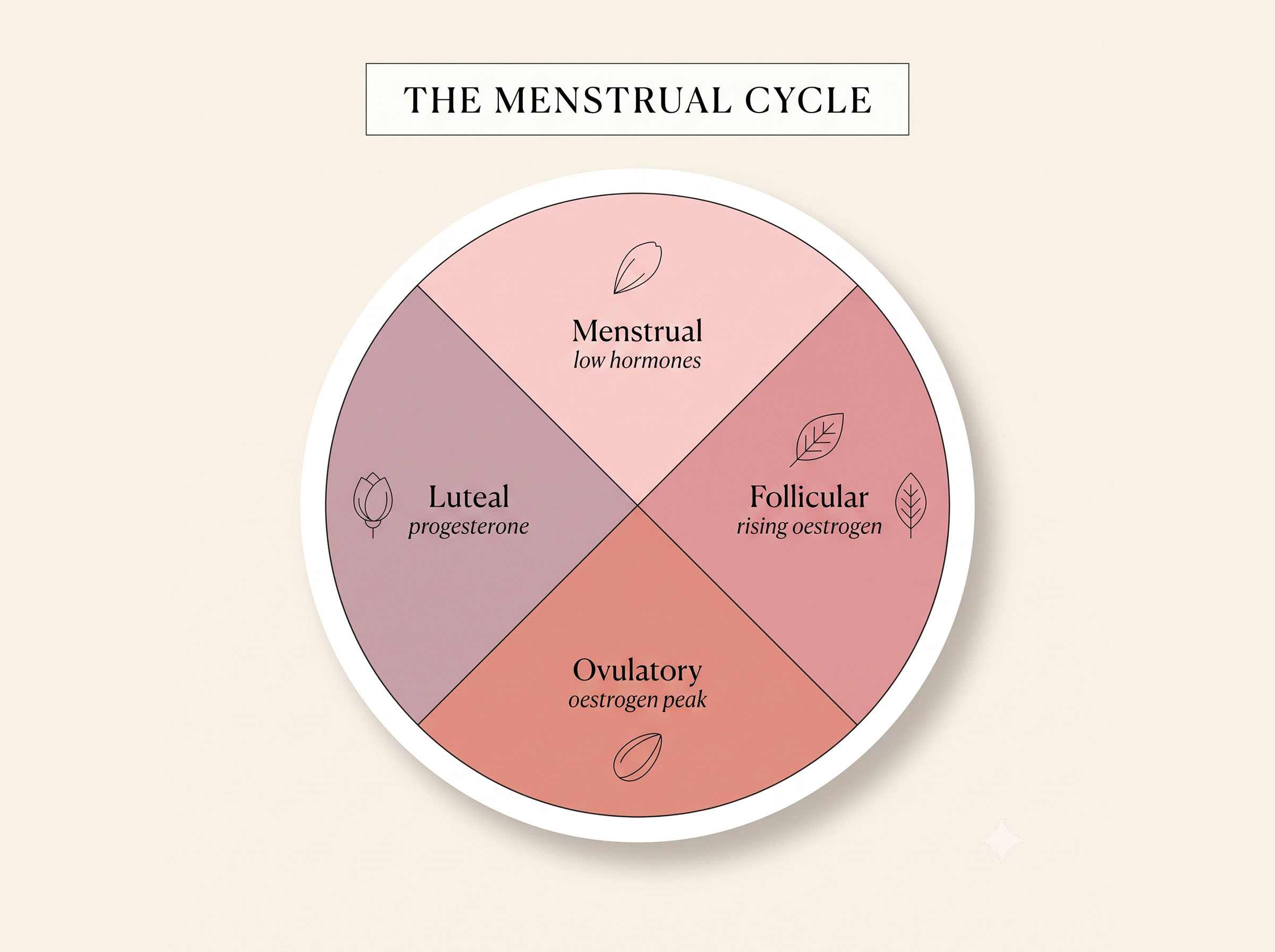
Day ranges describe a common 28-day pattern. Individual cycles vary, which is exactly why women track their own.
Reading the Body's Own Signals
Body literacy rests on three signs a woman can observe without any device more advanced than a thermometer and a notebook. Each has been studied for decades, and together they tell a fuller story than any prediction algorithm.
Basal body temperature. This is the body's temperature fully at rest, taken first thing in the morning before rising. After ovulation, progesterone nudges that baseline up by roughly a third to half a degree, and it stays raised until the next period. On its own a single reading means little; charted across a month, the pattern reveals the moment the fertile window closed. Women have used this “thermal shift” to read their cycles since the method was first documented in the early twentieth century.
Cervical mucus. The body's most honest daily signal, and the one most women were never taught to read. Across a cycle it changes in a predictable arc: dry after the period, then creamy, then — near ovulation — clear, slippery, and stretchy, before drying again. Studies have explored how closely these changes mirror rising and falling oestrogen, which is why observing them offers a real-time read on where a woman stands in her month.
Mood and energy patterns. The least tangible sign, and often the most telling. Kept honestly over two or three cycles, a simple daily note on mood and energy tends to reveal a rhythm — the confident follicular lift, the ovulatory peak, the luteal turn inward. Recognising that these shifts follow the hormones rather than arriving at random can change how a woman reads her own week. What looked like an inexplicable bad mood is often the body keeping perfect time. For a closer look at how the hormones drive these swings, our guide to the rhythm of hormones, mood, and energy maps the connection in detail.
“A period app tells you a date arrived. Body literacy tells you why the whole month felt the way it did.”
The systematic reading of cervical mucus was pioneered in the 1950s by an Australian husband-and-wife medical team, Drs. John and Evelyn Billings. Their work turned an observation women had passed down informally for generations into a documented, teachable method now studied around the world.
What Our Grandmothers Read Without an App
Long before a phone could predict a period, women read their cycles the old way — by paying attention. Historically, societies understood the female cycle as something tied to the moon, and the language survives in words like “menstruation” itself, rooted in the Latin for month. Many cultures built quiet traditions around the rhythm: knowledge passed from mother to daughter, grandmother to granddaughter, at the kitchen table rather than in a classroom.
What looks like a modern wellness trend is, in truth, a return to something women once simply knew. The tools have changed — a thermometer and a notebook in place of inherited memory — but the habit is old. A woman learning to read her own signs today is picking up a thread her great-grandmother would have recognised at once.
Putting It Into Practice
Body literacy is not learned in a single cycle. The pattern emerges slowly, over two or three months of gentle attention. The reward is a kind of fluency: a woman who can look at her own signs and know roughly where she stands, what her energy is likely to do this week, and why her body feels the way it does. That knowledge does not replace a doctor, and it was never meant to. What it offers is quieter and more personal — the confidence that comes from understanding a body a woman has lived in her whole life, and finally being able to read it.
You need nothing more than a notebook. Draw three columns and fill one line each morning for one full cycle:
- Temperature — taken before you get out of bed, same time each day.
- Cervical sign — dry, creamy, or clear-and-stretchy.
- Mood & energy — one honest word will do.
By the end of one month, the shape of your own rhythm starts to appear on the page. This is an observation exercise for self-knowledge — not a medical test or a form of contraception.
Your Questions, Answered
This article explains how women have learned to read their cycles and is not medical advice, diagnosis, or a method of contraception. For anything concerning your health, speak with a qualified doctor. For a broader look at the science, see the U.S. Office on Women's Health guide to the menstrual cycle and the American College of Obstetricians and Gynecologists overview of fertility-awareness methods.
Disclaimer: All content on this website—including articles, educational materials, and interactive calculators—is for informational, educational, and entertainment purposes only. The calculations, percentiles, and outputs generated by tools on this site are based on general statistical data and mathematical models; they do not constitute medical data, a clinical assessment, or a diagnosis.
Nothing contained on this website is a substitute for professional medical advice, diagnosis, or treatment. Always seek the guidance of a qualified healthcare professional or urologist with any questions you have regarding physical development, anatomy, or health conditions. Reliance on any information or tools provided by this website is solely at your own risk.