English
  Español


Somewhere between the third takeout order of the week and the vegetables quietly going soft in the back of the fridge, a lot of women land on the same thought: I should probably learn to cook. Not restaurant cooking. Not anything worth photographing. Just enough to put a warm, honest meal on the table without the low hum of dread that shows up around five o'clock.
If that sounds familiar, you are in far better company than you think — and far more capable than you've been led to believe. For most of history, cooking was not a specialized talent reserved for a gifted few. It was ordinary knowledge, handed from mother to daughter over a shared counter, learned by standing close and watching a pair of hands move. Somewhere along the way, that quiet inheritance got interrupted, and a whole generation grew up fluent in ordering and reheating but nervous around a cutting board. The good news is that the meaning a home-cooked meal has always carried is still available to you, and the on-ramp is much shorter than it looks.
This is a guide for the beginner who searches how to start cooking at home with no time and half-hopes the answer is "you don't have to." You do have to do a little. But only a little — and the payoff, in energy, money, and the simple pleasure of feeding yourself and the people you love, is generous.
Cooking Was Never Meant to Be a Performance
The first thing standing between most women and a home-cooked meal isn't time or skill. It's the picture in their heads. Cooking shows, glossy recipe reels, and twelve-ingredient dinners have quietly rewritten what "cooking" means, until anything less than a full production feels like failure. So people skip it entirely and reach for the delivery app instead.
Set that picture down. Cooking, at its most useful, is closer to laundry than to art: a rhythm of small, repeatable tasks you get faster and calmer at every time you do them. You are not auditioning. You are feeding yourself. A pot of rice, a pan of eggs, and a bowl of something green is a real dinner, and no one at your table will grade it.
Research on eating patterns consistently points the same direction — that women who prepare more of their own food tend to eat more whole ingredients and fewer heavily processed ones, simply as a side effect of being the one holding the spoon. You don't need a nutrition philosophy to benefit. You just need to be in the kitchen a little more often than you are now.
"You are not auditioning. You are feeding yourself — and that has always been enough."
The One Habit That Changes Everything: Cook Once, Eat Twice
If you take only a single idea from this guide, make it this one. The busiest, most tired women who still eat well almost never cook every night. They cook occasionally, in slightly larger amounts, and coast on it. Cooks call this batch prep, and it is the closest thing to a magic trick the kitchen offers.
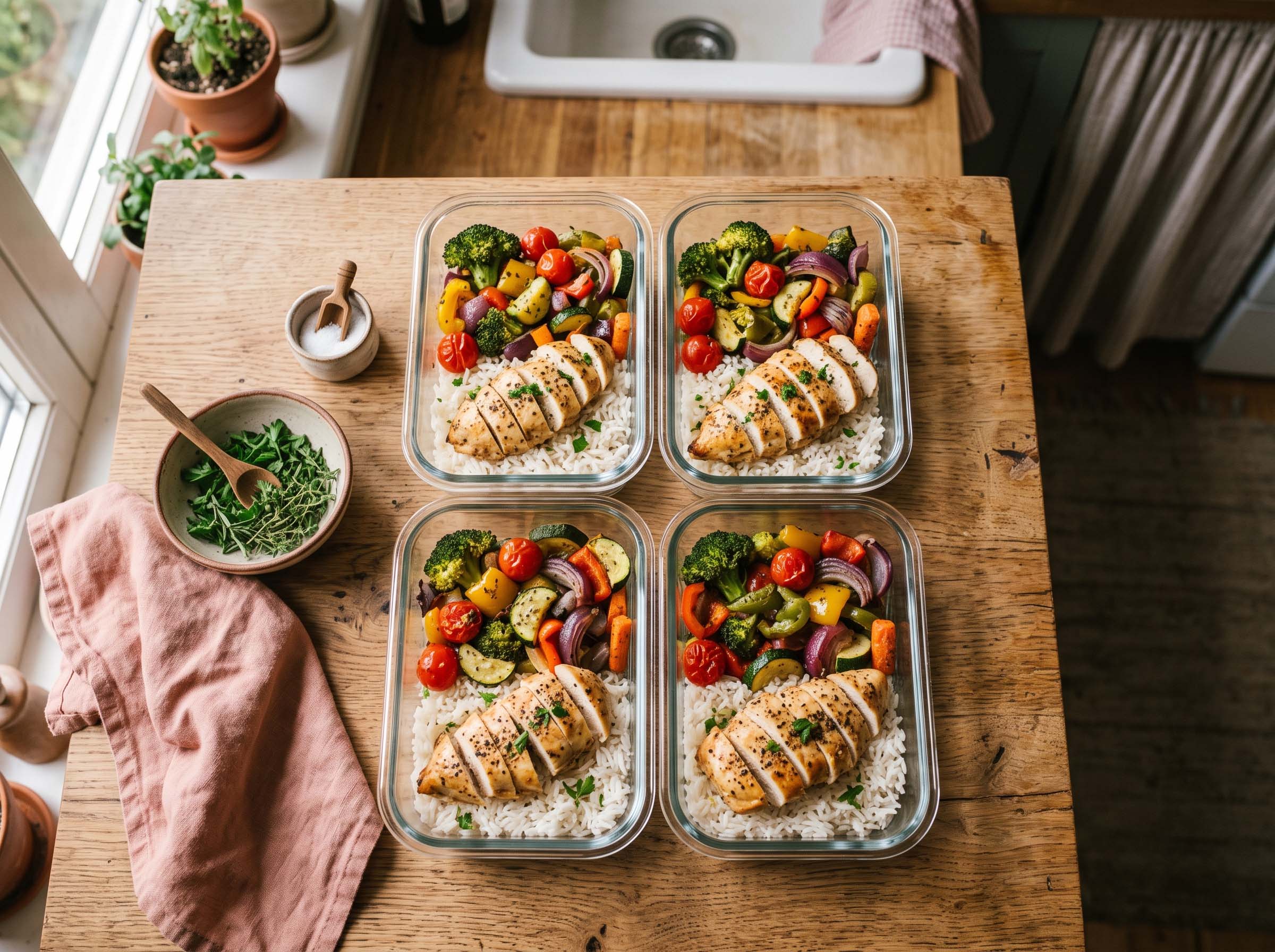
The mechanics are simple. Once or twice a week — a slow Sunday afternoon works well — you make two or three "base" things in quantity: a big pot of rice or grains, a tray of roasted vegetables, and one protein, whether that's a roasted chicken, a pot of beans, or a pan of ground meat. None of it is a finished meal yet. All of it is a head start. For the next three or four days, dinner becomes an assembly job instead of a cooking job: grains plus a scoop of protein plus vegetables plus whatever sauce is in the door of your fridge. Ten minutes, no dread.
Five Techniques That Ask Almost Nothing of You
You do not need to learn to cook. You need to learn five things that cook nearly everything. Master these and roughly eighty percent of simple home dinners open up to you, no recipe required. Think of the table below as your entire beginner curriculum.
Notice what isn't on the list: knife skills that take years, sauces from scratch, anything flambéed. Those can come later, if they ever come at all. Plenty of women cook happily for a lifetime on exactly these five and never feel they're missing a thing. If you'd like a trustworthy visual reference for how a balanced plate comes together, Harvard's Healthy Eating Plate lays it out plainly, without fads.
A Starter Grocery List You Can Actually Shop
Half of not-cooking is really a shopping problem: an empty fridge gives you no options but the phone. The fix is to keep a small, boring, reliable set of ingredients on hand — the culinary equivalent of a capsule wardrobe. Stock these and you can nearly always make something.
🛒 The Beginner's Pantry & Fridge
Pantry Backbone
- Rice & dried pasta
- Canned beans & tomatoes
- Olive oil, salt, black pepper
- Garlic & onions
- One or two dried herbs
Fridge Regulars
- Eggs
- A sturdy green (spinach, kale, cabbage)
- Carrots, peppers, whatever's in season
- Cheese & plain yogurt
- Lemons
Freezer Insurance
- Frozen vegetables
- Frozen fruit (for breakfast)
- A protein you trust
- Good bread, sliced
Shop this list once. Restock only what runs out. You've just removed the biggest reason people don't cook.
The word recipe comes from the Latin recipere, "to take" or "to receive" — the same root as receive. For centuries a recipe wasn't a rigid set of rules but something you were given: a piece of a mother's or grandmother's knowledge, adjusted every time it changed hands. You are allowed to receive it loosely, too.
What Other Kitchens Know That We Forgot
It helps to remember that the world's most beloved everyday food cultures were built by home cooks with limited time and money, not by professionals. A Mexican mother's pot of beans, a Japanese ichiju-issai plate of rice, soup, and one small dish, an Indian household's daily dal — these are not fussy. They are repeatable, thrifty, and built to feed a family night after night. Their genius is exactly the modesty this guide keeps recommending: a few trusted staples, made often, made well enough.
That inheritance is worth reclaiming, and not for the reasons a diet culture would give you. Cooking at home reconnects a woman to something older and steadier than any trend: the ordinary dignity of nourishing the people she loves with her own hands. Traditions around the world have long understood that the food a woman eats and the way she eats it shape how she feels through her day — her energy, her steadiness, her sense of being cared for, even when she's the one doing the caring. None of that requires a nutritionist. It requires a pot on the stove.
If the idea of cooking still feels heavy rather than hopeful, start smaller than you think you should. The point is not to overhaul your life this week. For a gentler frame on all of this, our piece on healing food without restriction is a good companion read — permission, not pressure.
Start With One Meal
Here is the entire assignment. This week, cook one meal you'll be a little proud of. Not seven. One. Roast a tray of vegetables and a piece of chicken, boil some rice, and put them on a plate. That's it. Do it again next week. Add a second dish only when the first feels easy.
Skill in the kitchen is not a gift handed to the lucky few. It is simply what repetition looks like after a while. Every confident home cook you've ever admired was once a woman standing nervously in front of a stove, unsure what to do with an onion. She just kept showing up — and one ordinary evening, without noticing the moment it happened, she realized she knew how to cook. You will get there the same way: one plate, one week, one small act of feeding yourself and your family at a time. For a simple, no-nonsense picture of building meals, the USDA's MyPlate guidance is a friendly place to check yourself against — but honestly, the pot on the stove will teach you more than any chart.
Common Questions From New Home Cooks
Disclaimer: All content on this website—including articles, educational materials, and interactive calculators—is for informational, educational, and entertainment purposes only. The calculations, percentiles, and outputs generated by tools on this site are based on general statistical data and mathematical models; they do not constitute medical data, a clinical assessment, or a diagnosis.
Nothing contained on this website is a substitute for professional medical advice, diagnosis, or treatment. Always seek the guidance of a qualified healthcare professional or urologist with any questions you have regarding physical development, anatomy, or health conditions. Reliance on any information or tools provided by this website is solely at your own risk.