English
  Español



On Friday evening, before the weekend can slip through her fingers the way weekends often do, a woman does one small, deliberate thing: she slides her phone into a drawer and turns the little key. Two days. No scrolling, no pinging, no half-attention given to a screen while a child asks a question for the third time.
It sounds almost quaint — and that is rather the point. The notion that a brighter outlook could be built from soil under the fingernails and a long walk down a familiar lane feels old-fashioned because it is old. Long before wellbeing became an industry, women reached for the garden gate and the open road when their spirits needed tending.
This is less about escape than about attention — where we place it, and what happens to the mind once we stop spending it on a device. Researchers who study mood keep arriving at the same unglamorous conclusion our grandmothers took for granted: some of the small daily activities that restore emotional balance are the ones closest to home.
Why the Phone Goes First
A positive mindset is not a mood you summon on command. It grows in the quality of attention a woman is able to give her own life. And attention, as it turns out, is a limited resource. Psychologists describe a kind of mental fatigue that sets in when we spend all day forcing ourselves to concentrate through distraction — the ping of a message, the pull of a notification, the small hit of novelty each swipe promises. The phone is engineered to fragment focus into a thousand tiny pieces, and a mind held in pieces rarely feels content.
This is why the drawer comes before the garden. Locking the device away for a weekend is not a punishment; it removes the single largest source of interruption from a woman's waking hours and lets her attention gather itself back into one whole thing. Research summarised by the American Psychological Association's review of the science of nature and the mind points to a simple pattern: a device-free stretch of time outdoors is linked to lower stress, steadier mood, and a restored capacity to pay attention. The phone is not the enemy. It is simply the first thing that has to be set down.
“A mind held in a thousand pieces rarely feels content. The drawer comes before the garden.”
The Particular Weight Women Carry
There is a reason the open loops of a household tend to hum loudest in a woman's head. Historically, women have kept the domestic ledger — who needs shoes, when the casserole comes out, whose birthday is coming, which child seemed a little quiet at breakfast. It is unpaid, invisible, and rarely switched off. A phone does not lighten that load so much as multiply it, adding every unanswered message and half-read article to a list that already never ends.
Studies on the mind's habit of turning a worry over and over — a pattern psychologists call rumination — have found that women, on average, report this style of thinking more often than men do. It is not a flaw; it can be the shadow side of a mind built to notice, to plan, and to care for others. But a busy mind needs somewhere to put itself down. Historically, that somewhere was often a task done with the hands and the body: kneading, weeding, walking a path worn smooth by generations. The work occupied the body just enough to let the mind loosen its grip.
The Garden's Old Medicine
For most of recorded history, the garden was a woman's territory. Medieval convents kept physic gardens where nuns grew herbs for the sick; the kitchen garden behind a farmhouse was tended by the woman of the house and fed everyone in it. These were not hobbies. They were duties — and, quietly, they were also refuges. To step out among the rows was to step away from the noise of the house and into a space that answered to weather and season rather than to anyone's demands.
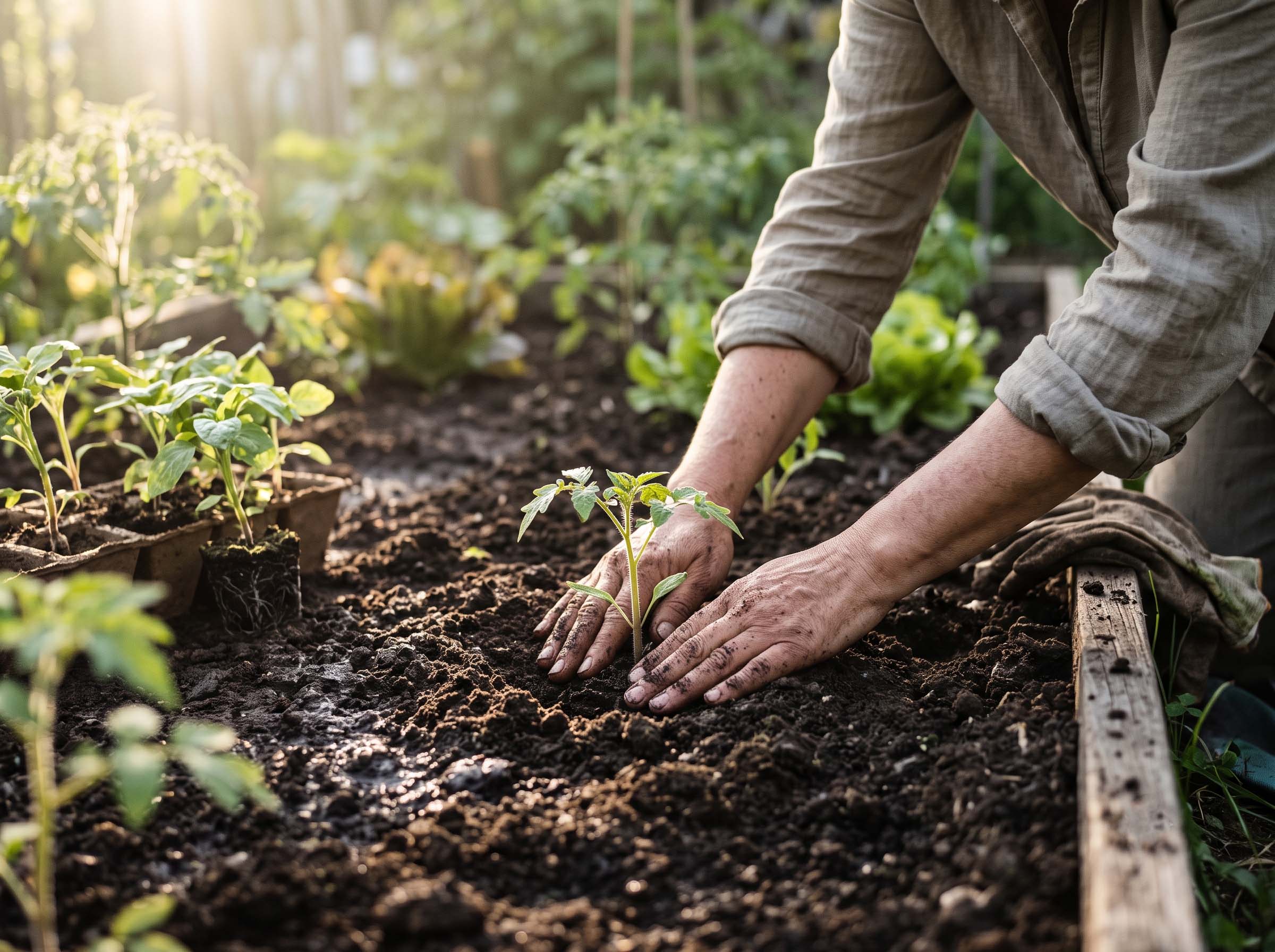
Modern research has begun to describe what those women felt without naming it. Studies of gardening and horticulture have linked time spent tending plants with improved mood and lower reported stress. Part of it seems to be the rhythm — the repetitive, gentle, forgiving nature of the work. Part of it is the reward of watching something grow because you cared for it, a small and honest form of control in a life that offers little. And part of it, delightfully, may be the dirt itself.
There is a family dimension here too. A garden is one of the few spaces where a mother and her children can work side by side without a screen between them — the toddler patting down soil, the older child proud of a single stubborn tomato. What the woman gets is not only a quieter mind but a rare kind of togetherness, the sort that used to be ordinary.
The Case for the Long Walk
If the garden loosens the mind, the walk sets it moving. And walking does something to thought that sitting simply does not. When Stanford researchers compared people walking with people seated, those on their feet produced markedly more creative ideas — roughly twice as many in one experiment — and the lift carried on even after they sat back down. Strikingly, it did not matter much whether they walked outdoors or on a treadmill facing a blank wall. It was the walking itself that mattered. You can read the Stanford team's summary of how walking gets the creative juices flowing and see the pattern for yourself.
Add the open air, and the effect deepens. The American Psychological Association's review of the research landed on a memorable figure: about two hours a week spent in green space is associated with people reporting good health and a strong sense of wellbeing. Two hours. Across a weekend, that is nothing — a walk before breakfast on Saturday, a long amble after Sunday lunch. No app, no step-count guilt, no equipment beyond a pair of comfortable shoes. Just a woman, a lane, and a mind finally free to wander alongside her.

The Weekend Reset at a Glance
And Then, Monday
The point of a locked drawer is not to hide from modern life for forty-eight hours and then dive back in unchanged. It is to remember what the mind feels like when it is not being pulled in ten directions — and to carry a little of that back with you. Most women cannot lock the phone away every day; the school run and the group chat and the work email will not allow it. But the weekend teaches the body a memory it can call on. A ten-minute walk after supper. Five minutes deadheading the roses before the house wakes. A meal eaten with the phone in another room entirely.
A positive mindset, built this way, is not a performance of relentless cheerfulness. It is the steadiness that comes from an attention that belongs to you again. If you would like to build that steadiness into ordinary days, it helps to have a simple daily routine that supports a steadier mind, and there are plenty of other gentle, natural ways to lift a low mood when a full weekend simply isn't on the cards. The garden and the lane will still be there. They have been waiting for women a very long time.
Quick-Start: Your Screen-Free Weekend
You'll Need
A drawer that locks (or a box on a high shelf), comfortable walking shoes, a pair of gardening gloves, and one person at home who knows how to reach you in a real emergency.
Do
- Tell your family the plan on Friday
- Keep one paper notebook for stray thoughts
- Set an old-fashioned clock so you're not tempted to “just check the time”
- Plan one walk and one garden task per day
Don't
- Swap the phone for the television
- Aim for a “perfect” garden or a long-distance hike
- Announce it online first (rather defeats the purpose)
- Feel you must fill every quiet minute
Try This at Home: A First Little Garden
You do not need an acre — a windowsill or a single pot on a step is enough to begin. Herbs are forgiving, quick to reward you, and useful in the kitchen.
Your Materials
- One or two medium pots with drainage holes
- A small bag of potting soil
- Seedlings or seeds of basil, mint, or parsley
- A watering can or an old jug
- A sunny sill or doorstep
Fill the pots, tuck in your seedlings, water gently, and set them where you'll see them each morning. The daily half-minute of noticing — new leaf, first flower — is the whole point.
Your Questions, Answered
Disclaimer: All content on this website—including articles, educational materials, and interactive calculators—is for informational, educational, and entertainment purposes only. The calculations, percentiles, and outputs generated by tools on this site are based on general statistical data and mathematical models; they do not constitute medical data, a clinical assessment, or a diagnosis.
Nothing contained on this website is a substitute for professional medical advice, diagnosis, or treatment. Always seek the guidance of a qualified healthcare professional or urologist with any questions you have regarding physical development, anatomy, or health conditions. Reliance on any information or tools provided by this website is solely at your own risk.