English
  Español



Many women notice that attraction is not a flat, constant thing. It rises and falls, sharpens and softens, moving with the rhythm of a body that is, whether we think about it often or not, built for reproduction. A woman who is happily married for years might find that in certain weeks she notices men more, catches her mind wandering, or feels her own husband more magnetic than usual.
Research suggests this is not a sign that something is broken. It is one of the more interesting corners of the science of desire, tied partly to the hormonal cycle women live with every month, and to a much older history of how societies have tried to explain, manage, and sometimes silence female wanting altogether.
For a broader look at how these same monthly hormonal shifts affect mood and the body more generally, it is worth reading about what birth control changes about a woman's natural hormone signals, since much of what researchers know about cycle-driven desire comes from comparing women on and off hormonal contraception.
The Biology Behind the Shift
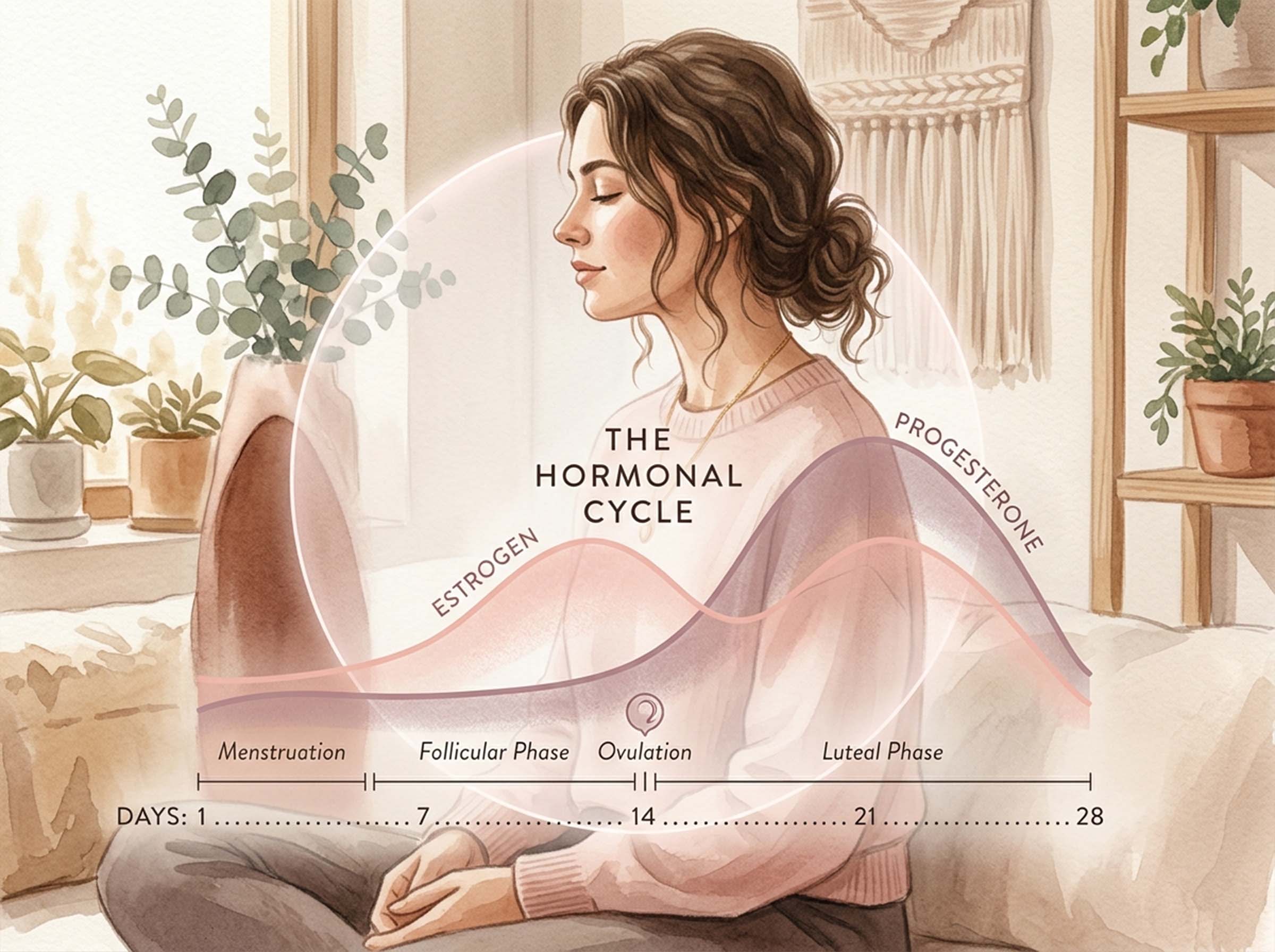
Across a roughly 28-day cycle, estrogen climbs steadily toward ovulation, peaking in the days just before an egg is released, while progesterone rises afterward and dominates the second half of the cycle. Estrogen is associated with heightened energy, sociability, and, in many studies, an uptick in general sexual desire. Progesterone tends to have a calming, sometimes sedating effect. This is not a controversial finding; it is well documented across decades of reproductive endocrinology.
What is more debated is a narrower question that psychologists call the ovulatory shift hypothesis: the idea that during the fertile window, women's attention toward men in general, not only their own partner, may sharpen slightly, reflecting an evolved pull toward reproduction at the moment conception is possible. Large diary studies tracking tens of thousands of entries have found modest increases in general desire and in-pair desire around peak fertility, and one large, preregistered study on ovulatory shifts in mate attraction found weak but measurable increases in women's general attraction during this window. Other researchers, using different designs, have found the effect is smaller than once claimed or disappears under stricter controls. The honest summary is that the science is real but still being argued over, and any single woman's experience will not map neatly onto a population-level average.
How Female Desire Was Understood Through History
Long before hormones had names, physicians had theories, and most of them were not kind ones. Ancient Greek medicine held that the uterus was a semi-independent organ that could wander through the body when "unsatisfied," producing everything from breathlessness to fainting spells. This idea, hysteria, from the Greek word for womb, persisted for over two thousand years, reshaped but never fully abandoned.
By the Victorian era, female desire had shifted from a medical curiosity to a moral hazard. Respectable women were widely believed to feel little or no sexual interest at all; those who did were sometimes diagnosed with "excessive" desire and treated with rest cures, cold baths, or worse. Sigmund Freud, writing at the turn of the twentieth century, reframed female sexuality as psychologically complicated rather than physically dangerous, but his theories still cast women's desire as something to be explained and managed by others rather than simply understood as normal.
It was not until the mid-twentieth century, through the survey work of Alfred Kinsey and the physiological research of William Masters and Virginia Johnson, that female arousal began to be studied directly rather than theorized about from a distance. Their findings, controversial at the time, established what is now widely accepted: that women's sexual response is a real, measurable, and highly variable biological process, not a moral condition.
What Cultures Around the World Have Believed
The Moon Connection
For thousands of years, women across cultures noticed that the menstrual cycle averages close to the length of a lunar month, roughly 29.5 days. This gave rise to fertility symbols, moon goddesses, and calendars built around women's bodies rather than the sun. Modern researchers are still exploring how much of that connection is coincidence and how much reflects something real.
Historically, societies have understood the connection between women's cycles and fertility long before laboratory science confirmed it. Many agricultural cultures tied menstruation and fertility to the moon, building festivals and rites around the rhythm of planting, harvest, and womanhood together. Spring fertility festivals across pre-modern Europe, for instance, openly celebrated feminine vitality as something tied to the land's own renewal, a far cry from the shame that would later dominate Victorian attitudes.
Other traditions moved in the opposite direction, treating female desire as something requiring careful containment through modesty codes, chaperonage, or early marriage, precisely because it was assumed to be powerful rather than absent. The contrast is worth sitting with: many pre-industrial societies took women's desire for granted as strong and natural, and built customs to channel it, while it was the more "modern" Victorian West that tried to argue it barely existed at all.
Desire, Hormones, and Relationship Satisfaction
Psychological research consistently finds that a woman's overall satisfaction in her marriage depends far more on emotional closeness, trust, and day-to-day partnership than on any hormonal fluctuation in a given week. Studies comparing women in relationships to single women found that increases in desire around ovulation tend to be strongest for in-pair attraction, meaning toward the woman's own partner, particularly when she rates him as attractive and emotionally engaged. Noticing other men during certain weeks of the cycle is a documented pattern in the research; acting on it is an entirely separate matter, and most women do not.
Life stage matters enormously here, and it is rarely discussed. Desire tends to look different for a newly married woman than for one who is postpartum, raising young children, or moving through the hormonal changes of perimenopause. Many women report that their baseline interest ebbs and flows across these seasons for reasons that have little to do with the monthly cycle at all, from sleep loss to stress to simply the mental load of running a household.
| Cycle Phase | Dominant Hormone | What Research Reports |
|---|---|---|
| Menstrual (Days 1–5) | Low estrogen & progesterone | Desire often reported as lower; energy typically returning by the end of this phase |
| Follicular (Days 6–13) | Rising estrogen | Steady increase in energy, mood, and reported desire |
| Ovulatory (Days 14–16) | Estrogen peak | Highest reported desire in most studies; subject of the ovulatory shift research debate |
| Luteal (Days 17–28) | Rising progesterone | Desire and energy typically decline; mood changes more common in the final days |
Living With a Body That Has Seasons
Understanding this history offers a kind of quiet relief. For most of Western medical history, female desire was treated as either nonexistent or dangerous, something to be diagnosed rather than simply lived with. Knowing that fluctuation is normal, studied, and shared by countless other women can take the edge off any private worry that something is wrong. It can also open an easier conversation with a husband, who may appreciate understanding that a wife's shifting moods and interest across the month are grounded in biology rather than in anything he has done.
Many women find that this kind of understanding actually strengthens the marriage rather than threatening it, because it replaces guesswork with information. A woman who knows her own rhythms can communicate them. A husband who understands the cycle in broad strokes is less likely to take a quiet week personally. For couples who want to build that kind of emotional fluency, our piece on staying emotionally present for a partner through life's changing seasons is a natural next read.
Common Questions
Disclaimer: All content on this website—including articles, educational materials, and interactive calculators—is for informational, educational, and entertainment purposes only. The calculations, percentiles, and outputs generated by tools on this site are based on general statistical data and mathematical models; they do not constitute medical data, a clinical assessment, or a diagnosis.
Nothing contained on this website is a substitute for professional medical advice, diagnosis, or treatment. Always seek the guidance of a qualified healthcare professional or urologist with any questions you have regarding physical development, anatomy, or health conditions. Reliance on any information or tools provided by this website is solely at your own risk.