English
  Español
  Português


There is a particular moment, usually somewhere around 7:40 on a weekday morning, that needs almost no description. The drawer is open. The drawer is empty. And somewhere in the back of the closet, zipped inside a beach bag from a trip two summers ago, there is a bikini bottom that is technically clean.
We asked 554 women to name the one thing they had actually done in that situation. Thirty-three chose the bikini — about one woman in seventeen, and the least popular answer on the list. Which is its own small surprise, because the swimwear solution is the one everybody tells stories about at brunch. The answer that came first was quieter, older, and involved a sink. Before anyone draws conclusions about generations, it is worth noting that the drawer itself has changed too, along with the fabrics that now fill most underwear drawers.
- 554 women each named a single back-up plan between 1 May and 30 June 2026.
- Hand-washing a pair and drying it quickly finished first with 101 women, two ahead of digging through the laundry basket at 99.
- Hand-washing was chosen by one woman in ten aged 18 to 24, and by more than one in three aged 65 and older — the only answer that climbs across every bracket.
- Two answers barely move with age at all. Five fall away. The poll remains open, so these figures describe a snapshot rather than a finish line.
One woman, one answer
The poll offered eight ways of solving the same small domestic emergency and asked for a single choice, which makes the results unusually clean to read. Every figure below is a share of real women rather than a share of answers, and every age column adds to a hundred. Nobody was asked how often, and nobody was asked to justify anything.
Forcing one answer changes what the numbers mean. A woman who has tried several methods over the years had to name the one that came to mind first — her default rather than her repertoire. What the poll captured, in other words, is the go-to move.
Table 1 — The Back-Up Plans: women choosing each answer
| Back-up plan | 18–24 n=144 |
25–34 n=132 |
35–44 n=103 |
45–54 n=80 |
55–64 n=57 |
65+ n=38 |
All n=554 |
|---|---|---|---|---|---|---|---|
| Hand-washed a pair and dried it quickly | 10% | 14% | 17% | 23% | 32% | 37% | 18% 101 |
| Dug through the laundry for a “not too dirty” pair | 18% | 18% | 18% | 18% | 18% | 16% | 18% 99 |
| Reworn a pair already worn | 15% | 15% | 16% | 15% | 16% | 16% | 15% 85 |
| Turned a pair inside out | 15% | 15% | 15% | 14% | 11% | 8% | 14% 77 |
| Bought new underwear instead of doing laundry | 13% | 12% | 11% | 10% | 7% | 8% | 11% 60 |
| Gone without | 12% | 11% | 11% | 10% | 9% | 8% | 11% 59 |
| Worn a swimsuit bottom | 9% | 8% | 7% | 6% | 5% | 5% | 7% 40 |
| Worn a bikini bottom instead | 8% | 7% | 6% | 5% | 4% | 3% | 6% 33 |
Each woman selected one answer, so every age column totals 100% before rounding. The right-hand column gives the share of all 554 respondents, with the raw count beneath. Bikini bottoms and swimsuit bottoms were offered as separate options; some readers may reasonably regard them as the same garment.
The sink wins, by two women
Hand-washing a pair and drying it quickly was the go-to for 101 of the 554 women who answered. Digging through the laundry basket for a pair that had not been worn very hard was the go-to for 99. That margin is two women, which is no margin at all — the honest reading is that the two leading solutions to an empty drawer are a basin and a hamper, running dead level at roughly 18% each.
What separates them is not how many women choose them. It is which women.
Chart 1
What 554 women named as their back-up plan
One answer per respondent, n=554. Source: Vagina Institute reader poll, 1 May – 30 June 2026.
One climbs, two hold, five fade
Sorting the same eight answers by age produces three distinct behaviours, and the neatness of the split is the most striking thing in the dataset.
Hand-washing rises without interruption: one woman in ten among the 18-to-24 group, one in six by the mid-thirties, nearly a third by the late fifties, and better than one in three among women 65 and older. It more than triples across the table.
Two answers barely move at all. The laundry-basket dig sits at 18% in five of the six brackets before easing to 16% among the oldest. Rewearing a pair holds between 15% and 16% throughout. These are the constants: whatever else changes across four decades, the hamper and the second wearing stay exactly where they are.
Chart 2
One climbs, one holds, one fades
Share of women within each age bracket choosing that answer. Bracket sizes range from 144 (18–24) to 38 (65+), so the oldest line carries the widest margin of error. Source: Vagina Institute reader poll.
The remaining five all thin out. Turning a pair inside out drops from 15% to 8%. Going without falls from 12% to 8%. Buying a fresh pack rather than running a load slides from 13% to around 8%. Both swim options shrink by roughly half. Something has to give when hand-washing takes an extra quarter of the field, and it is these five that surrender the ground.
The only answer that is a skill
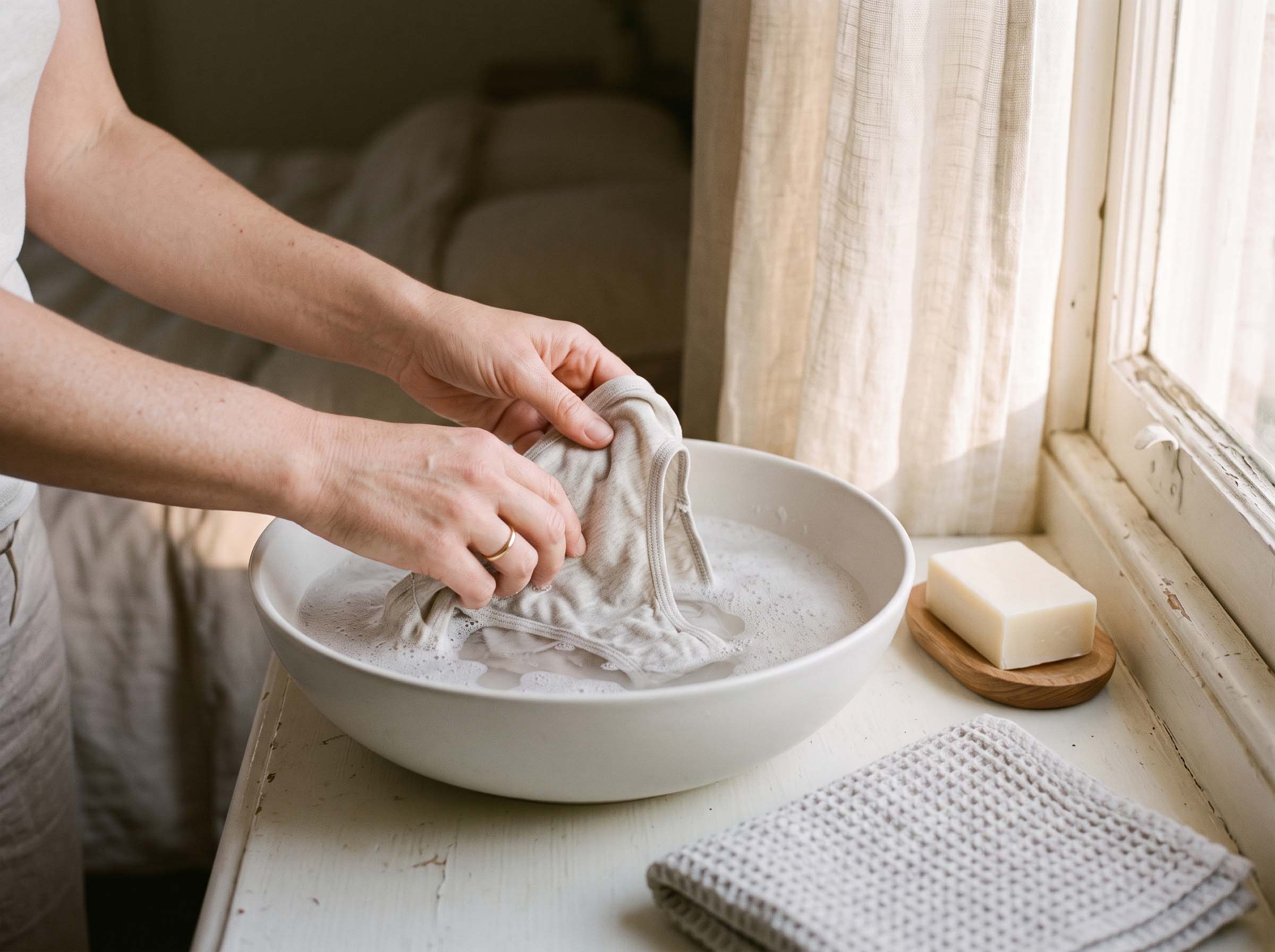
Hand-washing stands apart from the other seven for a reason that has nothing to do with arithmetic. Every other option on the list involves accepting something: a garment worn twice, a substitute garment, a purchase, an absence. The basin solves the problem outright, and it solves it in about four minutes.
Whether that reflects something taught or something learned by necessity, the poll cannot say. What it does show is a piece of practical household knowledge that has not travelled evenly down the generations. Delicate garments were once hand-washed as a matter of course, since machines were rough on fine fabric and fine fabric was costly to replace. That habit survived the arrival of the washing machine in the households that already had it, and largely skipped the households that did not.
Household rhythm matters here too. Figures from the U.S. Bureau of Labor Statistics time-use survey track a steady climb in daily household work with age — from 43 minutes a day among the youngest adults surveyed to 2.7 hours among those 65 and over. A woman running a household on a settled weekly routine rarely arrives at an empty drawer in the first place. A woman sharing a machine in a basement laundry room, or feeding coins into one down the street, arrives there often.
Seven of the eight answers are compromises. Only one is a skill — and it is the only one that grows as the years accumulate.
The retail escape hatch
Sixty women named buying new underwear rather than running a load — 11% overall, and 13% among the youngest bracket against roughly 8% among the oldest. It is the answer that says the most about the wider economy and the least about the drawer.
Underwear has become cheap in a way that would have been unimaginable to the households described in wash-day rhymes. A multipack can now cost less than a restaurant coffee and a half, which changes the arithmetic entirely: when the garment costs less than the hour required to clean it, buying is rational rather than lazy. Whether it is a good trade over a decade of drawers is a different question, and one the poll was not built to settle.
Daily-changed underwear is a surprisingly modern expectation. For most of the nineteenth century, wardrobes were small, laundering was heavy manual work, and undergarments were made of washable linen and cotton precisely because they were the layer that protected costlier outer clothing from the body. The undergarment was, in effect, the washable part of the outfit — the reason the coat above it could be worn for years.
Swimwear, and other honest substitutions
The two swim-related options finished at the bottom of the table, chosen by 33 and 40 women respectively. They behaved almost identically across the age columns, which suggests many readers saw them as the same answer. Whether they did is unknowable from the data, and the honest reading is that both describe a single instinct: reach for the nearest clean thing that fits.
Going without was named by 59 women. That answer sits in a slightly different category from the rest, because for a good many women it is not an emergency measure at all but a preference, particularly at night — a subject explored separately in the case for underwear-free nights. A single-choice poll cannot separate the woman who prefers it from the woman who ran out of options, which is a limitation worth naming rather than papering over.
What the numbers cannot tell us
Several things, in fact. Asking for one answer produces clean columns, but it flattens a real repertoire: a woman who hand-washes on Tuesday and raids the hamper on Friday appears here as one or the other, never both. The poll also asked whether a behaviour had been used, not how often, so a single memorable morning in a university dormitory counts the same as a weekly habit.
Sample size varies sharply across the table as well. The 18-to-24 bracket rests on 144 women; the 65-and-over bracket rests on 38, where a shift of two or three respondents moves the percentage by several points. The upward march of hand-washing is steady enough across six brackets to be worth taking seriously, but the exact figure at the oldest end is the softest number here. And 554 women who chose to answer a poll about laundry improvisation are not a random slice of the population. Readers curious about how these polls are built will find the same approach behind an earlier reader poll on the two minutes after a shower.
These figures cover the first two months of a poll that is still collecting answers, and every new response reshapes the table above. It takes about fifteen seconds, it is anonymous, and no identifying information is collected. There is also a longer set of questions for anyone who wants to go further than a single choice.
An anonymous single-choice reader poll conducted on vaginainstitute.com, reporting 554 responses received between 1 May and 30 June 2026. Each respondent selected one answer and one age bracket, so age columns total 100%. Bracket sizes: 18–24 (144), 25–34 (132), 35–44 (103), 45–54 (80), 55–64 (57), 65+ (38). The poll remains open and figures will change as further responses arrive. This is an informal readership poll, not a representative national survey, and results should be read as a picture of who answered rather than of women generally.
What lingers, once the percentages settle, is the shape of the thing rather than any single number. Eight ways to solve one small problem, two of them running dead level at the top, five quietly thinning out with the years, and one climbing steadily to take over the older end of the table — the one that involves a sink, four minutes, and knowing how. The bikini bottom makes the better story. The basin is the better finding.
Reader Questions
Disclaimer: All content on this website—including articles, educational materials, and interactive calculators—is for informational, educational, and entertainment purposes only. The calculations, percentiles, and outputs generated by tools on this site are based on general statistical data and mathematical models; they do not constitute medical data, a clinical assessment, or a diagnosis.
Nothing contained on this website is a substitute for professional medical advice, diagnosis, or treatment. Always seek the guidance of a qualified healthcare professional or urologist with any questions you have regarding physical development, anatomy, or health conditions. Reliance on any information or tools provided by this website is solely at your own risk.