English
  Español
  Português


Why did the 1948 edition delete what 19th-century anatomists had already drawn in full? Imagine a medical student in the autumn of 1948, sitting at a desk with the newest edition of the book every physician owned. She turns to the section on female anatomy, and something is not there. Not blurred, not simplified, not tucked behind a euphemism.
Simply absent — a structure that had been named by the Greeks, drawn by the Dutch, measured by the Germans, and printed in that very book within her own mother's lifetime.
The organ had not changed. The book had. And the story of how that happened is one of the strangest chapters in the history of medical publishing — a case less about biology than about editors, printing costs, and what a mid-century society was willing to put on a page. If you want the anatomical picture as it is understood today, our guide to mapping the vulva and its structures lays out what modern texts now show. What follows is the paper trail of how that knowledge was lost and found again.
- A German anatomist mapped the full female erectile structure — bulbs, legs and all — in 1844.
- The organ appeared, labelled, in the 1901 edition of the most trusted anatomy book in the English-speaking world.
- In the 25th American edition, published in 1948, it was gone.
- A fully labelled version did not return to that book until the 21st century.
- Historians still argue about how far the deletion spread — and that argument is part of the story.
1. The Map Existed Long Before the Erasure
Here is the detail that makes the whole episode so peculiar: nobody had to discover anything. In 1844, a German anatomist named Georg Ludwig Kobelt published a study of human erectile anatomy that included the female structure in full — not a small external bud, but a branching organ with internal arms and paired bulbs extending well beneath the surface. His plates were meticulous. Anatomists of the period, including the British surgeon Henry Savage, produced similar work.
Kobelt was not a fringe figure and his drawings were not controversial. They were simply good anatomy, done with a scalpel and a steady hand, decades before anyone thought to be embarrassed about it.
2. The Book That Became the Standard
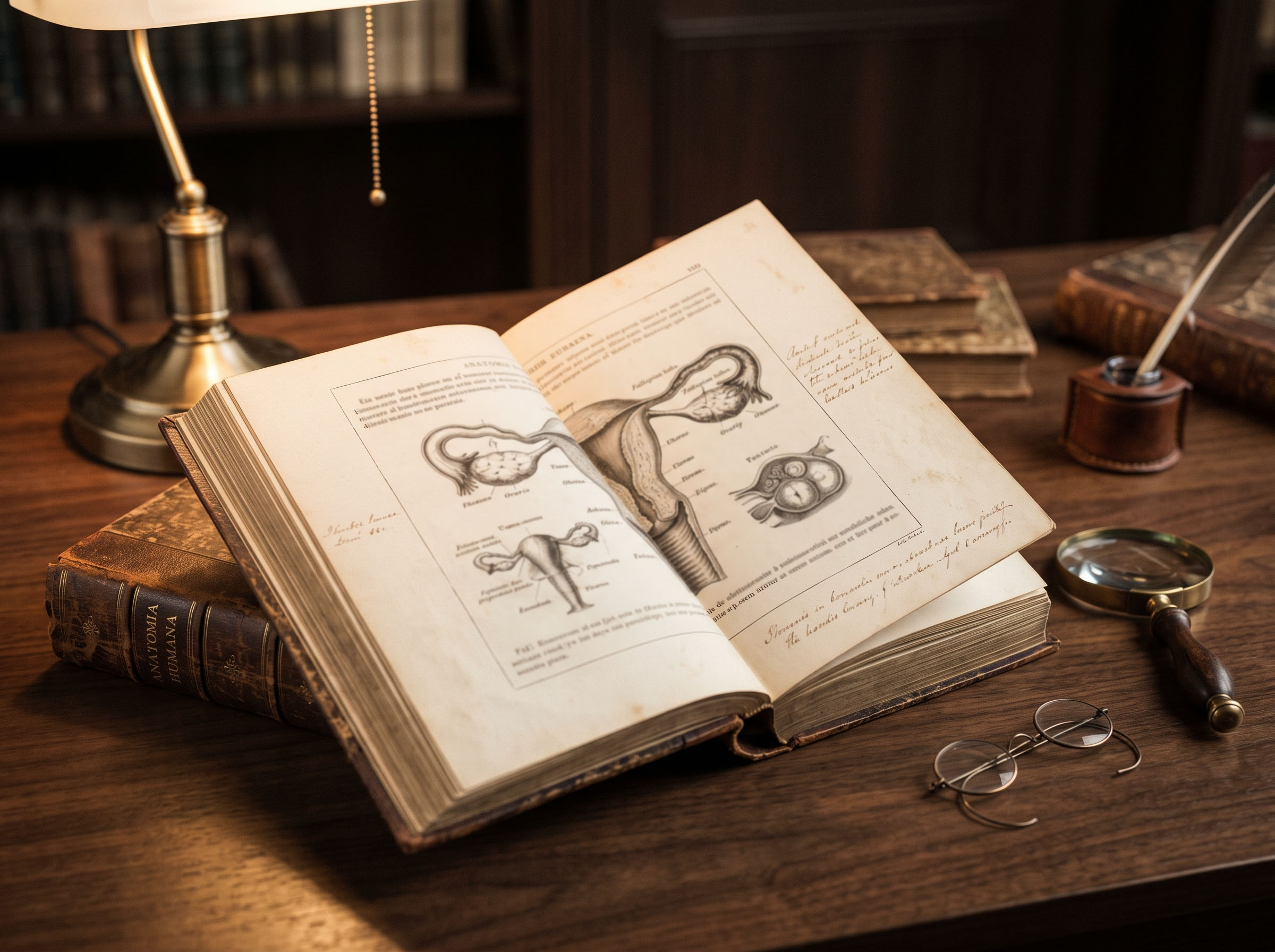
In 1858, a young London surgeon named Henry Gray published Anatomy: Descriptive and Surgical, illustrated by his colleague Henry Vandyke Carter. Gray died of smallpox three years later, at thirty-four. His book outlived him by more than a century and a half and became the reference work against which every other anatomy text was measured.
That authority matters enormously to what came next. When a book becomes the book, its omissions do not read as omissions. They read as facts. A student who cannot find something in Gray's does not conclude that the editor left it out. She concludes that it was never important.
3. 1901: Present, Labelled, Unremarkable
Turn to the American edition published in 1901 and the structure is there. Named, drawn, positioned correctly, treated with the same flat professional attention given to any other part of the body. There is nothing coy about it. Victorian anatomy, whatever else may be said of the era, was not squeamish inside the dissection room.
This is the fact that undoes the easy assumption most of us carry — that knowledge marches steadily forward and each generation knows a little more than the last. On this particular subject, the 20th century knew less than the 19th.
4. 1948: The Quiet Deletion
The 25th American edition of Gray's Anatomy was prepared under the editorship of Dr. Charles Mayo Goss, an accomplished anatomist who had held posts at Yale and Columbia. Under his hand, the structure was removed — dropped from the illustration that claimed to represent the region, and stripped from the surrounding description.
No announcement accompanied it. No editorial note explained the reasoning. Publishing practice of the period granted the editor of each edition considerable independence, which means the decision may well have rested with one man at one desk. What is genuinely remarkable is the silence that followed. A structure disappeared from the most consulted anatomy book in the English-speaking world, and the profession did not appear to notice.
5. Why That Year, and Not a Century Earlier?
The obvious answer — prudishness — is only half of one. Several currents met at the same moment.
- Fashionable theory. Early 20th-century psychoanalysis had reclassified the organ as immature and largely irrelevant to adult women. A structure deemed unimportant is an easy thing to cut.
- Editorial economics. Each new edition meant redrawing, re-engraving and repaginating. Detail that nobody was demanding was detail that could be trimmed.
- Social hygiene sensibilities. The 1940s were unusually cautious about anything touching on pleasure, and medical publishing was not immune to the mood of the culture that bought its books.
- No mechanism to object. There were vanishingly few women in senior anatomy or surgery to raise a hand and ask where it had gone.
None of this required a conspiracy. It required only that a small number of people found the subject unnecessary, and that nobody with standing disagreed loudly enough to matter.
The Paper Trail: A Publishing Timeline
| Year | What Happened on the Page |
|---|---|
| 1844 | Kobelt publishes detailed plates showing the complete internal and external structure. |
| 1858 | Henry Gray's anatomy is first published in London, illustrated by Henry Vandyke Carter. |
| 1901 | The organ appears, named and correctly placed, in the American edition. |
| 1948 | The 25th American edition, edited by Charles Mayo Goss, omits it from illustration and text. |
| 1963 | A small, unlabelled form reappears in the 27th edition — present, but unnamed. |
| 1998–2005 | Australian urologist Helen O'Connell publishes imaging-based studies re-describing the full structure. |
| 2008 | The 40th edition carries a fully labelled depiction — the first in roughly sixty years. |
Dates reflect the standard published account of the editions; edition numbering differs between the British and American lines.
6. The Long Middle: Present but Nameless
The return, when it came, was grudging. By 1963 a small form had crept back into the plates of the 27th edition — but without a label, and without the internal architecture Kobelt had drawn 119 years earlier. It was there in the way a smudge is there.
This is where the archival record becomes genuinely uncomfortable, and where the pattern turns out to be bigger than one book. Two academics, Lisa Jean Moore and Adele Clarke, surveyed anatomy texts across the 20th century and reported something counterintuitive: across successive editions, they found less detail and less labelling rather than more. A separate 2014 analysis of anatomy textbooks published in the Journal of Anatomy found that female anatomy was still routinely described by contrast with male anatomy rather than in its own right.
It is worth being precise here, because sloppy retellings have done the story no favours. Some anatomists push back on the broadest version of the claim, pointing out that many mid-century texts did continue to describe the structure in words even when illustrations were poor. The careful statement is this: it was not absent everywhere, but it was reliably shrunken, unlabelled, and given a fraction of the attention its counterpart received. In 1948, in the most famous book of all, it was gone outright.
| 1844 | The year the full structure was drawn accurately — fourteen years before Gray's book existed at all. |
| 60 | Approximate number of years between the 1948 deletion and the return of a fully labelled depiction. |
| 1963 | The year an unlabelled form reappeared — visible, but still unnamed. |
| 10,280 | Nerve fibre count reported by researchers in 2022 — higher than the figure repeated for decades. |
7. The Restoration
The correction came from imaging technology and from a surgeon who wanted to stop injuring her patients. Helen O'Connell, who became Australia's first female urologist, noticed that the surgical guidance available to her simply did not describe the territory she was operating in. Beginning in the late 1990s, she used magnetic resonance imaging and careful dissection to re-describe the organ — and what she published looked remarkably like what Kobelt had drawn in 1844.
The 40th edition of Gray's Anatomy, published in 2008, carried a fully labelled depiction. In a 2020 editorial in the Australian and New Zealand Journal of Obstetrics and Gynaecology, O'Connell reflected on how slowly that record had been corrected and how much remained thin.

8. What the Archive Actually Teaches
It would be easy to read this as a story about villains. The record does not really support that. Goss was a serious scholar. The publishers were not scheming. What the archive shows is something quieter and more useful: that authority and accuracy are not the same thing, and that a reference work is a series of human decisions about what deserves the page.
Medicine's history of misreading the female body is long and well documented — the same institutional confidence produced two thousand years of the wandering womb theory, and shaped a great deal of what history got wrong about the female form. None of that is an argument against modern medicine. It is an argument for the ordinary habit of asking questions, reading more than one source, and remembering that a printed diagram is a choice somebody made.
The organ never went anywhere. Only the drawing did. That is the whole of it — and it is worth knowing, because the same thing can happen to anything nobody thinks to check.
- Edition
- A substantially revised version of a book. Gray's has run to dozens, each with its own editor and its own choices.
- Plate
- A printed illustration, historically engraved separately from the text — which is why pictures and words could drift apart.
- Labelling
- The named annotations on a diagram. A structure can be drawn and still go unnamed, which is close to invisible for a student.
- Archival record
- The surviving printed evidence itself — the actual pages, compared side by side across years.
Questions Readers Ask
Disclaimer: All content on this website—including articles, educational materials, and interactive calculators—is for informational, educational, and entertainment purposes only. The calculations, percentiles, and outputs generated by tools on this site are based on general statistical data and mathematical models; they do not constitute medical data, a clinical assessment, or a diagnosis.
Nothing contained on this website is a substitute for professional medical advice, diagnosis, or treatment. Always seek the guidance of a qualified healthcare professional or urologist with any questions you have regarding physical development, anatomy, or health conditions. Reliance on any information or tools provided by this website is solely at your own risk.