English
  Español



There is a woman history has largely forgotten. No portrait survives. No diary, no letter, no firsthand account written in her own words. She has no first name in the official record — she is listed only as "the first wife of Feodor Vassilyev," a peasant farmer from the Shuya district of Russia. And yet, what she accomplished — if the account is to be believed — remains unmatched by any woman who has ever lived.
According to records submitted to the Russian government and later referenced by the Monastery of Nikolsk in 1782, this unnamed woman gave birth to 69 children over the course of her lifetime in the first half of the 18th century.
Sixty-nine. The number seems almost impossible, the kind of figure that belongs in mythology rather than in the annals of obstetrics. But unlike mythology, this story comes with a ledger — a count of births broken down by type, by survival rate, and by date. Whether you approach it with wonder, skepticism, or quiet awe, it is impossible to walk away from this story unmoved.
"She has no first name in the official record — and yet what she accomplished remains unmatched by any woman who has ever lived."
— Amara Leclerc, Curiosities & WondersThe Numbers Behind the Legend
The claim was not informal gossip passed down through a village. It was documented in a report sent to Moscow and recorded in the archives of the Nikolsk Monastery. According to that account, Feodor Vassilyev's first wife gave birth in a total of 27 pregnancies. She delivered 16 pairs of twins, 7 sets of triplets, and 4 sets of quadruplets. Of those 69 children, 67 survived infancy — a remarkable figure for any era, but especially for 18th-century rural Russia, where infant mortality routinely claimed a quarter or more of all newborns.
The story was later referenced in the Guinness World Records as the most prolific mother in recorded history, where it has held its place for decades, accompanied by the standard caveat that the record has not been independently verified from primary sources beyond the monastery account. That honest disclaimer matters — but so does the record's staying power. No researcher, archivist, or medical historian has yet produced a credible alternative claimant.
By the Numbers
The Breakdown: A Record Unlike Any Other
To put the Vassilyev record in context, consider what it actually looked like in terms of pregnancies, deliveries, and births. The table below reconstructs the breakdown as documented:
Cultural Insight
Women in 18th-Century Russia
In Imperial Russia, a woman's social standing, security, and spiritual identity were closely bound to her role within the household. Large families were not merely common — they were an expression of faith, prosperity, and duty. The Orthodox Church celebrated fertility, and communities measured a woman's worth, in part, through the vitality of her children. For a peasant wife in Shuya, bearing and raising children was not just her primary occupation — it was her life's entire architecture.
This context does not diminish what she endured — it explains why her story was considered worthy of official documentation at all.
What Life Must Have Actually Looked Like
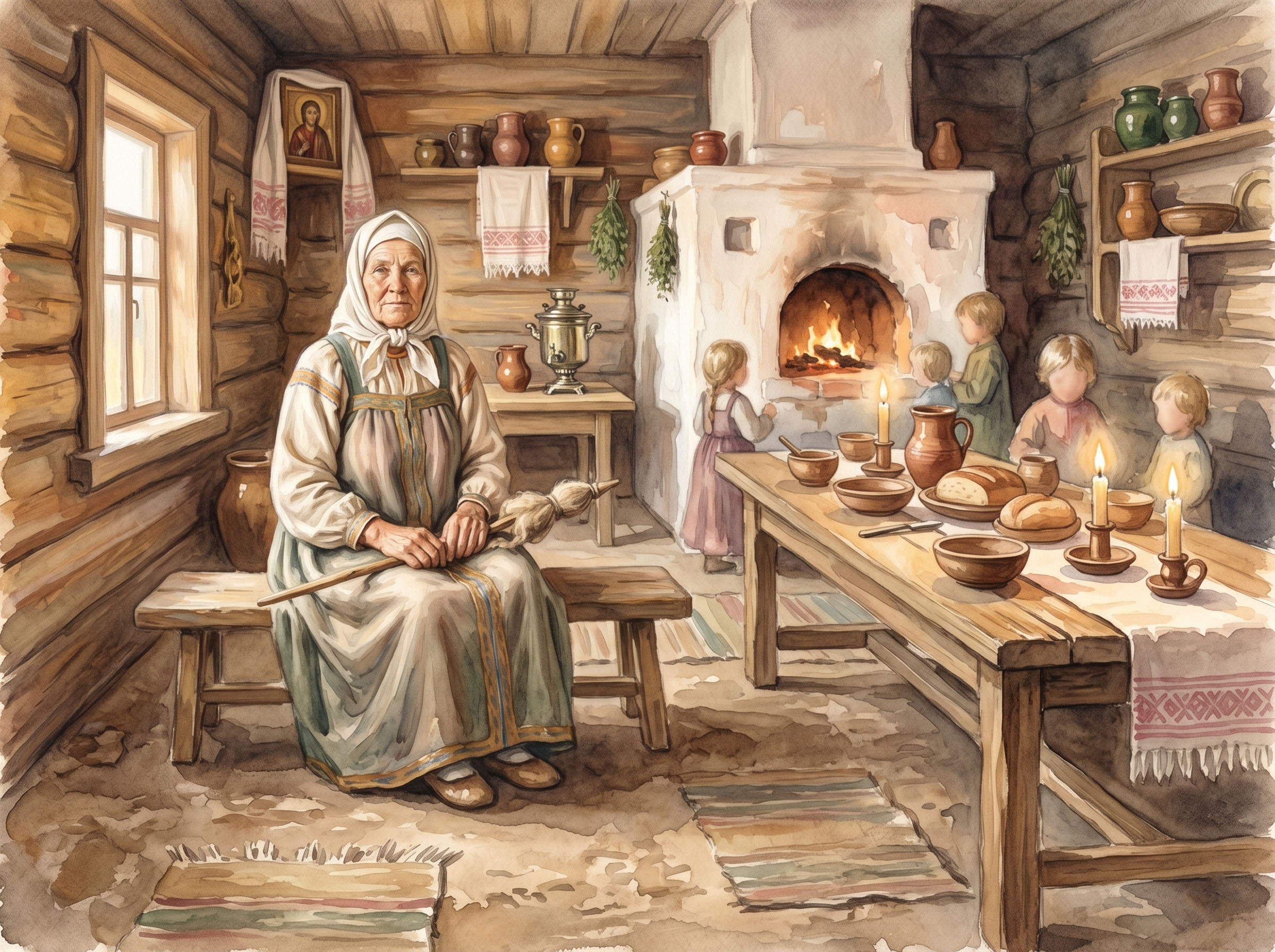
Set aside the numbers for a moment and consider the woman herself. Historians estimate she bore her first child likely sometime around 1707 and continued giving birth into the 1760s — more than four decades of near-continuous pregnancy, nursing, and child-rearing. In an era before anesthesia, before modern obstetric care, before the understanding of germ theory, every single delivery was a genuine risk to her life. A multiple pregnancy, even today, carries higher rates of complication. In the 18th century, a quadruplet delivery without medical intervention was, by any reasonable measure, a life-threatening event.
And she did it four times.
What sustained her — physically, emotionally, spiritually — we can only guess. The physical toll on a woman's body from even a handful of pregnancies is well-documented. Repeated stretching of the uterus, the demands of prolonged nursing, the nutritional strain of supporting multiple growing fetuses simultaneously — these are not trivial stresses even by today's standards. The medical community recognizes that women who carry multiples face elevated risks of preterm labor, anemia, gestational complications, and postpartum recovery challenges. That she survived 27 pregnancies in pre-modern conditions speaks to either extraordinary physiological resilience, remarkable constitution, or both.
Did You Know?
Multiple pregnancies run in families — and may have genetic roots.
Fraternal twins (and higher-order multiples) occur when a woman releases more than one egg during ovulation — a trait that can be inherited. Some women carry a genetic predisposition toward hyperovulation, making multiple pregnancies far more likely across their childbearing years. This may partly explain the extraordinary pattern seen in the Vassilyev record.
The Question Science Has Never Fully Answered
Modern researchers who have revisited this record often arrive at the same set of questions: How is it biologically possible to deliver 69 children in 27 pregnancies? The mathematics are, at minimum, plausible. Sixteen twin sets produce 32 children. Seven triplet sets produce 21. Four quadruplet sets produce 16. Together, that totals exactly 69. The arithmetic works — but the biology strains the imagination.
What makes the Vassilyev case particularly unusual is not just the volume of children but the recurring nature of higher-order multiples. The rate of naturally occurring triplets worldwide is roughly 1 in 10,000 pregnancies. Quadruplets occur naturally at around 1 in 700,000. To have seven triplet pregnancies and four quadruplet pregnancies in a single lifetime — without fertility treatments, which did not exist — would require a degree of hyperovulation that is, to put it plainly, almost without modern precedent.
And yet — there it is in the monastery record.
Some historians argue the record may include some degree of exaggeration or administrative conflation over time. Others point out that without strong motivation for fraud (the Vassilyev family gained no significant land, title, or tax benefit from the report), deliberate fabrication seems an unlikely explanation. The most intellectually honest position may simply be: this happened, we cannot fully explain it, and that is exactly what makes it extraordinary.
"The most intellectually honest position may simply be: this happened, we cannot fully explain it — and that is exactly what makes it extraordinary."
— Amara LeclercFeodor's Second Wife — And the Record That Keeps Going
There is a footnote to this story that is almost as remarkable as the story itself. After his first wife died — her exact age at death is unrecorded — Feodor Vassilyev remarried. His second wife bore him 18 more children across 8 pregnancies (6 sets of twins and 2 sets of triplets). That brings the total number of children born to Feodor Vassilyev across two marriages to 87 — a figure that may represent the largest documented family in recorded human history.
The detail that his second wife also delivered primarily multiples has led some geneticists to wonder whether hyperovulation — if that is what explains the pattern — might reflect something about the local population genetics of the Shuya region, or simply represent an extraordinary statistical coincidence across two marriages to different women.
Why History Forgot Her Name
It is a quiet irony that the woman who achieved the most extraordinary feat in the recorded history of human reproduction is remembered by no name. The record is filed under her husband's. This was not unusual for the era — women in 18th-century Russia, particularly those of peasant stock, were rarely the named subjects of official documentation. Their births, marriages, and deaths were recorded in church registries, often in the names of their fathers or husbands.
What is unusual is that the feat itself was considered important enough to document at all. Someone in Shuya thought the count mattered enough to report it to Moscow. A monk thought it worthy of inclusion in the monastery's archive. And so, stripped of her identity but not of her achievement, she survived the centuries.
In Brief
- The unnamed first wife of Feodor Vassilyev (Shuya, Russia) holds the Guinness World Record for the most children born to one woman: 69 children across 27 pregnancies.
- Her deliveries included 16 sets of twins, 7 sets of triplets, and 4 sets of quadruplets.
- An extraordinary 67 of her 69 children survived infancy — a remarkable rate for the 18th century.
- The record was first reported to Moscow and preserved in the archives of the Nikolsk Monastery, c. 1782.
- Feodor's second wife added 18 more children, bringing the household total to 87 — potentially the largest documented family in history.
- The record has been held for over 240 years without a verified challenger.
What She Means to the History of Motherhood
It would be easy — and perhaps instinctive — to read this story through a modern lens and feel a wave of exhaustion or even horror on her behalf. Sixty-nine children. Twenty-seven pregnancies. Decades without pause. That is one way to see it.
Another is to recognize what she represented within her own world: the absolute pinnacle of what women of her time and place were celebrated for — a life of extraordinary abundance, health, and family continuity. Her children filled a village. Her grandchildren and great-grandchildren may well have populated a region. The scale of her generative power is, by any honest measure, without parallel in the human record.
Whether one admires her story, marvels at it from a biological distance, or simply sits with the quiet weight of imagining her days — making bread, nursing infants, managing an ever-expanding household with no electricity, no running water, and no formula — there is no neutral response to this woman's life. She was, by every measure available to us, the greatest mother in recorded history. And she did it without a name on the page.
History gave that to her husband. Nature gave everything else to her.
Your Questions Answered
Further Reading
For those interested in the biology behind multiple births, the World Health Organization's overview of multiple birth factors and global trends offers a grounded look at what science currently understands about twin and higher-order pregnancies across populations.
Disclaimer: All content on this website—including articles, educational materials, and interactive calculators—is for informational, educational, and entertainment purposes only. The calculations, percentiles, and outputs generated by tools on this site are based on general statistical data and mathematical models; they do not constitute medical data, a clinical assessment, or a diagnosis.
Nothing contained on this website is a substitute for professional medical advice, diagnosis, or treatment. Always seek the guidance of a qualified healthcare professional or urologist with any questions you have regarding physical development, anatomy, or health conditions. Reliance on any information or tools provided by this website is solely at your own risk.