English
  Español



There is an animal roaming the savannahs of sub-Saharan Africa that has confused, fascinated, and at times horrified naturalists for centuries. The spotted hyena — Crocuta crocuta — looks, at first glance, like a rough-edged cousin of the dog. But look more carefully and you are looking at one of the most biologically unusual creatures on earth, and one whose story raises genuinely interesting questions about what female biology is capable of, and what it reveals about our own.
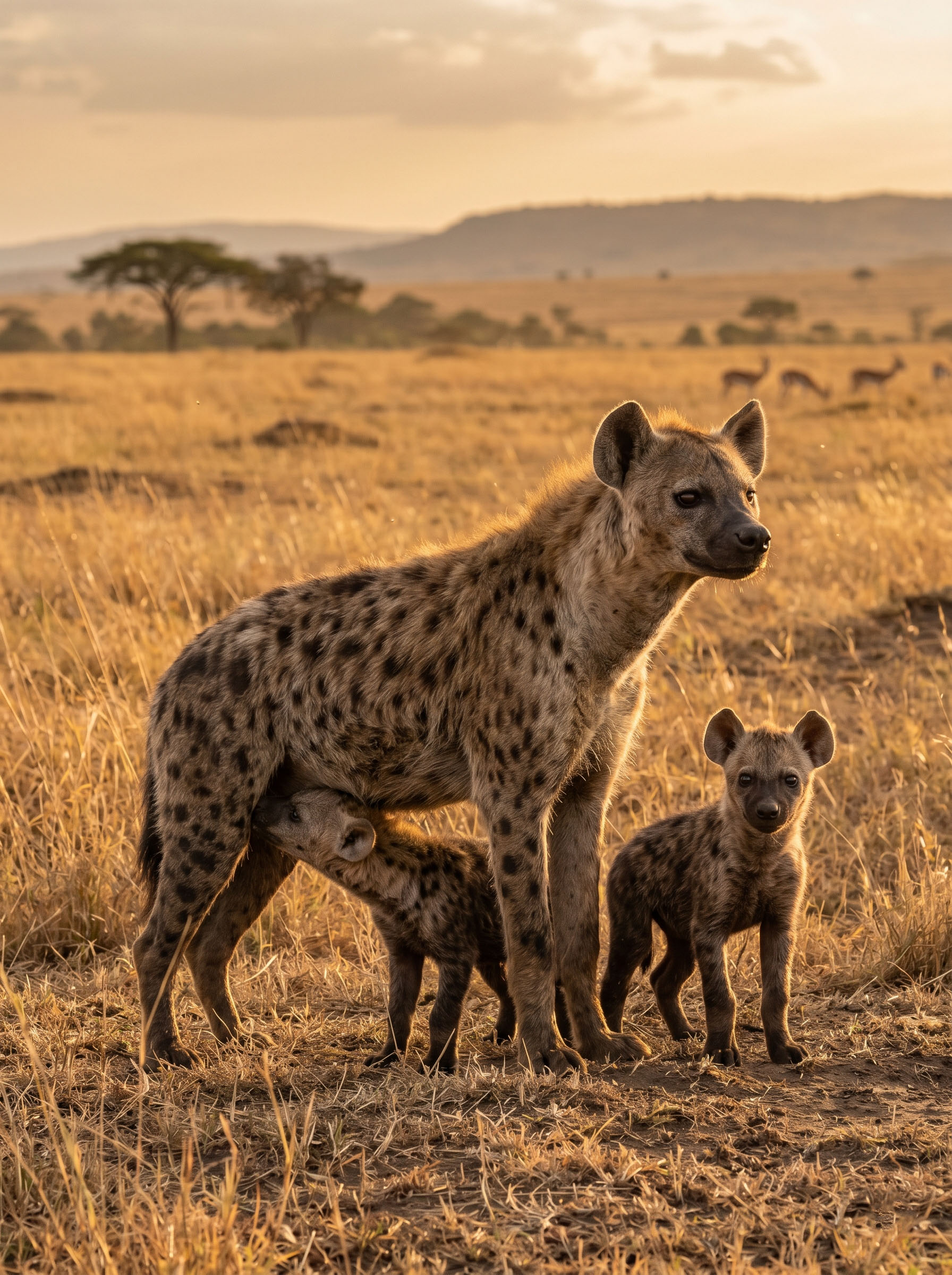
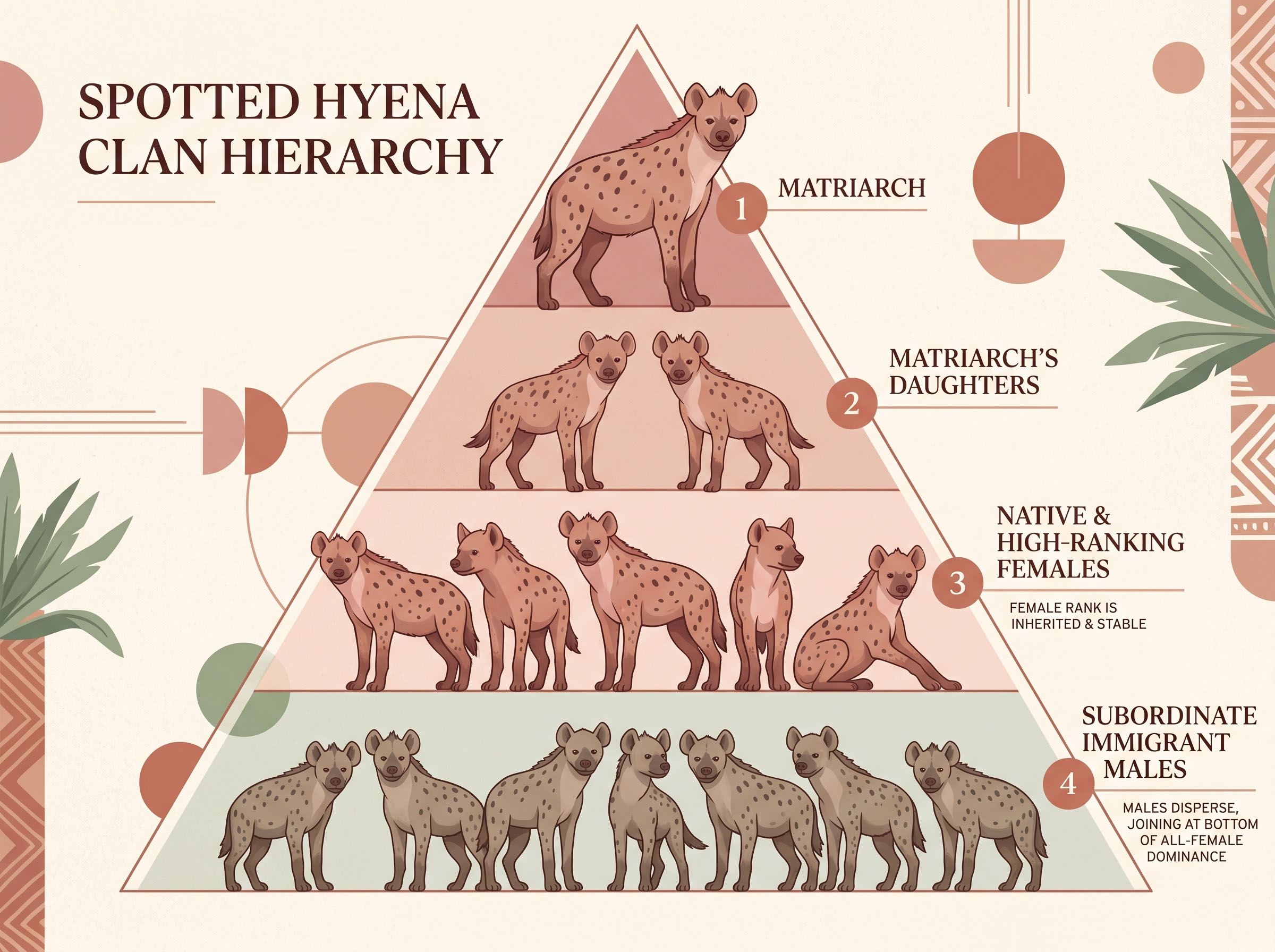
The spotted hyena lives in a strict female-led society. Every female outranks every male. The lowest-ranking female in the clan sits above the highest-ranking male. Females are larger, heavier, and measurably more aggressive than their male counterparts. They control access to food, territory, and mating. They lead hunts. They protect cubs. They make every decision that matters to the group's survival.
And then there is the anatomy — the detail that made Victorian naturalists blush and early zoologists genuinely uncertain about what sex they were even observing. Female spotted hyenas possess an elongated clitoris that closely resembles a male penis in both size and shape. They also lack an external vaginal opening; instead, the female reproductive and urinary systems share this single passage. The result is an animal that, externally, appears almost impossible to sex by sight alone.
For centuries, this led to the belief that hyenas were hermaphrodites. Ancient writers including Aristotle wrote about them as shape-shifters, animals that changed sex seasonally. That was wrong — but the curiosity was understandable. What was actually happening, biology would eventually reveal, was something far more interesting.
"Every female spotted hyena outranks every male — not through learned behaviour, but through biology written into her body before birth."
— Amara Leclerc, Cultural AnalystThe Androgen Question
Research suggests the answer lies in hormones — specifically, androgens. Androgens are a group of hormones that includes testosterone, and they are typically associated with male biology. But female spotted hyenas have androgen levels that, during pregnancy and early development, far exceed those of most other mammals, including the males of their own species.
Studies published in journals including Hormones and Behavior have explored how this androgen exposure during fetal development shapes the female hyena's anatomy and behaviour. The elongated clitoris — technically called a pseudo-penis — is the most visible result. But researchers believe the same hormonal environment also shapes the brain, producing females that are socially dominant, physically bold, and hardwired, from before birth, to lead.
This is not aggression in the crude sense. Female hyenas are not simply violent — they are strategically, socially dominant. Studies show they have sophisticated social memories, form alliances, and pass their social rank directly to their daughters. A female born to a high-ranking mother inherits that rank. The daughters of clan leaders grow into clan leaders themselves. Power, in hyena society, is a maternal inheritance.
Why Would Biology Do This?
It is a reasonable question. The pseudo-penis creates serious complications for reproduction. Females must give birth through this narrow passage, making hyena birth one of the most physically demanding of any land mammal. First-time mothers experience high rates of cub and maternal mortality during delivery. The anatomy that grants dominance also creates genuine biological cost.
So why would evolution produce and maintain this trait? Research suggests it is, in part, a side effect — androgens are the mechanism that produces dominance in this species, and the anatomical changes come along with that package. The dominance itself offers clear survival advantages: dominant females eat first, their cubs survive at higher rates, and their lineages persist. The biological "price" is steep, but the evidence suggests the social rewards have been worth paying across millions of years of evolution.
Other researchers have proposed that the pseudo-penis may serve secondary social functions — it appears in greeting rituals between clan members, and its presence may signal status or facilitate social bonding. In a species where dominance is everything, even anatomy becomes part of the social language.
Cultural Insight
The Hyena in Human Story
Across much of East and West Africa, the hyena has long held a complex place in folklore — feared, respected, and associated with witchcraft and the spirit world. In some Ethiopian traditions, spotted hyenas were believed to consume evil spirits. In ancient Egypt, hyenas appeared in hunting scenes on tomb walls, recognised as powerful creatures worthy of record.
The animal's reputation for strength and cunning — traits historically coded as male in human cultures — may have made the female hyena's dominance all the more bewildering to early observers who encountered them without scientific tools.
What This Tells Us About Female Biology More Broadly
The hyena is an extreme example, but it sits within a broader pattern that animal biology reveals about female reproduction: the female body is not a passive or simply receptive system. It is, in many species, an active, adaptive, and sometimes structurally radical one.
Studies across species have documented extraordinary variation in female anatomy and reproductive strategy. Female ducks possess corkscrew-shaped reproductive tracts that give them physical control over fertilisation. Female fossa — the cat-like predators of Madagascar — temporarily develop pseudo-penises during adolescence, possibly as a way to avoid unwanted male attention before they are reproductively mature. Female moles carry ovotestes — organs that produce both eggs and androgens — giving them androgen-driven traits that help them compete for underground territory.
The pattern, across these and other species, is that female reproductive anatomy is shaped not only by the requirements of reproduction but by the specific social and environmental pressures a species faces. The body adapts. The biology responds. What looks strange or counterintuitive when viewed in isolation often makes considerable sense when placed in ecological context.
Female Dominance & Anatomical Variation Across Species
| Species | Female Status | Anatomical Distinction | Key Driver |
|---|---|---|---|
| Spotted Hyena | All females outrank all males | Enlarged clitoris (pseudo-penis) | High prenatal androgens |
| Bonobo | Females form alliances to dominate males | Prominent clitoris; sexual signalling | Social bonding behaviour |
| Female Mole | Highly territorial, competes for space | Ovotestes produce androgens | Underground resource competition |
| Fossa (Madagascar) | Adolescent females avoid male attention | Temporary pseudo-penis in juveniles | Reproductive protection |
| Spotted Sandpiper | Females hold territory; males incubate | Larger, more brightly marked than males | Role reversal reproductive strategy |
The Birth That Costs Everything
Perhaps the most sobering chapter of the hyena story is the one that happens in those first hours of life. Because the pseudo-penis is the only passage through which a cub can be born, the birth canal is extraordinarily narrow. The umbilical cord is short relative to the length of the passage, meaning cubs risk oxygen deprivation during delivery. First-time mothers lose a significant proportion of firstborn cubs this way, and maternal mortality rates during first births are considerably higher than in subsequent pregnancies, when the passage has stretched.
Yet the species has thrived. Spotted hyenas are among the most successful large carnivores in Africa, adaptable across habitats from desert edges to forest margins to the outskirts of cities. The biology, for all its cost, works. And that is a useful reminder of something animal research consistently suggests: evolution does not optimise for comfort or ease. It optimises for reproductive success over time, even when the path to that success is genuinely punishing.
Reflections on Human Female Biology
Humans, of course, are not hyenas. Our social structures, reproductive biology, and anatomy occupy a very different space. But comparative biology has a long tradition of using the diversity of the animal kingdom as a lens through which aspects of human biology that can seem puzzling become more legible.
The androgen-dominance connection in hyenas, for example, connects to a broader scientific conversation about the role of prenatal hormone exposure in shaping behaviour and anatomy across species, including humans. Research has explored how variations in androgen exposure during human fetal development influence a wide range of traits — not in the dramatic way seen in the hyena, but subtly, and in ways that researchers continue to study.
The maternal inheritance of social position seen in hyenas also has echoes in human social history. Historically, societies have understood maternal lineage as a powerful transmitter — not only of biological traits, but of status, land, name, and identity. Matrilineal societies across Africa, the Pacific Islands, and parts of Asia have organised inheritance through the mother's line for thousands of years. The hyena, it turns out, has been running this system far longer than any human civilisation.
There is also something worth sitting with in the recognition that female biology — across many species — has been shaped by competition, strategy, and active physical adaptation. The idea of the female as simply passive in evolutionary terms does not hold up well against the evidence. Studies of evolutionary biology at Science.org consistently show that female animals across species have been active agents in shaping the course of reproductive evolution — through mate choice, competitive behaviour, anatomical adaptation, and cooperative strategy.
✦ Did You Know?
Hyena cubs are born with their eyes open and their teeth already erupted.
Unlike most carnivore cubs, which are born helpless, spotted hyena cubs arrive ready to compete. Littermates — usually twins — begin fighting for dominance within hours of birth. In same-sex litters, this sibling rivalry can be lethal. Researchers believe this early aggression is another expression of the androgen-rich prenatal environment, hardwiring competition before the cubs have even seen the savannah.
What Female Power Actually Looks Like in Nature
The spotted hyena is sometimes co-opted as a symbol of raw aggression, or alternatively used to make political points about gender. Neither use does the animal justice, and neither is really the point. The more honest and interesting reading is simply this: biology is wide. The range of strategies, structures, and anatomical solutions that evolution has produced to allow females to survive, reproduce, and raise young successfully is genuinely remarkable — and the spotted hyena sits near the outer edge of that range.
Many women, especially mothers, will recognise something in the hyena's story that does not require any ideological framing. The investment in cubs, the protection of young, the passing of knowledge and standing from mother to daughter — these are not alien concepts. What is striking is simply the biological extremity with which the hyena enacts them. In this species, the usual assumptions about which sex is larger, more aggressive, or anatomically more complex simply do not apply.
Research published in peer-reviewed literature, including studies accessible through the National Institutes of Health's reproductive biology archive, has deepened scientific understanding of how androgen exposure shapes female anatomy and social behaviour across mammalian species. The hyena sits at one end of a spectrum that includes, in subtler ways, most female mammals — including us.
The lesson, if there is one, is that female biology has always been more varied, more adaptive, and more structurally inventive than older, simpler accounts suggested. The hyena just happens to make that point in the most unforgettable way possible.
Worth Knowing
Spotted hyenas are more closely related to cats than to dogs — despite appearances.
Hyenas belong to the family Hyaenidae, which is part of the suborder Feliformia — the cat-like carnivorans. Despite their dog-like posture and gait, they share a deeper evolutionary kinship with mongooses, civets, and cats than with any canine. Their remarkable social intelligence, often compared to that of primates, is increasingly recognised by researchers as one of the animal kingdom's more underappreciated cognitive stories.
A Final Thought
The next time someone describes a woman as unusually assertive, or wonders at the way a mother will move mountains for her children, it is worth remembering that these tendencies have very long biological roots — and that nature has, in at least one extraordinary species, taken them to their absolute extreme.
The spotted hyena does not know she is breaking rules. She is simply living the biology she was born with, raising the cubs she has fought to protect, and passing her rank to daughters who will do the same. That, in its own way, is a story as old as life itself.
Explore more on related topics: Biological Marvels | Modern Womanhood
Questions Readers Ask
Disclaimer: All content on this website—including articles, educational materials, and interactive calculators—is for informational, educational, and entertainment purposes only. The calculations, percentiles, and outputs generated by tools on this site are based on general statistical data and mathematical models; they do not constitute medical data, a clinical assessment, or a diagnosis.
Nothing contained on this website is a substitute for professional medical advice, diagnosis, or treatment. Always seek the guidance of a qualified healthcare professional or urologist with any questions you have regarding physical development, anatomy, or health conditions. Reliance on any information or tools provided by this website is solely at your own risk.