English
  Español



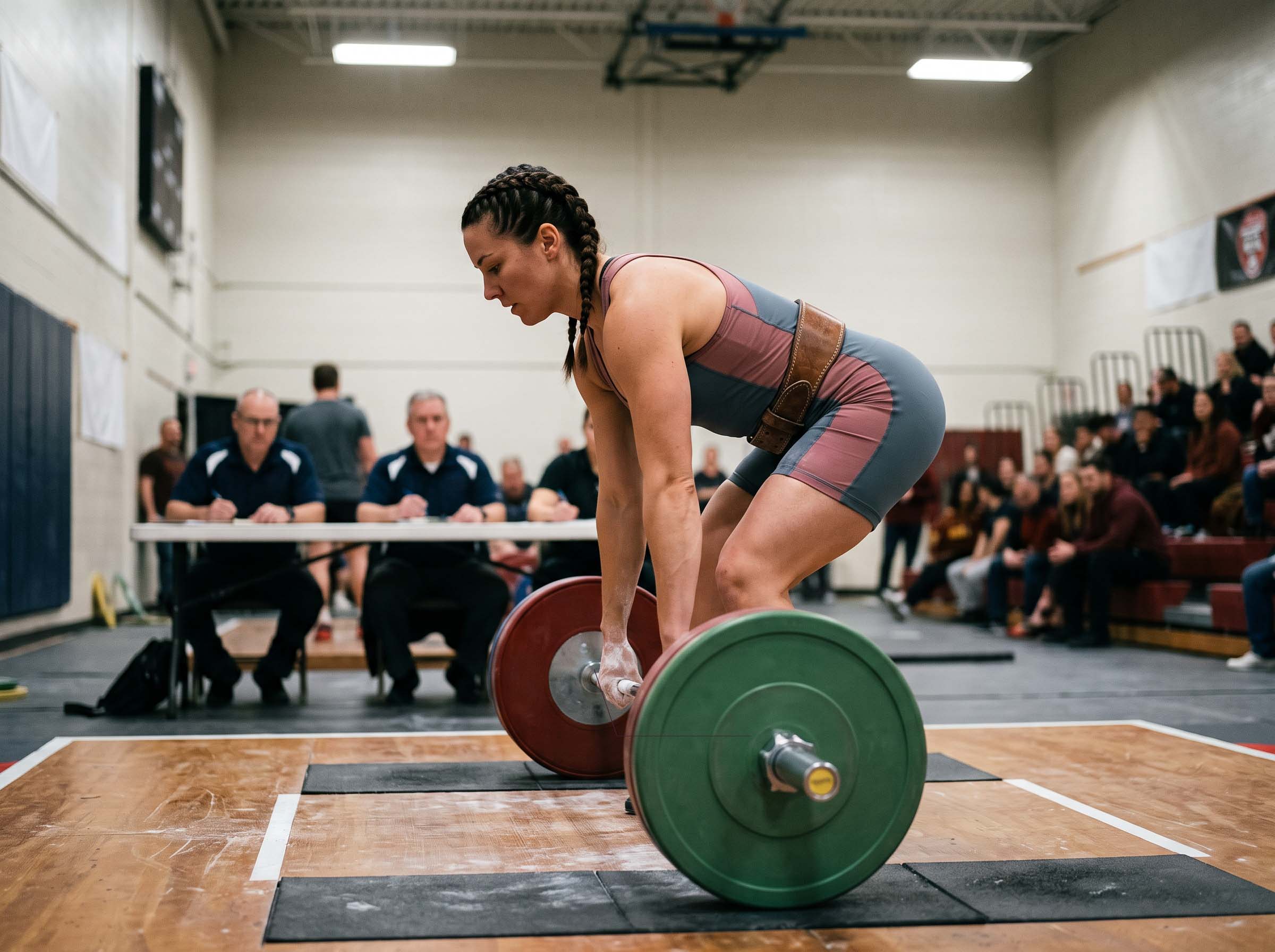
The bar is loaded, the chalk is down, and a woman steps onto a competition platform in front of three judges. She sets her grip, fills her chest, and pulls a weight that most people could not shift with a car jack. Somewhere in the two seconds between the floor and lockout, a small patch darkens the fabric of her singlet, and a stream of urine pours out. The lift is good. The camera moves on.
In competition halls and training gyms this happens often enough that lifters have quiet shorthand for it, and almost nobody discusses what is actually going on — which is a shame, because the answer is one of the more interesting problems in human mechanics, and it turns on the behaviour of a structure most women were never taught to picture: the pelvic floor and the architecture it supports.
A maximal lift briefly turns the abdomen into a sealed, pressurised container. Measured pressures inside that container during heavy squats and deadlifts run several times higher than during a hard cough.
Continence at that instant is a mechanical contest, and researchers surveying female strength and impact athletes keep finding the same surprise: high fitness does not settle the contest the way sports science long assumed it did.
The abdomen as a pressure vessel
To move a very heavy object off the ground, the spine has to resist folding. The body's solution is elegant and old: seal the airway, contract the diaphragm downward, tighten the abdominal wall, and turn the trunk into a rigid cylinder of pressurised fluid and tissue. Engineers would recognise the principle from a fizzy drink can, which supports considerable weight while sealed and crumples the moment it is opened. Lifters know the technique as bracing; physiologists have measured what it costs.
The numbers are startling. A systematic review pooling sixteen studies of high-intensity resistance exercise reported pressures inside the abdomen exceeding 200 mmHg during heavy squats, with deadlifts and leg presses clustering in the range of 161 to 176 mmHg. Standing quietly registers somewhere near 20 mmHg. A deliberate breath-hold against a closed throat, performed on a clinic table, produces something in the region of 65 mmHg. A maximal lift is not a slightly bigger version of a cough. It is a different order of event.
Figures pooled from a 2019 systematic review of intra-abdominal and intrathoracic pressures during high-intensity resistance exercise. Measurement methods and participant profiles differed between the studies included.
Two pressures, one small tube
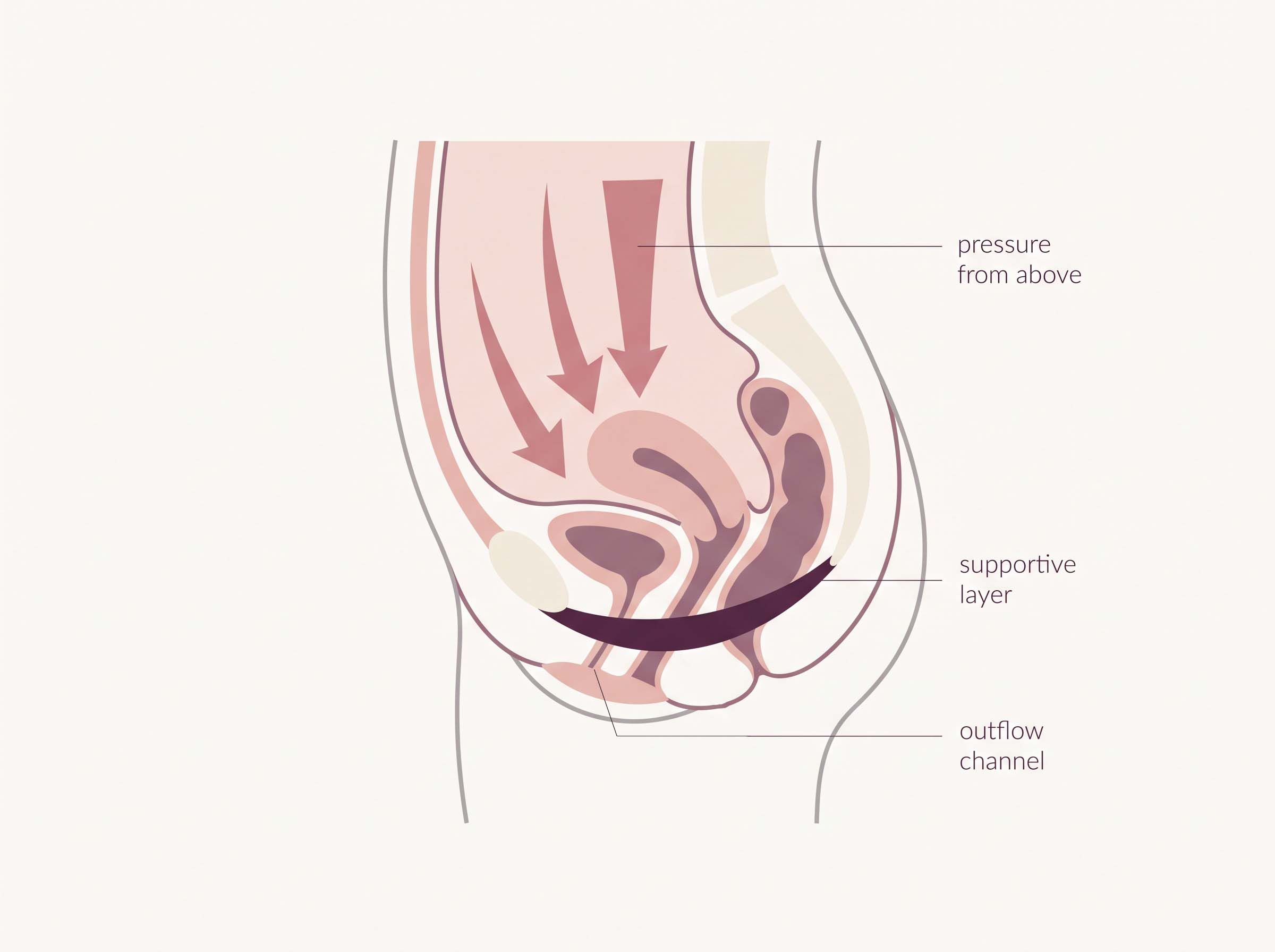
Everything above the pelvis presses down. The bladder sits inside that pressurised space, and the urethra — the short channel leading out of it — sits at the bottom, passing through the floor of the pelvis. Whether anything escapes during a maximal effort comes down to a comparison: the pressure pushing on the bladder against the pressure holding the urethra shut. When the first exceeds the second, fluid moves. There is no more mystery to it than there is in a garden hose.
What makes the female arrangement worth studying is how the closing pressure is produced. In 1994, anatomist John DeLancey published dissection work proposing what became known as the hammock hypothesis of urethral support. His argument was that the urethra does not close by squeezing alone. It rests on a supportive layer built from the front wall of the vagina and the connective tissue anchoring it sideways to the pelvic wall and to the levator muscles. Pressure arriving from above compresses the urethra against that layer, flattening it shut. The downward force is not only the problem; under normal conditions it is also part of the solution.
That model reframes the entire question. A firm backstop turns rising abdominal pressure into closing pressure. A backstop that gives way under load lets the same force become a leak. The same physics produces opposite outcomes depending on the stiffness of a structure nobody can see.
The timing problem
Strength is only half of it. The muscles of the pelvic floor normally fire slightly before a rise in abdominal pressure rather than in response to it, a pattern researchers describe as feed-forward activation. The system anticipates. A cough, a sneeze, a jump, a pull from the floor — each is preceded by a small preparatory contraction that stiffens the support before the load arrives. Milliseconds matter here. A contraction that arrives late meets a pressure wave already at peak, which is a poor position from which to close anything. Laboratory work has also found that these muscles fatigue after strenuous activity like any other muscle group, which raises an obvious question about the tenth heavy set of a session and one that the research has not fully answered.
The assumption that did not survive contact with data
Sports medicine long held that athletic women, being conditioned everywhere else, would be conditioned here too. Then researchers began asking them.
In 2002, a Swedish team surveyed the country's entire population of elite trampolinists — thirty-five athletes, most of them teenagers, none of whom had given birth. Eighty percent reported involuntary leakage, exclusively during training, beginning on average two and a half years into their careers. Strength sports produce lower but far from trivial figures. A cross-sectional survey of 824 competitive female weightlifters across 29 countries found moderate or more severe symptoms in 32 percent, with the predicted probability climbing alongside weekly training hours. A meta-analysis pooling 4,823 women in high-intensity functional fitness put overall prevalence near 44.5 percent, the great majority of it the pressure-related kind.
One survey of strength athletes is worth reading closely for a different reason: when asked which movements produced leakage, respondents named the deadlift alongside the jumping and skipping drills that everyone expects. Something about a slow, maximal, breath-held pull belongs in the same category as repeated impact, which is not obvious from watching either.
Figures drawn from separate studies published between 2002 and 2022, using different questionnaires, definitions and populations. They indicate a pattern across sports rather than directly comparable rates.
What the numbers cannot settle
These are surveys, and surveys have limits worth stating plainly. Almost every study in this field is cross-sectional: it photographs a group at one moment and cannot establish what caused what. Whether years of heavy training alter pelvic support, or whether women with particular structural characteristics are drawn to and succeed at particular sports, is not answered by asking athletes a set of questions once.
The findings also refuse to arrange themselves neatly. Prior pregnancies raise the odds in most datasets, yet the trampolinists had never been pregnant. Higher body mass raises them too, while age — the strongest predictor in the general population — showed no association among the weightlifters surveyed. Athletes who came to strength sport from a high-impact background carried more risk than those who did not, which hints that history matters as much as current training. Meanwhile the assumption that exercise itself determines pelvic outcomes keeps producing results in both directions, depending on the sport, the load and the population studied.
The same downward force that closes the channel in one woman opens it in another. The physics does not change. The architecture does.
Why the strongest women are the interesting case
Extreme conditions have always been where physiology gives up its secrets. Altitude research explained oxygen transport; heat chambers explained sweating. Competitive lifting is a comparable laboratory, and one of the few places where the pelvic support system is loaded to the edge of its working range on purpose, repeatedly, under supervision, with the weight written down afterwards.
That is why the field has grown quickly since women's participation in strength sport expanded. World Athletics has begun surveillance work on pelvic floor health among its athletes. Researchers now argue about whether the standard measurement tools — questionnaires designed for the general adult population — are even the right instruments for a twenty-four-year-old national-team lifter whose only symptom appears at 90 percent of her one-repetition maximum. Several trials have tested whether targeted muscle training changes anything for female functional-fitness athletes specifically, and the results are still being argued over.
A structure asked to do two jobs
Underneath all of this sits a design problem that evolution never fully resolved. The floor of the female pelvis has to be firm enough to hold everything above it against gravity and sudden pressure, and yielding enough to open completely for childbirth. Those requirements pull in opposite directions. The compromise between them is the reason the whole subject exists, and the reason a 180-kilogram pull is a more revealing test of the arrangement than anything a laboratory would be permitted to arrange deliberately. Women who lift heavy things are, without intending to, running the most informative experiment available on a part of the body that medicine spent centuries not asking about. The patch on the singlet is data.
Questions readers ask about this
Disclaimer: All content on this website—including articles, educational materials, and interactive calculators—is for informational, educational, and entertainment purposes only. The calculations, percentiles, and outputs generated by tools on this site are based on general statistical data and mathematical models; they do not constitute medical data, a clinical assessment, or a diagnosis.
Nothing contained on this website is a substitute for professional medical advice, diagnosis, or treatment. Always seek the guidance of a qualified healthcare professional or urologist with any questions you have regarding physical development, anatomy, or health conditions. Reliance on any information or tools provided by this website is solely at your own risk.