English
  Español



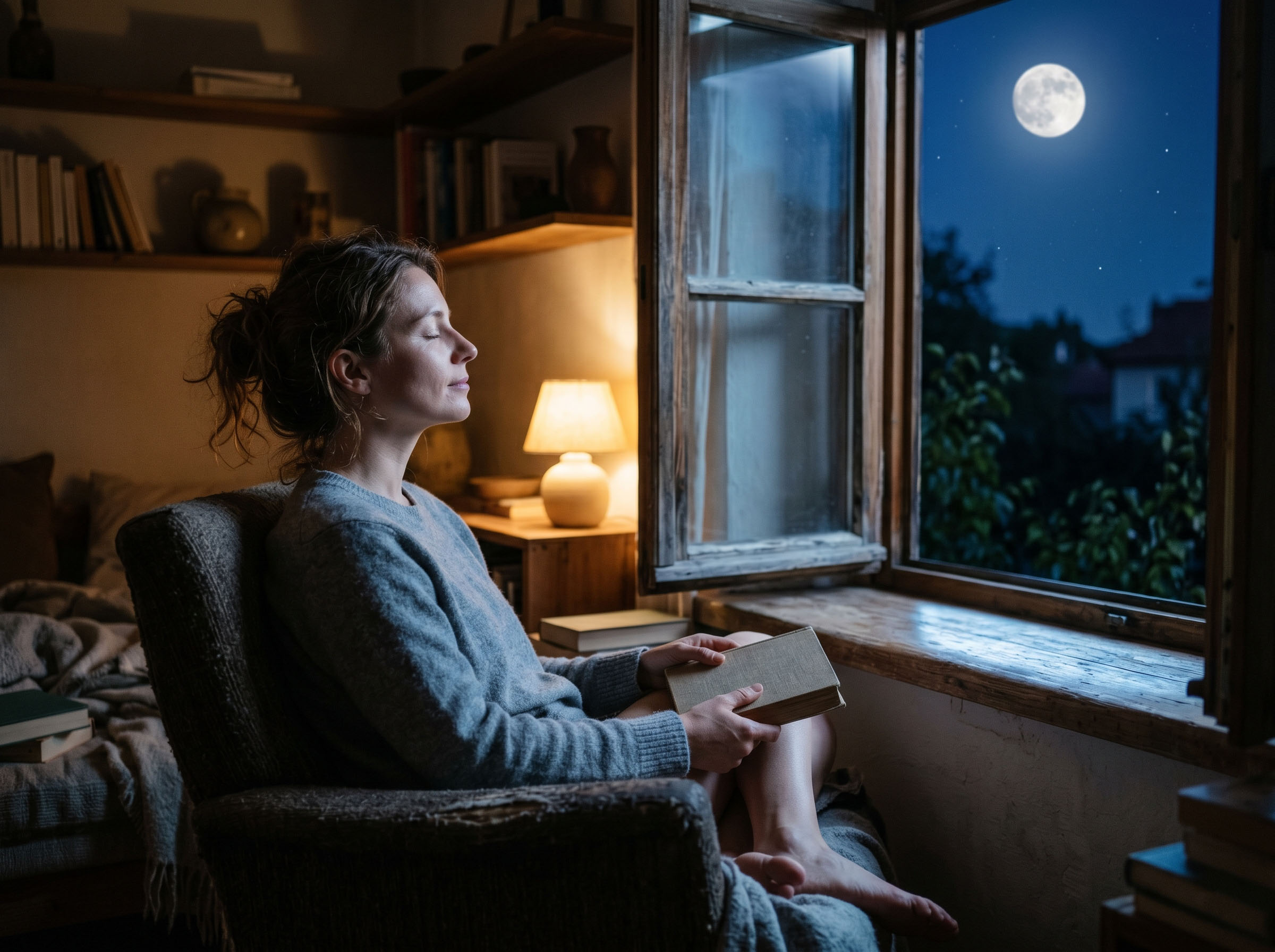
There is something quietly magnetic about a full moon. Women have been stepping outside on clear nights for as long as memory reaches, looking up, and feeling — however briefly — that the sky is in conversation with their bodies. Grandmothers have whispered about it. Midwives once scheduled it. Farmers planted by it.
And somewhere between ancestral wisdom and modern biology, a persistent question lingers: does the moon actually do anything to the menstrual cycle, or is it the most beautiful coincidence nature ever arranged?
The average menstrual cycle runs roughly 28 days. The lunar cycle — the time it takes the moon to travel from one new moon to the next — runs roughly 29.5 days. That proximity is striking enough to have generated centuries of lore, rituals, and, more recently, peer-reviewed research. Whether you are a woman who tracks her cycle on an app or one who still glances at the moon before bed, the story of how humans connected these two rhythms is far more layered than a simple yes or no.
"The average menstrual cycle runs roughly 28 days. The lunar cycle runs roughly 29.5 days. That proximity is striking enough to have generated centuries of lore — and, more recently, peer-reviewed research."
— Amara Leclerc
From Myth to Midwives: What the Old Stories Say
Across cultures separated by oceans and centuries, women have associated menstruation with the moon. In ancient Rome, the goddess Luna was credited with governing the female body. Indigenous communities in the Americas held moon lodges — spaces where women rested together during their cycles, honoring a rhythm they believed mirrored the sky. In parts of rural Europe well into the early modern period, farmers' wives tracked both planting schedules and their own cycles by lunar phases, not out of superstition alone, but out of a practical trust in natural timing that had been passed down through generations of mothers.
🌙 Cultural Insight
Moon Lodges & Sacred Cycles
Many Native American nations, including the Lakota and Cherokee, held that women during their menstrual cycle carried a heightened spiritual power — so potent that they were traditionally excused from all labor and invited to rest in a dedicated moon lodge. This was not exclusion; it was honor. Grandmothers taught granddaughters that their bodies were in dialogue with the cosmos, and the moon was the messenger.
Mermaid lore adds another layer to this ancient association. In coastal cultures from West Africa to Scotland, mermaids were not merely romantic sea-creatures — they were specifically tied to tidal power and to women's bodies. The mermaid's tail, fluid and moon-pale, was read as a symbol of the watery, cyclical nature of womanhood itself. In some Gaelic traditions, mermaids were said to come ashore during certain moon phases to weave or wash; their presence near the water's edge was a sign that the tides — and women on land — were at their most potent. These legends were not meant to be taken literally, but they carried cultural weight: they told women that their bodies were powerful, tidal forces, not inconveniences to be managed.
The mermaid as a symbol of female cyclical power survived well into the modern era, resurfacing in literature, art, and even modern wellness branding, where lunar imagery is now standard shorthand for anything connected to feminine health. It is a remarkably durable metaphor.
✨ Did You Know?
The word "menstruation" shares its Latin root with the word for month — mensis — which itself derived from the Greek word for moon, mene. Language has always known what science is still measuring.
What the Research Actually Shows
For most of the 20th century, the scientific establishment treated moon-cycle synchrony as charming folklore and little else. Then, in 2021, a study published in Science Advances by researchers at the University of Washington changed the conversation. The team analyzed menstrual cycle data from 22 women over periods ranging from one to 32 years — some records stretching back decades — and found that longer cycles (those over 27 days) did show periods of synchronization with lunar cycles, particularly with lunar gravitational and light cycles. Importantly, this synchrony weakened in women who spent more time indoors exposed to artificial light at night, suggesting that whatever lunar influence exists may be mediated by light exposure, not mystical force.
That is a genuinely interesting finding, and it is worth sitting with carefully. It does not say the moon controls your cycle. It says that in longer cycles, there are windows when the two rhythms fall into step — and that the modern built environment, with its artificial lighting, may have disrupted a sensitivity that older generations of women, who lived closer to natural light rhythms, would have experienced more consistently. It is less magic and more circadian biology.
An earlier and more widely cited study — conducted by Winnifred Cutler in 1980 and published in Human Biology — found a significantly higher concentration of menstrual onsets around the new moon phase than would be expected by chance. The study was small and has been debated, but it opened a line of inquiry that has never fully closed. Subsequent studies have produced mixed results, with some showing weak correlations and others showing none, which is exactly what you would expect if the effect is real but small, easily masked by modern lifestyle variables like shift work, stress, travel across time zones, and — most significantly — constant indoor lighting.
What no credible researcher argues is that the moon's gravitational pull acts directly on the fluid in your body the way it acts on the ocean's water. The tidal analogy, while poetic, does not hold up mechanically: the moon's gravitational effect on a small, enclosed body of water is negligible compared to its effect on an ocean. Your body is not a tide pool. But the moon's light cycle is a different matter — and that is where the more credible science is pointing.
📊 By the Numbers
~28
Average menstrual cycle length (days)
29.5
Lunar synodic cycle length (days)
22
Women tracked in the 2021 Science Advances lunar study
32 yrs
Longest individual cycle record analyzed in that study
A Quick Look at What's Been Studied
The research field is small but growing. Here is a snapshot of what some key studies found and where their limitations lie:
The Modern Legends: What Women Are Actually Telling Each Other
Walk into any mothers' group or open a cycle-tracking app forum and you will find the moon conversation alive and well — but it has picked up some distinctly 21st-century additions. There is the widely shared claim that hospitals see more births during full moons, that women living together eventually sync their cycles (a phenomenon known as "menstrual synchrony" or the "McClintock effect"), and that sleeping without curtains or adding a light source during your pre-ovulatory phase can shorten irregular cycles. Some of these claims have scientific traction. Others have become urban legends dressed in wellness language.
The hospital birth claim, for example, has been studied repeatedly — and largely debunked. Large-scale analyses of birth records show no statistically meaningful spike in deliveries during full moons, despite the fact that nearly every labor and delivery nurse will tell you otherwise with great conviction. The perception is likely a form of confirmation bias: full-moon nights are memorable, and a busy delivery room on such a night gets filed in memory more vividly than a busy delivery room on an ordinary Tuesday. That is not a failure of intelligence; it is simply how human memory works.
Menstrual synchrony is more interesting. The original 1971 study by Martha McClintock found that women living in close quarters — a dormitory, in that case — gradually brought their cycles into alignment, presumably through pheromone signaling. For decades this was taught as established fact. More rigorous follow-up research, including a 2006 analysis published in Human Nature, found that the original methodology had significant flaws and that the synchrony observed was consistent with what you would expect from random chance among cycles of similar length. The current scientific consensus is skeptical, though not closed — pheromone research in humans is genuinely complicated to conduct and easy to get wrong.
💡 Worth Knowing
What about the light-exposure trick?
The practice of sleeping with a light on during the middle days of your cycle to regulate an irregular period is sometimes called lunaception, a term coined by Louise Lacey in her 1975 book of the same name. Proponents suggest that mimicking moonlight with a soft lamp during the three nights around ovulation can help lengthen short luteal phases. No large clinical trial has confirmed this — but a small number of reproductive endocrinologists note it is low-risk, costs nothing, and for some women with irregular cycles, anecdotally appears to help. It sits at the edge of evidence, which is where a lot of interesting women's health questions live.
Ancient Rhythm, Modern Woman
None of this means women who feel a pull toward moon-tracking are fooling themselves. Human beings evolved outdoors, under open skies, with natural light as the only clock. The circadian system — the body's internal timekeeper — is genuinely sensitive to light cycles, and the menstrual cycle is regulated by hormones that are themselves entangled with circadian rhythms. It is entirely plausible, and in some studies gently supported, that spending time outdoors, sleeping in genuine darkness, and reducing late-night screen exposure could have a modest positive effect on cycle regularity. If the moon is involved, it is as a light source with a reliable rhythm — a natural metronome — not as a magical force acting on the body from a quarter-million miles away.
What makes the moon-cycle connection so enduring is not that it is provably true in every woman's case. It is that it gives women a dignified framework for paying attention to their bodies. The grandmother who noted the moon phase when her cycle arrived was practicing cycle awareness decades before anyone called it that. The midwife who scheduled births by the moon was, at minimum, encouraging women to think of their bodies as operating in time with something larger than the daily grind. That instinct — to see the female body as a timed, rhythmic, purposeful system rather than an inconvenient variable — is not folklore. It is wisdom.
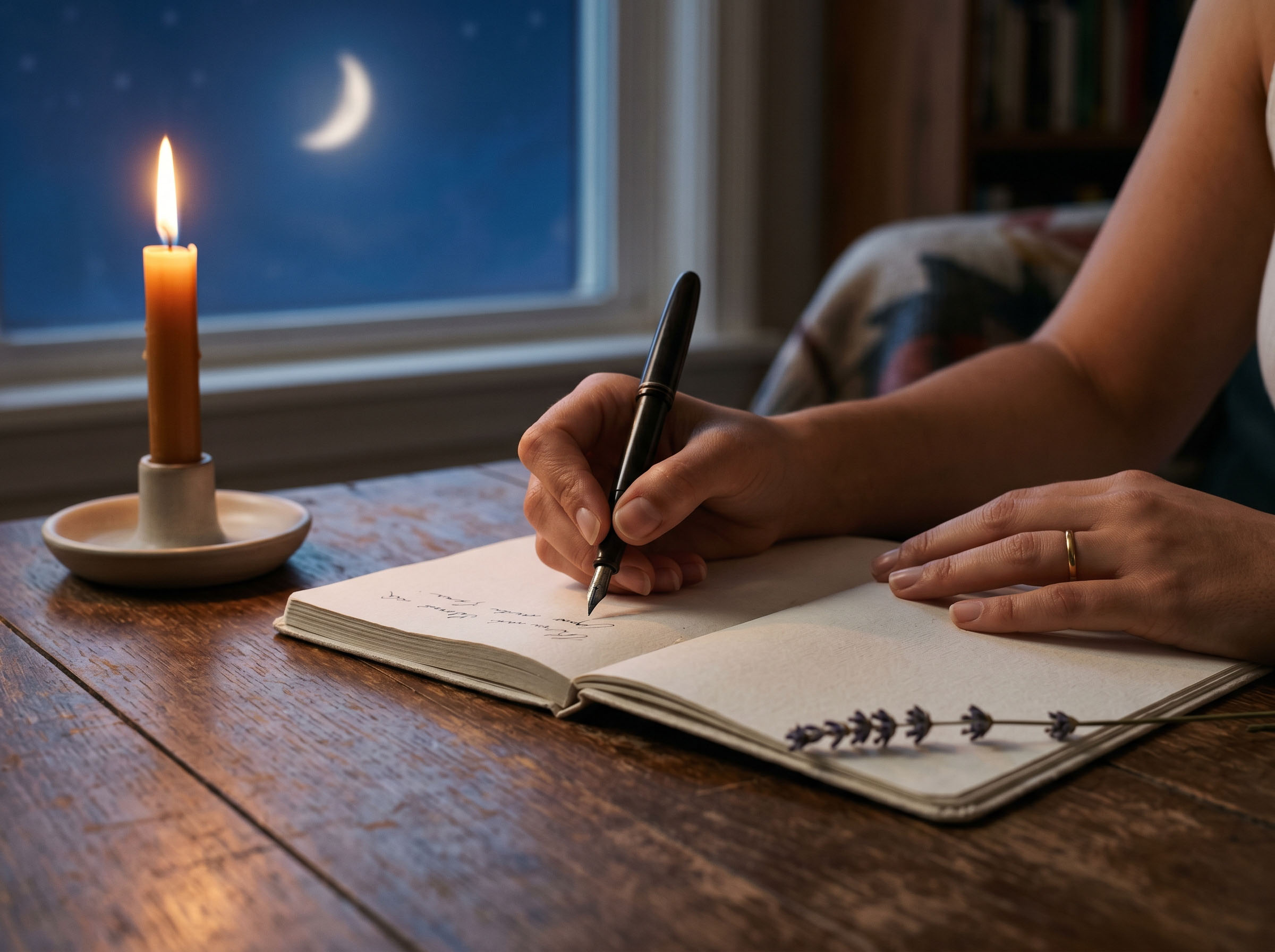
"The grandmother who noted the moon phase when her cycle arrived was practicing cycle awareness decades before anyone called it that."
— Amara Leclerc
🌿 Try This at Home
One Month of Moon & Cycle Awareness
- Download a free moon phase calendar for the current month and note today's phase.
- For 30 days, record the start and end of your cycle, your energy levels, and your sleep quality alongside the moon phase.
- Try sleeping in a darker room than usual and reducing screen use after 9 PM for two weeks — note any shifts in sleep quality.
- On the night of the next full moon, spend 15 minutes outside. No phone. Just sky. It is good for you regardless of what the moon does to your hormones.
This is a personal observation exercise, not a medical protocol. For health concerns about your cycle, speak with your doctor.
The Answer, Honestly
Does the moon influence the menstrual cycle? The honest answer is: probably a little, for some women, under the right conditions — and far less than the poetry suggests. The near-match in cycle length is almost certainly more than pure coincidence; our species evolved under an open sky, and it would be stranger if the body had developed no sensitivity to the most reliable light cycle in the night sky. But that sensitivity, if it exists in modern women, is largely masked by the electric world we live in. The moon has not changed. We have.
What has not changed is the instinct to look up and feel something. The mermaid at the tideline, the grandmother counting moon phases, the woman in the mothers' group who swears her period always arrives with the full moon — they are all reaching for the same thing: a sense that the female body is not random, not chaotic, but timed to something ancient and deliberate. Science may not have fully confirmed that feeling yet. But it has not dismissed it either. And sometimes, the most honest thing research can offer is a very good reason to keep watching the sky.
For further reading: The 2021 Science Advances study on lunar and menstrual cycle synchrony can be found at science.org — Helfrich-Förster et al., "Human Menstrual Cycles Are Influenced by Moon Cycles" (2021). For a broader overview of circadian biology and reproductive health, the NIH National Institute of Child Health and Human Development — Menstruation & the Menstrual Cycle provides reliable, up-to-date clinical context.
Your Questions Answered
📋 In Brief
- The average menstrual cycle (~28 days) and lunar cycle (~29.5 days) are close in length — and that proximity has inspired mythology, ritual, and research for thousands of years.
- A 2021 study found that longer menstrual cycles can fall into synchrony with lunar light and gravitational rhythms, with synchrony weakening in women exposed to heavy artificial light at night.
- Claims about full-moon births and menstrual synchrony among women who live together are either debunked or require much stronger evidence.
- The moon's light cycle — not its gravitational pull — is the most plausible biological mechanism for any genuine effect.
- Regardless of the science, moon-based cycle awareness has practical value: it encourages women to observe and track their bodies over time.
Disclaimer: All content on this website—including articles, educational materials, and interactive calculators—is for informational, educational, and entertainment purposes only. The calculations, percentiles, and outputs generated by tools on this site are based on general statistical data and mathematical models; they do not constitute medical data, a clinical assessment, or a diagnosis.
Nothing contained on this website is a substitute for professional medical advice, diagnosis, or treatment. Always seek the guidance of a qualified healthcare professional or urologist with any questions you have regarding physical development, anatomy, or health conditions. Reliance on any information or tools provided by this website is solely at your own risk.