English
  Español
  Português



Ask a happily married woman how she knows her husband loves her, and she rarely points to fireworks. She points to something quieter: he remembered how she takes her coffee, he called during the drive home, he sat with her in silence after a hard day. Psychologists who study close relationships have spent half a century trying to understand why some signals of love land so deeply while others, even sincere ones, seem to pass right through.
The answer sits at the crossing point of three fields: attachment theory, which studies how humans learn to trust and be trusted; neuroscience, which maps what happens in the brain and body during bonding; and cultural history, which reminds us that the outward forms of love have shifted even while its underlying purpose has not. Understanding how couples communicate love in a long-term relationship, research suggests, has less to do with romantic instinct and more to do with a handful of patterns that repeat, unnoticed, across decades.
What Attachment Theory Actually Says About Adult Love
British psychiatrist John Bowlby proposed in the mid-twentieth century that infants are born with a biological drive to stay close to a reliable caregiver, and that this drive does not disappear with age — it simply changes shape. Canadian researcher Mary Ainsworth later built on Bowlby's work with a series of observational studies identifying consistent patterns in how young children respond to a caregiver's departure and return. Children who could count on a caregiver being available and responsive tended to explore the world with more confidence and settle more easily once reunited.
Researchers who carried this line of work into adulthood, including Cindy Hazan and Phillip Shaver in their widely cited 1987 study, found that romantic partners come to serve many of the same functions caregivers once did: partners are sought out in times of stress, missed during separation, and relied upon as what researchers term a "secure base" from which to face the rest of life. Many women report they don't need dramatic proof of love so much as a felt sense that their partner will be there — reachable, responsive, and consistent, three qualities researchers describe as the backbone of a secure attachment in marriage.
This research does not suggest that a woman's early experiences lock her into one fixed way of loving forever. Studies tracking relationships over time have found that a steady, attentive partner can gradually shift a person's sense of security, just as an unpredictable one can unsettle it. What the research does suggest is that love is communicated less through single dramatic gestures and more through a pattern, repeated over months and years, of being findable and being kind when found.
The Age of the Love Letter
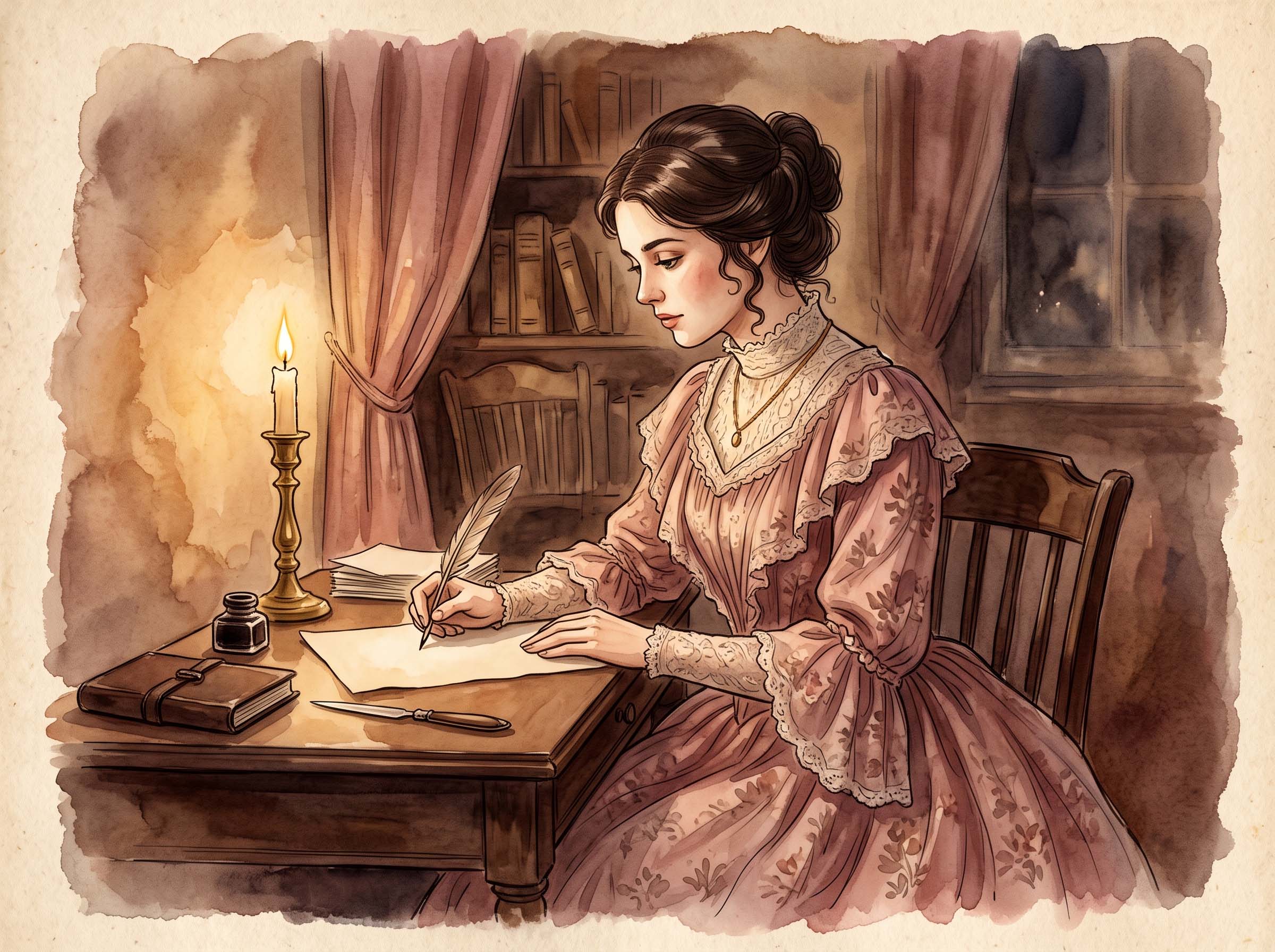
During the nineteenth century, as postal routes expanded across Europe and North America, letter-writing manuals became household staples, teaching ordinary wives and husbands separated by war, work, or migration how to put devotion into words. Many of these letters were kept for a lifetime and passed down as family heirlooms, treasured not for eloquence but for proof of steady affection across distance.
The Body's Own Love Language: Oxytocin, Touch, and Presence
Long before couples exchange vows, their bodies are already exchanging chemical signals. Oxytocin, a hormone released during touch, eye contact, and close physical proximity, helps explain why simple, low-cost gestures — a hand on the back, a hug held a few seconds longer than usual — often communicate love more convincingly than words alone. Researchers at Georgetown University's overview of the neuroscience of romantic attachment describe how oxytocin and a related hormone, vasopressin, are released from the pituitary gland and work alongside dopamine, the neurotransmitter tied to pursuit and reward, to produce the layered experience people simply call "being in love."
Early in a relationship, dopamine tends to dominate, producing the giddy, preoccupied feeling many women recognize from new romance. Over time, in relationships that continue to feel secure, oxytocin activity tends to play a larger role, supporting the calmer, steadier form of attachment associated with long marriages and family life. This shift is one reason a relationship that has settled into comfortable routine has not necessarily lost its spark — it may simply be running on a different, quieter chemical system, one built for presence rather than pursuit.
This is also why physical presence itself functions as a form of communication. A woman who sits beside her husband while he manages a stressful phone call, without saying a word, is sending a signal her nervous system, and his, can register directly.
In the observational studies that helped build modern relationship science, researchers found they could estimate a couple's long-term stability from watching only a short sample of an ordinary conversation, based largely on how partners responded to one another's small, everyday bids for attention rather than on anything dramatic either partner said.
How Love Has Been Spoken Through History
The instinct to bond is old, but the outward vocabulary of love has changed a great deal across centuries and cultures. In medieval Europe, the tradition of courtly love produced an entire literature of longing — poems and letters written between people who were often kept apart by social rank or existing marriage vows, where words did nearly all the work presence could not. In many agrarian societies, by contrast, love was communicated far less through language and far more through labor: a husband who kept the roof sound and the harvest secure, and a wife who managed the household with skill, understood their daily competence itself as an expression of devotion.
The rise of the postal service in the nineteenth century gave ordinary people, not only poets, a new outlet for written affection, and letters between spouses separated by war or migration became treasured family records, some of which survive in archives today as evidence of how couples sustained closeness across distance. The twentieth century, with the telephone and eventually text messaging, compressed the gap between feeling something and being able to say it, for better and for worse. Some historians argue this compression has made modern couples more fluent in expressing love verbally, though perhaps less practiced in the older, slower forms of demonstrating it through steady action.
This history offers useful perspective: a woman whose grandmother rarely heard "I love you" but never doubted her husband's devotion was not experiencing a lesser form of love, only a different dialect of it.
How Couples Have Signaled Love, Then and Now
| Era | Primary Way Love Was Shown | What It Relied On |
|---|---|---|
| Medieval & early modern | Poetry, letters, courtly gestures | Language, patience, discretion |
| Agrarian households | Daily labor and provision | Reliability, shared work |
| 19th–early 20th century | Handwritten letters across distance | Patience, written vulnerability |
| Today | Words, small daily acts, and shared presence | Consistency, responsiveness, attention |
Words, Actions, Presence: What Long-Term Satisfaction Research Shows
Psychologist John Gottman spent decades observing couples in a research setting, tracking their conversations, physiology, and eventual outcomes over years. One of his most cited findings involves what he calls "bids for connection" — the small requests people make throughout an ordinary day for attention, affection, or support, such as pointing out something outside the window or mentioning a rough moment at work. According to the Gottman Institute's research on relationship stability, couples who consistently turned toward these everyday bids were markedly more satisfied years later than couples who let most bids pass unanswered, and this single behavior pattern predicted relationship outcomes with notable accuracy.
"Love is communicated most convincingly not through its most dramatic expression, but through the sum of its smallest, steadiest ones."
This research helps explain why grand romantic gestures, while pleasant, are rarely what sustains a marriage over twenty or thirty years. Long-term satisfaction research instead points toward small, frequent, reliable signals — a returned bid, a remembered detail, a hand reached for during a difficult conversation. Words, actions, and simple presence each carry weight, but studies suggest their power comes less from any single instance and more from their repetition, which slowly builds what researchers describe as a reserve of trust a couple can draw on during harder seasons.
Many long-married women describe this reserve in plain terms: they say they trust their husband because he has shown up, again and again, in ways too numerous to list individually. That accumulated evidence, more than any single word or gift, appears to be what the research on attachment and long-term relationship satisfaction consistently points toward.
- 1969 — the year John Bowlby published the first volume of Attachment and Loss, founding modern attachment theory.
- 1987 — Hazan and Shaver's study first applied attachment theory directly to romantic love.
- ~4 years — the approximate span researchers associate with the most intense early "honeymoon" phase of a relationship, before deeper attachment bonds typically take a stronger hold.
The Quiet Consistency of Lasting Love
None of this diminishes the value of saying the words, planning the anniversary dinner, or writing the occasional letter. Attachment research, neuroscience, and relationship science each confirm that words, actions, and presence all matter, and that most secure relationships draw on all three in some combination suited to the couple's own personalities and season of life. What the research consistently cautions against is treating any one of them as sufficient on its own, or assuming a partner who struggles to find the right words is not communicating love in other, equally valid ways. For women building a lasting partnership, the science offers a reassuring, if unglamorous, conclusion: love endures less by grand declaration and more by quiet, repeated proof.
Questions Women Often Ask About Communicating Love
Disclaimer: All content on this website—including articles, educational materials, and interactive calculators—is for informational, educational, and entertainment purposes only. The calculations, percentiles, and outputs generated by tools on this site are based on general statistical data and mathematical models; they do not constitute medical data, a clinical assessment, or a diagnosis.
Nothing contained on this website is a substitute for professional medical advice, diagnosis, or treatment. Always seek the guidance of a qualified healthcare professional or urologist with any questions you have regarding physical development, anatomy, or health conditions. Reliance on any information or tools provided by this website is solely at your own risk.