English
  Español


There is a quiet intelligence in the female body that most of us never fully learn to hear. Long before modern fitness science began documenting the mechanics of pelvic floor function, women across history — from the temples of ancient India to the bathhouses of the Ottoman Empire — understood, in practical and often ritualized ways, that movement, breath, and stillness all had a role to play in the health of a woman's reproductive center.
Yoga, in particular, has accumulated thousands of years of anecdotal and now increasingly scientific evidence to suggest it does something genuinely useful for the female pelvis. Research suggests that consistent yoga practice can support pelvic floor muscle coordination, reduce tension in the hip flexors and deep rotators that directly share fascial attachments with the uterus and vaginal canal, and regulate the hormonal stress response that can disrupt menstrual cycles. For many women, that is a remarkable amount of return on an investment of a yoga mat and thirty minutes of intentional movement.
This guide explores the why behind that return — and which specific poses appear most beneficial based on what studies and women's health researchers have observed.
Before You Begin
This article is educational in nature and is not a substitute for individualized guidance from a qualified healthcare provider or pelvic floor physiotherapist. If you are postpartum, currently experiencing pelvic pain, or have a reproductive condition, consult a professional before beginning any new movement practice.
What the Pelvic Floor Actually Does
The pelvic floor is a layered hammock of muscle and connective tissue that spans the base of the pelvis, running front to back between the pubic bone and the tailbone. In women, it supports three structures: the bladder, the uterus, and the rectum. But its role is far more nuanced than simple support. The pelvic floor coordinates with the diaphragm and the deep abdominal muscles during every breath cycle, syncing with inhalation and exhalation in a rhythm that most of us have never consciously noticed.
Studies exploring pelvic floor electromyography — measurements of muscle electrical activity — have found that women who practice yoga regularly show better pelvic floor muscle coordination than sedentary controls. What that coordination means practically: less leakage with coughing or sneezing, better ability to consciously relax the muscles (which matters enormously for comfort during intimacy and gynecological examinations), and a measurable reduction in tension-related pelvic discomfort.
Many women report that before discovering yoga or pelvic-focused movement, they had no real awareness of this part of their body at all. They had been taught, culturally and medically, to simply endure whatever arose — period pain, tension, discomfort — rather than to understand its mechanical origins. The growing field of pelvic floor physiotherapy has begun to change that, and yoga has proved to be a natural companion discipline.
"The pelvic floor coordinates with every breath cycle — a rhythm most of us have never consciously noticed."
Lexi Pierce — Vagina InstituteThe Historical Thread: Yoga, Femininity, and the Body
Yoga's origins in the Indian subcontinent are ancient and layered, but what is often overlooked in Western wellness conversations is that many of the classical yoga texts — the Hatha Yoga Pradipika foremost among them — described specific practices related to female reproductive vitality explicitly. The mula bandha, or root lock, is a muscular engagement of the perineum and pelvic floor that has been part of yoga's anatomical vocabulary for centuries. Ancient practitioners understood intuitively what modern physiologists have since confirmed: that the base of the torso is not a passive structure, but an active and trainable one.
Historically, movement traditions for women were far more body-aware than many Western cultures acknowledged. From the structured physical rituals of Ayurvedic postpartum care in South Asia, to the targeted therapeutic movements in traditional Chinese medicine for women's reproductive health, to the ancient Greek gymnastics practiced by Spartan women — who were specifically trained for physical strength as a matter of cultural policy for healthy childbearing — the idea that female movement is reproductive medicine is older than modern science by millennia.
Cultural Insight
Yoga & the Womb Across Civilizations
In the Ayurvedic tradition of ancient India, specific yoga postures and breathwork sequences were prescribed to women after childbirth as part of a formal 40-day postpartum recovery rite. The practice of prasava yoga — birth yoga — was not a modern invention but a structured protocol. Meanwhile, in ancient Egypt, papyrus records suggest temple priestesses engaged in postures we would recognize today as forward folds and hip openers as part of fertility ritual practice. The female body in motion was sacred, not shameful.
The Stress–Cycle Connection
One of the most well-researched mechanisms linking yoga to reproductive health is its effect on the stress response. Cortisol — the body's primary stress hormone — directly influences the hypothalamic-pituitary-ovarian axis, the hormone signaling cascade that regulates ovulation, menstruation, and cycle regularity. Research suggests that chronically elevated cortisol can suppress ovarian function, shorten luteal phases, and worsen premenstrual symptoms.
Studies examining yoga's effect on cortisol levels have found that regular practice — even sessions as short as 20 minutes — is associated with measurable reductions in salivary cortisol. For women navigating irregular cycles, intense premenstrual tension, or stress-related fertility concerns, this is not a trivial finding. It suggests that a yoga practice maintained consistently over weeks and months could, through hormonal pathways, create a more stable internal environment for the reproductive system.
Many women report, anecdotally, that yoga gave them back a sense of body trust that years of chronic stress had eroded. That experience has a biological basis.
Eight Poses Worth Understanding
The following poses appear consistently in women's health research, pelvic floor physiotherapy recommendations, and yoga therapeutic literature for their relevance to pelvic and reproductive function. Note that each pose has multiple potential adaptations — what matters most is attentiveness to your own body's response.
Quick Reference: Eight Poses & Their Focus Areas
| Pose (Sanskrit Name) | Primary Focus | Cycle Phase Best Suited |
|---|---|---|
| Bound Angle Pose (Baddha Konasana) | Inner thigh & pelvic floor release | All phases; supported in menstruation |
| Child's Pose (Balasana) | Deep pelvic floor relaxation | Menstruation & luteal phase |
| Bridge Pose (Setu Bandha Sarvangasana) | Pelvic floor strengthening | Follicular & ovulatory phases |
| Garland Pose (Malasana) | Deep pelvic opening | Follicular & ovulatory phases |
| Happy Baby (Ananda Balasana) | Sacral decompression & release | Luteal & menstrual phase |
| Cat-Cow (Marjaryasana-Bitilasana) | Spinal mobility & uterine circulation | All phases |
| Supported Reclined Butterfly | Restorative pelvic release | Menstruation |
| Legs-Up-the-Wall (Viparita Karani) | Pelvic congestion relief & calm | Premenstrual & menstrual phase |
1. Bound Angle Pose — Baddha Konasana
Seated with the soles of the feet touching and the knees falling open, Baddha Konasana is perhaps the most classically female-oriented posture in yoga's vocabulary. It directly stretches the adductor muscles of the inner thigh, which share fascial connections with the pelvic floor. Research in pelvic floor physiotherapy consistently notes that tension in the adductors contributes to pelvic floor hypertonicity — the chronic tightening that underlies many forms of pelvic pain and discomfort during intercourse.
Holding this position gently for two to five minutes, especially with conscious slow breathing, allows the pelvic floor to decompress rather than engage. The distinction matters: most fitness contexts cue women to tighten the pelvic floor. Here, the goal is the opposite — educated release.
2. Child's Pose — Balasana
Child's Pose, with knees wide and hips settling toward heels, places the pelvis in a position of gravity-assisted opening. The broad version (knees wide apart) particularly increases the stretch through the inner groin and the posterior pelvic floor. Many pelvic floor physiotherapists recommend this pose specifically during menstruation, when the uterus is in active contractile work and the surrounding musculature benefits from passive rather than active engagement.
Adding a folded blanket under the hips transforms this into a fully supported restorative position that many women find profoundly effective for cramping — not by numbing sensation, but by allowing the pelvis to stop bracing against it.
3. Bridge Pose — Setu Bandha Sarvangasana
If Child's Pose represents the release end of the pelvic spectrum, Bridge Pose represents the strengthening end. Lying on the back with knees bent and feet flat, lifting the hips toward the ceiling engages the glutes, hamstrings, and — crucially — the pelvic floor in an integrated, functional pattern. Studies exploring bridge pose as a component of pelvic floor rehabilitation have noted its value in activating the levator ani muscles (the deepest layer of the pelvic floor) without the isolation-focused instruction of traditional Kegel exercises.
Functional integrated movement like Bridge appears to produce more sustainable pelvic floor strength improvements than isolated contractions alone, according to emerging research in physiotherapy literature. The glutes and pelvic floor are teammates; training them together reflects how the body actually works.
4. Garland Pose — Malasana
The deep squat — heels on the floor, hips dropped below knee level — is one of the oldest human resting positions and one that much of the modern world has lost entirely due to chair culture. Anthropologically, women in cultures where squatting is a normal daily posture show markedly different pelvic floor characteristics than sedentary Western populations. The Malasana position places the sacrum in posterior tilt and the hip joints at near-maximum external rotation, creating space in the pelvic outlet that no other standing position replicates.
Research on labor and birth positions has noted that full squatting increases pelvic outlet diameter by up to 28% compared to supine positioning — a fact that traditional midwifery in cultures from West Africa to rural Japan built entire birth practices around. As a daily mobility exercise, Malasana trains the body toward a range of motion it was anatomically designed to use.
Did You Know?
In traditional Japanese postpartum care (satogaeri bunben), women returned to their mother's home for 30–60 days of structured recovery that included specific floor-based movements — many resembling yoga's Malasana and forward fold positions — designed to restore pelvic floor function and uterine positioning after birth. This was not informal; it was cultural medicine passed from mother to daughter across generations.
5. Happy Baby — Ananda Balasana
Lying on the back and drawing the knees toward the armpits while holding the outer edges of the feet, Happy Baby decompresses the sacroiliac joints and gently tractions the lumbar spine. The position simultaneously stretches the inner groin and allows the sacrum to widen — a movement that reduces tension in the posterior pelvic floor (the deep muscles connecting the coccyx and sacrum). Many women with premenstrual pelvic heaviness or the low-back-and-pelvic discomfort of the luteal phase find this pose provides immediate relief.
6. Cat-Cow — Marjaryasana-Bitilasana
The flowing spinal wave of Cat-Cow — arching and rounding the spine repeatedly in coordination with the breath — is among the simplest and most effective mobilization exercises for the female pelvis. The movement creates a pumping action through the sacral fascia and surrounding ligaments, supporting pelvic circulation. Research exploring yoga for dysmenorrhea (painful periods) has consistently included spinal mobility flows in protocols that showed reductions in menstrual pain scores. The mechanism appears to involve both improved local circulation and a reduction in the bracing tension that painful periods often generate in the surrounding musculature.
7. Supported Reclined Butterfly
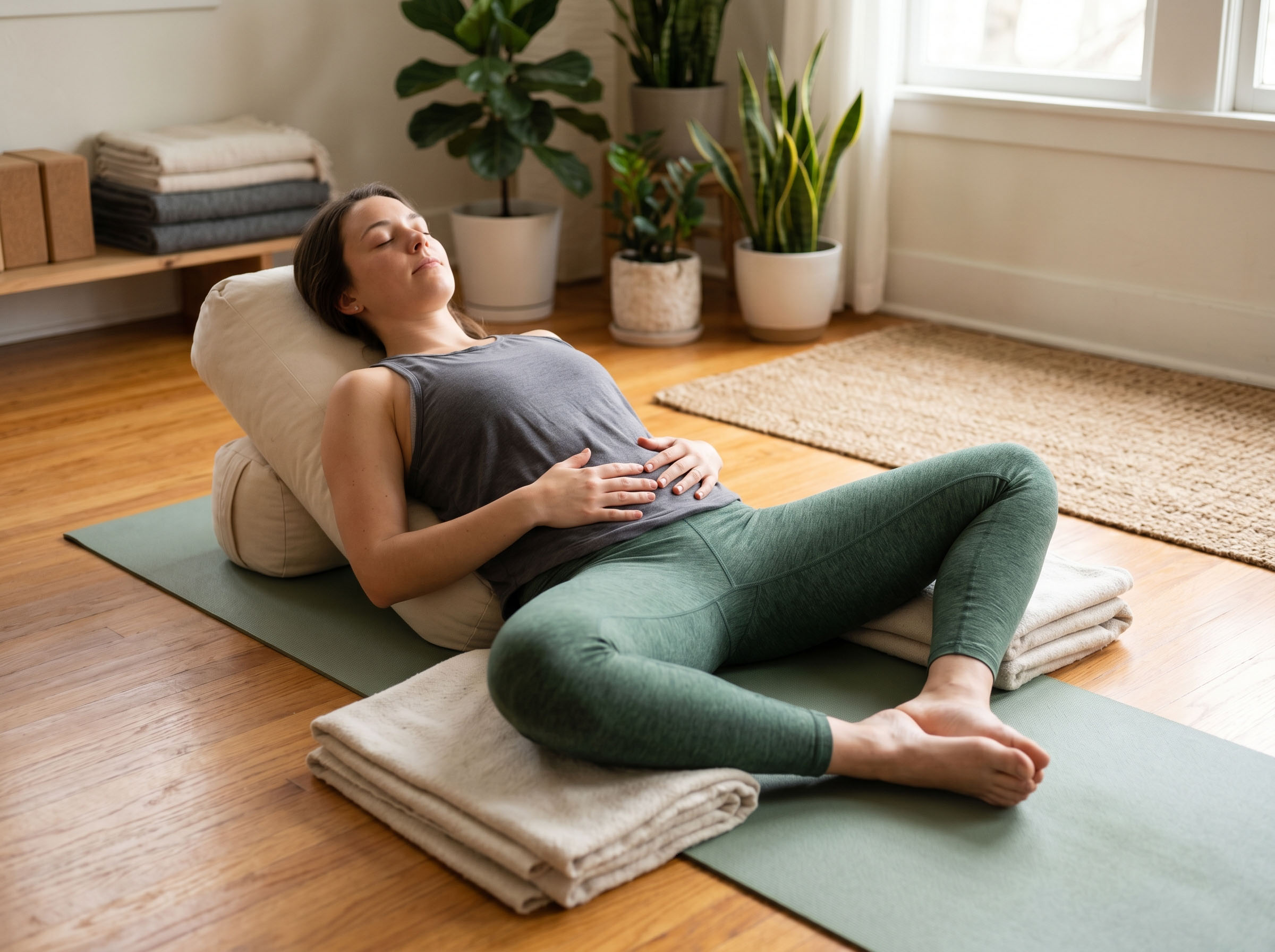
A bolster or stack of folded blankets placed lengthwise under the spine, with the soles of the feet together and the knees falling open, creates a fully passive version of the pelvic opening achieved in Baddha Konasana. This supported configuration requires nothing of the practitioner except willingness to remain still. For women managing intense cramping or the first days of menstruation, this may be the most appropriate and physically accessible option available. The passive chest opening it creates simultaneously supports slow, deep breathing — which activates the parasympathetic nervous system and can reduce pain perception.
8. Legs-Up-the-Wall — Viparita Karani
Considered one of yoga's most traditionally therapeutic inversions, Viparita Karani involves lying with the buttocks at the base of a wall and the legs extended vertically upward. The inversion of blood flow from the legs and pelvis creates a notable shift in pelvic venous pressure. Many women who experience the pelvic fullness and heaviness associated with premenstrual syndrome or with jobs that require prolonged standing report significant relief from even ten minutes in this position. Studies examining lower limb venous return and pelvic congestion have supported the physiological rationale.
Matching Poses to Your Menstrual Cycle
Research in exercise science increasingly supports the idea of cycle-syncing — adjusting movement intensity and type to the hormonal phase the body is currently in. A woman's physiology shifts meaningfully across the roughly 28-day cycle: estrogen rises from menstruation through ovulation, creating conditions of higher energy, better strength output, and greater tissue flexibility. Progesterone rises through the luteal phase, creating the conditions for fatigue, ligament laxity, and the kind of inward withdrawal that many women experience in the week before their period.
Yoga adapted to this reality might look like more active, strengthening postures — Warriors, Bridge, Malasana — during the follicular and ovulatory phases, and a shift toward restorative and release-focused poses — Legs-Up-the-Wall, Supported Butterfly, Child's Pose — during the luteal and menstrual phases. This is not weakness; it is working intelligently with the body's actual state rather than against it.
Many women report that this simple reframe — moving with their cycle rather than despite it — produced more significant changes in their sense of physical wellbeing than any other single adjustment to their fitness practice.
Quick-Start Guide
Your First Pelvic-Aware Yoga Week
What You'll Need
- A yoga mat
- One firm bolster or two folded blankets
- A wall space (for Viparita Karani)
- A yoga block (optional but helpful for Malasana)
- 20–30 minutes, three times per week
Do's
- Breathe into your belly — not just your chest — with every pose
- Allow 30–60 seconds minimum in each held pose
- Choose restorative poses on high-pain or high-fatigue days
- Track how each pose feels across your cycle over 4–6 weeks
Don'ts
- Force any pose that creates sharp or pinching sensation
- Grip the pelvic floor — the goal is awareness, not constant contraction
- Replace professional pelvic floor care with yoga alone if you have existing dysfunction
- Ignore persistent pelvic pain — seek a physiotherapist
Breath as the Invisible Practice
No discussion of yoga and pelvic health is complete without attention to the breath. Diaphragmatic breathing — slow, belly-expanding inhalation followed by a full exhalation — is the mechanism through which yoga does much of its pelvic floor work. On every inhalation, the diaphragm descends and the pelvic floor responds by gently lengthening downward. On every exhalation, both structures gently recoil upward. This coordinated movement is the body's natural pelvic floor exercise program — one that happens forty thousand times a day for those who breathe fully and deeply, and barely at all for those who breathe shallowly into the upper chest.
Studies examining women with pelvic floor dysfunction — urinary leakage, prolapse symptoms, pelvic pain — have found a high prevalence of disrupted breathing patterns. The chest-breathing that chronic stress encourages effectively decouples the pelvic floor from its natural rhythmic training. Teaching the body to breathe fully again, through yoga or any conscious breathwork practice, may be one of the simplest and most underappreciated interventions available to women managing pelvic concerns.
For further reference on the anatomy and science of pelvic floor function, the International Urogynecology Journal's research on yoga and pelvic floor rehabilitation provides accessible peer-reviewed context for readers who want the scientific foundation behind these practices.
In Brief
What the Research Tells Us
- Regular yoga practice is associated with improved pelvic floor muscle coordination
- Cortisol reduction through yoga may support more regular menstrual cycles
- Deep squatting (Malasana) expands the pelvic outlet — with implications for comfort, birth, and pelvic mobility
- Restorative inversions reduce pelvic venous pressure and are widely reported to relieve premenstrual heaviness
- Diaphragmatic breathing is the pelvic floor's natural training mechanism — yoga makes it conscious
- Cycle-syncing yoga intensity to hormonal phases is supported by emerging exercise science
The Practice, in Perspective
Yoga is not a cure. It is a practice — which means its value accumulates over weeks and months of return, not a single session. What the science suggests, and what many women across many cultures have understood intuitively, is that the female pelvis responds to movement, breath, and stillness in ways that have real bearing on reproductive comfort, cycle regularity, and lifelong pelvic function.
There is something worth honoring in that. The body that carries life, manages a monthly hormonal symphony, and navigates decades of physical change deserves more than a generic fitness prescription. It deserves movement that was designed — or discovered through centuries of practice — with its particular architecture in mind.
The poses described in this guide are a starting point. They are widely studied, broadly recommended across pelvic health disciplines, and have the unusual distinction of being simultaneously ancient and increasingly evidence-backed. Bring curiosity to them. Bring patience. And pay attention to what your body has been quietly trying to tell you.
The American College of Obstetricians and Gynecologists guidance on exercise and pelvic health offers authoritative context for women who want professional medical framing alongside their movement practice.
Common Questions
Disclaimer: All content on this website—including articles, educational materials, and interactive calculators—is for informational, educational, and entertainment purposes only. The calculations, percentiles, and outputs generated by tools on this site are based on general statistical data and mathematical models; they do not constitute medical data, a clinical assessment, or a diagnosis.
Nothing contained on this website is a substitute for professional medical advice, diagnosis, or treatment. Always seek the guidance of a qualified healthcare professional or urologist with any questions you have regarding physical development, anatomy, or health conditions. Reliance on any information or tools provided by this website is solely at your own risk.