English
  Español
  Português



There is a particular sensation that modern communication has nearly erased: the physical feeling of waiting for someone you love. Not the small irritation of an unanswered text message, but a slower, more deliberate kind of suspense — the sort that once defined the earliest days of courtship, when affection unfolded over weeks and months rather than minutes.
Historically, societies have understood that the space between two people, held open a little longer than convenience allows, tends to deepen rather than diminish desire. This is not a modern discovery. It appears, in one form or another, in nearly every courtship tradition on record, from Regency drawing rooms to arranged-marriage negotiations still practiced today.
This is not an article about strategy. It is an article about inheritance — about why so many women, across so many centuries and continents, describe the waiting itself as part of what made love feel real. Research suggests the answer lies somewhere between psychology and custom, and understanding it says a great deal about how romantic love has been experienced, and expected, by women throughout history.
A Correspondence of Centuries
For most of Western history, courtship was, quite literally, a slow-moving correspondence. In the Regency and Victorian periods, letter-writing was often the only private communication a couple was permitted, and for ordinary families it was frequently too costly to indulge in often. A letter carried weight precisely because it took days to arrive and days to answer. Each one was composed carefully, sealed, and, in many households, kept for a lifetime.
Beyond letters, an entire architecture of pacing governed how a courtship progressed. A gentleman could not introduce himself to a lady without a formal introduction. A young woman's dance card limited how many times a suitor could partner her in an evening. Chaperones accompanied nearly every meeting, and walks together — however innocent — were treated as significant milestones rather than casual outings. Engagements themselves often lasted years, particularly among working-class couples who needed time to save for a household. According to historians who study the period, this was not mere prudishness; it reflected a broader cultural belief that a bond worth keeping was one allowed to form gradually, under the watch of family and community, rather than rushed toward decision. For a closer look at how these customs shaped early nineteenth-century romance, HISTORY's overview of Regency-era courtship rituals offers a well-documented account.
Courtship Rituals Across the World
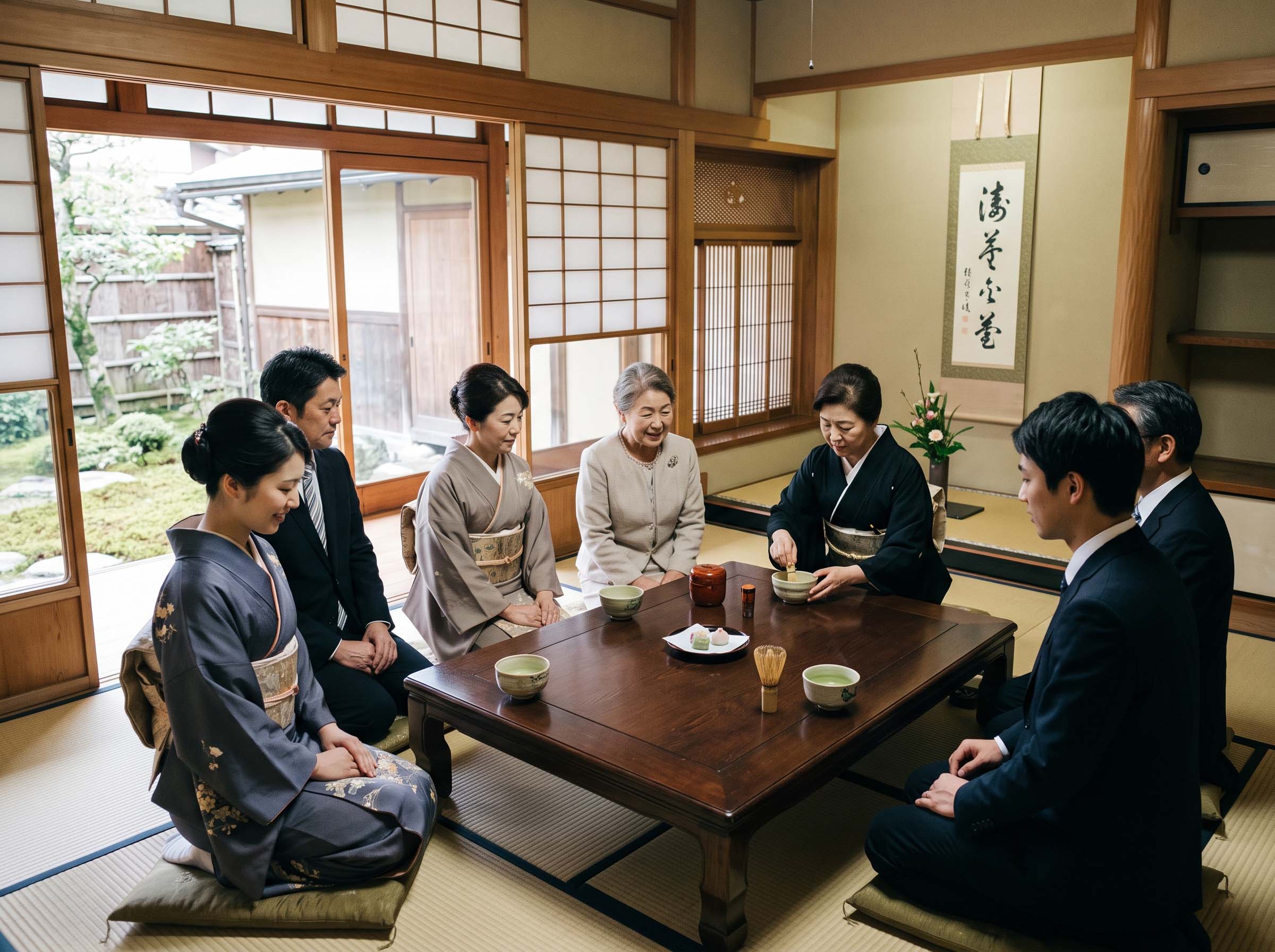
Anthropologists who study courtship have long noted that nearly every culture builds some form of interval into the path toward marriage — a stretch of time in which families, and not just the couple, participate in the unfolding relationship. In Japan, the tradition of omiai arranges a formal introduction between two families, often followed by several structured meetings before either party commits to pursuing the relationship further. Each meeting is a small, deliberate step rather than a single decisive moment.
In many South Asian communities, courtship within an arranged-marriage framework similarly unfolds across a series of family visits, each one building familiarity before a final decision is made. In parts of West Africa, bride-price negotiations between families can extend over months, involving gifts, discussions, and ceremonial visits that draw the wider community into the anticipation of the match. And across the Ottoman world and much of the Middle East, engagement periods historically included a sequence of ceremonial markers — among them the henna night, a gathering held in the days before a wedding — each one adding to the sense that the union was approaching, rather than arriving all at once.
What these traditions share, despite their differences, is a conviction that meaning accumulates over time. The wedding day was rarely the beginning of the story; it was the culmination of a courtship that had already been building, deliberately, for months or years.
Japan's Omiai Tradition
An omiai is a formal, family-arranged introduction between two people considering marriage. A go-between, often a trusted relative or family friend, coordinates the first meeting, which typically takes place over tea in a quiet, neutral setting.
Rather than a single verdict, the practice unfolds across several meetings, giving both families time to observe compatibility before any commitment is made — a structure still used by many Japanese couples today, alongside more contemporary paths to marriage.
The Quiet Science of Anticipation
Modern researchers have taken a genuine interest in why delay affects desire so powerfully. One frequently cited study, published in the Journal of Personality and Social Psychology and examined at length by Psychology Today's review of relational uncertainty research, found something worth sitting with: it is not doubt about a partner's affection that heightens desire. Ambiguity about whether someone actually cares tends to weaken attraction rather than strengthen it. What sustains desire is something more specific — the sense that a person's regard is real and growing, while the relationship itself is still permitted to unfold gradually, rather than being resolved all at once.
In other words, the old courtship rituals may have understood something researchers are only now describing with precision. A slow reveal is not the same as withholding. The letters, the chaperoned visits, the ceremonial markers spaced across months — all of it communicated sincerity through the quiet, non-verbal signals couples have always used to express affection while still leaving room for the relationship to grow. That combination, certainty of feeling paired with patience in pacing, appears to be what keeps longing alive rather than letting it curdle into doubt.
In the Victorian era, women often communicated interest — or a polite decline — through the language of flowers, known as floriography. A gift of red roses signaled passionate love, while violets conveyed faithfulness. An entire courtship could be conducted, in part, through the careful selection of a bouquet.
What the Slow Reveal Says About Us Today
It is easy to assume that instant messaging and dating apps have made anticipation obsolete. In practice, many women report a quieter response: a longing for exactly the pacing their grandmothers described. Studies exploring modern dating culture have repeatedly found that women frequently name the compression of courtship — the jump from introduction to intimacy within days — as one of the more disorienting aspects of contemporary romance, precisely because it removes the gradual unfolding that once made a growing bond feel earned.
Traditional courtship placed real value on time as a form of respect. A man who wrote letters for months, who asked a father's permission, who waited through a long engagement, was understood to be demonstrating seriousness through patience rather than urgency. That framework gave women a measure of agency, too: the pace of a courtship was rarely one person's decision alone, and a woman's willingness to continue corresponding, to accept another visit, or to keep a suitor's photograph was itself a meaningful signal, exchanged in small, deliberate increments rather than all at once.
"Anticipation was never about withholding affection — it was about giving it room to become undeniable."
None of this suggests that modern women should recreate Victorian chaperonage or write letters by candlelight, however romantic the image. It suggests something gentler: that the old instinct toward pacing was not simply a product of restrictive social codes. It reflected an understanding, refined across generations and cultures, of how genuine affection is best allowed to grow — steadily, visibly, and with enough room to become something a woman can trust.
Questions Women Often Ask About Courtship and Anticipation
The rituals themselves have largely faded — the calling cards, the fan language, the months-long silences between letters. But the underlying psychology they were built around has not. Whether it takes the form of a Victorian correspondence, a Japanese omiai, or simply a courtship built from small, consistent gestures rather than grand ones, the pattern remains consistent across centuries and continents: love given room to grow tends to be love that lasts.
Disclaimer: All content on this website—including articles, educational materials, and interactive calculators—is for informational, educational, and entertainment purposes only. The calculations, percentiles, and outputs generated by tools on this site are based on general statistical data and mathematical models; they do not constitute medical data, a clinical assessment, or a diagnosis.
Nothing contained on this website is a substitute for professional medical advice, diagnosis, or treatment. Always seek the guidance of a qualified healthcare professional or urologist with any questions you have regarding physical development, anatomy, or health conditions. Reliance on any information or tools provided by this website is solely at your own risk.