English
  Español



Long before pleasure devices lined the shelves of pharmacies and boutiques, women found their own ways to understand their bodies. What has changed is not the underlying curiosity — it's how openly that curiosity can now be discussed. Today, tools designed for personal pleasure are sold beside skincare and vitamins in mainstream retail, a shift that says as much about changing attitudes as it does about the products themselves.
This piece looks at where these tools came from, what research actually says about the female pleasure response, how different cultures have approached the subject, and why many marriage and family therapists now treat this topic as part of a broader conversation about wellbeing rather than a taboo to step around.
A History Longer Than You'd Expect
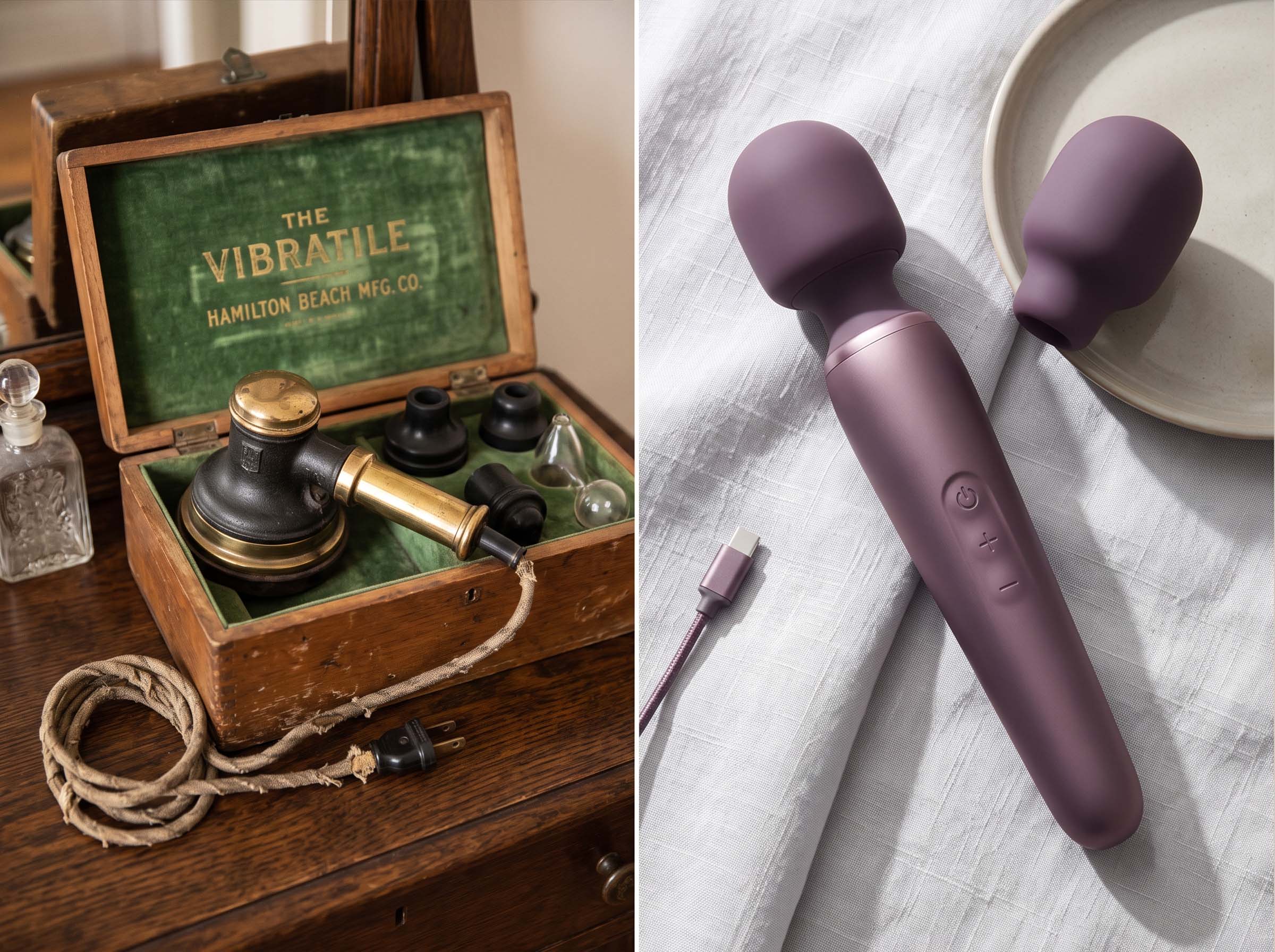
The idea of a device built for personal pleasure is not a modern invention. Archaeologists have documented smooth, shaped objects in Paleolithic sites believed to have served this purpose, carved from stone thousands of years before recorded history. Ancient Chinese and Roman writings reference similar objects made from wood, leather, or ivory. What's notable is not that these tools existed, but how differently each era chose to talk — or not talk — about them.
The Victorian era offers one of the more curious chapters. Historians such as Rachel Maines, whose research is widely cited in academic circles, have described how vibrating devices were marketed to Victorian-era physicians as medical instruments for treating "hysteria," a catch-all diagnosis of the time. Whether every detail of that history holds up to modern scrutiny is still debated among historians, but the broader pattern is well documented: for much of Western history, female pleasure was discussed only when it could be repackaged as medicine, never as something a woman might simply want for herself.
That began to shift in the mid-20th century, as the women's health movement encouraged more direct, self-directed conversations about anatomy and pleasure. By the 1990s and 2000s, pleasure products moved from adult-only retailers into mainstream wellness spaces, a transition that continues today with brands positioning these items as beauty and self-care essentials rather than something to be hidden away.
Did You Know?
The word "vibrator" first appeared in American medical advertisements in the 1880s, decades before the same devices were sold openly for personal use.
What Research Says About the Female Pleasure Response
Modern research into female sexual response owes a great deal to the work of Masters and Johnson in the 1960s, who were among the first to study the physiological stages of arousal in a laboratory setting rather than relying on assumption or anecdote. Their work, along with later research from institutions such as the Kinsey Institute, established that female arousal and pleasure involve a broad network of nerve pathways, blood flow changes, and muscular response — not a single, simple mechanism.
Later research has continued to refine this picture. Studies have explored how psychological factors such as stress, body image, and relationship security influence physical response just as much as anatomy does. Many women report that pleasure is highly context-dependent, shaped by mood, environment, and trust as much as by any physical stimulus. Researchers studying sexual wellbeing frequently note that this mind-body connection is more pronounced in women than in men, which may help explain why cultural attitudes toward female pleasure have historically been more tangled than attitudes toward male pleasure.
Where do pleasure tools fit into this research? Clinical sexologists and pelvic health professionals have increasingly discussed them as one legitimate option among many for women looking to better understand their own bodies, particularly for women navigating changes after childbirth, during menopause, or simply as part of ordinary self-awareness. Reputable health organizations, including the Kinsey Institute's research division, have published findings suggesting that women who report higher familiarity with their own bodies also report higher satisfaction in their intimate relationships — though researchers are careful to note that correlation is not the same as causation.
How Different Cultures Have Approached the Subject
Attitudes toward female pleasure have never been uniform across history or geography. In parts of ancient India, texts such as the Kama Sutra treated female pleasure as a subject worthy of scholarly attention, discussed alongside etiquette, aesthetics, and marital duty. Ancient Japanese art from the Edo period, meanwhile, depicted pleasure devices with a matter-of-fact openness that stands in contrast to the discretion of later centuries.
By comparison, many Western societies moved through long stretches where female pleasure was either ignored in polite conversation or actively pathologized, as the Victorian "hysteria" diagnosis illustrates. Some traditional societies developed their own quiet customs — passed between mothers, aunts, and grandmothers rather than written down — for addressing questions about intimacy within marriage. Anthropologists studying these oral traditions note that even in cultures with strict public modesty norms, private, women-only spaces often served as places where practical knowledge was shared generation to generation.
Today's more open marketplace represents less a total break with the past and more a return to something closer to how many pre-modern societies handled the subject: practically, and often within the privacy of marriage and trusted female relationships, rather than as public spectacle.
Pleasure, Wellbeing, and Relationship Quality
Researchers studying marital and long-term relationship satisfaction have repeatedly found that intimacy and communication are closely linked. Studies published in journals such as the Journal of Sex Research have explored how couples who communicate openly about desire and pleasure tend to report higher relationship satisfaction overall, independent of frequency alone. Pleasure, in other words, appears to function less as an isolated physical event and more as one thread in the broader fabric of a healthy marriage — connected to trust, communication, and emotional safety.
For many women, the introduction of a personal pleasure tool into their own routine — whether used alone or with a spouse — is framed by therapists less as a novelty and more as a form of body literacy: understanding one's own response well enough to communicate it clearly to a partner. Marriage counselors sometimes recommend this kind of self-awareness specifically because it can reduce the guesswork that leads to frustration in long-term relationships.
| Category | Common Materials | General Consideration |
|---|---|---|
| External-use devices | Medical-grade silicone | Widely recommended as a beginner-friendly, body-safe material |
| Wellness and massage tools | Stainless steel, glass | Non-porous and easy to sanitize between uses |
| Couples-oriented tools | Silicone, ABS plastic | Often designed with input from both partners' comfort in mind |
Quick-Start Basics
Do: Choose body-safe, non-porous materials such as medical-grade silicone, glass, or stainless steel. Clean tools before and after use according to manufacturer instructions. Take your time and let curiosity, not comparison, guide you.
Don't: Share personal-use items without proper cleaning. Feel pressured by marketing claims that promise unrealistic results. Hesitate to talk with your doctor if you have questions about a health condition before introducing something new.
Cultural Insight
In parts of Edo-period Japan, discreet pleasure objects were considered part of a bride's household goods, sometimes included in wedding trousseaus as a practical, unremarkable item rather than a scandalous one.
What research consistently avoids is prescribing a single "right" approach. Every woman's body responds differently, and comfort with any tool — physical or emotional — develops at its own pace. The through-line in most credible research is simply that self-knowledge tends to support confidence, and confidence tends to support connection with a spouse or long-term partner.
Talking About It Without Overcomplicating It
Perhaps the most practical shift in recent decades isn't the tools themselves but the willingness to discuss them plainly, the same way one might discuss a skincare routine or a fitness goal. Family physicians and pelvic floor specialists increasingly bring the subject up as a normal part of women's health visits, particularly around milestones such as postpartum recovery or the transition into menopause, when changes in sensation and comfort are common and worth understanding rather than quietly enduring.
For women weighing whether this is a subject worth exploring for themselves, the historical and research record offers a reassuring backdrop: curiosity about one's own body has existed in every era and every culture, even when the surrounding conversation was quieter than it is today.
Common Questions
Disclaimer: All content on this website—including articles, educational materials, and interactive calculators—is for informational, educational, and entertainment purposes only. The calculations, percentiles, and outputs generated by tools on this site are based on general statistical data and mathematical models; they do not constitute medical data, a clinical assessment, or a diagnosis.
Nothing contained on this website is a substitute for professional medical advice, diagnosis, or treatment. Always seek the guidance of a qualified healthcare professional or urologist with any questions you have regarding physical development, anatomy, or health conditions. Reliance on any information or tools provided by this website is solely at your own risk.