English
  Español
  Português



Grief does not stay in one place. It moves through a woman's days, her sleep, her friendships, and eventually into the parts of life built on closeness — touch, trust, and being fully seen by another person. When a marriage ends, whether through death, divorce, or a long slow drifting apart, intimacy is often one of the last things to return, and one of the hardest to talk about openly.
Yet women have never faced this passage without a map. Long before modern psychology gave it language, societies across the world built customs, timelines, and communities around exactly this moment: the space between losing closeness and finding it again. Looking at how different cultures have handled this transition does not hand a woman a formula. It offers her something quieter and, in many ways, more useful — company.
The Old Rules Around Grief and the Body
Historically, few societies expected a woman to sort out her grief in private and simply resume life on her own schedule. Structure was built in. Victorian England, for instance, prescribed stages of mourning dress that lasted up to two years for a widow, gradually easing her from black crepe back into color and, eventually, back into courtship. In Islamic tradition, a widow observes iddah, a mourning period of four months and ten days, during which remarriage is set aside entirely. In Hindu households in India, an elaborate thirteen-day ritual gathers extended family around the widow, and her role within the household shifts as she is supported through the transition rather than left to manage it alone.
These traditions are easy to mistake for restriction. Read differently, they served as protection. A defined mourning period gave a woman social permission to slow down, and it signaled to everyone around her — suitors included — that she was not to be rushed. Many of these customs functioned less like a punishment and more like a fence, built to keep a woman's healing safe from other people's timelines.
| Culture / Tradition | Practice | What It Protected |
|---|---|---|
| Victorian England | Staged mourning dress, up to two years | A public, gradual re-entry into social and romantic life |
| Islamic Tradition | Iddah — four months and ten days | Time set apart before remarriage is considered |
| Hindu India | Thirteen-day family ritual | Communal support and a clear shift in household role |
| Irish Tradition | The wake — extended family and neighbors gather | Shared storytelling and open, communal expression of grief |
| Māori (New Zealand) | Tangihanga — a multi-day gathering | Full community presence before life resumes |
Cultural Insight
The Keening Women of Ireland
In old Irish tradition, grief was often led aloud by women. The bean chaointe, or keening woman, sang a wailing lament over the dead, giving the community permission to weep openly rather than hold sorrow in private. Women were, quite literally, entrusted with the sound of mourning.
What Modern Research Says About Coming Back
Psychology did not begin studying recovery from loss until fairly recently, but its findings echo something older cultures already assumed: growth and grief are not opposites. Researchers Richard Tedeschi and Lawrence Calhoun coined the term post-traumatic growth to describe positive change that can follow hardship — a deepened appreciation for life, stronger relationships, and a clearer sense of personal strength. Research grounded in posttraumatic growth studies from the American Psychological Association suggests that a meaningful number of people who face significant adversity report this kind of positive shift over time, not instead of their pain but alongside it.
What the research does not offer is a schedule. Studies on post-traumatic growth consistently find wide variation between individuals — some women describe feeling steady within a year, others take much longer, and neither pace is treated as more correct than the other. Many women report that closeness with a partner returns unevenly: warmer some weeks, distant the next, without that back-and-forth meaning anything has gone wrong.
The Common Thread: Community, Not a Clock
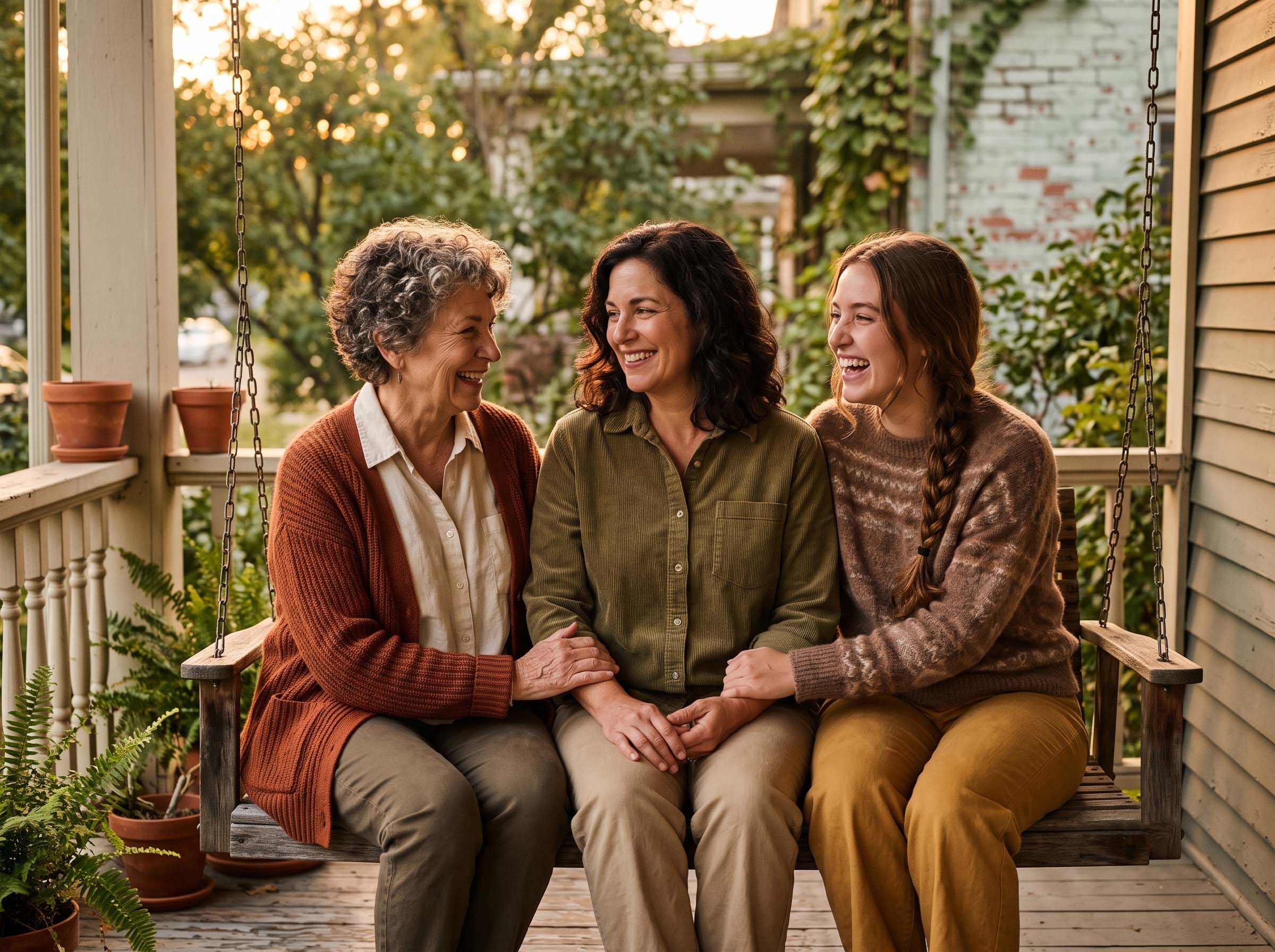
Anthropologists who study grief across societies keep landing on the same observation: the cultures that support women best through loss rarely rely on a strict timeline. They rely on people. Cross-cultural research on grief and mourning traditions describes how, in many non-Western societies, mourning is treated as a shared family responsibility rather than a private task — female relatives move in temporarily, elder widows mentor younger ones, and daily rituals of washing, cooking, and storytelling quietly rebuild a woman's sense of normal life.
Modern life, particularly in the West, often strips this structure away. A woman may be expected to return to work within days, manage a household alone, and process a private ache with little communal ritual to lean on. Historically speaking, societies have understood that this kind of isolation makes the road back to closeness — with a partner, with friends, with one's own sense of self — considerably harder to walk.
"The cultures that helped women heal best rarely gave them a deadline. They gave them company."
Reclaiming Closeness on Her Own Terms
Intimacy after loss is rarely only about romance. Many women describe rediscovering closeness first through friendship, through their children, or through a faith community, long before they feel ready for a new romantic bond. Research on adjustment after loss suggests this gradual, layered return — small moments of trust and warmth building on one another — tends to hold up better than any pressure to "get back out there" on a particular timeline.
This is, in many ways, the same wisdom older cultures built into their rituals, simply carried into modern language. A widow in Victorian England was not expected to court again in month one. A woman mourning in an Irish village was not expected to grieve quietly and alone. The specifics of each tradition differ, but the underlying respect is consistent: a woman's return to closeness, to trust, and to herself deserves patience rather than a program.
Questions Readers Often Ask
No two women arrive at closeness again by the same road, and history never expected them to. What the record does show, across centuries and continents, is that women have always found their way back — to trust, to touch, to themselves — when the people around them offered patience instead of a deadline, and company instead of a program.
Disclaimer: All content on this website—including articles, educational materials, and interactive calculators—is for informational, educational, and entertainment purposes only. The calculations, percentiles, and outputs generated by tools on this site are based on general statistical data and mathematical models; they do not constitute medical data, a clinical assessment, or a diagnosis.
Nothing contained on this website is a substitute for professional medical advice, diagnosis, or treatment. Always seek the guidance of a qualified healthcare professional or urologist with any questions you have regarding physical development, anatomy, or health conditions. Reliance on any information or tools provided by this website is solely at your own risk.