English
  Español
  Português



Before language, there was touch. Before love letters and wedding vows and whispered endearments, there were hands — reaching, holding, pressing palm to cheek in the dark. Anthropologists have long understood that physical contact is among humanity's oldest and most honest forms of communication. Long before any culture developed a written word for love, it was already being expressed through the body: in a mother's cradling arms, a lover's lingering hand, a friend's steadying grip during grief.
We live in an age saturated with words. Texts, emails, social media declarations — love is announced constantly and loudly. Yet many women quietly notice that words, however abundant, can sometimes feel hollow. Research suggests that non-verbal communication, including touch, accounts for the vast majority of emotional meaning exchanged between two people. The words are the surface. The touch is the truth beneath it.
"Long before any culture developed a written word for love, it was already being expressed through the body — in a mother's cradling arms, a lover's lingering hand."
— Elena Mireau, The Language of Touch
A History Written on Skin
Historically, societies have understood touch as a moral and spiritual language, not merely a physical one. In ancient Greece, the philosopher Aristotle named touch the most fundamental of the senses — the one sense without which, he argued, no animal could survive. Unlike sight or hearing, touch requires closeness. It cannot be faked across a room. For the Greeks, this intimacy made touch not just pleasurable but philosophically significant: it was the sense that confirmed our physical presence to one another.
In medieval Europe, the codes governing touch between men and women were extraordinarily elaborate. A knight who touched a lady's hand during a formal greeting was making a declaration of respect; a hand held too long, or pressed too warmly, carried entirely different meaning. These rituals were not repressive — they were a rich vocabulary. Every gradation of touch communicated something specific about intention, status, and feeling. The culture understood that touch was information.
In Edo-period Japan, physical contact between unmarried men and women in public was highly restricted, which made even the briefest accidental contact charged with meaning. Classical Japanese literature is full of such moments — a sleeve brushing against another in the dark, the graze of fingers during the exchange of a letter — treated as profound romantic events. Constraint, historically, has often intensified the communicative power of touch rather than diminishing it.
Across the Pacific, many Indigenous cultures of the Americas used structured touch in ceremonies of greeting, healing, and courtship — practices that anthropologists have documented as carrying precise social and spiritual meaning. Touch was not casual; it was ceremonial. It said: I see you, I acknowledge you, I am bound to you in some way.
What Science Says About Skin
Research into the biology of touch has opened remarkable windows into why physical contact feels so fundamentally different from other expressions of love. The skin is the body's largest organ and contains a specialized class of nerve fibers — called C-tactile afferents — that appear to exist specifically to respond to gentle, stroking touch at a particular speed (roughly 1–10 centimeters per second). These fibers send signals directly to areas of the brain associated with social bonding and emotional reward.
Studies have explored the role of oxytocin — sometimes called the bonding hormone — in physical touch between partners. Research suggests that skin-to-skin contact, even non-sexual forms like hand-holding or a gentle arm around the shoulder, triggers oxytocin release in both people simultaneously. This shared biological response is part of why a hug from the right person can feel genuinely calming in a way that reassuring words sometimes cannot. The body is responding to something real and chemical, not symbolic.
Research published in journals focused on social psychology and relationship science has also explored the concept of affective touch — touch intended specifically to communicate emotion rather than information or assistance. Studies suggest that trained observers can identify specific emotions — compassion, love, gratitude, even anger — from touch alone, with accuracy rates well above chance. We are, it seems, far more literate in the language of touch than we consciously realize.

The Vocabulary of Everyday Touch
Many women report that in long-term relationships, it is not the grand gestures they remember most — it is the small, recurring touches that become their own private language. The hand that finds the small of your back in a crowded room. The thumb that strokes your knuckles while you sit together at dinner. The forehead kiss offered without occasion or reason. These touches are not decorative; they are sentences in a language the couple has built together over time.
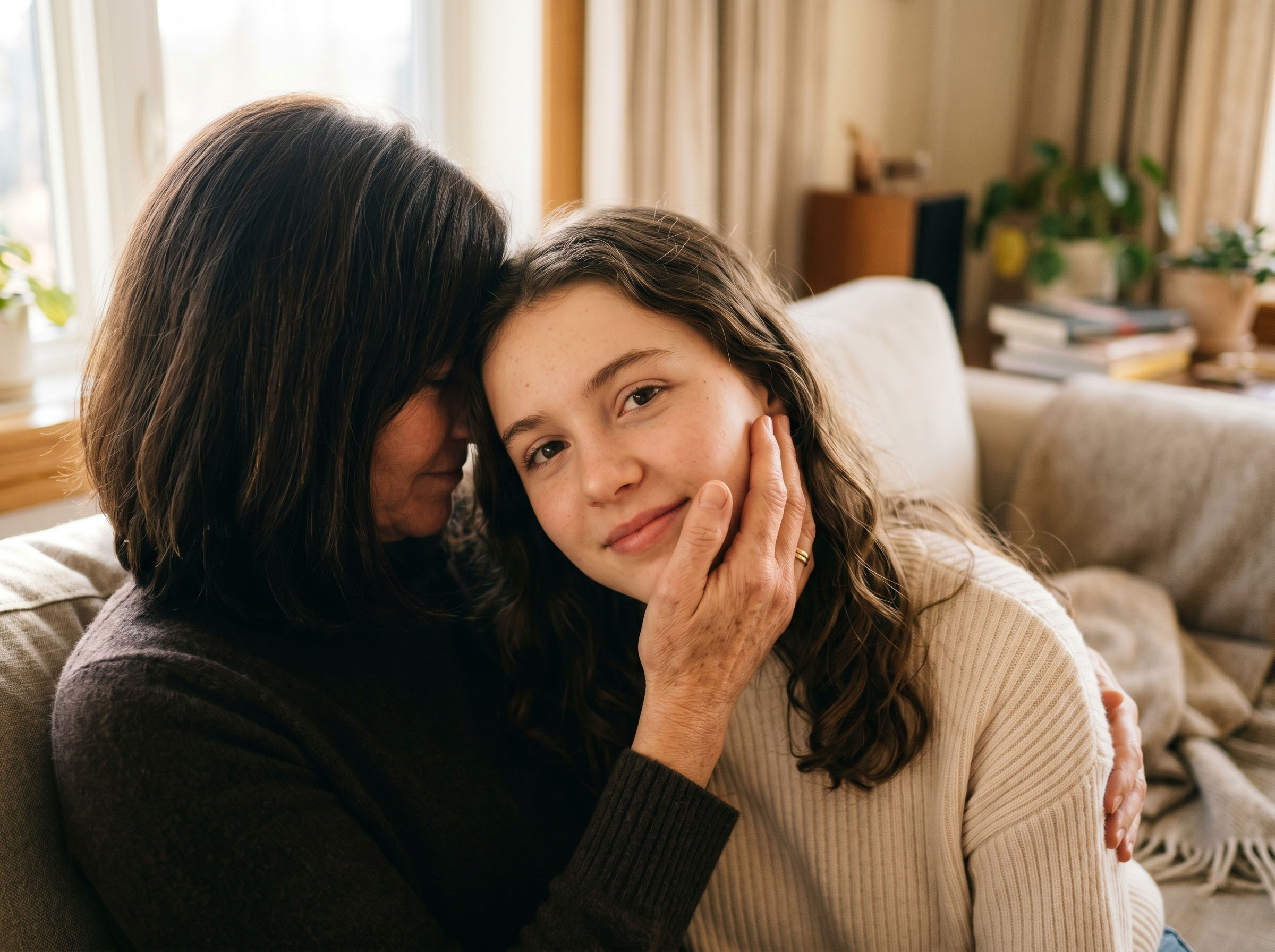
Relationship researchers have identified several distinct categories of non-sexual intimate touch and their associated emotional meanings. A hand on the shoulder communicates support and steadiness. A cradled face communicates tenderness and deep attention. The forehead-to-forehead press — found in romantic iconography across dozens of cultures from South Asia to Scandinavia — communicates a kind of intimate equality, two people meeting at the same level, sharing the same breath. Back-stroking tends to communicate comfort and safety; fingers laced tightly together during a difficult moment communicate solidarity.
What is notable is how consistent these meanings are across cultures that have had little historical contact with each other. This suggests that some of this vocabulary is not taught — it is intuited. The human body may carry a kind of innate grammar of touch.
💡 Did You Know?
Research from DePauw University found that strangers could accurately identify emotions like love, gratitude, and sympathy from a single one-second touch on the arm — with no visual cues, no words, and no context. Touch is not just a supplement to communication. In many cases, it is more precise than language.
Touch as Courtship: Rituals Across Cultures
The anthropology of courtship reveals that cultures have always used regulated touch as a central part of romantic signaling. In many West African societies, formal dances during courtship allowed men and women to engage in rhythmic, choreographed physical contact — a way of communicating compatibility, physical attunement, and mutual interest within a publicly sanctioned setting. The dance was both display and dialogue.
In traditional Italian and Spanish courtship — the passeggiata culture of the evening promenade — young couples would walk together in public under family observation, and the gradual, careful introduction of touch was a legible progression: arm-in-arm first, then hand-in-hand, each step watched and understood by the community as a milestone. Touch announced the relationship's seriousness.
In many parts of rural India, where arranged marriages have been the norm, first physical contact between spouses — often the clasping of hands during a marriage ceremony — is understood as profoundly significant precisely because it is the first. It is not casual. The weight of that initial touch carries the gravity of a lifelong promise.
Studies of contemporary courtship in Western cultures show that early-relationship touch still functions as a negotiation and a signal system. Research suggests that light, casual touch during a first conversation — a brief touch on the arm to emphasize a point — increases positive impressions and feelings of connection, provided it is contextually appropriate and warmly intended. The body is evaluating the touch even when the conscious mind is focused on conversation.
📋 Reference Table
When Touch Is Lost — and What It Costs
Many women report that one of the earliest signs of distance in a relationship is not the absence of words — it is the absence of touch. Couples can continue to speak, even argue, even laugh together, while the subtle physical language between them quietly goes quiet. The hand that no longer seeks yours across the table. The embrace that lasts one beat less than it used to. These small withdrawals are noticed — often more acutely than the words that accompany them.
Research into relationship satisfaction consistently shows that couples who maintain regular, affectionate, non-sexual physical contact report higher levels of both emotional connection and relationship security. This is not simply correlation; studies exploring touch deprivation suggest that the absence of warm physical contact produces measurable psychological effects, including heightened anxiety, reduced sense of belonging, and lowered mood. The body keeps its own record of who has touched it with care.
This has particular significance for mothers. Research suggests that the enormous amount of physical care-giving touch mothers provide — holding, nursing, comforting, lifting — can sometimes leave them feeling physically depleted and, paradoxically, touch-averse toward their partners. Understanding this as a real and documented physiological response, rather than a failure of love, is an important part of maintaining honest intimacy during the demanding seasons of motherhood. Communicating about touch — what is needed, what is too much, what has changed — becomes its own act of care.
🌷 Worth Remembering
In relationships, touch does not automatically diminish with time — it diminishes with inattention. Couples who deliberately maintain physical affection — not just during intimacy, but in the ordinary moments of shared life — tend to sustain stronger emotional bonds over decades. Touch is a practice, not just a feeling. It has to be chosen.
Relearning the Language
One of the more quietly significant insights from relationship research is that couples who feel disconnected can often rebuild emotional intimacy faster through deliberate, affectionate touch than through conversation alone. Touch bypasses the verbal mind — its defenses, its tendency to misinterpret, its rehearsed responses — and speaks more directly to the part of us that simply feels.
This does not mean touch is a substitute for honest communication. It means touch is its own channel — parallel to words, not subordinate to them. Learning to use both together, intentionally, is one of the more underappreciated arts of long-term love.
Historically, cultures that have formalized and ritualized touch — through greetings, ceremonies, dances, and daily customs — seem to have understood something that modern life, with its relentless focus on verbal and digital communication, has partially forgotten: that the body has its own language, and that love, in its fullest expression, speaks in both.
A relationship in which two people have developed a rich private vocabulary of touch — where a certain hand on a certain shoulder means I'm with you, where a particular kind of quiet embrace means I'm sorry, where a held gaze and a pressed forehead means something neither could quite put into words — is a relationship that has built something genuinely its own. It has become, in the deepest sense, a language for two.
✨ Try This
Building Your Touch Vocabulary
- During one conversation this week, put your phone down and place your hand on your partner's arm while they're speaking. Notice if it changes the quality of the exchange.
- Introduce one deliberate, unhurried touch per day that has no instrumental purpose — not part of intimacy, not a greeting — just presence. A hand on the shoulder while passing in the kitchen. A brief forehead kiss during the afternoon.
- Pay attention to the touches you receive that feel most meaningful. Try to understand what they communicate that words don't. Then consider: are you offering those kinds of touches back?
- If you're going through a difficult season in your relationship, try sitting together in physical contact — hands held, arms touching — during a conversation rather than across the table. Research suggests this can lower defensiveness and increase emotional openness.
The Touch That Lasts
There is a reason that in our most shattering moments — grief, fear, overwhelming joy — we reach for another person. We do not reach for their words. We reach for their hand, their arms, their physical presence. In those moments, the body knows what the mind cannot always articulate: that love is not abstract. It lives in the tangible, the warm, the immediate.
Research suggests that the memory of touch is stored differently than the memory of words — more viscerally, more durably, more emotionally. Many women can recall, with striking clarity, the specific feeling of a particular embrace from years ago. The warmth of a hand that held theirs during something difficult. The way a certain person's touch made them feel, for the first time, genuinely safe.
This is the language of touch at its fullest: not just communication, but a form of proof. Proof that someone is there. Proof that they mean it. Proof that love, for all the beautiful and complicated words we use to describe it, is ultimately something felt in the body, given through the hands, and remembered in the skin.
For those interested in exploring the science behind affective touch and bonding, the research team at the UC Berkeley Greater Good Science Center offers extensive research-backed resources on compassion, connection, and the science of human bonding. For a deeper look at the anthropology of courtship rituals, the Smithsonian Magazine's science of love and attraction offers a thoughtful survey of the field.
Related reading on the Vagina Institute: Explore our pillar guide on Emotional Connection in Relationships and our in-depth feature on The Science of Attraction for further context on the research and history covered in this article.
Questions Readers Ask
📖 In Brief
- Touch is one of humanity's oldest and most universal languages of love, preceding written or spoken language by millennia.
- Specialized nerve fibers in the skin respond specifically to gentle, affectionate touch and trigger biological bonding responses including oxytocin release.
- Research suggests that trained observers can identify specific emotions from touch alone with accuracy well above chance — the body communicates more precisely than most of us realize.
- Courtship rituals across cultures — from medieval European greetings to Japanese literary tradition to South American ceremony — have long used regulated touch as a legible language of romantic intention.
- Many couples report that the first sign of emotional distance is not a withdrawal of words but a withdrawal of touch.
- Deliberate, affectionate daily touch — even brief and non-sexual — is consistently associated with higher relationship satisfaction and emotional security over time.
- Touch is not a supplement to love; in many moments, it is its fullest expression.
Disclaimer: All content on this website—including articles, educational materials, and interactive calculators—is for informational, educational, and entertainment purposes only. The calculations, percentiles, and outputs generated by tools on this site are based on general statistical data and mathematical models; they do not constitute medical data, a clinical assessment, or a diagnosis.
Nothing contained on this website is a substitute for professional medical advice, diagnosis, or treatment. Always seek the guidance of a qualified healthcare professional or urologist with any questions you have regarding physical development, anatomy, or health conditions. Reliance on any information or tools provided by this website is solely at your own risk.