English
  Español
  Português



Something unusual has been happening in popular culture over the past several years. Across magazines, social media platforms, podcast episodes, and television dramas, a particular narrative has gathered real momentum: men, we are told, are becoming more emotionally open. More communicative. More willing to discuss what they want, what they feel, and what they need from the women in their lives. Articles arrive in steady waves celebrating the "emotionally available man," the husband who cries at films, the boyfriend who articulates his attachment style on the first date.
For many women, especially those in long-term relationships or raising sons, this raises a genuinely interesting question — one worth examining with some care. Is this a real, measurable cultural shift in how men think and behave? Or is much of what we are seeing a media-shaped story, one that reflects the preferences of certain editorial voices rather than the actual experience of most men and women living ordinary lives?
The honest answer, as is often the case with human behavior, turns out to be: a little of both. But the proportions matter, and they matter more than most trend pieces are willing to admit.
What the Research Actually Shows
Studies have explored male emotional expression for decades, and the picture that emerges is more complicated than either cheerful headlines or cynical dismissals suggest. Research suggests that men do, in fact, experience a broad range of emotions — loneliness, tenderness, grief, anxiety, pride — at roughly the same frequency as women. The difference that consistently appears in the data is not in how often men feel things, but in how they tend to express them, and to whom.
A long-running body of sociological work, including studies from researchers at institutions like the American Psychological Association, has documented that men in many Western cultures are more likely to express emotions through action — problem-solving, providing, showing up — than through verbal disclosure. This is not a deficit. It is a different grammar of care, one that women who grew up watching fathers, grandfathers, and brothers operate this way will likely recognize immediately.
What has genuinely shifted in recent years, particularly among younger men in their twenties and early thirties, is a measurable increase in comfort with discussing mental health. Research from multiple surveys conducted across the United States, Canada, and the United Kingdom indicates that young men today are more likely than their fathers' generation to seek therapy, describe feelings of anxiety to a friend, or acknowledge when they are struggling. That is real, and it is worth acknowledging.
What is less clear is whether this represents a deep restructuring of male psychology — or a surface-level vocabulary shift, where men have learned a new language without necessarily rewiring how they move through relationships.
"Men have always had an emotional interior life. What changes across generations is the permission structure — who gets to see it, and under what circumstances."
— Clara Voss, Trends & Forecasts
The Media's Role: Reporting a Trend or Creating One?
Here is where the analysis becomes more pointed. There is a meaningful difference between a journalist observing a cultural shift and a media ecosystem actively promoting a particular vision of masculinity — and then reporting on the coverage as though it were evidence of the underlying reality.
Much of what gets labeled "men becoming more open about preferences" in mainstream media is, on closer inspection, a relatively narrow slice of male experience: highly educated, coastal, often professionally adjacent to media or creative industries. These men are genuinely more likely to speak in the emotional vocabulary that dominates progressive cultural spaces. They are interesting interview subjects. They make for compelling personal essays.
But they are not representative. Surveys consistently show that the majority of men — particularly those working in trades, agriculture, manufacturing, or military service — retain communication patterns closer to their fathers' generation. Many women partnered with these men report not that their partners are closed off or emotionally absent, but that their emotional expression simply takes different forms: loyalty, reliability, physical presence, acts of service. Historically, societies have understood these as perfectly coherent expressions of love and commitment. The contemporary media tendency to pathologize this difference as "emotional unavailability" tells us more about who is writing the articles than about the men being described.
Progressive Feminism and the Redefinition Project
It would be intellectually dishonest to discuss this topic without acknowledging the ideological current running beneath it. Over the past two decades, a significant strand of progressive feminist thinking has made the restructuring of male behavior — specifically, the feminization of male emotional expression — a stated cultural goal. The argument, broadly, is that traditional masculinity is inherently harmful, that men who do not express themselves in stereotypically feminine ways are somehow broken, and that this brokenness explains a wide range of social problems.
This framework is contested, and not only by conservatives. A growing number of social scientists, including researchers who hold no particular political affiliation, have raised substantive questions about whether the campaign to make men more "emotionally expressive" in the specific way that framework demands is actually beneficial to men, to women, or to the relationships between them.
Research suggests that relationship satisfaction for women is not straightforwardly correlated with having a partner who talks about feelings at length. Studies exploring what women actually report wanting in long-term partners consistently place traits like reliability, humor, competence, and loyalty at least as high as verbal emotional availability. Many women, particularly those who identify with traditional values, report that what they want from a partner is not a man who processes emotions the way a woman would — but a man who is present, dependable, and genuinely interested in her wellbeing.
That is a different thing. And conflating the two does a disservice to both sexes.
What Women Are Observing at Home
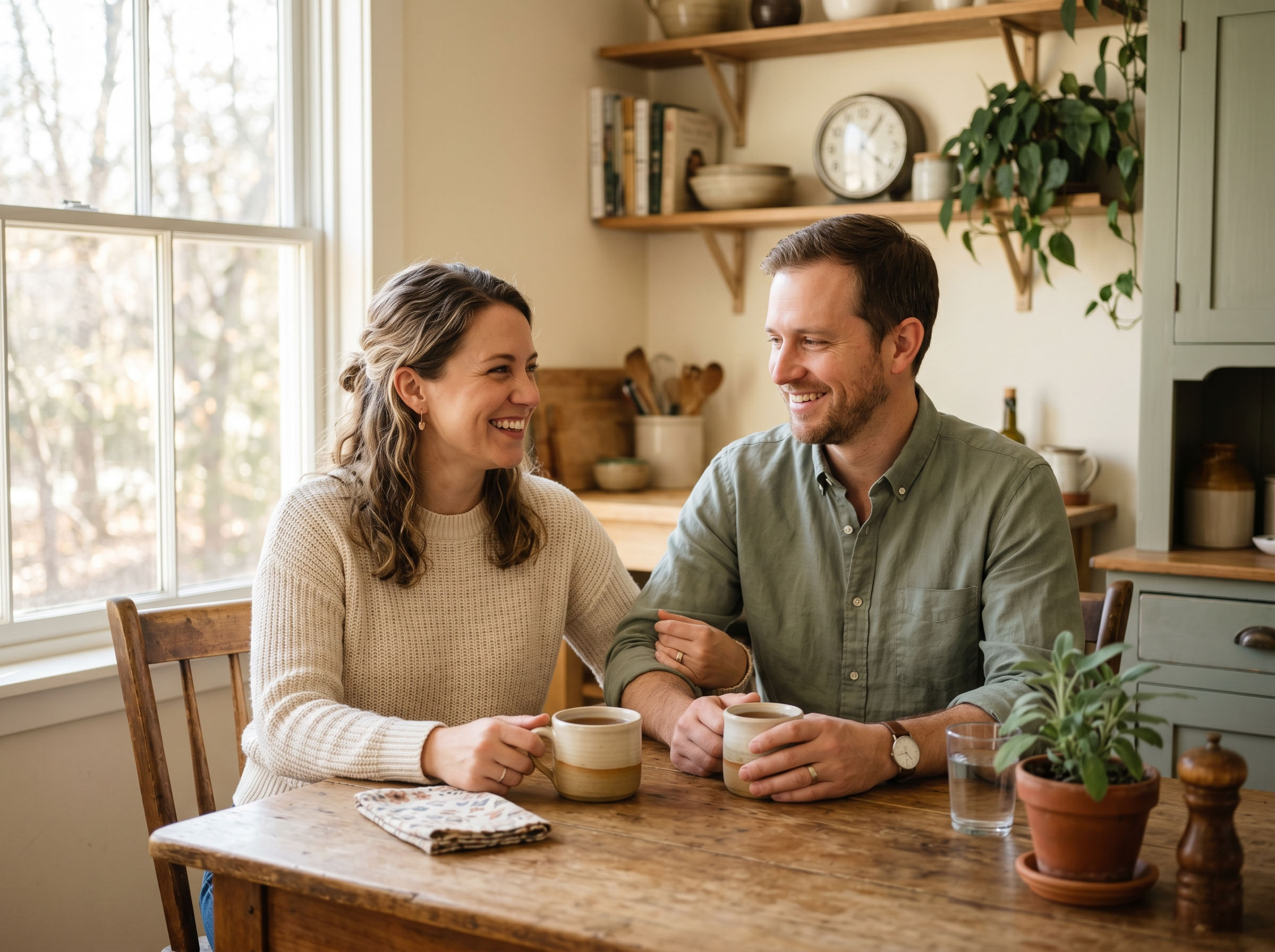
Away from the think-pieces and social media threads, women who are actually in relationships with men tend to describe a more nuanced picture. Many women report that the men in their lives are, in practical terms, perfectly willing to discuss what they want — preferences about weekends, about family decisions, about the kind of relationship they are trying to build — when the conversation is anchored to something concrete.
What men typically resist, across nearly all cultural contexts, is open-ended emotional excavation for its own sake. This is not because they have nothing to say. It is, researchers suggest, a matter of purpose and context. Men tend to open up alongside an activity, or in response to a specific situation, rather than in response to an abstract invitation to "talk about how you're feeling."
Women who understand this pattern — and many mothers raising sons will recognize it instantly — often report higher satisfaction in their communication with male partners. Not because they have somehow "fixed" the man, but because they have stopped measuring his emotional engagement against a template that was never his to begin with.
Worth Noting
A 2022 survey by YouGov found that the majority of men across all age groups said they do discuss personal preferences and concerns with their female partners — but most preferred to do so in practical, action-oriented contexts rather than open-ended emotional conversations. The gap between "emotionally available" and "emotionally expressed differently" may be larger than most trend coverage acknowledges.
The Generational Genuinely Shifting Piece
It is worth being precise about what is actually changing, because something is. Research from longitudinal studies tracking young men born in the 1990s and early 2000s shows a measurable increase in the following: willingness to seek mental health support, comfort discussing anxiety and stress with close friends, and stated desire for deeper emotional connection in romantic partnerships.
These are real data points, not media invention. They reflect, at least in part, a generation of young men who grew up in households where mental health conversation was somewhat less stigmatized than in their grandfathers' era, and who came of age with access to online communities where emotional expression among men was actively modeled.
Whether this represents a durable cultural shift or a generational characteristic that moderates with age remains genuinely open. Research on how men's communication patterns change across the life course — particularly after marriage and fatherhood — suggests that many men become more rather than less private as their responsibilities deepen. The thirty-two-year-old who talks openly about his feelings may, by forty-five, look considerably more like his father than either of them would have predicted.
Did You Know?
Anthropologists studying male communication across 189 cultures found that in every single culture surveyed, men have developed some context-specific channel for emotional expression — whether through ritual, music, sport, humor, or one-on-one trusted friendship. The idea that men "don't have emotions" has no cross-cultural basis whatsoever. What varies is the structure within which those emotions are expressed.
Source: Cross-cultural anthropological literature on male socialization and expressive behavior.
The Question Women Are Quietly Asking
There is a question beneath all of this that many women — especially those raising children — are thinking about, even when they do not say it aloud. The question is something like: if the culture tells my son that his natural way of being is problematic, and tells my daughter that she should want a man who expresses himself in a particular way, and then measures all real relationships against that standard — who does that actually serve?
It is not a hostile question. It is a thoughtful one. Mothers in particular tend to have a front-row view of how boys actually develop, how naturally they form deep loyalties, how fiercely they protect what they love, and how differently that love tends to be expressed compared to their sisters. Many women report that watching their sons be pathologized for perfectly normal developmental patterns — while simultaneously seeing media narratives insist that "men are becoming more open" — creates a kind of cognitive dissonance that is hard to name but impossible to ignore.
The honest cultural analysis is that two things are true at once. Some men—particularly younger, urban, progressive educated men in female studies, and more effeminate men—are genuinely more verbally expressive about their preferences and feelings than their fathers were. At the same time, media coverage of this shift has been wildly disproportionate to its actual prevalence, partly because the journalists, writers, and audiences most likely to produce and amplify these stories come overwhelmingly from the very demographic where the change is most noticeable.
Most men, in most places, are still communicating through the grammar of action. And most women, if they are honest about what they find most meaningful in their relationships, will confirm that this is not as impoverished as the trend pieces suggest.
By the Numbers
| 61% | of men surveyed across the US and UK say they regularly discuss relationship preferences with their partner — but prefer to do so around a specific topic or decision rather than general emotional check-ins. (YouGov, 2022) |
| 34% | increase among men under 35 seeking therapy between 2016 and 2023, according to data from the American Psychological Association. |
| 72% | of women in one relationship satisfaction study rated "reliability and presence" as highly important, compared to 48% who rated "verbal emotional disclosure" as equally important. (Journal of Social and Personal Relationships, 2021) |
| ~12% | of men and boys in media trend articles about "male emotional openness" work in blue-collar sectors, despite representing over 30% of the male workforce — suggesting significant sampling bias in coverage. |
A More Useful Frame
Rather than asking whether men are becoming more like women in how they express themselves — which is, when examined carefully, a somewhat odd aspiration — a more productive question might be: are men and women getting better at understanding each other's emotional languages?
Research into relationship communication suggests that the couples reporting the highest satisfaction are not those where the man has adopted a more stereotypically feminine communication style. They are couples where both partners have developed a working understanding of how the other person expresses care — and have stopped penalizing each other for not doing it the same way.
That is a less dramatic story than "men are finally opening up." It does not generate the same number of clicks. But it is considerably more grounded in what the data actually shows — and, if the women who spend their days navigating real relationships are any guide, it is much closer to the truth of how love and communication actually work between men and women.
For women raising sons, partnering with men, or simply trying to make sense of a media environment that sometimes seems more interested in reshaping human nature than observing it: the most useful thing may simply be to trust your own experience. Research is instructive. Cultural trend coverage is selective. And the man sitting across from you at dinner, showing up reliably, asking good questions, and making you feel safe — may be considerably more "open" than anyone giving him a headline would suggest.
For a broader look at how relationships and communication are evolving for women today, explore our coverage in Relationships & Communication and Modern Womanhood — two of our most-read pillar collections.
Questions Women Are Asking
Disclaimer: All content on this website—including articles, educational materials, and interactive calculators—is for informational, educational, and entertainment purposes only. The calculations, percentiles, and outputs generated by tools on this site are based on general statistical data and mathematical models; they do not constitute medical data, a clinical assessment, or a diagnosis.
Nothing contained on this website is a substitute for professional medical advice, diagnosis, or treatment. Always seek the guidance of a qualified healthcare professional or urologist with any questions you have regarding physical development, anatomy, or health conditions. Reliance on any information or tools provided by this website is solely at your own risk.