日本語
日本語  Deutsch
  English
  Español
  Français
  Português



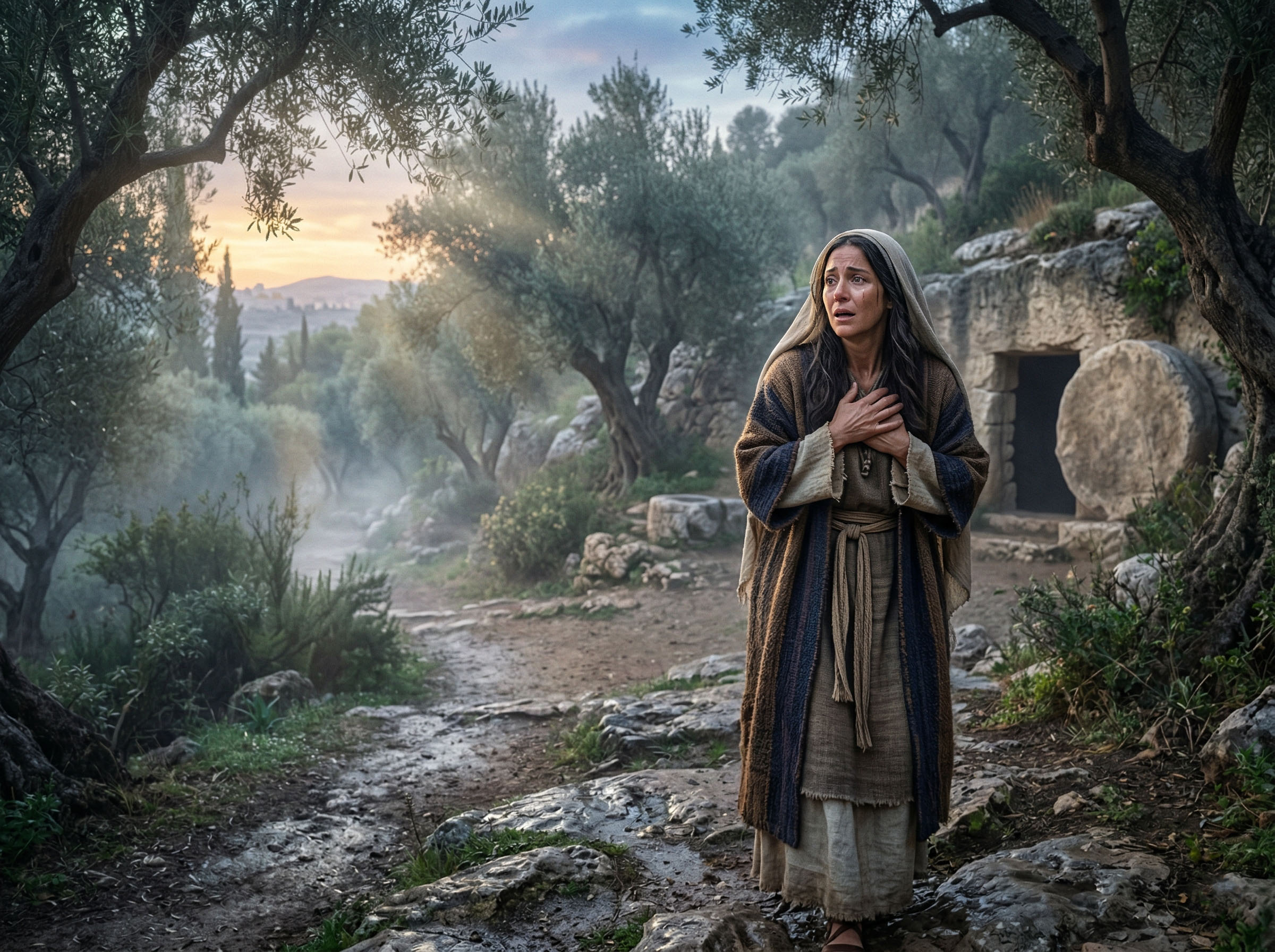
There is a moment in the Easter story that tends to get rushed past in sermons and Sunday school lessons, yet it may be the most quietly extraordinary moment in all of Western religious history. A woman stands alone in a garden, weeping. She has come at dawn, before the men, before the crowds, before anyone else dared. She peers into an empty tomb and, when she turns around, she is the first human being on earth to encounter the risen Christ.
Her name is Mary Magdalene. And for two thousand years, her story has been one of the most misread, misrepresented, and — only recently — carefully restored chapters in the Christian faith.
This Easter, it is worth pausing to understand who she truly was, what the ancient world understood about her role, and why the place of women in the resurrection story carries a significance that goes far deeper than tradition alone.
She was the first human being on earth to encounter the risen Christ — and she was a woman. That detail was not accidental. It was written, preserved, and passed down through every Gospel account.
— Amara LeclercA Name Carried Through Every Gospel
What is remarkable — and often overlooked — is that Mary Magdalene is the one constant. Matthew, Mark, Luke, and John: all four Gospel writers name her, all four place her at the crucifixion and at the tomb. In a period when women's testimony was not considered legally valid in much of the ancient world, the Gospel writers preserved her witness anyway. Some scholars of early Christianity argue this fact alone suggests the accounts were not constructed to suit cultural convenience — because if they were, a woman would not have been the primary resurrection witness at all.
She is mentioned by name twelve times across the four Gospels — more than most of the male apostles. She followed Jesus from Galilee. She stood at the foot of the cross when most of the male disciples had scattered. She came to the tomb on the third morning carrying spices to anoint the body, an act of tender, devoted care that was considered sacred women's work in Jewish tradition.
And it is to her that Jesus first appears. In John's account, she mistakes him for the gardener. When he speaks her name — "Mary" — she recognizes him immediately and becomes the bearer of the most consequential news in Christian history. The early church Fathers, for all their complexity on the question of women, gave her the title Apostola Apostolorum: Apostle to the Apostles. She was sent to tell the others. That is, by definition, what an apostle does.
Who Was She, Really?
For centuries, Mary Magdalene carried a false reputation. A conflation of three separate women in the Gospels — made in a 591 AD sermon by Pope Gregory the Great — led to centuries of the assumption that she had been a prostitute. This was formally corrected by the Catholic Church in 1969, and Pope Francis elevated her feast day in 2016 to the same liturgical status as the male apostles, with a document that explicitly called her "Apostle to the Apostles."
The Gospels themselves say something quite different about her origins. Luke 8:2 identifies her as a woman from whom "seven demons had been cast out." In the first-century Jewish context, this language most likely described a serious illness — physical or what we might today call a severe mental health crisis — from which Jesus healed her. After that healing, she became one of his devoted followers. Luke also notes something striking: she, along with other women in the group, supported Jesus's ministry financially "out of their own means." She was not a woman on the margins. She was a woman of some independent means and standing.
Magdala, her hometown, was a prosperous fishing town on the Sea of Galilee, known for its fish-salting trade and its wealth. To be from Magdala was not to be from poverty. Her name itself — Mary of Magdala — was a mark of distinction, not shame.
The Myrrh-Bearers: Women of the Resurrection
In the Eastern Orthodox Christian tradition, Mary Magdalene is venerated not alone, but as leader of the Myrrhbearers — a group of holy women who came to the tomb with spices and ointments. Their feast day is celebrated on the Second Sunday after Pascha (Easter).
The use of myrrh — an aromatic resin with ancient sacred significance across many cultures — for anointing the dead was women's sacred duty. These women who came before dawn were fulfilling a ritual role considered holy and necessary.
In some early Christian communities of the Middle East, these women were painted in iconography wearing red garments — a color of dignity and courage, not shame.
The Anointing Woman and the Language of Sacred Touch
One of the most arresting scenes associated with Mary Magdalene in art and tradition is the anointing: a woman kneeling, pouring expensive ointment over Jesus's feet, drying them with her hair. Whether this is literally Mary Magdalene or a composite in the Gospel tradition, it has become inseparable from her image — and it carries a meaning that goes beyond mere sentiment.
Anointing was a priestly act. In the Hebrew Bible, kings and priests were anointed with oil to signify their sacred appointment. The word "Christ" itself comes from the Greek Christos, meaning "the Anointed One." When a woman performs this act on Jesus in the Gospels, the significance is layered and deliberate. Jesus defends her action in every account where it appears. In Mark 14:9, he says: "Wherever the gospel is preached throughout the world, what she has done will also be told, in memory of her."
This is no small statement. He is declaring that her act of devotion — physical, intimate, female — is part of the gospel itself. Not a footnote to it.
It is worth sitting with that thought. At a time when the boundaries between sacred and domestic, priestly and maternal, were tightly drawn and largely male-defined, the Gospels record a woman performing one of the most symbolically loaded acts in the entire narrative. And Jesus validates it publicly, in front of disciples who objected to what they called waste.
Mary Magdalene is the patron saint of contemplatives, repentant sinners, apothecaries, perfumers, hairdressers, and women. Her feast day — July 22 — was elevated by Pope Francis in 2016 to the rank of a feast (not merely a memorial), making her the only woman besides the Virgin Mary to hold this liturgical rank among the apostles and evangelists in the Roman Catholic calendar.
Women as Witnesses: A Theological Anomaly That Was Never Erased
Early Christianity spread through a world that granted women very little formal public authority. Roman law, Jewish tradition, and Greek philosophy all placed women in secondary roles when it came to legal testimony and public religious life. Against this backdrop, the Gospels are quietly astonishing documents.
Not one Gospel writer removed or downplayed the women from the resurrection account. The women who come to the tomb — Mary Magdalene among them — are never replaced by male witnesses. When the male disciples hear the women's report, Luke's Gospel says they thought it sounded like "nonsense" and did not believe them. Yet Luke still records what the women said. The women's witness is preserved even when it was not believed.
Many historians of early Christianity, including N.T. Wright and scholars at institutions like Oxford and Notre Dame, have pointed to this as one of the strongest arguments for the historical authenticity of the resurrection accounts. No one constructing a fictional account in the first century, for a first-century audience, would have invented a woman as the primary witness if they wanted it to be believed. The fact that she is there — that all four Gospel writers left her there — suggests the story was told the way it was told because that is how it happened.
📖 Reference Guide
The Feminine and the Sacred: Womanhood as Witness
There is something worth reflecting on in the very nature of what these women did. They came to the tomb to anoint a body. This was not an act of power or theology — it was an act of love, of care, of the kind of devoted attention that women have offered to the dying and the dead across all of human history. It is the same impulse that draws a mother to her child at three in the morning, that keeps a daughter at a hospital bedside, that compels a woman to bring food to a grieving neighbor.
It is, in a sense, the most ancient and holy form of presence: to show up, in the dark, with what you have, for someone you love.
And in the Easter story, this very ordinary act of female devotion becomes the vehicle for the most extraordinary encounter in the Christian faith. The women were not the ones with theological training. They were not the ones who had been inside at the Last Supper debating scripture. They were the ones who came anyway, at dawn, with their spices and their grief. And they were the ones who found the tomb empty first.
This has led many theologians — across traditions ranging from Catholic to Anglican to Eastern Orthodox — to speak of a particular kind of feminine spiritual attentiveness that the Easter story seems to recognize and honor. Not in the language of ideology, but in the plain language of who showed up and who did not.
Her Symbol, Her Legacy, Her Vessel
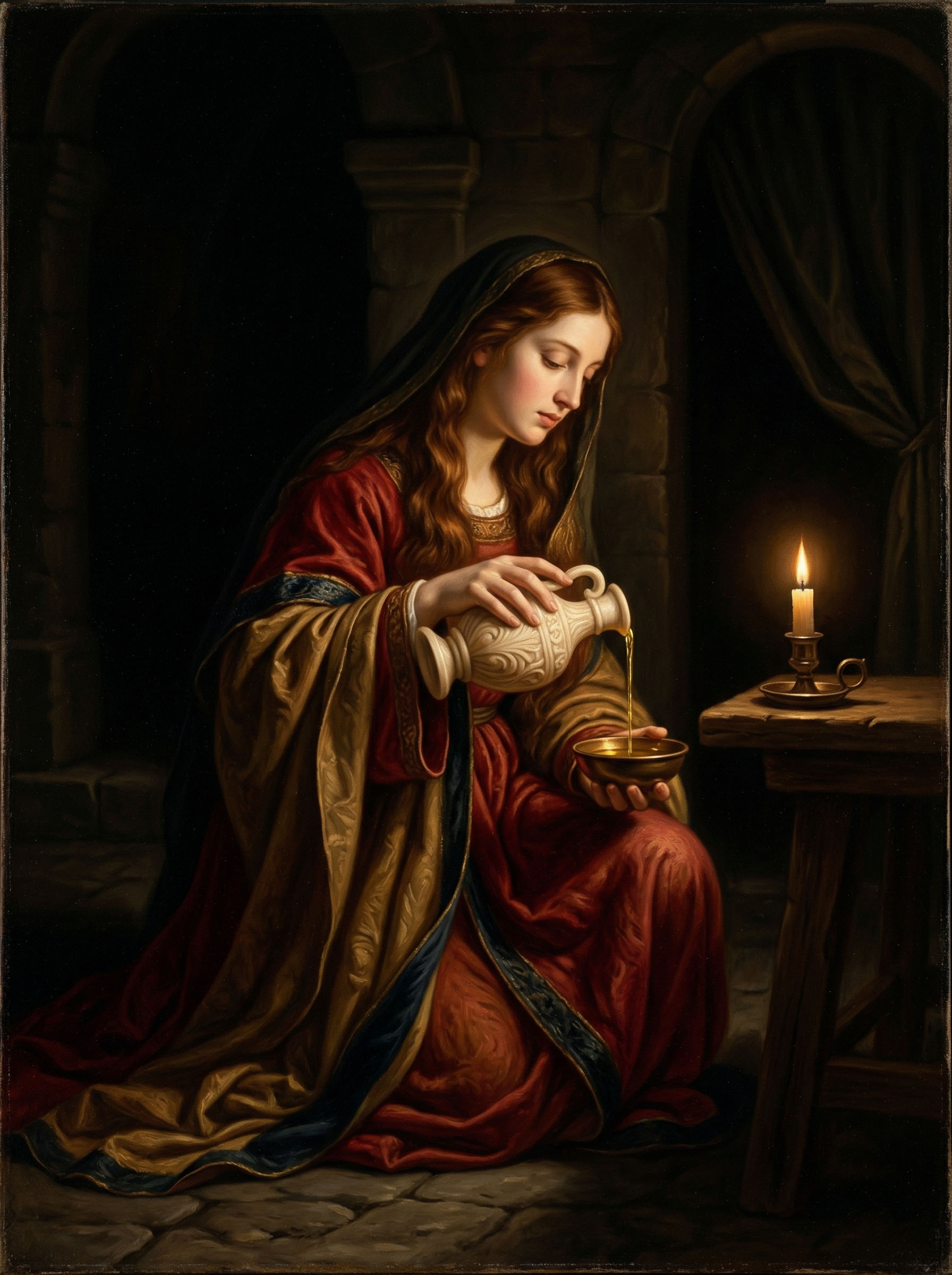
In Christian iconography, Mary Magdalene is almost always depicted holding a small jar — an alabaster flask of ointment or perfume. It is her symbol across every tradition: Catholic, Orthodox, Protestant. This jar — this small container of sacred, fragrant oil — is a quiet symbol of so much that was considered female and holy in the ancient world.
Across many ancient cultures, the vessel itself was a sacred symbol: the container, the holder, the bearer of life and precious things. In pre-Christian spiritual traditions throughout the ancient Near East, vessels and containers held deep symbolic meaning as images of the feminine principle — that which holds, nurtures, and preserves. Pottery, oil, water, grain — all held in sacred vessels, all associated with feminine care and divine sustenance.
Mary Magdalene carries her flask as a priest carries a chalice. And her act of anointing — of applying precious oil through hands, through touch, through physical presence — is the act of a woman who understood that the sacred does not always announce itself in thunder. Sometimes it arrives in fragrance. In touch. In the quiet act of showing up.
There is a beauty in this that centuries of misreading her story have obscured. She is not a fallen woman redeemed. She is, as the early church titled her, an apostle — a woman sent with a message, carrying her flask, her faith, and her grief into the garden before the sun came up.
Every woman who has ever sat with grief, shown up in the dark, or offered care without recognition is, in some quiet way, walking the same road Mary Magdalene walked that first Easter morning.
The Easter story does not only happen in empty tombs and triumphal processions. It happens in small acts of faithfulness, carried out by women who came before the sun rose.
Restoring Her Name — and What It Means for Women Today
The correction of Mary Magdalene's story matters for reasons that stretch well beyond theology. For more than a thousand years, a woman who was, by every Gospel account, an exemplary disciple and the first resurrection witness was instead remembered primarily through the lens of sexual sin she never committed. That misreading shaped how generations of women were taught to see female devotion, female spiritual authority, and the relationship between womanhood and holiness.
When the Church formally corrected this in the twentieth century, and when Pope Francis gave her feast day equal standing with the male apostles in 2016, it was not a concession to modern pressure. It was a return to what the text had always said. The Gospels never called her a prostitute. Four Gospel writers named her, honored her witness, and placed her at the center of the most sacred event in the Christian calendar.
For women of faith today — and for women who simply find themselves drawn to the deep wells of spiritual tradition — Mary Magdalene offers something rare: a figure who held her place at the most difficult moments, who did not abandon her presence even when hope seemed entirely gone, and who was rewarded for that faithfulness not with a seat at a table, but with a garden, a risen friend, and a message she was trusted to carry.
That is a story worth knowing in full. That is the Easter story that has always been there, waiting to be read again with fresh eyes.
Questions Women Ask About Mary Magdalene
Answered by Amara Leclerc, cultural historian
What to Remember About Mary Magdalene and Easter
- Mary Magdalene is named in all four Gospels — more times than most male apostles.
- She was a woman of means from a prosperous Galilean town, not a woman of the margins.
- The label of "prostitute" was a 6th-century error, corrected by the Catholic Church in 1969.
- She was the first recorded witness of the resurrection — a detail preserved across every Gospel account.
- Early church writers gave her the title Apostola Apostolorum: Apostle to the Apostles.
- Pope Francis elevated her feast day in 2016 to equal standing with the male apostles.
- Her symbol — the alabaster flask — represents devotion, anointing, and the sacred feminine act of care.
- The women came before dawn, before the men, with spices and love. That faithfulness is at the heart of Easter.
Disclaimer: This content is for informational and educational purposes only and does not constitute medical advice. It is not intended to be a substitute for professional diagnosis or treatment. Always consult with a qualified healthcare provider regarding any medical condition or treatment plan. Never disregard professional medical advice because of something you have read here.