日本語
日本語  Deutsch
  English
  Español
  Français
  Português



Long before there were pharmacies, lab cultures, or prescription pads, there were women. Women who watched, learned, and shared. Women who kept careful mental notes on which herb cooled the burning, which rinse restored the balance, which poultice a grandmother had used and her grandmother before her.
Across every civilization on record, vaginal infections — particularly what we now recognize as bacterial vaginosis, yeast infections, and trichomoniasis — were part of the lived experience of womanhood. And women, with remarkable ingenuity, found ways to address them.
This is not a story about primitive superstition or medical ignorance. It is a story about observation, community knowledge, and the kind of quiet expertise that flourished among women for millennia. Some of it was rooted in genuine science, even if no one had that word yet. Some of it was ritual wrapped around real remedy. And some of it was simply wrong — though often no more wrong than the male-dominated medicine of the same era.
To trace the history of how women treated vaginal infections is to trace something larger: the history of women's relationship with their own bodies, across cultures and centuries.
In Brief
- Women across history developed sophisticated remedies for vaginal infections long before modern medicine.
- Ancient Egyptian, Greek, Ayurvedic, and Indigenous traditions all addressed vaginal health with botanical knowledge.
- Some historical treatments contained real antimicrobial or probiotic properties now recognized by science.
- Cultural context shaped whether women's remedies were celebrated, suppressed, or quietly passed down.
- Modern research is revisiting these traditions — with fascinating, and sometimes surprising, results.
Ancient Egypt: The First Written Remedies
✦ Cultural Insight
"Sekhmet's Daughters"
In ancient Egypt, the goddess Sekhmet was associated with both disease and healing. Female healers who worked with women's health concerns were sometimes called her "daughters" — a title that carried social authority. These healers operated openly within Egyptian society, recorded their methods, and were respected for their expertise. The idea of women's medicine as something secretive or shameful came much later — and from very different cultural traditions.
The ancient Egyptians were meticulous record-keepers, and their medical papyri — particularly the Ebers Papyrus, dated to around 1550 BCE — contain some of the earliest written references to gynecological complaints. Egyptian physicians (some of whom were women) documented treatments for discharge, odor, and itching that bear more than a passing resemblance to conditions we recognize today.
Among the recommended treatments: vaginal suppositories made from acacia gum, honey, and lint. This combination, while it sounds antiquated, is genuinely interesting to modern researchers. Acacia ferments into lactic acid, which creates an acidic environment — exactly the kind of environment a healthy vagina maintains naturally. Honey is well-documented for its antimicrobial properties. The Egyptians may not have known about pH or lactobacilli, but they stumbled onto a treatment with real logic behind it.
Other Egyptian remedies were less effective, including fumigation treatments where women would crouch over burning herbs to "purify" the womb. While the herbal smoke itself may have had mild antiseptic properties, the approach was more ritual than remedy. Still, the Egyptians' overall instinct — that vaginal health was worth documenting, treating, and taking seriously — placed them ahead of many cultures that followed.
Ancient Greece and Rome: When Men Started Writing the Rules
Greek and Roman medicine is where things get more complicated. The Hippocratic texts, written primarily by male physicians, contain extensive sections on "diseases of women" — and the treatments recommended were often more about the physicians' theories than women's actual experiences. The infamous "wandering womb" theory, which held that the uterus was a sort of free-floating organ that could move throughout the body causing illness, led to some genuinely bizarre treatments.
And yet. Alongside the womb theories and the fumigation rituals and the marriage-as-medicine prescriptions, there are traces of real knowledge. Greek and Roman women used vinegar-based rinses — acidic, and therefore genuinely useful for disrupting certain bacterial overgrowths. Pomegranate rind was used as an astringent. Garlic, with its potent allicin content, appeared in multiple traditions as both an oral remedy and, yes, an inserted one.
"The women who kept herbal knowledge alive across centuries were not practicing superstition — they were practicing what would eventually become evidence-based care."
— Amara Leclerc
Roman women, particularly those in wealthier households, had access to female healers called medicae — documented through inscriptions and texts as legitimate medical practitioners. These women maintained knowledge networks independent of the formal male medical tradition, and their treatments were often more practically grounded. Where male physicians were theorizing, many female healers were observing results.
Ayurvedic Tradition: Balance as the Baseline
In ancient India, the Ayurvedic medical system approached vaginal health through the lens of doshas — the three constitutional energies (Vata, Pitta, and Kapha) whose imbalance was thought to underlie disease. Vaginal discharges and infections were categorized under Yonivyapat, a set of gynecological disorders with remarkably detailed clinical descriptions across different classical texts.
What's striking about Ayurvedic treatments for these conditions is their sophistication. Herbal formulations were tailored to the type of discharge — color, consistency, odor, accompanying symptoms all mattered. Treatments included internal herbal preparations, vaginal washes with decoctions of neem (now known to have significant antifungal properties), turmeric, and triphala. Probiotic-adjacent interventions, like fermented foods and yogurt-based preparations, were also used — centuries before Western medicine understood the role of bacteria in vaginal health at all.
The Ayurvedic tradition also placed considerable weight on prevention. Diet, lifestyle, and seasonal practices were all considered relevant to gynecological health. Women were advised to maintain specific hygiene practices and to avoid certain foods during different phases of their cycle. While not every recommendation has modern backing, the fundamental framework — that vaginal health is connected to overall systemic health — is very much in line with contemporary understanding.
Table 1 — Historical Treatments by Culture & Their Modern Assessment
Traditional Chinese Medicine: Patterns, Not Just Symptoms
In Traditional Chinese Medicine (TCM), vaginal discharge and infections were classified under daixia — literally "below the belt." Rather than treating isolated symptoms, TCM practitioners assessed patterns. A yellow, thick, odorous discharge suggested "damp heat" in the lower burner; a white, thin discharge with no odor pointed to a cold or deficient pattern. Each presented differently and was treated differently.
Herbal washes using ku shen (sophora root) and huang bai (phellodendron bark) were common external treatments — and modern phytochemical analysis has confirmed that both plants contain compounds with genuine antibacterial and antifungal activity. Internal herbal formulas were prescribed to address the underlying pattern. This dual approach — treating both local symptoms and systemic imbalance — echoes what integrative medicine practitioners advocate today.
TCM gynecology texts, some dating back over a thousand years, contain clinical observations of vaginal conditions that are impressively detailed. The women who sought treatment were not dismissed or told their symptoms were imaginary. Their complaints were categorized, analyzed, and addressed with a level of seriousness that many women in Western history could only envy.
✦ Did You Know?
The vaginal microbiome wasn't formally characterized by science until the early 2000s — yet women in Ayurvedic, Chinese, and even medieval European traditions were already using fermented and probiotic-adjacent preparations to support vaginal health. They didn't have the vocabulary of Lactobacillus crispatus, but they had the observation: certain foods and preparations kept women healthier. The science eventually caught up with the intuition.
Medieval Europe: Between Herbalism and Superstition
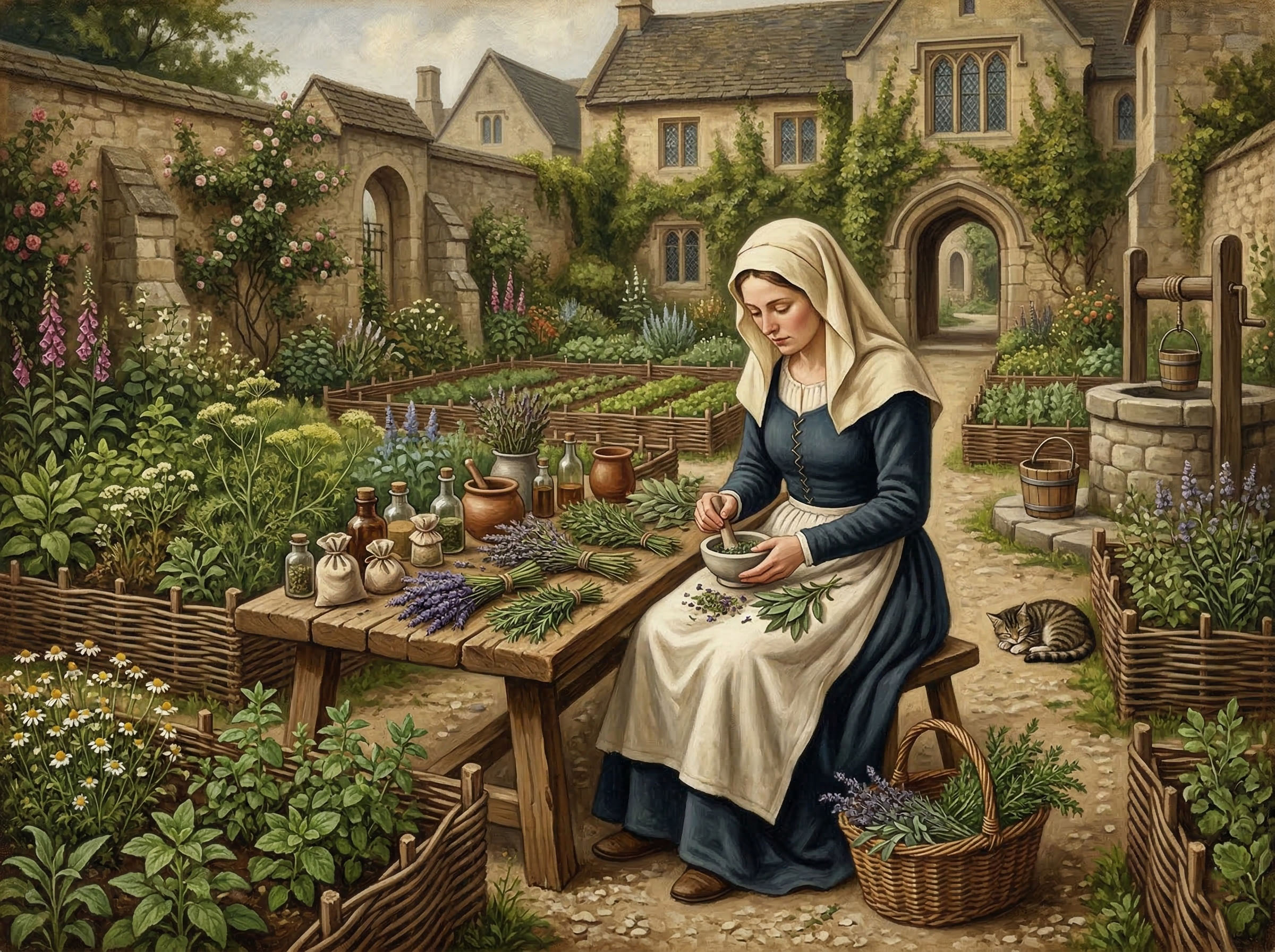
Medieval European women navigated a complicated landscape for their health. Formal medicine was increasingly dominated by the Church and by male university-trained physicians — neither of whom were particularly interested in gynecological nuance. And yet, a parallel tradition survived and quietly thrived: the herbalist, the midwife, the wise woman of the village.
Hildegard of Bingen, the 12th-century German abbess, polymath, and mystic, wrote extensively on women's health in her medical texts. Her recommendations for gynecological complaints included preparations using mugwort, feverfew, and various botanicals that she described with clinical precision unusual for the era. Whatever one thinks of Hildegard's theological framework, her botanical observations were genuinely sophisticated.
The general European medieval approach to vaginal infections included herbal sitz baths, wine-based rinses (wine being mildly acidic and containing some preservative compounds), and pessaries — suppositories placed internally — made from combinations of herbs, wax, and oil. Some of these would have had modest therapeutic benefit. Others, like preparations involving lead compounds, would have done serious harm.
The 15th and 16th centuries brought increasing hostility toward female healers in parts of Europe, as the professionalization of medicine deliberately excluded women and the witch trial era cast suspicion on herbalists. Much traditional knowledge was lost or driven underground. The women who kept herbal knowledge alive across centuries were not practicing superstition — they were practicing what would eventually become evidence-based care.
Indigenous Traditions of the Americas: Plant Knowledge as Legacy
Across the diverse Indigenous cultures of North and South America, women's health was woven into broader healing traditions maintained by female healers, midwives, and medicine women. Specific practices varied enormously by nation and region, but certain patterns emerge in the ethnobotanical literature.
Yarrow (Achillea millefolium) appears across dozens of Indigenous traditions as a treatment for gynecological complaints — a plant that modern analysis has confirmed contains antimicrobial and anti-inflammatory compounds. Cedar and sage were used in cleansing preparations. Bear root (Ligusticum porteri), used extensively in Southwestern traditions, has demonstrated significant antimicrobial activity in laboratory settings.
What distinguishes many Indigenous approaches is their integration of the physical, the spiritual, and the social. A woman experiencing chronic vaginal infections wasn't treated as simply a malfunctioning body — she was a whole person whose relationships, diet, stress, and spiritual life were all relevant to her healing. While this holistic view can be romanticized, its fundamental insight — that women's health is not isolated from the rest of their lives — is one that contemporary medicine is slowly and genuinely rediscovering.
Across virtually every major civilization, women found ways to treat vaginal infections — often with approaches that had genuine therapeutic merit. The real question is not why these traditions existed, but why so much of this knowledge was systematically ignored once formal medicine took over.
The 19th Century: When Things Got Worse Before They Got Better
The Victorian era represents a strange turning point. On one hand, germ theory was emerging and the foundation of modern microbiology was being laid. On the other hand, medical attitudes toward women's bodies reached a peculiar nadir of paternalism. Vaginal discharges were moralized rather than treated. Women who reported symptoms were sometimes accused of sexual immorality. Physicians — male and female — frequently attributed gynecological complaints to hysteria, masturbation, or insufficient piety.
Meanwhile, the actual treatments of the era ranged from the useless to the actively harmful. Carbolic acid douches, mercury-based preparations, and caustic chemical applications were among the interventions visited upon women who had the misfortune to seek medical help for vaginal infections. The traditional herbal and botanical approaches, by comparison, look almost gentle.
It was not until the 20th century — with the discovery of antibiotics, the identification of specific vaginal pathogens, and eventually the sequencing of the vaginal microbiome — that medicine developed genuinely effective treatments for vaginal infections. Even then, progress was uneven: bacterial vaginosis, the most common vaginal infection in women of reproductive age, was not formally characterized until the 1980s. In some sense, the women of ancient Egypt and Ayurvedic India were more systematically engaged with the condition than Western medicine was for most of the 20th century.
✦ Your Questions, Answered
What History Leaves Us With
Across virtually every major civilization, women found ways to treat vaginal infections — often with approaches that had genuine therapeutic merit. They did this without microscopes, without germ theory, without the vocabulary of microbiomes or pH balance. They did it through careful observation, through networks of shared knowledge, and through the simple reality that their bodies were their bodies, and they were paying attention.
The story of historical treatments for vaginal infections is, ultimately, a story about women's intelligence — practical, empirical, relentlessly applied to the problems of lived life. Some of that intelligence was preserved in medical texts. More of it was transmitted quietly, woman to woman, across generations. Some of it was lost. And some of it, as researchers are increasingly discovering, was right all along.
There's something quietly satisfying about that. The ancient Egyptian healer with her acacia suppositories, the Ayurvedic practitioner prescribing her neem wash, the medieval herbalist with her yarrow preparation — they didn't need validation from a pharmaceutical company. They had what women have always had: careful eyes, accumulated wisdom, and the deep, practical motivation of wanting to feel better.
That's not a small inheritance. It's worth knowing it's ours.
✦ Quick-Start: If You Want to Explore Further
📚 Learn More
- The Ebers Papyrus
- Hippocratic texts on women's medicine
- Ethnobotanical literature on Indigenous women's health
- Research on the vaginal microbiome
✔ Good to Know
- Traditional remedies are a history lesson, not a prescription
- Always consult a healthcare provider for symptoms
- Vaginal infections are common — historically and today
- The vaginal microbiome is highly individual
✘ Common Myths
- Traditional = ineffective (often untrue)
- Modern = always better (Victorian medicine disproves this)
- Vaginal infections were rare historically (they were not)
- Women didn't understand their bodies (they did, remarkably)
Disclaimer: This content is for informational and educational purposes only and does not constitute medical advice. It is not intended to be a substitute for professional diagnosis or treatment. Always consult with a qualified healthcare provider regarding any medical condition or treatment plan. Never disregard professional medical advice because of something you have read here.